
Search Growth Lab
Search
Policy Area
Research Project
Content type
Country/Region
Research Type
Author
-

Project
United States
Mapping the Functional Structures of State Governments
Researchers find economic structure trumps income, location and ideology when examining differences in U.S. state governments. -

Project
North America
Pathways to Prosperity in Wyoming
This project leverages frameworks of growth diagnostics and economic complexity to address varied statewide challenges, while working collaboratively with stakeholders across the state to improve outcomes in housing, workforce access, local spending, and growth of energy opportunities. -
Working Papers
A Growth Perspective on Wyoming
This report sets out to understand if the economy of the State of Wyoming is positioned to grow into the future. To do this, the report begins by investigating the […]
This report sets out to understand if the economy of the State of Wyoming is positioned to grow into the future. To do this, the report begins by investigating the past. To know where the state economy could be headed, and how that direction may be improved, it is critical to understand how the state developed the economic structure and drivers that it has today. Thus, Wyoming’s economic trajectory is explored over the long, medium, and short term. From this investigation, we find that Wyoming faces an overall growth problem, but we also find a high degree of variation in economic engines and growth prospects across the state. The problem that this report identifies is that the composition of economic activities is not positioned to sustain a high quality of life across all parts of the state.
“Across all parts of the state” is an essential part of the problem statement for Wyoming. While some local and regional economies in the state are growing and bumping up against identifiable constraints, other local and regional economies are experiencing sustained contractions and will require new sources of growth in order to retain (or expand) population and high quality of life. Since economic dynamics vary significantly across the state, analysis is conducted in as much geographic detail as possible. By combining historical and geographic dimensions of growth, this report aims to inform pathways for sustained and inclusive prosperity across Wyoming.
Related project: Pathways to Prosperity in Wyoming
-
Reports
Childcare Supply in Wyoming
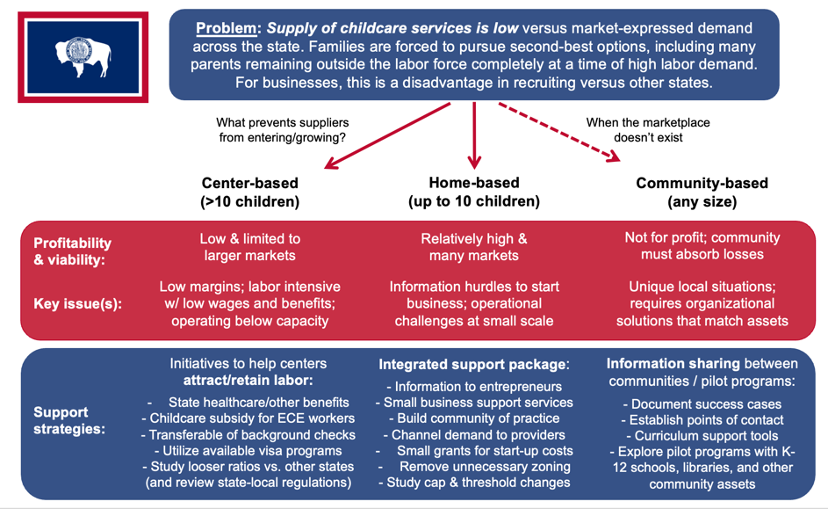
This white paper summarizes Growth Lab research on the childcare market in Wyoming, where supply of childcare slots systematically falls short of demand. This nationwide problem is prevalent across Wyoming, […]This white paper summarizes Growth Lab research on the childcare market in Wyoming, where supply of childcare slots systematically falls short of demand. This nationwide problem is prevalent across Wyoming, including in both its larger population centers and smaller communities. The low population of many Wyoming communities adds to the challenge. Research that is summarized in the white paper identify differential constraints affecting childcare centers and home-based childcare facilities. Centers make up most childcare slots in the state and are plagued by a staffing challenge derived from low business margins and low wages that centers can afford under “reasonable” fee structures for the market, which cause many to operate below capacity despite widespread wait lists and demand. Home-based providers, which are particularly important for lower-population settings in Wyoming that cannot support larger centers, face operational challenges typical of very small businesses and new providers face a few solvable start-up hurdles.
Through collaboration with an interagency working group in Wyoming, this white paper identifies a set of targeted initiatives for enabling business entry and childcare slots through both centers and home-based facilities. The focus of these initiatives is on expanding supply as opposed to subsidizing demand through subsidies to parents and families. Though an expansion of funding in this form would be useful, and the state government dramatically underspends on early childhood education in comparison to its longstanding focus on high K-12 spending, the focus is on low-cost and impactful ways to enable the market to better expand supply to meet high expressed demand.
The following diagram summarizes the diagnosis and key strategies. Over the second half of 2024, the interagency working group and partners across Wyoming have focused on implementing a subset of these action points.
-
Working Papers
Diagnosing Wyoming’s Workforce Challenges
Wyoming is facing two distinct labor market challenges: in the short-term low workforce availability is a constraint while in the long-term job and wage growth have stagnated. Currently, Wyoming’s labor […]Wyoming is facing two distinct labor market challenges: in the short-term low workforce availability is a constraint while in the long-term job and wage growth have stagnated. Currently, Wyoming’s labor market is characterized by tightness and employers are struggling to fill positions. However, the current tightness of the labor market is not a phenomenon that is specific to Wyoming but instead is prevalent across the country. What sets Wyoming apart is the lack of growth in employment and wages over the long-term. Understanding these differing dynamics is important because policy responses may attempt to address the short-term issue without considering the underlying structural causes of the long-term dynamics. This will likely be ineffective and not lead to lasting change. For lasting change, the structural issues of the long-term dynamic need to be addressed. An often-discussed solution is to increase the supply of training and education – this has merits in its own right but will not solve the long-term labor market challenge facing Wyoming. Only 38% of all jobs in Wyoming require tertiary education, the second lowest of any US state. Additionally, our analysis shows that the returns to a tertiary degree in Wyoming are significantly below those of its peers. Unsurprisingly, the lack of demand for tertiary-educated workers leads many young Wyomingites with a tertiary degree to leave the state. Overall, however, Wyoming has become an exporter of well-trained young people. Increasing the supply of tertiary education will not address the underlying structural issues facing the labor market. A main driver of Wyoming’s lagging performance has been the comparatively low labor productivity in the state. Most of Wyoming’s industries have a lower output per worker than the respective national industry and pay lower wages on average. Industries that fall into this category cover 82.8% of all employment in Wyoming. The few industries in which Wyoming is more productive than the rest of the US are mostly related to natural resource extraction. Wage dynamics of occupations in the state exert a similar pattern where STEM-related occupations have not seen much growth, indicating low demand in the state. To address the long-term issue, Wyoming needs to create the conditions for a more complex economy that can use the potential of its human capital instead of excessively relying on its natural resources. The challenge is to attract and grow competitive companies in industries with strong demand. A critical factor in doing so is scale. Many more knowledge-intensive industries tend to develop in places that are larger urban agglomerations. Wyoming should focus on the positive forces of agglomeration to develop these industries and make use of the productive potential it has. Creating the conditions for this includes place-based investments and an enabling regulatory framework. In Wyoming, housing regulations have been an important barrier preventing further agglomerations, but efforts are underway to address this barrier. In the short-term, solutions that are focused on increasing the available labor pool within the state appear most promising in easing the current constraint. This is especially true when they address structural barriers that could persist after the labor market cools off. Our work documents specific recommendations within the areas of childcare, justice-involved individuals, higher education, and out-of-state workers (Section 3.2) that aim to increase the participation from these labor pools in Wyoming’s workforce. These are labor pools that are significant in size and have underutilized potential in terms of labor force participation within the state. Related project: Pathways to Prosperity in Wyoming -
Working Papers
Eight Decades of Changes in Occupational Tasks, Computerization and the Gender Pay Gap
New research from Ljubica Nedelkoska, Shreyas Gadgin Matha, and others finds that computerization had two counteracting effects on the pay gap – it simultaneously reduced it by attracting more women into better-paying occupations, and increased it through higher returns to computer use among men. We build a new longitudinal dataset of job tasks and technologies by transforming the U.S. Dictionary of Occupational Titles (DOT, 1939 -1991) and four books documenting occupational use of tools and technologies in the 1940s, into a database akin to, and comparable with its digital successor, the O*NET (1998 -today). After creating a single occupational classification stretching between 1939 and 2019, we connect all DOT waves and the decennial O*NET databases into a single dataset, and we connect these with the U.S. Decennial Census data at the level of 585 occupational groups. We use the new dataset to study how technology changed the gender pay gap in the United States since the 1940s. We find that computerization had two counteracting effects on the pay gap -it simultaneously reduced it by attracting more women into better-paying occupations, and increased it through higher returns to computer use among men. The first effect closed the pay gap by 3.3 pp, but the second increased it by 5.8 pp, leading to a net widening of the pay gap.
-
Journal Articles
Estimating the drivers of urban economic complexity and their connection to economic performance
Royal Society Open Science, 8
Estimating the capabilities, or inputs of production, that drive and constrain the economic development of urban areas has remained a challenging goal. We posit that capabilities are instantiated in the […] Estimating the capabilities, or inputs of production, that drive and constrain the economic development of urban areas has remained a challenging goal. We posit that capabilities are instantiated in the complexity and sophistication of urban activities, the know-how of individual workers, and the city-wide collective know-how. We derive a model that indicates how the value of these three quantities can be inferred from the probability that an individual in a city is employed in a given urban activity. We illustrate how to estimate empirically these variables using data on employment across industries and metropolitan statistical areas in the USA. We then show how the functional form of the probability function derived from our theory is statistically superior when compared with competing alternative models, and that it explains well-known results in the urban scaling and economic complexity literature. Finally, we show how the quantities are associated with metrics of economic performance, suggesting our theory can provide testable implications for why some cities are more prosperous than others.
-
Working Papers
Getting the Ball Rolling: Basis for Assessing the Sports Economy
Data on the sports economy is often difficult to interpret, far from transparent, or simply unavailable. Data fraught with weaknesses causes observers of the sports economy to account for the […]Data on the sports economy is often difficult to interpret, far from transparent, or simply unavailable. Data fraught with weaknesses causes observers of the sports economy to account for the sector differently, rendering their analyses difficult to compare or causing them to simply disagree. Such disagreement means that claims regarding the economic spillovers of the industry can be easily manipulated or exaggerated. Thoroughly accounting for the industry is therefore an important initial step in assessing the economic importance of sports-related activities. For instance, what do policymakers mean when they discuss sports-related economic activities? What activities are considered part of the “sports economy?” What are the difficulties associated with accounting for these activities? Answering these basic questions allows governments to improve their policies.
The paper below assesses existing attempts to understand the sports economy and proposes a more nuanced way to consider the industry. Section 1 provides a brief overview of existing accounts of the sports economy. We first differentiate between three types of assessments: market research accounts conducted by consulting groups, academic accounts written by scholars, and structural accounts initiated primarily by national statistical agencies. We then discuss the European Union’s (EU) recent work to better account for and understand the sports economy. Section 2 describes the challenges constraining existing accounts of the sports economy. We describe two major constraints – measurement challenges and definition challenges – and highlight how the EU’s work has attempted to address them. We conclude that, although the Vilnius Definition improves upon previous accounts, it still features areas for improvement.
Section 3 therefore proposes a paradigm shift with respect to how we understand the sports economy. Instead of primarily inquiring about the size of the sports economy, the approach recognizes the diversity of sports-related economic activities and of relevant dimensions of analysis. It therefore warns against attempts at aggregation before there are better data and more widely agreed upon definitions of the sports economy. It asks the following questions: How different are sports-related sectors? Are fitness facilities, for instance, comparable to professional sports clubs in terms of their production scheme and type of employment? Should they be understood together or treated separately? We briefly explore difference in sports-related industry classifications using data from the Netherlands, Mexico, and the United States. Finally, in a short conclusion, we discuss how these differences could be more fully explored in the future, especially if improvements are made with respect to data disaggregation and standardization.
-
Working Papers
Grants in Wyoming: Constraints and Solutions
Wyoming communities are reliant on grants to fund local priorities, yet the grants system is not effectively meeting the needs of many communities across the state. This problem is central […]Wyoming communities are reliant on grants to fund local priorities, yet the grants system is not effectively meeting the needs of many communities across the state. This problem is central to the growth challenges of many rural economies across the state. Although this problem pre-dates the recent expansion of federal grant programs, the importance of this problem has grown in the last several years as the scale and complexity of federal grant opportunities — particularly discretionary grants — has increased. Wyoming communities are struggling to navigate and benefit from these federal funding opportunities. As of late 2023, the state is significantly underperforming many comparator states in the number of federal grants received and the distribution of federal grants across the state. Grant writers and administrators face a sometimes impossible task in navigating an ever-shifting grants landscape. This is a challenge for local governments across the country but may be especially important in Wyoming due to narrow local tax bases and the rural nature of the state.
Through an eight-month effort combining research and action, we have explored the causes of this problem to inform potential solutions. We have identified four principal constraints that are most to blame for Wyoming’s underperformance: (1) Lack of relationships between communities and funders; (2) Inability to follow changing grant opportunities (esp. federal); (3) Shortage of prioritized community needs and “grant ready” project plans; and (4) Overreliance on “local heroes” – especially for smaller communities. We argue that these challenges are “principal constraints” because they are binding for the largest number of communities, especially smaller communities. However, there are additional constraints that are critical for other communities, especially those that have more experience with accessing state and federal grants. This note summarizes key evidence we have found on each of these principal constraints. These constraints occur early in the grants process, meaning many potentially promising grant opportunities are never pursued. We find that many federal grant programs and discretionary award processes are inconsistent with the realities of scarce staff, resources, and bandwidth of local governments, especially in small communities. However, we find widespread examples and evidence that these constraints can be overcome through actions to enable a strong state-wide network that supports local leaders and grant administrators. Examples of success within the state and in other states show that building the capabilities of the network and enabling all communities to access the knowhow of the network can lead to much better grant outcomes.
The note closes with a discussion of how to target a network-enabling response to the grants problem. We outline a first-best option that centers on establishing regional officers who would be responsible for a set of tasks that would respond directly to the principal constraints identified. This approach would require annual funding, but preliminary analysis shows the return on investment overall would be very high and the approach would have the greatest benefits for smaller communities across the state. Very initial designs have been explored for how to establish such a system building on existing assets. Finally, we compare this first-best approach to alternative approaches that are closer to the current support actions underway in the state.
-
Working Papers
Housing in Wyoming: Constraints and Solutions
Quantitative evidence supports the contention that Wyoming’s housing market is constrained, to a greater degree than many other parts of the US. Prices are persistently above expectations given economic fundamentals […]Quantitative evidence supports the contention that Wyoming’s housing market is constrained, to a greater degree than many other parts of the US. Prices are persistently above expectations given economic fundamentals in most parts of the state, and the supply of new housing in Wyoming is on average less responsive to price increases than in other US counties. This has undermined natural population growth and contributed to a low amount of population density close to city centers in Wyoming, as compared to other US cities with comparable population levels. Importantly, this phenomenon is not simply the result of pandemic-era economic frictions. The evidence shows that these constraints have durably persisted in Wyoming.
This housing constraint weighs heavily on the broader Wyoming economy, and chokes off growth in new industries that could add to the Wyoming economy beyond its natural resource base. Businesses consistently report a lack of access to workforce as a leading problem that ultimately results from a lack of housing. Some businesses have even tried to create their own housing for employees, and news reports abound of teachers and nurses who secure jobs in Wyoming communities but then have to leave because they cannot find housing.
Key problems behind Wyoming’s housing constraints include excessive regulations concerning housing density and insufficient investment in arterial infrastructure. For example, there is evidence that over-regulated minimum lot sizes in Wyoming are blocking the creation of supply to match free-market demand for houses with smaller amounts of land. Other areas of over-regulation include those concerning allowable housing types, building height, parking spaces per dwelling, and the housing approval process itself. This may be seen as surprising given Wyoming’s reputation as a low-regulation state, but Wyoming maintains restrictions that other states and countries have discarded as outdated and highly counterproductive. Besides outright restrictions on housing development, we find that the most common cost driver undermining the housing development has to do with low public investment in needed arterial infrastructure, especially water systems. Land supply as well as material and construction costs are not primary constraints to housing development across the state, but may matter for select communities.
We suggest a portfolio of policy changes for the state of Wyoming to explore in order to solve its housing constraints. One category of changes is regulatory, and focuses on deregulation, reducing bureaucratic overhead, and shifting from veto-cratic to democratic housing approval procedures. Another category is focused on investment on infrastructure to support housing, and exploration of state-local funding structures to facilitate continuous infrastructure improvement. If implemented, these changes will not only help to solve Wyoming’s housing constraints but also facilitate housing development in a way that combats urban sprawl, and in doing so protects open spaces outside of cities that Wyomingites value.
Related project: Pathways to Prosperity in Wyoming