
Mexico Projects & Research
The Growth Lab has conducted research across Mexico, on the national and subnational level.

Research Projects
-

Project
Latin America
Charting Economic Growth Strategies in Hermosillo
As part of our research agenda on cities as engines of economic growth, researchers are studying emerging growth opportunities across Sonora with a focus on Hermosillo that stem from a context of relocation of global supply chains, green energy transition, and the rise of knowledge-intensive services. -

Project
Baja California
Economic Growth in Baja California, Campeche & Tabasco
The goal of this project was to diagnose the challenges and obstacles confronting Baja California, Campeche and Tabasco in terms of growth and productivity, and identify the development strategy that would allow for expansion or strengthening of their industries through transitioning to activities with greater complexity or added value. -
Project
Mexico
Mexico Atlas of Economic Complexity
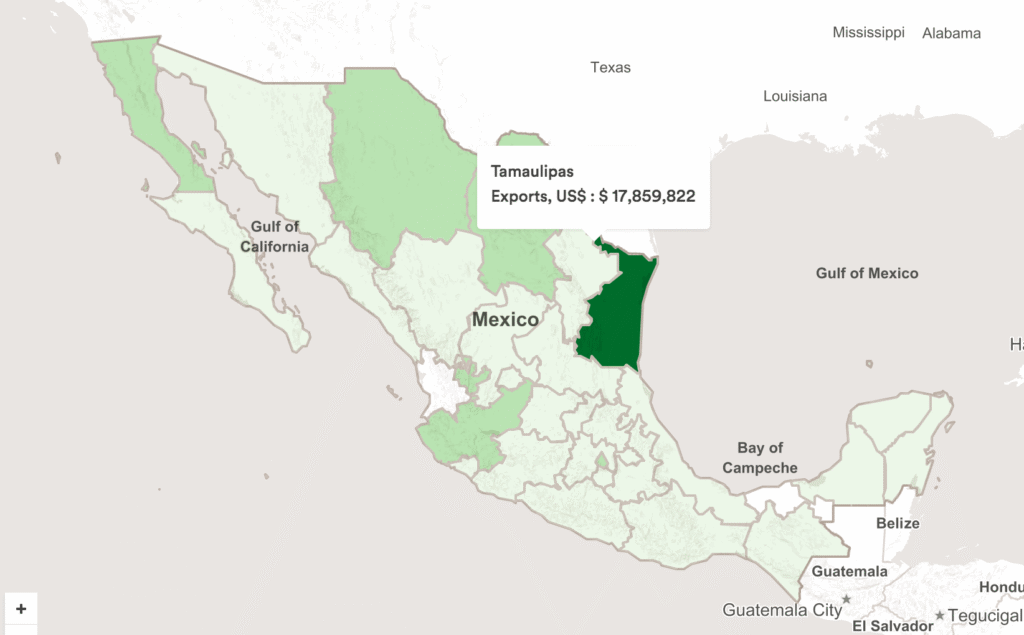
Large income gaps prevail across regions in Mexico. Nuevo Leon exhibits levels of productivity similar to those of South Korea, while Guerrero and Chiapas experience productivity levels below Honduras. These large disparities reproduce even as we break into smaller geographical units: Tuxtla Gutierrez, Chiapas’ capital, has eight times the income of Aldama and Mitontic, its poorest municipalities. -

Project
Chiapas
Analysis of Economic Potential of Mexico’s Southern States (Chiapas)
Collaboration (2014-2015) with the Mexican Ministry of Finance to examine the underlying causes of poverty in Mexico’s poorest state. -

Project
Latin America
Mexico Competitiveness
The key strengths and weaknesses of Mexico’s economic landscape are explored in a comprehensive new report co-produced by the World Economic Forum (WEF) and Harvard’s Center for International Development (CID).
Latest Research
Working Papers
Serving From Hermosillo: Opportunities in Cross-Border Trade of Services
Technological advances have increased the general tradability of services, leading international trade in services to outpace trade in goods, especially after the global financial crisis and the COVID-19 pandemic. Services […]
Technological advances have increased the general tradability of services, leading international trade in services to outpace trade in goods, especially after the global financial crisis and the COVID-19 pandemic. Services once considered less tradable due to the necessity of physical proximity between consumer and provider are now increasingly digitized and delivered remotely. Cross-border services now represent 79% of all internationally traded services, and digitally deliverable activities like engineering, accounting, database and other information services are experiencing yearly U.S. imports growth rates over 15%. This report analyzes how Mexico has been capitalizing on some of these trends over the past five years using the most granular data available. Then, we analyze opportunities from the perspective of Hermosillo.
Hermosillo is poised to benefit from this global expansion due to its comparative advantages and existing productive capabilities in potentially tradeable services. We estimate the revealed comparative advantage of Hermosillo in each tradeable service category and find that the city is better positioned than similarly rich and complex cities in Mexico to take advantage of several of these opportunities. This is because Hermosillo is currently intensive in these opportunities, and also because Hermosillo has other industries that are similar to the opportunities in terms of their occupational structure (which could potentially supply additional labor in case tradeable service industries were to expand rapidly). Moreover, Hermosillo’s wage differentials compared to the U.S. are significant for most industries and occupations, including all tradable service industries and teleworkable occupations. This provides a cost advantage for foreign firms seeking to outsource part of their operations. Hermosillo also boasts a well-educated workforce with high levels of schooling and a strong emphasis on STEM fields, positioning it well to meet a potential expansion in educated labor demand.
Some tradable services represent bigger opportunities for Hermosillo, but the city will need to develop new capabilities in cross-border service provision in order to take advantage of them. In particular, engineering services, database and other information services, business and management consulting, research and development, education, and accounting services require attention and further research to inform effective strategies. To realize these opportunities, local firms may need to overcome sector-specific challenges related to internationalization. Policymakers can play a pivotal role by fostering strategic partnerships, attracting multinational service providers to bring in knowhow, and creating supportive enabling environments for teleworking and digital service provision.
Working Papers
Una Estrategia de Crecimiento Económico para Hermosillo
Hermosillo se está quedando atrás en materia de crecimiento económico y diversificación productiva. Históricamente la ciudad se ha beneficiado de una fuerte presencia manufacturera, liderada por Ford, y un capital […]Hermosillo se está quedando atrás en materia de crecimiento económico y diversificación productiva. Históricamente la ciudad se ha beneficiado de una fuerte presencia manufacturera, liderada por Ford, y un capital humano de alta calidad; sin embargo, se quedó rezagada con respecto a ciudades comparativas en términos de creación de empleo y diversificación económica entre 2010-2020. Este bajo desempeño se deriva principalmente de un menor crecimiento y diversificación de la industria manufacturera en comparación con ciudades mexicanas más dinámicas. Es importante destacar que Hermosillo mantiene importantes ventajas competitivas, sobre todo en infraestructura logística, costos de y acceso a electricidad, y calidad del capital humano. Pero también enfrenta retos en materia de sustentabilidad del agua, de asequibilidad y de oferta de vivienda, así como de movilidad urbana. Hermosillo debe encontrar una combinación de políticas públicas que le permitan capitalizar en sus ventajas, así como solucionar las potenciales restricciones al crecimiento que va a enfrentar.
Hermosillo tiene claras oportunidades para acelerar su crecimiento económico. Hay tres cambios importantes en el contexto global que Hermosillo puede aprovechar: la transición energética, la relocalización de las cadenas de suministro y el boom del comercio internacional de servicios digitales. Estas tres tendencias se alinean particularmente con algunas de las ventajas competitivas existentes de Hermosillo. La ubicación estratégica de la ciudad cerca del mercado estadounidense, la mano de obra calificada, sus instituciones educativas y los abundantes recursos solares la ponen en buena posición para capitalizar estos cambios a través de acciones de política pública.
Las oportunidades económicas de Hermosillo podrían desbloquearse si la ciudad resuelve estratégicamente sus principales limitaciones. La gestión sostenible del agua y la mejora de su planificación urbana, particularmente en vivienda y transporte público, son las restricciones más urgentes que, una vez atendidas, permitirían a la ciudad crecer a un ritmo más cercano a su potencial. El incremento de la oferta vivienda y el desarrollo de un sistema de transporte público eficiente reduciría los costos de vida y los costos laborales para las empresas, haciendo a Hermosillo más atractiva para trabajadores e inversionistas. A su vez, es necesario establecer un modelo sostenible de gestión del agua que permita garantizar el crecimiento futuro de la ciudad. La resolución de estas limitaciones es esencial para posicionar a Hermosillo como un centro importante para las cadenas de suministro de manufactura avanzada, de la industria verde y de servicios digitales en el norte de México. La ciudad tiene muchos elementos a su favor para prosperar, pero requiere abordar estas limitaciones de manera coordinada para desbloquear su próxima fase de crecimiento económico.
Working Papers
Nearshoring in Hermosillo: Analysis of Economic Growth Opportunities
This is one of four Growth Lab reports that aim to identify promising growth opportunities for Hermosillo. The focus of this report is nearshoring. Nearshoring is not a new phenomenon in […]This is one of four Growth Lab reports that aim to identify promising growth opportunities for Hermosillo. The focus of this report is nearshoring. Nearshoring is not a new phenomenon in Mexico, but recent changes in U.S. policy aimed to incentivize nearshoring of critical industries. This report first explores current realities of nearshoring and friendshoring in recent years, based on global trade and the distance which U.S. imports are traveling, and Mexico’s dynamics in global trade and investment in comparison to other countries. The report then evaluates the economic growth opportunities that nearshoring could incentivize in Hermosillo. We analyze the nearshoring opportunity set for Hermosillo across products and industries and if they are based on the city’s productive capabilities.
This report confirms that nearshoring and friendshoring have been taking place in global trade and investment in response to U.S. policy between 2017 and 2023. Mexico has made gains in its exports to the U.S. market in recent years as exports from China have lost ground, but it is not the only country doing so. A few countries like Vietnam benefited even more, despite being geographically far from the U.S. market. Mexico is seeing growth in products it has traditionally exported, but it is not seeing much diversification into products that the U.S. has deemed critical. Nor is Mexico seeing promising investment trends that would signal an acceleration of growth in these opportunities. Given Hermosillo’s position as a large city that is near the U.S. market, and to a growing market in Arizona in particular, the process of nearshoring represents a potentially transformational chance to jumpstart growth in attractive industries to better position the local economy for the future.
This report provides analysis to begin to identify the most promising nearshoring opportunities for Hermosillo, but local action is needed to build on these initial observations. We identify products and industries that are attractive opportunities for nearshoring in Hermosillo and we evaluate which industries are most consistent with Hermosillo’s existing industry structure and underlying productive capabilities. Promising opportunities stand out in industries related to medical equipment, electronics, machinery, and plastics and the latter sections of this report explore these opportunities in some detail, both quantitatively and more qualitatively. Local strategies to capitalize on these opportunities will vary in design and local actors should weigh the criteria provided and other considerations when deciding which industries are the highest priority for targeted investment promotion and other action steps. One exception, however, is in the value chain for semiconductors, where the emerging opportunity to supply and complement the value chain that is forming in Arizona is too large to pass up. Semiconductors represent an essential area that policymakers and the business community in Hermosillo should embrace, along with a set of additional promising nearshoring opportunities.
Working Papers
Growth Through Diversification in Hermosillo
In this report, we study Hermosillo’s economic performance and assess critical issues affecting the city’s ability to achieve stronger economic growth. Although Hermosillo is far from experiencing economic stagnation, it […]In this report, we study Hermosillo’s economic performance and assess critical issues affecting the city’s ability to achieve stronger economic growth. Although Hermosillo is far from experiencing economic stagnation, it fell behind other cities that managed to become successful economic hubs between 2010 and 2020. The main reason behind this trailing growth is Hermosillo’s relatively low diversification and investment dynamics, especially in the manufacturing sector. We apply growth diagnostic testing on various potential constraints to economic growth: logistics, electricity, water, human capital, housing, and transportation. Although none of them have directly constrained economic growth in the past, some are explicit threats to increasing growth in the future, thus catching up with high-performing peers. Electricity, human capital, and logistics are comparative advantages, while water, housing, and transportation are threats.
In 2025, Mexico is expected to start a new period in its economic history marked by the promise of nearshoring and a new presidential administration. In the past, Mexico has gone through milestones that heavily impacted its economic development path, like the establishment of NAFTA and the China Shock (Hanson, 2010). The rise of Northern Mexico and other regions like El Bajío as global manufacturing hubs has resulted from greater integration with the North American market. This has brought foreign direct investments (FDI) targeted at establishing manufacturing sites primarily to cater to US demand and exports to the rest of the world. Mexico holds high expectations that nearshoring will bring opportunities of the same or greater magnitude. In that context, Hermosillo stands out as a city with the potential to exploit those opportunities and enhance its economic transformation. It is crucial to analyze its binding constraints for economic growth, comparative advantages, and potential concerns to understand how well-positioned Hermosillo is to take advantage of this momentum.
Following the introduction and a methodological overview, the report is divided into four main sections. Section 3 provides a growth perspective on Hermosillo; Section 4 presents an analysis of growth constraints; Section 5 explains the local diversification challenge in detail; and Section 6 describes strategic policy areas to accelerate growth that result from this growth diagnostic analysis.
Working Papers
Green Growth Opportunities for Hermosillo: Supplying the Global Energy Transition
As the world decarbonizes, demand for products that enable the green transition will increase rapidly. Solar panels and wind turbines will be needed to generate renewable energy, and critical minerals […]As the world decarbonizes, demand for products that enable the green transition will increase rapidly. Solar panels and wind turbines will be needed to generate renewable energy, and critical minerals like copper and lithium will be required for wiring and batteries. Many other products and services within supply chains for such “green products” have a similar dynamic but are less widely known. While reducing carbon emissions often comes in conflict with economic development goals, producing the products that enable the world to decarbonize presents a significant opportunity for places to diversify their economies and generate income for their citizens.
This section analyzes Hermosillo’s opportunities to produce green products. We analyze the industries which produce these green products and Hermosillo’s capabilities in those industries in the most granular detail that data currently allows. We find not only that Hermosillo can produce products needed for the green transition and thus capture new sources of income for its people and businesses, but also that many of these products are good stepping stones for future economic activities. In the process of learning how to produce these products, Hermosillo can better enable further diversification opportunities. We classify these opportunities accordingly, along both the intensive margin –– industries in which Hermosillo already has a revealed comparative advantage –– and the extensive margin, in which it does not.
The most immediate green opportunity for Hermosillo lies in the mining of metals. Critical minerals required for the green transition, such as lithium and copper, are present in Sonora, but recent federal policy changes threaten expansion and productivity. The Government of Sonora needs to leverage its experience dealing with mining interests, environmental issues, and the demands of local communities to help co-produce mining policies which are both sustainable and productive. These can have positive spillovers in Hermosillo in the form of mining services growth and the location of mining company headquarters in the city, as in the past.
Overall, Hermosillo has opportunities to leverage the green transition to help diversify its economy, but it is not as well-positioned as its peers. Hermosillo will need to coordinate investment efforts in order to compete with peer cities, who are better positioned to take advantage of these opportunities today. Industries such as manufacturing of electronic components and semiconductors and manufacturing of plastics products are among the more feasible and attractive industries for Hermosillo to target for promotion. Coordinating the manufacturing of green inputs with efforts to take advantage of solar energy resources is a strong strategy for the city. Large solar parks will need to be constructed to harness the cities’ solar energy resources. By using the planned build-out of these industries as a source of final demand, Hermosillo may be able to out-compete peer cities in attracting a solar panel OEM, which would help diversify the city into electronic components and semiconductors, as well as into the manufacturing of electric generation equipment.
Working Papers
Green Growth Opportunities for Hermosillo: “Powershoring”
The process of global decarbonization offers significant growth opportunities for Hermosillo, given its outstanding solar power potential. As fossil fuels are relatively cheap to transport, they created an “energy flat […]The process of global decarbonization offers significant growth opportunities for Hermosillo, given its outstanding solar power potential. As fossil fuels are relatively cheap to transport, they created an “energy flat world,” allowing industries to thrive in locations that are far away from energy sources. Renewable energy, however, is much more costly to transport. Because of this, energy-intensive industries are naturally incentivized to relocate to areas with competitive green energy in a decarbonizing world ––something known as “powershoring.” Powershoring is a green growth opportunity for Hermosillo; that is, a pathway for Hermosillo to accelerate its own economic growththrough helping the global economy to decarbonize. Powershoring is becoming an increasingly important opportunity as businesses face carbon taxes and other costs inconsuming fossil fuel energy, which come from both regulators and consumers.
Hermosillo’s powershoring strategy should involve both attracting new industries and exploring new growth opportunities for existing industries. On the intensive margin of existing industries, companies may expand by integrating renewable energy into their own consumption of renewable sources. Hermosillo can build on its strengths in the food and agricultural sectors. On the extensive margin of new industries, attractive opportunities arise in the chemicals manufacturing cluster, the glass and ceramics cluster, and the semiconductors and electronics cluster. The industries identified in these clusters can be targeted for potential investment promotion efforts, given their large energy demands. In this report, we provide initial observations on several of these industries from an investment promotion perspective.
To establish Hermosillo as a prime destination for industries seeking lower emissions, government and industry must work together on long- and short-term strategies. A significant obstacle is the intermittency of solar energy, which is subject to weather variability and the unavoidable reality that the sun does not shine at night. A current approach by companies is to use energy from the grid in combination with green energy certificates to offset resulting carbon emissions, but this practice is untenable for some end consumers. Over the longer-term, intermittency could be resolved through advances in battery storage and connections to neighboring regions, where wind power and other complementary renewable energy can be sourced. Since decarbonizing the grid is a long-term scenario, early movers can capitalize on opportunities through green industrial parks that provide a dedicated supply of renewable energy. The region’s energy infrastructure will need to evolve to ensure stability, but the short-term focus should be on industries that align with Hermosillo’s existing capabilities and renewable potential. Prioritizing sectors where processes are more easily electrified, and water needs are manageable appears to be the most logical place to begin a dynamic process of attracting and growing powershoring opportunities in Hermosillo.
Journal Articles
Place-specific determinants of income gaps: New sub-national evidence from Mexico
Journal of Business Research
The literature on wage gaps between Chiapas and the rest of Mexico revolves around individual factors, such as education and ethnicity. Yet, twenty years after the Zapatista rebellion, the schooling […] The literature on wage gaps between Chiapas and the rest of Mexico revolves around individual factors, such as education and ethnicity. Yet, twenty years after the Zapatista rebellion, the schooling gap has shrunk while the wage gap has widened, and we find no evidence indicating that Chiapas indigenes are worse-off than their likes elsewhere in Mexico. We explore a different hypothesis and argue that place-specific characteristics condition the choices and behaviors of individuals living in Chiapas and explain persisting income gaps. Most importantly, they limit the necessary investments at the firm level in dynamic capabilities. Based on census data, we calculate the economic complexity index, a measure of the knowledge agglomeration embedded in the economic activities at the municipal level. Economic complexity explains a larger fraction of the wage gap than any individual factor. Our results suggest that the problem is Chiapas, and not Chiapanecos.
Working Papers
Tabasco: Diagnóstico de Crecimiento
Since 2003, the GDP per capita of Tabasco has consistently figured among the 4 largest in the country. However, this level of economic activity has not translated into an equally […]Since 2003, the GDP per capita of Tabasco has consistently figured among the 4 largest in the country. However, this level of economic activity has not translated into an equally favorable performance in other social welfare metrics. According to CONEVAL, the Tabasco poverty rate in 2016 was 50.9%, seven percentage points higher than the national rate (43.6%). On the other hand, the average monthly income of the workers of the state is in the 40th percentile of all the states.
This discrepancy can be explained because the mining activity, despite accumulating only 3% of jobs, represents more than 50% of the state’s GDP. If we only consider non-oil GDP, we have that the GDP per capita of the state has tended to be located around the country’s median, and for 2016 it was in the 30th percentile nationwide.
Working Papers
Tabasco: Reporte de Complejidad Ecónomica
Este estudio busca identificar las capacidades productivas de Tabasco a partir de un análisis de la composición de sus exportaciones y su empleo basándose en la perspectiva de la complejidad […]Este estudio busca identificar las capacidades productivas de Tabasco a partir de un análisis de la composición de sus exportaciones y su empleo basándose en la perspectiva de la complejidad económica. Asimismo, busca identificar productos potenciales que requieran una base de conocimientos productivos similar a la que ya tiene Tabasco y que le permita mejorar su complejidad económica actual y prospectiva.
Para tales efectos, primero se explora la evolución en el tiempo del valor de las exportaciones de Tabasco y la composición de las mismas, así como de los principales productos de exportación. En sentido, se tiene que las exportaciones de Tabasco están determinadas por el sector petrolero. Los envíos de petróleo representan alrededor del 97% de las exportaciones estatales y explican más del 90% del aumento de las exportaciones de la última década.
Working Papers
Tabasco: Diagnóstico Industrial
En este estudio se consideraron los productos priorizados en el Reporte de Complejidad Económica de Tabasco y se procedió a evaluar su potencial a partir de un conjunto de consideraciones […]En este estudio se consideraron los productos priorizados en el Reporte de Complejidad Económica de Tabasco y se procedió a evaluar su potencial a partir de un conjunto de consideraciones de mercado. Luego, se agregó el potencial de cada producto en distintas colecciones de producto, y se seleccionó una industria cuya estimulación y desarrollo constituya una apuesta de desarrollo prometedora el estado. Respecto de éste se detallaron algunas estadísticas generales como una forma de evaluar su potencial de crecimiento e impacto para la economía local, estatal y nacional.
Para el objeto de este estudio, el sector industrial escogido para el análisis de cuellos de botella fue el de “Químicos” y, más puntualmente, los productos: “Agentes de limpieza orgánicos (ex. Jabón)”, “Aprestos y aceleradores de tintura”, “Mezclas de sustancias odoríferas”, “Placas fotográficas” y “Tinta”. El desarrollo de esta colección de productos representa una importante oportunidad, la que, a la fecha, los productores mexicanos no han podido aprovechar del todo. Sin embargo, estos productos han presentado un gran dinamismo dentro de México en los años recientes. Entre 2004 y 2014, las exportaciones de México en estos productos se han duplicado, el empleo en los sectores asociados a estos productos ha aumentado un 20%, y el salario promedio en estos sectores ha aumentado entre 40% y 50%.
Working Papers
Tabasco: Insumos para el desarrollo de recomendaciónes
En este documento se presentaron una serie de insumos para el desarrollo de políticas para Tabasco, que apuntan a la estructuración de una estrategia de transformación productiva que le permita […]En este documento se presentaron una serie de insumos para el desarrollo de políticas para Tabasco, que apuntan a la estructuración de una estrategia de transformación productiva que le permita al estado revertir la tendencia adversa de los últimos años y promover una senda de crecimiento sostenido. Asimismo, este documento buscó consolidar los principales hallazgos de las investigaciones que hicieron parte del proyecto “Diseño de estrategias de transformación productiva para Tabasco.Working Papers
Campeche: Diagnóstico de Crecimiento
Campeche cuenta con el PIB per cápita más alto de todo México. Si bien buena parte de este desempeño se debe a la actividad petrolera (la cual representa 80% de […]Campeche cuenta con el PIB per cápita más alto de todo México. Si bien buena parte de este desempeño se debe a la actividad petrolera (la cual representa 80% de la actividad económica del estado), incluso si se considera únicamente el PIB no petrolero per cápita el estado se ubicaba por encima del 80% de las entidades federativas del país. En 2016 el PIB per cápita de la entidad –a pesar de ser el más alto de todo México – era 45% de su valor en 2003, lo que equivale a una caída anual promedio de aproximadamente 6%. Si bien esta caída ha sido sostenida, las razones que la subyacen parecen haber variado en el tiempo.
En el período 2003-2009 se evidenció una divergencia entre el comportamiento de la actividad petrolera y la no petrolera. Por un lado, todos los sectores de la economía no petrolera, con la excepción de servicios de apoyo a los negocios, reflejaron tasas de crecimiento positivas. Por el contrario, la actividad petrolera cayó abruptamente, debido a que a pesar de que hubo aumentos en la cantidad de pozos de desarrollo perforados y en la cantidad de equipos de perforación activos, la producción petrolera cayó 26%, alcanzado con ello niveles que no se habían observado desde 1997.
Working Papers
Campeche: Reporte de Complejidad Económica
Este estudio busca identificar las capacidades productivas de Campeche a partir de un análisis de la composición de sus exportaciones y su empleo basándose en la perspectiva de la complejidad […]Este estudio busca identificar las capacidades productivas de Campeche a partir de un análisis de la composición de sus exportaciones y su empleo basándose en la perspectiva de la complejidad económica. Asimismo, busca identificar productos potenciales que requieran una base de conocimientos productivos similar a la que ya tiene Campeche y que le permita mejorar su complejidad económica actual y prospectiva.
Para tales efectos, primero se explora la evolución en el tiempo del valor de las exportaciones de Campeche y la composición de las mismas, así como de los principales productos de exportación. En sentido, se tiene que las exportaciones de Campeche están determinadas por el sector petrolero. Los envíos de petróleo representan alrededor del 88,7% de las exportaciones estatales y explican en su totalidad la caída de éstas desde el 2008.Working Papers
Campeche: Diagnóstico Industrial
En este estudio se consideraron los productos priorizados en el Reporte de Complejidad Económica de Campeche y se procedió a evaluar su potencial a partir de un conjunto de consideraciones […]En este estudio se consideraron los productos priorizados en el Reporte de Complejidad Económica de Campeche y se procedió a evaluar su potencial a partir de un conjunto de consideraciones de mercado. Luego, se agregó el potencial de cada producto en distintas colecciones de producto, y se seleccionó una industria cuya estimulación y desarrollo constituya una apuesta de desarrollo prometedora el estado. Respecto de éste se detallaron algunas estadísticas generales como una forma de evaluar su potencial de crecimiento e impacto para la economía local, estatal y nacional.
Para el objeto de este estudio, el sector industrial escogido para el análisis de cuellos de botella fue el de “Textiles” y, más puntualmente, los productos: “Abrigos para mujeres, de punto”, “Calzoncillos para hombres, de punto”, “Camisas para hombres, de punto”, “Camisas para mujeres”, “Camisas para mujeres, de punto” , “Las demás prendas de vestir, de punto”, “Suéteres (jerseys) y artículos similares, de punto”, “Sostenes y artículos similares”, “Trajes para hombres, de punto”, “Trajes para mujeres, de punto”, “Trajes y pantalones para hombres”, “Trajes y pantalones para mujeres” y “Trapos y cordajes textiles en desperdicios”. El desarrollo de esta colección de productos puede representar una oportunidad. Sin embargo, recientemente las exportaciones de estos productos por parte de México han venido perdiendo espacios en el mercado global, siendo el valor de las exportaciones mexicanas de estos productos en la actualidad menos de la mitad de lo que era en 2004.
Working Papers
Campeche: Insumos para el desarrollo de recomendaciónes
En este documento se presentaron una serie de insumos para el desarrollo de políticas para Campeche, que apuntan a la estructuración de una estrategia de transformación productiva que le permita […]En este documento se presentaron una serie de insumos para el desarrollo de políticas para Campeche, que apuntan a la estructuración de una estrategia de transformación productiva que le permita al estado revertir la tendencia adversa de los últimos años y promover una senda de crecimiento sostenido. Asimismo, este documento buscó consolidar los principales hallazgos de las investigaciones que hicieron parte del proyecto “Diseño de estrategias de transformación productiva para Campeche”.Working Papers
Baja California: Diagnóstico de Crecimiento
Baja California se ha ubicado consistentemente entre los estados más prósperos de México, pero también entre los de crecimiento más volátil. De hecho, el desempeño económico reciente del estado estuvo […]Baja California se ha ubicado consistentemente entre los estados más prósperos de México, pero también entre los de crecimiento más volátil. De hecho, el desempeño económico reciente del estado estuvo marcado por una fuerte fase de desaceleración (como consecuencia de la crisis financiera en Estados Unidos), y una de recuperación, en la que si bien la entidad logró alcanzar sus niveles de crecimiento pre-crisis, solo ha podido hacerlo de manera parcial en términos de productividad, ingresos laborales, y empleo.
Esta trayectoria de colapso y recuperación parcial invita a una reflexión sobre los dilemas que enfrenta la entidad, particularmente en torno a sus fuentes de vulnerabilidad. Como se vio, una parte importante de la caída del producto durante el periodo de desaceleración viene explicada por la contracción de la demanda en los Estados Unidos. Sin embargo, factores más específicos al estado, tales como su integración multidimensional con California (incluyendo la del mercado inmobiliario), jugaron un papel amplificador de los efectos de la crisis. Adicionalmente, el hecho de que la entidad no haya sido capaz de mitigar los efectos de la transición tecnológica de su principal producto de exportación o de re-desplegar estos conocimientos productivos en actividades que permitieran recuperar plenamente los ingresos medianos, el empleo y la productividad laboral, puede ser indicio que existen características, propias de su naturaleza productiva, que abonan bien sea a aumentar la vulnerabilidad o a reducir la capacidad de recuperación.
Working Papers
Baja California: Reporte de Complejidad Económica
En el Diagnóstico de Crecimiento de Baja California se describieron las principales tendencias recientes del desempeño económico del estado. En esta subsección se resumen los principales hallazgos de dicho reporte, a modo […]En el Diagnóstico de Crecimiento de Baja California se describieron las principales tendencias recientes del desempeño económico del estado. En esta subsección se resumen los principales hallazgos de dicho reporte, a modo de motivación para este estudio1. Baja California se ha ubicado consistentemente entre los estados más prósperos de México. Sin embargo, también destaca por presentar uno de los crecimientos más volátiles. La entidad fue la de menor crecimiento no-petrolero entre las 32 del país entre 2003-2010, sin embargo, desde entonces, ha crecido por encima de la media del país y a la par de otras entidades fronterizas. ¿Por qué la economía de Baja California ha presentado un desempeño más volátil? ¿Qué elementos propiciaron un ciclo de colapso y recuperación más acentuado que en otros lugares comparables? ¿Cuáles son las condiciones locales que amplifican la vulnerabilidad del estado y lo dejan más expuesto a crisis externas?Working Papers
Baja California: Diagnóstico Industrial
En este estudio se consideraron los productos priorizados en el Reporte de Complejidad Económica de Baja California y se procedió a evaluar su potencial a partir de un conjunto de […]En este estudio se consideraron los productos priorizados en el Reporte de Complejidad Económica de Baja California y se procedió a evaluar su potencial a partir de un conjunto de consideraciones de mercado. Luego, se agregó el potencial de cada producto en distintas colecciones de producto, y se seleccionó una industria cuya estimulación y desarrollo constituya una apuesta de desarrollo prometedora el estado. Respecto de éste se detallaron algunas estadísticas generales como una forma de evaluar su potencial de crecimiento e impacto para la economía local, estatal y nacional.
Para el objeto de este estudio, el sector industrial escogido para el análisis de cuellos de botella fue el de “Maquinaria industrial, herramientas y equipo” y puntualmente los productos: “Arboles de transmisión”, “Aparatos para soldar”, “Artículos de grifería para tuberías, calderas, etc.”, “Aparatos para regulación automáticos”, “Bombas para líquidos”, “Calderas para calefacción central” “Contadores de gas, líquido o electricidad”, “Densímetros, termómetros, etc.”, “Lavadoras de ropa”, “Los demás contadores”, “Máquinas de cosechar o trillas”, “Máquinas herramienta para trabajar madera”, “Máquinas para fabricar elementos impresores”, “Máquinas y aparatos para soldar”, “Máquinas y aparatos para trabajar caucho o plástico”, “Máquinas para el procesamiento de tela”, “Partes para máquinas para trabajar maderas o metales” y “Útiles intercambiables para herramientas de mano”. El desarrollo de esta colección de productos presenta oportunidades muy atractivas tanto a nivel nacional como internacional. Más aún, la producción de estos productos ha exhibido un importante dinamismo en el país durante los últimos años. Las exportaciones mexicanas de estos productos han aumentado en valor un 175% durante en el período 2004-2014. Asimismo, el empleo en las industrias asociadas al desarrollo de estos productos ha aumentado más de 35%.
Working Papers
Baja California: Insumos para el desarrollo de recomendaciones
En primer lugar, en este reporte se realizó una consolidación de los principales hallazgos de las investigaciones previas relativas al estado. En términos generales, se planteó que la entidad destaca […]En primer lugar, en este reporte se realizó una consolidación de los principales hallazgos de las investigaciones previas relativas al estado. En términos generales, se planteó que la entidad destaca por ser una de las más prospera del país, pero, al mismo tiempo, por haber exhibido un virtual estancamiento económico durante los últimos años. Esta situación se explicaría, en gran medida, por el efecto de la crisis financiera en Estados Unidos sobre su demanda por exportaciones, pero también por factores más específicos al estado, tales como el mayor impacto de la recesión estadounidense producto de la integración multidimensional de la entidad con California (incluyendo la inmobiliaria) y el shock tecnológico que afectara la producción de televisores, su producto de exportación más importante. Por otro lado, como principales restricciones a la diversificación productiva y el crecimiento económico en el futuro, se identificaron los problemas de inseguridad que vive el estado, así como su significativa dependencia de la actividad maquiladora. Este último elemento resulta relevante podría llevar a sobre-estimar las capacidades productivas existentes y hacer a la entidad más vulnerable a pequeños cambios regulatorios, tecnológicos o de demanda.
Posteriormente se presentó una descripción de las estrategias de desarrollo económico actuales encabezadas por autoridades a diversos niveles. Para ello, se realizó un mapeo de la oferta de programas públicos productivos y los actores que intervienen en su diseño y ejecución en base al Plan de Desarrollo Estatal 2014-2019, los Planes Municipales de Tijuana (2017-2019) y Mexicali (2017-2019) la Ley de Desarrollo Económico del Estado, la Agenda de Innovación, el Sistema Estatal de Indicadores, y la información cualitativa recogida durante visitas a la entidad. Esta revisión sistemática puso de relieve que el diseño de las estrategias de desarrollo económico ha contemplado, en su mayoría, proyectos con alcance vertical y un foco en la provisión de diferentes clases de insumos públicos. Esto resulta positivo toda que son precisamente este tipo de políticas las que presentan un mayor potencial para reducir los problemas de coordinación entre el sector público y privado y, por tanto, resultar en aumentos en la productividad. Sin perjuicio de lo anterior, es posible identificar obstáculos que inhiben una implementación eficiente de las estrategias. En particular, la falta de un proceso consultivo y guiado para la asignación de estímulos y la inexistencia de mecanismos para recolectar información sobre los factores que puedan desalentar la llegada de inversiones.
Working Papers
There is a Future after Cars: Economic Growth Analysis for Hermosillo
For 30 years, Hermosillo has been wondering whether it has a future after Ford. Until the early 1980s, the city relied mainly on agricultural activity. When the multinational motor company […]For 30 years, Hermosillo has been wondering whether it has a future after Ford. Until the early 1980s, the city relied mainly on agricultural activity. When the multinational motor company arrived in this northwestern Mexican city in 1986, it changed the history of a region that up until that point had relied heavily on agriculture. The assembly plant was established and many auto parts suppliers sprang up, triggering industrialization and increasing the complexity of its economy, its productivity, and wages. Intensive manufacturing development turned Hermosillo into the fifth richest metropolitan area in Mexico in 1998.
Broadly speaking, this growth trajectory was maintained. In 2015, Hermosillo was in the top 5% of wealthiest municipalities, with poverty levels and informal employment rates significantly lower than in the rest of the country. But the economy of this city in Sonora State has clearly lost its dynamism over the past few years. Even in Mexico’s low-growth context during the period 2005-2015, growth in per capita gross domestic product in Hermosillo (1.3%) fell below the federal average (1.4%). Hermosillo’s relative performance during this decade was not uniform. Between 2005 and 2010, it grew at a rate of 1.3%, placing it in the 66th percentile (among the top 34% for growth rate) of all municipalities in Mexico. In the second half of the decade, Hermosillo barely reached 1.2% growth, falling to the 47th percentile (53% of Mexican municipalities grew more). The situation worsened in the years 2013-2015, when output per worker fell by 7.2%.
What happened in Hermosillo? Can the current economic structure sustain the municipality’s high wages and guarantee future growth? What policy interventions are needed?
Seeking answers to these questions, the Growth Lab at Harvard’s Center for International Development joined forces with the Inter-American Development Bank or IDB, in particular with its Emerging and Sustainable Cities Program (ESC). This program is a technical assistance initiative that provides support to regional governments to develop and execute urban sustainability projects. ESC’s goal is to contribute to priority urban interventions to provide the sustainable, harmonious growth of cities. This part of its vision is aligned with the idea of promoting inclusive growth and prosperity that guides the Growth Lab’s research.
Working Papers
Place-specific Determinants of Income Gaps: New Sub-National Evidence from Chiapas, Mexico
The literature on income gaps between Chiapas and the rest of Mexico revolves around individual factors, such as education and ethnicity. Yet, twenty years after the Zapatista rebellion, the schooling […]The literature on income gaps between Chiapas and the rest of Mexico revolves around individual factors, such as education and ethnicity. Yet, twenty years after the Zapatista rebellion, the schooling gap between Chiapas and the other Mexican entities has shrunk while the income gap has widened, and we find no evidence indicating that Chiapas indigenes are worse-off than their likes elsewhere in Mexico. We explore a different hypothesis. Based on census data, we calculate the economic complexity index, a measure of the knowledge agglomeration embedded in the economic activities at a municipal level in Mexico. Economic complexity explains a larger fraction of the income gap than any individual factor. Our results suggest that chiapanecos are not the problem, the problem is Chiapas. These results hold when we extend our analysis to Mexico’s thirty-one federal entities, suggesting that place-specific determinants that have been overlooked in both the literature and policy, have a key role in the determination of income gaps.
Working Papers
Towards a Prosperous and Productive Chiapas: Institutions, Policies, and Public-Private Dialog to Promote Inclusive Growth
Since the Zapatista revolution of January 1994, enormous amount of resources coming from the federal government have poured over Chiapas. The gap in years and quality of education has been […]Since the Zapatista revolution of January 1994, enormous amount of resources coming from the federal government have poured over Chiapas. The gap in years and quality of education has been reduced significantly; and road, port and airport infrastructure have undergone a dramatic transformation. And yet, the income gap between Chiapas and the rest of Mexico has only widened. To understand why, a multi-disciplinary team of twelve experts have devoted significant time and resources to study different aspects of the development dynamic of Chiapas. As a result, 5 base documents have been published analyzing Chiapas:
– Complexity profile
– Growth Diagnostic
– Institutional Diagnostic
– Poverty profile
– Pilot of productive dialogs and inclusive growth in an indigenous communityThis report resumes the findings from these and articulates their corresponding recommendations into a policy plan.
According to our hypothesis, Chiapas is wedged in a low productivity trap. A modern production system, responsible for productivity increases, income and development elsewhere in the world, requires a number of complementary inputs or capacities that are absent in Chiapas. As a result, its economy consists of a few primary products of little or no technological sophistication, and a vibrant service industry fueled by public expenditure in its larger cities. In this situation, there are no incentives to acquire additional education or skills because there is no demand for them in the economy. As we have proved, the few that manage to emigrate earn salaries elsewhere in Mexico slightly above other migrants with similar qualifications. As it turns out, it is not about the Chiapanecos, it is about Chiapas.
To overcome the current dilemmas and spark the engine of growth, Chiapas needs to resolve its issues of coordination, connectivity and gradually promote economic activities of higher complexity. Yazaki, one of the few manufacturers present in Chiapas, is an example of the role of the state in helping the economy to overcome the chicken-and-egg dilemmas, providing the public goods required – in an initial push – by a more complex economy. Our recommendations are based in identifying the productive capabilities embedded within the current productive structure of Chiapas four largest urban agglomerations, and leveraging on them to board on different potential, more complex industries that use a similar base of knowledge. To conquer those industries and diversify its economy, Chiapas needs a public-private agency empowered to iteratively solve the issues and bottlenecks these potential industries face in each particular place. Public transport and housing policy can be used as means to incorporating the surrounding communities into the increasingly modern economies of urban centers. Special economic zones and agro-industrial parks can be used to spur productivity in those areas where labor and appropriability are the most binding constrains.
Working Papers
Implementing Productive Development Policies in Chiapas: Institutional Framework
This document proposes a new institutional framework for the implementation of productive development policies (PDP) in Chiapas , with the objective of promoting a structural change in the Chiapas economy […]This document proposes a new institutional framework for the implementation of productive development policies (PDP) in Chiapas , with the objective of promoting a structural change in the Chiapas economy in search of greater diversity and productive complexity.
The first section contains a diagnosis of the current context of PDP in the State. A low degree of implementation and execution is observed , despite the abundance of analysis, prescriptions and initiatives to support private companies. This situation cannot be attributed to the scarcity of resources. Although there are not many resources available at the state level for PDPs, there are at the level of existing federal programs. These are coordination and leadership deficiencies in the public sector , which interact with coordination problems within the private sector itself , with the perception of political-institutional instability , and with a history of mistrust, to form a scenario of little collaboration at different levels, so that many of the existing opportunities are wasted.
The second section describes the conceptual foundations for a new institutional framework that enables the effective implementation of PDP, reflected in four basic principles . First, the new framework must be built with relatively few state budget resources . Second, it is emphasized that it should focus on the coordination between the public and private sectors , which requires specific skills and knowledge within the public sector, the building of a relationship of trust , and the proactive promotion of the organization and coordination of the private sector.. Third, an emphasis on the provision of public goods and services, and not market interventions. Fourth, the promotion of a dynamic iterative process.
Once the principles have been established, the third section details the specific coordination proposal for the implementation of the new institutional framework. She focuses on the following five points. First, the designation of an implementing body on which the leadership and responsibility for the PDP implementation process clearly falls. Second, it is recommended to provide said entity with a technically competent staff. Third, it must have political autonomy. Fourth, it must be proactive, in an action-oriented dynamic process. Lastly, you must foster leadership in the private sector. At the end, illustrative examples of how the practical implementation of this dynamic process could be given are discussed.
Working Papers
Pilot of Inclusive Growth in indigenous communities of Chiapas (Cruztón, Chamula)
The Growth Lab at Harvard’s Center for International Development, the Los Grobo Foundation, and the School of Senior Management and Business Administration of Barcelona (EADA), with the support of the […]The Growth Lab at Harvard’s Center for International Development, the Los Grobo Foundation, and the School of Senior Management and Business Administration of Barcelona (EADA), with the support of the Ministry of Finance and Public Credit of the Government of Mexico, have partnered to conduct an exploration of the productive attitudes and skills of the indigenous communities of Chiapas. Given the high degree of dispersion of these communities, we have decided to select a pilot location, relatively close to urban areas, and implement the methodology of the Empower Communities program developed by the Los Grobo Foundation there.
Our final objective is to increase the understanding of the social, political, cultural and productive complexity of the indigenous communities of Chiapas, using as a vehicle a methodology that promotes participatory diagnosis, identifies capacities and resources, in the process of designing a collective development plan. territorial. Through the pilot implementation of Empower Communities, the team seeks to create a knowledge base that allows us to strengthen our capacity to design and implement development policies in indigenous communities with a productive aspect, as a complement to the social assistance policies that predominate in the place.
Working Papers
The Low-Productivity Trap: Chiapas Growth Diagnostics
Chiapas is not only the lowest per capita entity in Mexico, but also the one that has grown the least during the last decade. As a result, the gap that […]Chiapas is not only the lowest per capita entity in Mexico, but also the one that has grown the least during the last decade. As a result, the gap that separates it from the rest of the country has been widening significantly. This performance contrasts with the environment of relative macroeconomic and institutional stability that has prevailed during this period.
The low level of income in Chiapas is consistent with the inability of the state to produce things that it can sell beyond its limits. Its per capita exports are among the lowest in Mexico and are concentrated in a series of agricultural primary products, which are traded in highly competitive markets with very low margins.
What are the reasons behind Chiapas’ poor economic performance? This document follows the growth diagnosis methodology developed by Hausmann, Rodrik and Velasco (2005), adapting it to a sub-national context. Our objective remains the same: to identify the main constraints to economic growth in Chiapas.
According to the results of our analysis, the main restrictions on the growth of the state are not found in any of the usual suspects. Low levels of education to some extent are associated with the backwardness of Chiapas, but barely enough to explain a small part of the gap. The orography and the climate of Chiapas represent a challenge for the lifting and maintenance of its infrastructure, but the latter does not appear as the main restriction to the development of its productive fabric. There is also no evidence of credit market failures. The low levels of private credit in Chiapas are more associated with the low productivity of the economic activities carried out there than with bottlenecks or insufficiencies in the supply of financing.
Our conclusion is that Chiapas is in a (low) productivity trap. Its main problem is that it has an economy of very low complexity or sophistication, which reflects its few productive capacities. Modern production systems require a number of complementary inputs that are absent in Chiapas. In this context, productive diversity and private investment are low because returns to investment are also very low. Since the demand derived from private investment is low, it inhibits the emergence of a supply of complementary inputs, giving rise to a problem of coordination similar to that of the egg and the hen. Solving this coordination problem requires state intervention. Some of the few cases of manufactured exports that exist in Chiapas have resulted from successful state interventions to coordinate the existence of inputs needed for production with the demand for them. This feature provides the supporting argument that justifies the creation of Special Economic Zones.
In Chiapas, this situation is further aggravated by the combination of three factors: (1) high government transfers, (2) lack of public transportation and (3) low educational level.
Government transfers have effects similar to those identified in the economic literature of the Dutch disease: to increase the relative costs of tradable goods by tilting economic activity to the non-tradable sectors. The absence of a public transport system directly reduces the net benefit of working in the city if you live in the countryside. Thus, a dual equilibrium has been established with significant differences between wages across the entire range of professions and occupations between cities and their nearest rural communities. Finally, although Chiapas has gradually closed the educational gap that separates it from the rest of the country, there are still significant differences. In our opinion, This gap is due to the fact that the decision to accumulate years of schooling is partly endogenous to the returns obtained from education. Seen this way, education gaps would be a mirror of the differences in terms of production methods that predominate in Chiapas, in contrast to the rest of the country. For this reason, we observe that while returns to education are higher in Chiapas, it is more profitable for each educational level to emigrate (to a place where there are other complementary inputs that make higher productivity and a higher salary possible) than to stay in work the entity. Chiapas emigrants, although few, receive similar incomes to workers with the same level of education at the destination. Education gaps would be a mirror of the differences in terms of production methods that predominate in Chiapas, in contrast to the rest of the country. For this reason, we observe that while returns to education are higher in Chiapas, it is more profitable for each educational level to emigrate (to a place where there are other complementary inputs that make higher productivity and a higher salary possible) than to stay in work the entity. Chiapas emigrants, although few, receive similar incomes to workers with the same level of education at the destination. Education gaps would be a mirror of the differences in terms of production methods that predominate in Chiapas, in contrast to the rest of the country. For this reason, we observe that while returns to education are higher in Chiapas, it is more profitable for each educational level to emigrate (to a place where there are other complementary inputs that make higher productivity and a higher salary possible) than to stay in work the entity. Chiapas emigrants, although few, receive similar incomes to workers with the same level of education at the destination. For each educational level it is more profitable to emigrate (to a place where other complementary inputs exist that make possible a greater productivity and a higher salary) than to stay to work in the entity. Chiapas emigrants, although few, receive similar incomes to workers with the same level of education at the destination. For each educational level it is more profitable to emigrate (to a place where other complementary inputs exist that make possible a greater productivity and a higher salary) than to stay to work in the entity. Chiapas emigrants, although few, receive similar incomes to workers with the same level of education at the destination.
The policy implications of this diagnosis point to the need to take advantage of the knowledge that already exists in the greater populated centers of Chiapas and in the rest of Mexico to promote diversification towards other more complex activities that can build upon the capacities already Existing in the area. The creation of a public transport system linking the rural communities surrounding the city could solve the constraint of labor shortages, while opening up greater urban employment opportunities for the inhabitants of neighboring rural communities. This is a typical example of the egg and chicken dynamics that prevails in Chiapas, since a minimum scale of operation is required for the creation of an efficient public transport system,
Our prescription suggests that we take the mountain to Muhammad, since Muhammad has not gone to the mountain. That is to say, to try to solve the problems of coordination through an intervention that approaches the work opportunities to where the workers are, given that under the current conditions the latter do not find it profitable to get closer to where the job opportunities are. There are rural areas with low participation rates and high poverty rates in the neighborhood of San Cristóbal de las Casas. This is also a region where there is a lot of uncertainty for private economic activity, since the existence of ejido territories of community ownership predominates there. One implication of our analysis could be to create an Industrial Park around San Cristóbal, That solves the lack of public goods that has kept away the private economic activity (legal insecurity, difficulty to get land, social unrest), and at the same time bring the companies where the available labor is. The experience within Chiapas of companies like Arnecom-Yazaki indicates that with short training periods, workers could be integrated into relatively modern systems and deal productively.
This solution is a step on which we can enter a sustained development dynamic, through successive improvements in productivity derived from the transformation of production and the progressive adoption of more modern production systems. To grow, Chiapas must start by learning to do things that are already produced in the rest of Mexico and can sell out of the state. From there, the economic fabric and knowledge associated with more modern methods of production will be created, and from there gradually the export capacity can be developed and more complex activities can be developed.
Working Papers
La Complejidad Economica de Chiapas
Chiapas es el estado más pobre de México, y también el menos diversificado en su estructura productiva. Según los hallazgos de este reporte, esa dualidad no es una coincidencia casual. […]Chiapas es el estado más pobre de México, y también el menos diversificado en su estructura productiva. Según los hallazgos de este reporte, esa dualidad no es una coincidencia casual. La escasa complejidad económica de Chiapas, medida tanto por la escasa sofisticación de sus exportaciones como por la exigua diversidad en la composición de su empleo, es uno de los factores asociados a sus bajos niveles de ingreso y escaso crecimiento. Para cambiar el patrón de crecimiento de Chiapas es necesario cambiar su estructura de producción, haciéndola más compleja y sofisticada.
Afortunadamente, existe un enorme potencial para que diferentes lugares de Chiapas se muevan de manera gradual hacia productos e industrias de mayor sofisticación, con base en el conocimiento con el que ya cuentan hoy en día. No todos los lugares tienen el mismo potencial; la diversidad de capacidades productivas que existe en México se reproduce hacia el interior de Chiapas de manera fractal. Nuestros análisis indican que la variedad de niveles de ingresos hacia adentro de las regiones sigue siendo mayor que las diferencias entre los promedios de esas regiones. Esta característica justifica la utilización de un enfoque municipal, centrado en aquellas zonas urbanas de mayor población, con suficiente diversidad y sofisticación como para justificar un análisis de productos e industrias “adyacentes” de mayor complejidad que requieran capacidades similares a las ya existentes. Este enfoque reconoce que la esperanza en el corto plazo para muchos ciudadanos que no habitan en la vecindad de las regiones más sofisticadas del estado está en la posibilidad de moverse gradualmente hacia niveles de productividad agrícola más alta.
En este reporte se identifican cuáles son los productos e industrias que ofrecen las mejores posibilidades de diversificación productiva para incrementar la complejidad económica de cuatro de los municipios más complejos de Chiapas, considerando sus capacidades iniciales. Como resultado, se presenta un resumen diferenciado de las principales posibilidades y los retos que debe superar cada lugar para capitalizarlas. Comitán de Domínguez debe centrarse en resolver restricciones logísticas asociadas a conflictos sociales para capitalizar sus posibilidades como destino turístico de alto nivel, y desarrollar una base de fabricación de artículos para el hogar y textiles. San Cristóbal de las Casas está bien posicionado para aprovechar las habilidades desarrolladas en la producción de artesanías y transferirlas a la de textiles sofisticados, en adición a nuevas oportunidades en recubrimientos metálicos, y fabricación de alimentos y bebidas. Para materializar el potencial de Tuxtla Gutiérrez se requiere reconvertir ese amplio sector de servicios que responde a la demanda creada por el gasto público en la capital del estado, en una base de manufacturas más diversa. Los principales candidatos para movilizar esa transformación productiva son los sectores de textiles y peletería, procesamiento de alimentos, y ciertas categorías particulares de maquinaria por línea de producción.
De todas las regiones de Chiapas, Tapachula es la que posee mayor potencial para expandir su base exportadora hacia productos de mayor complejidad. La región concentra la mayoría de las exportaciones del estado, y cuenta con la creación de la Zona Económica Especial (ZEE) y su parque industrial que permiten abordar nuevas capacidades productivas más complejas y adyacentes. Se identifica el potencial de los productos plásticos, de pinturas y películas, y de metalurgia, de relojes y equipos de soldadura, como unas oportunidades únicas en el estado para promover su transformación productiva.
Nuestro reporte concluye con una reflexión sobre la necesidad de traducir la identificación de los potenciales de cada una de las regiones en una realidad distinta, en una economía diversa, compleja, y próspera. La transformación productiva de Chiapas comenzará por la mejora de la productividad agrícola y la creación de oportunidades en las zonas urbanas que permiten aglomeraciones de conocimientos diversos en firmas complejas. El crecimiento económico en Chiapas no requiere innovación, sino más bien de que el estado aprenda del resto de México a producir de manera eficiente los bienes que el resto del país ya produce.
Esta posibilidad exige a su vez de la existencia de un sector público capaz de convocar a firmas existentes, y otras que ya operan en el resto de México, para inaugurar nuevas facilidades de producción en Chiapas, combinando nuevas tecnologías y conocimientos con los que ya existen en la región. Así, se va desarrollando de forma gradual la densidad de su tejido productivo y diversidad económica. En última instancia, la clave para capitalizar el enorme potencial de Chiapas está en un cambio en la orientación del discurso productivo, que priorice la diversificación de la economía y la conquista gradual de sectores de mayor complejidad como herramienta para promover el crecimiento inclusivo.
Working Papers
¿Por Que Chiapas es Pobre?
Chiapas es, comoquiera que se le mire, el estado más atrasado de México. Su ingreso por habitante es el más bajo de las 32 entidades federativas, apenas 40% de la […]Chiapas es, comoquiera que se le mire, el estado más atrasado de México. Su ingreso por habitante es el más bajo de las 32 entidades federativas, apenas 40% de la media nacional. Su tasa de crecimiento durante la década 2003-2013 también fue la más baja (0,2%), por lo que la brecha que lo separa del promedio nacional creció de 53% a 60%. Eso quiere decir que hoy en día el ingreso promedio de una entidad federal en México está dos veces y media por encima de Chiapas. Los dos estados que le siguen, Oaxaca y Guerrero, están 25% y 30% por encima de Chiapas2. De acuerdo con el Instituto Nacional de Estadística y Geografía de México (INEGI), Chiapas es también el estado de mayor pobreza (74,7%) y pobreza extrema (46,7%).