New ‘Greenplexity’ Tool Guides Policymakers, Investors on Strategies for Green Growth
November 20, 2024
Created by Harvard’s Growth Lab with the support of the Ministry of Economy of the Government of Azerbaijan
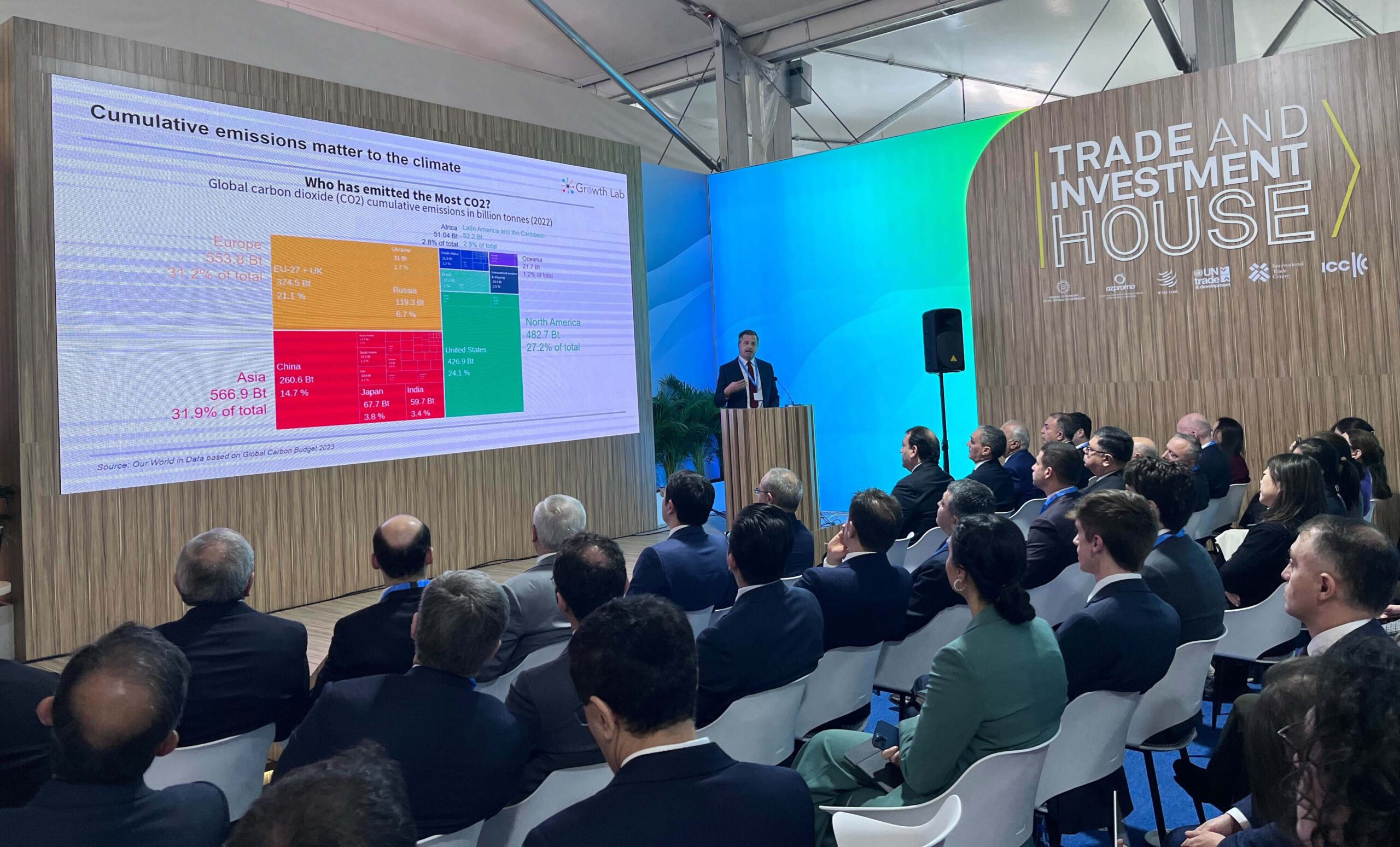
Growth Lab senior research manager Tim Cheston unveils Greenplexity during his presentation on green growth strategies at COP29 in Baku, Azerbaijan.
BAKU, AZERBAIJAN – Today at the UN Climate Change Conference (COP29), the Growth Lab at Harvard Kennedy School launched Greenplexity, an interactive tool that helps countries identify their localized opportunities for green growth by supplying what the world needs for the global energy transition.
The tool provides ten years of data for ten green value chains: batteries, critical minerals, the electric grid, electric vehicles, green hydrogen, heat pumps, hydroelectric, nuclear, solar, and wind power, and includes strategic outlooks for more than 140 countries.
“We hope this tool will help us change the conversation around the energy transition where we not only talk about how a country can lower its emissions, but what each country can do to supply what the world needs to reduce global emissions,” said Ricardo Hausmann, founder and director of the Growth Lab and Rafik Hariri Professor of the Practice of International Political Economy at Harvard Kennedy School. “By supporting global decarbonization efforts and adopting a context-specific strategy for green growth, policymakers have a chance to transform their economies.”
The Growth Lab believes decarbonization will present a defining opportunity for growth by creating new industries, markets, and paths to economic development. Countries seeking to supply the booming demand for critical minerals, inputs, or green technologies required for green products such as solar panels and batteries can analyze how close these value chains are to their productive capabilities through Greenplexity.
With Greenplexity, users can find a country’s location in each green value chain and determine its level of competitiveness.

From there, users discover the country’s presence in each value chain compared to its expected value and the global average.

Next, the tool analyzes the country’s best opportunities to enter green value chains by exploring the trade-off between measures of feasibility and attractiveness of each product. By exploring each dimension, users will obtain a deeper perspective on the potential each product offers.
Underpinning Greenplexity is a similar framework of economic complexity that is featured in the Growth Lab’s Atlas of Economic Complexity, which provides place-based research insights on growth opportunities for 250 countries and serves over 2 million users. The launch of Greenplexity is coupled with new Atlas visuals depicting the connectedness of products across green value chains. This allows countries to chart their paths to growth in a decarbonizing world. Over the coming year, Greenplexity will be enhanced with new data, features and strategies for green growth.
Contact: chuck_mckenney@hks.harvard.edu
Phone: (617) 495-8496