
Namibia’s Diversification Strategy: Finding A Way Forward
Namibia is a country of 2.5 million people that gained independence from South Africa in 1990 and shares a legacy of apartheid that informs the socio-spatial distribution of its citizens. Its economy is highly reliant on the exports of a few primary commodities, such as minerals like diamonds, copper, uranium, gold, and zinc, and agricultural goods like fish and livestock. The mineral economy drives much of the growth of the country. Similar to my country, Peru, Namibia had a period of high growth during the commodity boom (2002 – 2015) but is now facing a growth challenge because of exogenous shocks such as falling commodity prices and COVID-19.
The Growth Lab is supporting the Government of Namibia (GoN) in the quest of finding new growth drivers that promote inclusive development. The project covers a wide range of research activities, such as: understanding the drivers of macroeconomic sustainability, diagnosing the constraints to growth and identifying the most binding structural barriers preventing Namibia from realizing sustainable growth and diversification opportunities, studying inequality and labor market dynamics across the country, and analyzing the economic and export diversification opportunities by applying the framework of complexity analysis. A key objective is leveraging the existing capital-intensive industries (i.e., minerals) to set the basis for productive diversification towards industries that can employ more people with higher capabilities and jumpstart the Namibian economy.
Although productive diversification and inclusion are shared goals, there are different approaches being considered to foster these new opportunities. On the one hand, the GoN has consistently promoted “beneficiation” since 2012 through its homegrown agenda. The beneficiation, or value-added, strategy focuses on adding more value downstream to current exports. On the other hand, the Growth Lab sees productive transformation as focusing on sectors that are “similar” in terms of skills and capabilities because of the shared knowhow required in the production process. These opportunities are (i) implicitly revealed through production and export data – i.e., like the product space; and (ii) not necessarily along the lines of vertical value chains, which might seem unintuitive at first glance. Put simply, while many governments believe that a strategy to diversify should go from cotton to textiles, the Growth Lab finds evidence of an optimal strategy that may go from cotton to fruits or coffee. “Similarity” is better understood through knowhow in the production process rather than vertical value chain integration.
Nonetheless, the idea behind beneficiation is intuitive and appealing to an economic-political messaging about “doing more at home.”It is an appealing idea for many reasons: saving on transportation costs as well as secured and cheaper local supply, and domestic import substitution. It also supports a sense of national pride by promoting the notion that employment and skills “evolve” downstream to higher-value products. Moreover, in a country with a dependence on commodities, adding value is also seen as an option to reduce exposure to the volatility of the international markets (i.e., selling batteries is less volatile than selling copper).
However, the Growth Lab has empirical evidence proving that countries do not transform by adding more value to their existing exports down the value chain. Klinger et al (2008) assess the effectiveness of beneficiation by analyzing international trade data for 200 countries over the previous 50 years. The conclusions – which are aligned with the economic literature on the same topic – is that countries do not transform by adding more value to their existing exports down the value chain. Instead, countries accumulate productive capabilities, redeploy, and recombine them into larger sets of more sophisticated products and services. Hence, beneficiation is likely to be unsuccessful.
My role in the Namibia project during the internship largely consisted in creating a new dataset using Namibia’s trade data to identify and compare the two approaches to industrial diversification. Based on Klinger et al (2008), I worked on the analysis, refined it with members of the team and external experts, and then presented my work to the counterparts. My findings were used in the policy recommendations made by the Growth Lab team to the Government of Namibia.
These are just a few highlights of what I learned:
- Analysis is a stronger piece of evidence than intuitive arguments: During my internship, I helped advance the agenda by identifying the top 50 industries that should be prioritized following a beneficiation strategy, and preparing a graph that contrasted them vis-à-vis the industries identified in the economic complexity report within the same product space. The graph showed how beneficiation is “as good as random”: the prioritized industries require different sets of capabilities and can differ greatly from Namibia’s existing industries. The visual contrast between both strategies made a stronger point than any theoretical discussion.
- History matters, context matters, and public perception matters: In the MPA/ID program, we learn that policies are not just about what is technically correct. One must take into account political and administrative feasibility. Given the historically salient role of beneficiation in the country, and in the broader South African Development Community, it was politically complex to expect a full shift out from beneficiation, so the team proposed a “middle ground” strategy: following capabilities first, then beneficiating if that’s in the optimal set. Some products in the plastics and rubbers product group fit these criteria since they were both directly downstream and in line with the existing set of capabilities.
- It matters not only when assessing policy recommendations, but also when thinking about the messages we want to convey: In Namibia, the Growth Lab recognized that we were outsiders to the country and that our message could be perceived as though we believed that the country was not capable of adding value to its existing industries. Thus, we looked for examples of industries where Namibia currently adds value to imported products (i.e., copper) to make the point that we do believe they are able to add value, but that it did not necessarily have to be to domestic products.
- Every good idea on paper leads to a lot of effort to implement them in order for them to materialize: Many policy recommendations sound reasonable on paper but fail to delve into how policymakers can actually “make it happen” given the existing organizational capacity and institutional setup. To address this natural gap in going from ideas to action, the Growth Lab facilitated the introduction of productivity taskforces and developed a framework of best practices to show how policymaking could be implemented to reduce coordination failures that constrain diversification efforts. As part of this process, we met with counterparts in the GoN to first understand similar efforts in the past to set up such taskforces and we incorporated those learnings into our recommendations.
- You cannot pursue single policies in isolation of other policy priorities. They have to complement each other. Fiscal sustainability and industrial policy had to go hand-in-hand: While diversification is a way of addressing Namibia’s growth and inclusion challenges, the team was also very aware of the fiscal constraints that the GoN currently faces. To that end, we argued that a beneficiation strategy was likely to require more fiscal resources given the big push needed to develop new capabilities. Similarly, a key best practice for the implementation of productivity taskforces is that they should not focus on measures that increase profits for firms (i.e., tax benefits), but on measures that help increase overall productivity.
The Limits of the Rule of Law to Address Systemic Corruption
José Ignacio Hernández for the Corruption, Justice, and Literacy Program website
Venezuela is considered one of the world’s most corrupt countries. A common strategy to address its corruption, and one advocated by the likes of the Council on Foreign Relations no less, is “reinstating the rule of law.” Similarly, the International Commission of Jurists has proposed to “recover the country’s democratic institutions and the functioning of the rule of law.”
Without a doubt, the rule of law should be restored in Venezuela to tackle corruption. The real question to ask, however, is this: What is the root cause of corruption in the country? If the cause is flawed rules, then, yes, the solution should be institutional reform that creates new rules and institutions. This in fact is the path Maduro’s regime has followed, while also recommending a legislative overhaul to boost anti-corruption policies.
Plenty of evidence exists, however, to conclude that flawed rules are not the primary driver of systemic corruption.
And, furthermore, the problem with any strategy focused on institutional reform to reinstate the rule of law to promote anti-corruption policy lies in the assumption that the branches of the Venezuelan Government possess the capability to enforce the policy.
Instead, the root cause of the country’s corruption problem resides not in its laws but in the fragility of the Venezuelan state. The first condition to reinstate the rule of law is that the state should have the capability to enforce the rule of law. And that condition is missing in Venezuela.
That is why, according to Matt Andrews, in the absence of a capable state, institutional reforms will have minimal impact; state fragility will prevent effective enforcement of the new institutions. In Venezuela, even the best comptroller under the proper framework would all but certainly fail to implement successful anti-corruption policies.
Rather than push for institutional reform to reinstate the rule of law in Venezuela, we should diagnose and measure the fragility of the state. As in Lampedusa’s novel The Leopard, any anti-corruption strategy based only on an institutional reform will “change everything” to allow everything to stay “as it is.”
Nine lessons from LEG 2020: Economic Diversification of Gabon
Guest blog by Milaine Rossanaly
This is a blog series written by the alumni of the Leading Economic Growth Executive Education Program at the Harvard Kennedy School. 65 Participants successfully completed this 10-week online course in May 2021. These are their learning journey stories.
This course has benefited me tremendously. My background is in business administration so I intuitively understood concepts of growth, productivity, inclusion, binding constraints and others, but this course allowed me to understand them much better. I have a long list of take-aways from this course that I will apply in the future, but perhaps a few highlights are the following:
- It is critical to thoroughly diagnose the problem, identify true binding constraints (and not constraints in general) through a systematic analysis and determine entry points. I really like the use of a fishbone diagram to display these causes in a ‘deconstruction’ of the problem.
- I enjoyed learning about “high bandwidth organizations”, particularly the case of Costa Rica.
- I learnt about the action-learning oriented iterative approach to pursuing a growth strategy, particularly the example of Sri Lanka, which allows an incremental step-by-step approach aiming to invest in building blocks to build legitimacy and political buy-in as we move forward, while drawing lessons at every stage and showing results.
- I understood new concepts like latent practices, positive deviance, gap analysis, complex vs complicated problems and the Problem-Driven Iterative Adaptation (PDIA)
- I learnt so much from the Korea and Singapore success stories, about the importance and role of leadership and multi-agent leadership structures.
- The role of technology in development and the role of knowhow as the slowest form of technology to transfer between individuals, firms, and societies as the limiting factor on economic growth.
- I learnt new sources of data such as the wonderful Atlas of economic indicators.
- I learnt new ways to measure success in growth strategies, the importance of inclusion+growth indicators in the post-Covid ear that focus on reorganizing the economy to promote productive relationships, good jobs and more.
- A few quotes that I particularly liked: “Society knows more, not because individuals know more, but because individuals know different”, “Copying best practice helps you play, but it does not help you compete. Creating gives you the competitive edge.”
I better understood my growth challenge throughout the course of 10 weeks. I deconstructed the problem piece by piece, looked for alternative solutions, identified new actors and agents to involve in the solution, found new data to support the challenge and measure what success would look like and think about an inclusive growth strategy in the post-covid era that focuses on the development of the local economy and strengthening of business services to create employment and generate positive spillovers for the population.
My economic growth challenge was centered on economic diversification in Gabon during this course, but I was recently informed of an upcoming lateral move on July 1 when I will start working on Ethiopia. I will revisit this course and the materials to analyze the growth story of Ethiopia to prepare for my transition. I am really looking forward to it. Thank you.
The course was excellent, professors were incredible, the material was great and very helpful. I wish it was longer!
To learn more about Leading Economic Growth (LEG) watch the faculty video, and visit the course website. This blog was originally published by the Building State Capability program. Visit their blog for more learning journey stories.
LEG Blog Series: Developing Economic Complexity in Western Australia’s remote, sparsely populated regional centres
Guest blog by Giles Tuffin
This is a blog series written by the alumni of the Leading Economic Growth Executive Education Program at the Harvard Kennedy School. 65 Participants successfully completed this 10-week online course in May 2021. These are their learning journey stories.
1. Some of the key insights I have learnt include:
Just because your region produces raw goods (like iron ore) doesn’t mean that you should be making downstream goods from it (like steel). The raw goods are available on the open market, and can be easily shipped to your nearest port. On the other hand, cost of transporting manufactured goods is far higher. So you must have a very strong competitive advantage to make it worth producing downstream goods from your raw products.
PDIA is an excellent approach to solving complex problems. Some key insights are: stay focused on the problem, and use it to keep others focused; break down bigger problems into smaller, solvable problems; and start addressing these problems to gain momentum and create authority.
Binding constraints act as a handbrake to development in your region. They should be identified (particularly by looking for the high prices and workarounds they create) and addressed as directly as possible (including via the PDIA approach).
Understanding a region’s ‘sense of us’ is hugely importance to creating buy‑in for policy you create. Without this understanding, you will end up pushing against a people’s culture and get nowhere.
2. Some of the key insights about my growth challenge included:
- I initially was targeting creating EC in the regions. As the course progressed, I realized this was not feasible, and focused on creating EC in regional centres (ie. towns with populations over 10,000 people).
- Some of the binding constraints I considered included: limited access to export markets; high overheads; limited government support to help businesses become globally competitive; limited ecosystems; and difficulty accessing export markets.
- Confirmation that my preferences for doing things informally and quickly, at the middle‑management level, can yield good results (noting that you do need to get proper authority at some point).
3. One of the key things I will use from this course is the creation of Black Belt Teams and high‑bandwidth organisations. Too many bureaucrats in WA only talk to other bureaucrats. Getting out into the field and talking directly with industry is crucial. While we have Regional Development Commissions who do this (particularly with existing industry), there is a lack of focus on engaging with emerging industry.
4. I have a suggestion rather than a question.
PDIA is an excellent approach that can be used in both developed and developing countries. However, I feel that much of the approaches of EC and binding constraints are less useful in developed countries that already have more ‘letters’ and well developed institutions for things like credit, education, public transport etc. This may be because the majority of case studies and deep dives are focused on developing countries (which in fairness is where the majority of the Growth Lab’s work has taken place).
With this in mind, I’d suggest some materials that specifically cover developed countries, including:
- How the product space and employment space are likely to look very different for developed countries, because of the higher proportion of people in the services sector (including professional workers) – see diagrams below.
- How best to use the product and employment space to look not just for new ‘letters’, but for new innovations that aren’t yet listed in both spaces.
- What sort of binding constraints are most likely to apply to developed countries (noting that the approach to finding them remains the same as for developing countries).
- Other approaches for fostering global competitiveness.
- Any insights from the Growth Lab team that came to WA regarding the differences between developed and developing countries.
5. Thank you for a wonderful course! I’ve learned lots – now to apply it!
To learn more about Leading Economic Growth (LEG) watch the faculty video, and visit the course website. This blog was originally published by the Building State Capability program. Visit their blog for more learning journey stories.
LEG Blog Series: Leading Change When Things Are Good
Guest blog by Carmel Quin
This is a blog series written by the alumni of the Leading Economic Growth Executive Education Program at the Harvard Kennedy School. 65 Participants successfully completed this 10-week online course in May 2021. These are their learning journey stories.
Western Australia is a prosperous State in a diverse and wealthy country. Our growth challenge is not one that we experience today – but one that looms large on the horizon.
Much of the State’s wealth comes from the export of non-renewable commodities – natural resources that will not last forever. If we want to maintain our standard of living in the future, it is vital that new drivers of growth are developed.
The question I, and many others, have sought to understand is – what might these new growth opportunities be and how can we best support them? Further, how can we prompt meaningful and sustained action to address a problem before its impacts are felt?
- Economic complexity underpins growth: A foundational concept in the course has been that technology in the form of knowhow or working knowledge is the strongest determinant of economic growth over the long-term. It is the variety of expertise within a society that determines its growth. When different people know how to do different things, these capabilities can be added together to make innovative and increasingly complex products. In comparison to an economy with highly concentrated know-how, say in agriculture or mining, an economy with people and firms that each specialise in a variety of different know-how will be able to work together to produce a much more diverse and complex set of goods and services.
- A new direction needs a compelling problem: Focusing the efforts of stakeholders around an explicit goal (or a series of goals) is critical to making progress towards sustainable economic growth. In order to do this, the way that we communicate the problem must attract attention and mobilise action. Put simply – the problem needs to matter to others – particularly to those that can authorise change. A good problem, supported by evidence, will draw people to it. In an environment with competing issues and limited resources, it is important to understand our problem and not to jump to an expedient ‘solution’.
- Moving from low bandwidth to high bandwidth: The model of a ‘high bandwidth’ organisation describes how we can improve the way we go about seeking, holding and using information. In seeking to identify and address barriers to growth, information, or more accurately, intelligence, is critical. This may be around constraints to innovation, missing public goods or barriers to enhanced productivity. An organisation that undertakes in depth engagement with a variety of local stakeholders before taking action is far more likely to focus on the things that can make a real difference. An organisation that develops a system whereby engagement and learning are continual and groups are empowered to respond to barriers is a powerful tool in enhancing economic growth. This model shows clearly the inherent power in asking questions and taking action.
- We all need to lead: It is natural that leadership should form part of my key learnings from this course (it’s in the title). The aspect that I find myself focused on is – who leads in relation to growth? There can be no single leader for such a broad concept with complex implementation. Who then is responsible for convening and motivating groups to identify new ways of working to address persistent problems or to capitalise on emerging opportunities? Leading Economic Growth puts forward a concept of ‘multi-agent leadership’ – the right people doing the right things at the right time. Within this model of leadership, there are many different types of leaders. One type of leader is one who authorises (a more traditional view of leadership) as well as those who make connections, identify problems, implementers and people who generate ideas. Such a model empowers all of us to take an active role in leading growth.
Further to the learnings above, I have been able to reflect and develop some new insights about my particular growth challenge.
The prospect of seeking to catalyse some new or innovative action around the growth challenge facing WA is somewhat overwhelming. This is due to not only the complex nature of any economic growth issue but also the somewhat delayed nature of the challenge making seeking change more difficult. A strong motivator to act is a desire to contribute to the identification and realisation of new growth opportunities in regional WA.
The need to consider local capabilities (know-how) which varies between different regions and centres means that there can be no ‘one size fits all’ approach to economic diversification in WA. A ‘top-down’ approach with a singular solution – or even a limited number of major initiatives – will not have the necessary regard for local situations and opportunities. A highly targeted approach to growth interventions, while a useful component, may not lead to inclusive growth with far reaching benefits.
It is challenging to see how the current embedded knowledge in the economy can be leveraged (combined and added to) to develop new and tradeable products and services to support future growth. The State’s working knowledge reflects a lack of capabilities in the production of complex goods and services for export. Other knowhow is related to ubiquitous goods and services that serve the State’s population.
This suggests there is a need for the State to take a strategic approach to the identification of sector growth opportunities through ‘Strategic Bets’. This situation requires ‘long jumps’ to be coordinated and planned to allow for capability and industry development in export products that hold strategic merit and feasibility. The approach to economic growth taken in WA will need to be explicit, targeted and active. Growth and diversification opportunities will not come to fruition on their own as based on existing knowhow it is difficult to move in to new products.
Another area on which I have reflected is the potential binding constraints to growth that may be present in the State’s economy. Binding constraints to growth are typically in low supply but high demand and if they could be addressed, they would result in growth. A further consideration is that firms that are less intensive in the constraint are able to thrive, while firms that are intensive in the constraint may be observed trying to overcome it.
A binding constraint in terms of my growth challenge may be the lack of knowhow in complex products and services. I consider that if the State were able to accumulate knowhow in complex products through skilled individuals – those skilled people could drive the production of more complex and higher value goods and services that could contribute to growth.
Data also suggests that Foreign Direct Investment in non-mining sectors is in relatively low supply. Major international investment in Australia in non-mining firms has not made its way into the State in the same way as international mining investment. This suggests that the overall business environment is conducive to diverse international investment but there may be barriers when it comes to establishing in WA.
In terms of how I will use what I have learned in this course, I have developed a deeper understanding of key theories and concepts supported by practical skills and options for preliminary and next steps. The practical Problem Driven Iterative Adaptation toolkit is an action-oriented framework that represents a clear methodology to build our capabilities while seeking to solve complex problems. This approach may lead us towards the innovation ecosystem, infrastructure needs, availability of skilled labour, presence of complex know-how or the mix of foreign direct investment. What will be important is that we are informed by local intelligence on real problems are – instead of being focused on a solution determined in advance. A logical, sequential process that delivers incremental outcomes will help to build support for future action that can contribute to real change. I look forward to being part of it.
To learn more about Leading Economic Growth (LEG) watch the faculty video, and visit the course website. This blog was originally published by the Building State Capability program. Visit their blog for more learning journey stories.
Apply Now: Leading Economic Growth (Online)
Sophisticated Tools. Practical Approaches.

Stimulating growth is the top economic priority for many countries and localities around the world. Yet many are trapped, lacking the productive capability to solve problems and expand to new industries to drive development. New growth strategies need paths, processes and organizations to address this problem.
Leading Economic Growth (Online) brings together leading experts in economic development with practitioners from around the globe to focus on practical approaches to shared growth and development. Led by Professor Ricardo Hausmann and Professor Matt Andrews, the curriculum provides a framework for understanding economic growth, as well as sophisticated tools for diagnosis, decision making, and implementation.
In this ten-week program, you will have the opportunity to apply the concepts, frameworks, and tools you learn to your economic growth challenge that you are addressing in your city, region or country. To successfully complete this program, you will be required to complete all ten individual assignments and attend all ten peer learning group sessions. These program elements will help you develop a strategy that you can implement to promote economic growth in your city, region, or country. Participants are expected to commit a minimum of three hours/week to live sessions and approximately five hours/week to self-study time.
Watch Profs. Hausmann and Andrews discuss who should apply for the course, the types of challenges often faced, and what participants will takeaway.
Testimonial
“It was one of the most stimulating learning experiences I have had. Not only was I able to expand my viewpoint about development and economic growth, but I was also able to think more deeply about the growth challenge I am tackling in my country.”
– Student from Spring 2021 LEG
Read this blog for more testimonials from previous students and to access their learning journey stories.

The Growth Lab’s Most Important Academic Papers of the Past Decade on Economic Complexity
This blog post originated as a thread on Twitter. Written by Frank Neffke.
At the Growth Lab, an interdisciplinary team of researchers explores the foundations of economic growth from both an academic and applied angle.
Our Economic Complexity approach starts from the assumption that technology takes the form of tools, codes and knowhow. Because each individual can only acquire so much knowhow in a lifetime, a country’s collective knowhow grows by distributing different bits of knowhow across different brains. In that sense, countries know more, because individuals in them know different. Complex places are places that can mobilize a diverse body of knowhow. Complex products are products that require more knowhow. Two core quantities developed at the Growth Lab are the Product Space (a network that links products or industries with similar capabilities requirements) and the Economic Complexity Index (ECI, a measure of how much knowhow an economy can mobilize).
Since knowhow is often tacit, embodied in skills and routines, knowhow diffuses with people and teams of people. However, because knowhow is distributed across different people, to use it, it needs tying back together by firms, cities, or countries.
Our research established that this view has testable implications that are borne out in the data. In our work, we explore how knowhow grows at the local level, how it diffuses and how it is coordinated within individuals, firms, and value chains. Below, we list our most important academic papers of the last ten years on Economic Complexity.
The Network Structure of Economic Output (2011)
Modeling complexity: Ricardo Hausmann and César Hidalgo describe the economy as a tripartite network connecting places to the capabilities they have and products they can make, explaining stylized facts about exports and why complex worlds feature a poverty trap.
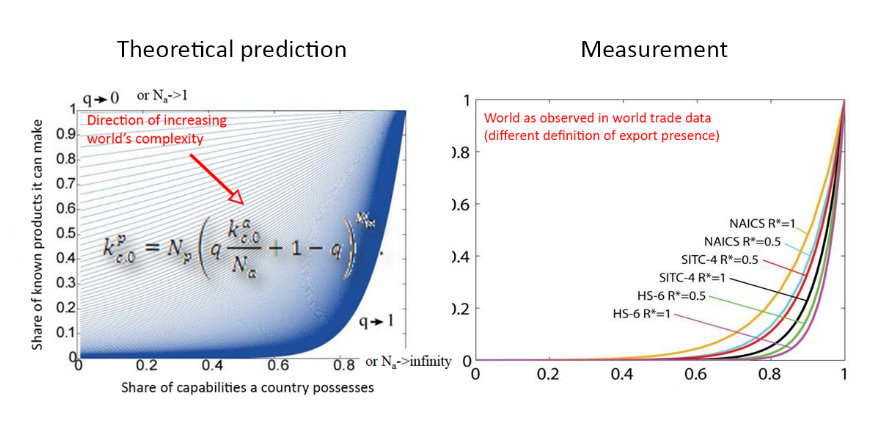

Explaining the Prevalence, Scaling and Variance of Urban Phenomena (2016)
Taking the model to cities, Andres Gomez-Lievano, Oscar Patterson-Lomba and Ricardo Hausmann ask: Why do larger cities exhibit higher wages and more innovation, but also more rare diseases and crimes? Because these all are socially complex phenomena.
The Atlas of Economic Complexity (2011)
Authored by Ricardo Hausmann, César Hidalgo, Sebastian Bustos, Michele Coscia, Alex Simoes and Muhammed Yildirim, the Atlas is a guide to the world of economic complexity through trade data: explanations of core concepts, empirical tests and country-specific visualizations. [Explore the tool]
A Structural Ranking of Economic Complexity (2019)
Measuring complexity: Ulrich Schetter embeds a structure of log-supermodular productivities into a multi-product Eaton-Kortum model to show that under these conditions the Economic Complexity Index really does measure complexity.
Implied Comparative Advantage (2014)
The Product Space revisited: Hausmann, Dan Stock and Muhammed Yildirim construct a Ricardian model to explain why growth of exports in countries (or of industries in cities) can be predicted from product and country spaces.
Why do Industries Coagglomerate? How Marshallian externalities differ by industry and have evolved over time (2016)
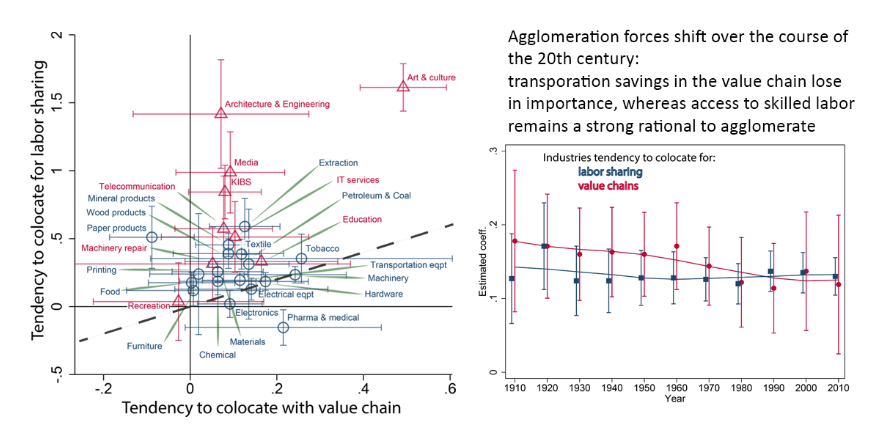
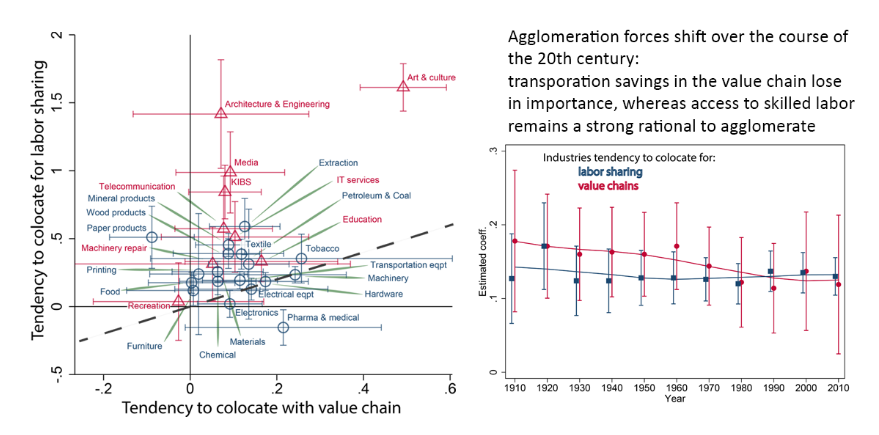
Neave O’Clery, Dario Diodato and Frank Neffke dissect the industry space: Why do industries collocate? It depends: services to share workers, manufacturing to be close to their value chain. But over time, sharing workers increasingly dominates.
Skill Relatedness and Firm Diversification (2012)
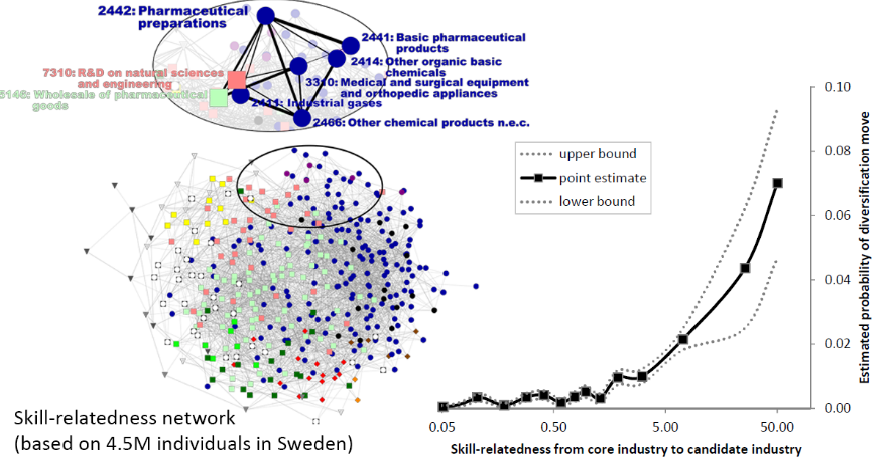
Firms diversify into industries for which their workers have the right skills. Frank Neffke and Martin Henning show that skill-relatedness, which they infer from large-scale data on how people change jobs across industries, predicts firm diversification 60x better than value chain linkages.

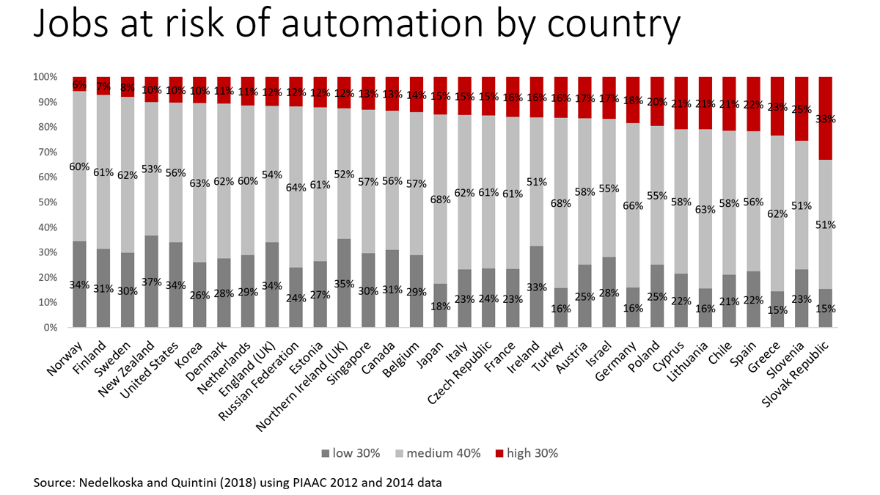
Automation, Skills Use and Training (2018)
Capabilities of machines: Ljubica Nedelkoska and Glenda Quintini estimate the risk of automation for 32 countries, representing close to 600M jobs. It is the jobs of the young, not the old that are more at risk of automation.

Welcome Home in a Crisis: Effects of Return Migration on the Non-migrants’ Wages and Employment (2018)
Diffusing knowhow through return migration. Hausmann and Nedelkoska show that the massive return of relatively low-skill, yet experienced Albanians from Greece in the financial crisis didn’t lead to unemployment, but to new jobs & wage increases.
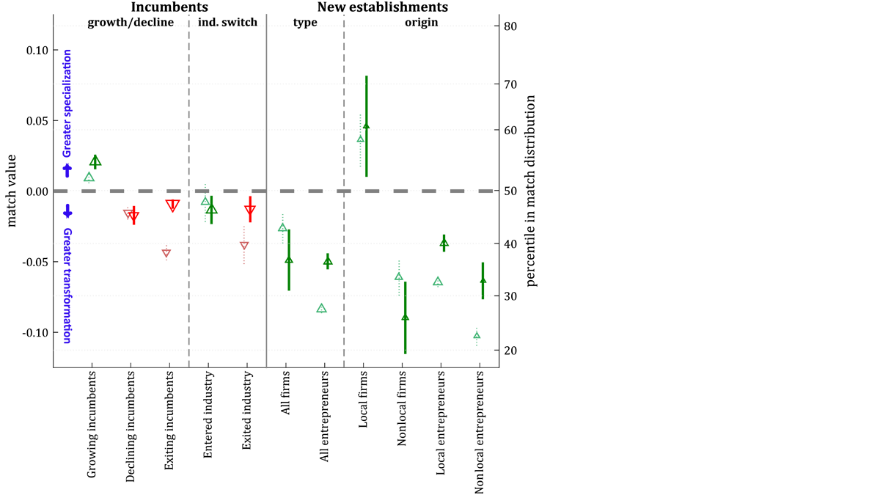
Agents of Structural Change: The Role of Firms and Entrepreneurs in Regional Diversification (2017)
How do regions make long developmental jumps? Frank Neffke, Matte Hartog, Ron Boschma and Martin Henning show that regions change mostly by the creation of new economic establishments. However, the most transformative diversification is not due to new establishments of local firms or local entrepreneurs, but due firms and, to a lesser extent, entrepreneurs from outside the region starting new establishments and therewith transferring new capabilities to the region from elsewhere.

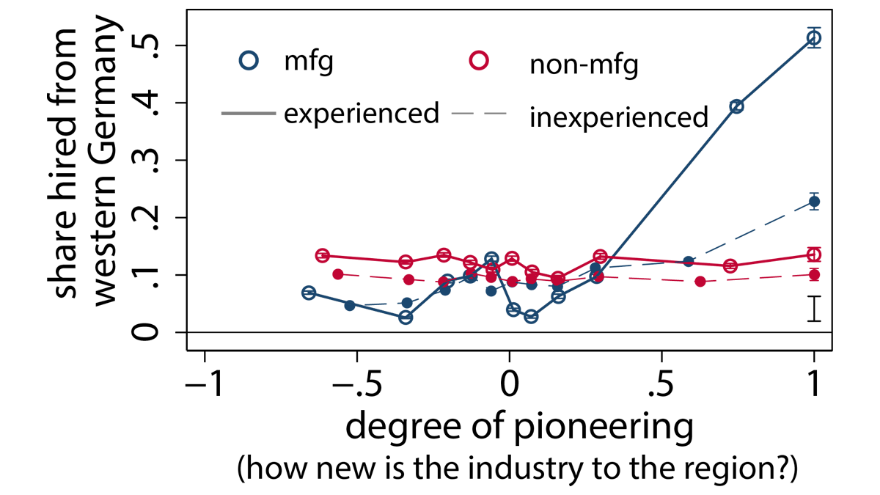
The Workforce of Pioneer Plants: The Role of Worker Mobility in the Diffusion of Industries (2019)
How did former East Germany reindustrialize? Using social security data, Hausmann and Neffke show that the pioneer firms in the east that brought in new manufacturing industries relied heavily on the sudden possibility of accessing human capital in the west: the majority of experienced workers in these firms did not come from eastern Germany, but moved in from western parts of the country.

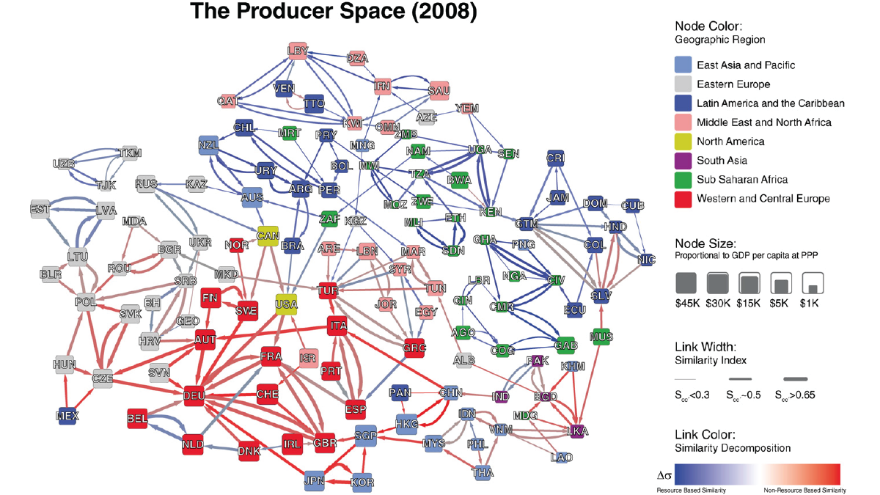
Neighbors and the Evolution of the Comparative Advantage of Nations: Evidence of International Knowledge Diffusion? (2014)
Learn from your neighbors. Dany Bahar, César Hidalgo, and Ricardo Hausmann show that countries diversify their exports by moving into products that their neighbors were already exporting. This paper also introduces the country space: a network linking countries with similar exports.

Knowledge Diffusion in the Network of International Business Travel (2020)
However, learning doesn’t require permanent proximity. Michele Coscia, Frank Neffke, and Ricardo Hausmann show how transient proximity diffuses knowledge through business travel, helping countries diversify into the industries of their visitors’ home countries. [Explore the research]
The Value of Complimentary Co-workers (2019)
Coordinating knowhow. If global knowledge keeps growing, we need to divide it across ever more people. As Frank Neffke shows, the result is growing interdependence: the value of your skills comes to depend on how well your co-workers’ skills complement yours. [Explore the research]
Functional Structures of US State Governments (2018)
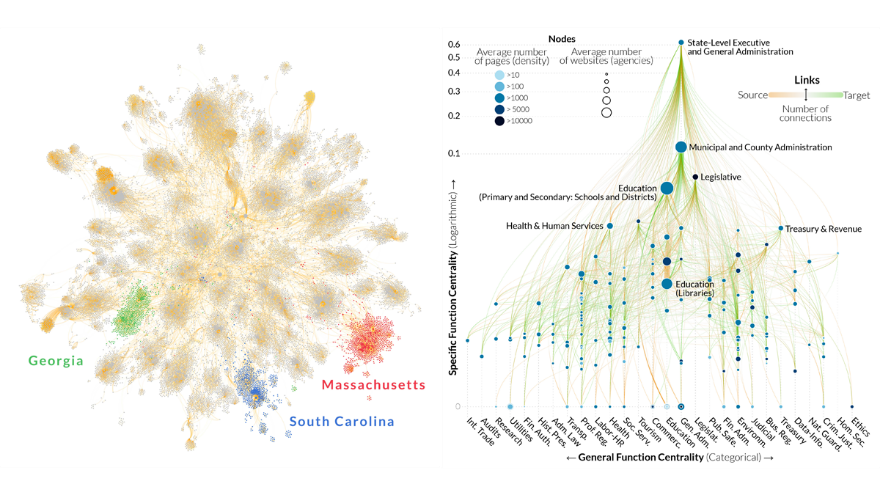
State capabilities. Steve Kosack, Michele Coscia, Evann Smith, Kim Albrecht, Albert-Laszlo Barabasi and Ricardo Hausmann reconstruct the online digital footprint of US state governments and show that it mostly reflects not ideology or location but a state’s economic structure. [Learn more]

Horrible Trade-offs in a Pandemic: Lockdowns, Transfers, Fiscal Space, and Compliance (2020)
Fighting COVID-19 involves horrible trade-offs. Ricardo Hausmann and Ulrich Schetter show why they are particularly excruciating in countries without unlimited access to foreign credit and why there is a dire need of massive financial support. [Learn more]
You’ll find all of our publications in the Growth Lab’s repository Our research agenda keeps deepening & expanding: we are working on theoretical foundations, the diffusion, adoption and upgrading of capabilities, innovation, changing tasks and occupations, localization and more. Stay tuned!
15 Visual Insights from the Growth Lab in 2020
The Growth Lab has over 50 faculty, fellows, research assistants, and staff working on development challenges in more than a dozen countries worldwide. Our research in 2020 included modeling pandemic-related tradeoffs, mapping the network of global business travel, identifying foreign exchange constraints in Ethiopia, tracking the migration of the Albanian diaspora, and uncovering environmentally friendly diversification opportunities in Peru. Every project, paper, and presentation brought hundreds of charts, graphics, dashboards, and prototypes. We thought it would be worthwhile to share some of our more notable visual insights from this year.