Learning Policy in Practice: Insights from the Growth Lab Summer Interns in Albania
Prepared by Daniela Muhaj and Jessie Lu
Three Master in Public Administration in International Development (MPA/ID) students spent this past summer in Albania as Growth Lab interns, working with local counterparts to develop and implement programs on the ground and making the leap from the classroom to learning policy in practice. Recently, we hosted our interns – Damian Galinsky, Uriel Kejsefman, and Shivani Mishra – in a panel discussion to talk about the work they conducted and its role in the broader Growth Lab Albania strategy. They spoke to their experiences living and working in Albania as well as to lessons learned when trying to translate academic and theoretical insights into policy actions. Key highlights from this conversation are summarized below.Origins of the Growth Lab Engagement in Albania
The Growth Lab began working in Albania in fall 2013 in response to a slowdown in the country’s economic growth. A combination of a stalling in external drivers of growth – remittances and exports – and restrictions against the effectiveness of fiscal and monetary policies constrained the country’s economic recovery. Albania’s economic circumstances at the time demanded a new perspective and a new mindset on the policies as well as processes leading to stronger more sustainable growth.
Working with the Government of Albania and the Open Society Foundations and led by Professor Ricardo Hausmann, the first phase of the project “Economic Growth in Albania” ran between 2014 and 2017 and focused on achieving macroeconomic stability, building medium-term fiscal strength, and developing sectors to drive economic growth. For more information on the Growth Lab Albania project, visit our website.
Development as Going Beyond Ensuring Macroeconomic Stability
Once the binding constraint of the macroeconomic crisis was relaxed, resources were released and the necessary momentum was created to engage in policy areas that would catalyze sustainable and more inclusive growth in Albania. As part of this strategy, the Albania interns worked in advancing the Growth Lab’s involvement in setting up a first-of-its-kind investment institution, strengthening inclusive growth through rural development, and assessing viable strategies to channel investment in untapped infrastructure development opportunities.
Investments are considered a main source of sustainable growth, yet developing countries often lack the management capacity and knowhow to develop their assets. This is where structures such as investment agencies, granted that they are set up properly, can be instrumental in realizing investment potential. Over the summer, Damian worked with the government to lay the groundwork for the development of an Albanian Investment Corporation that will aid the government in attracting and managing investment projects for economic development. As part of this work, Damian worked with local stakeholders to define the role of the institution, scope possible investment projects, and rank potential projects based in their feasibility and potential returns.
Location matters in development. However, lack of connectedness resulting from infrastructure gaps makes it challenging for countries to tap on regional opportunities with positive spillovers to growth, and connectedness matter. While Albania is strategically located between Croatia and Greece – two of the most popular tourist destinations in the Mediterranean – it has a relatively weak tourist sector, due in part to a lack of marinas. Marinas have been on the government’s radar for years and during his internship, Uriel identified major obstacles to their development, convened key government stakeholders to align on a vision, attracted investment from multilateral development banks, and identified next steps for the implementation of the vision.
Development efforts tend to be biased toward capital cities and big urban centers, but Albanian villages have untapped growth potential especially in agrotourism and export-led agriculture production scaling. The question is, what’s the best way to unleash this untapped potential to ensure that sources and gains from growth are not unequally distributed? The Albanian 100 Villages project was created to develop and tap into the potential of rural villages and communities through attracting investment and improving connectivity. Shivani developed a framework for the project; a roadmap for implementation; structures to ensure responsibility, coordination, and accountability; and a system for monitoring and evaluating the progress of the program.
Making the Leap: Academic Theory and the Reality of Enacting Development in Practice
Based on their experiences, the interns discussed challenges faced and lessons learned, as well as what makes a good policy work and what causes a good policy in theory to go bad in practice. Particular challenges that can be addressed include ensuring work as well as policy continuity, the often-underestimated importance of back office due diligence work, and harnessing the knowledge that is generated from stakeholders who are “trying and failing” to implement policies.
Setting up systems for continuity is important and helps address many of the issues associated with short-term engagement. To accommodate the academic schedule, the Growth Lab internship lasts for eight to ten weeks and create a wide range of challenges including condensed time to get to know systems and stakeholders and limited influence on policies after the internships end. In this context, good policy in practice means laying the groundwork for environments that are conducive to implementation of policies and creating systems and records to ensure that knowledge is not lost once engagement ends. This is true not only for internships and short-term engagements but for government offices as well.
Adjusting mindsets, expectations, and goals are essential for effective implementation of policies. Sometimes, policy descriptions may not align with reality and projects may lack vision and proper structure, but this is not an excuse to abandon and not pursue them. Rather, creating good policies involves identifying desired goals and delineating the steps and systems needed to achieve these goals. Often, working on policy does not always immediately require the technical know-how taught in academic programs—more ground work, though less exciting, lays the necessary foundation for policies to take shape.
Finally, people are central to ensuring that good policies are created and implemented. Collecting qualitative data by talking to stakeholders can help to shed light on why certain projects are not being implemented, how intrinsic motivations affect policy decisions, and what incentive structures exist that drive or prevent action from being taken. Navigating government relationships and understanding human-centered dynamics are as equally important as the quantitative data that usually constitutes the basis of policy-making decisions.
Learning Policy in Practice: Insights from the Growth Lab Summer Interns in Albania
Prepared by Daniela Muhaj and Jessie Lu
Three Master in Public Administration in International Development (MPA/ID) students spent this past summer in Albania as Growth Lab interns, working with local counterparts to develop and implement programs on the ground and making the leap from the classroom to learning policy in practice. Recently, we hosted our interns – Damian Galinsky, Uriel Kejsefman, and Shivani Mishra – in a panel discussion to talk about the work they conducted and its role in the broader Growth Lab Albania strategy. They spoke to their experiences living and working in Albania as well as to lessons learned when trying to translate academic and theoretical insights into policy actions. Key highlights from this conversation are summarized below.Origins of the Growth Lab Engagement in Albania
The Growth Lab began working in Albania in fall 2013 in response to a slowdown in the country’s economic growth. A combination of a stalling in external drivers of growth – remittances and exports – and restrictions against the effectiveness of fiscal and monetary policies constrained the country’s economic recovery. Albania’s economic circumstances at the time demanded a new perspective and a new mindset on the policies as well as processes leading to stronger more sustainable growth.
Working with the Government of Albania and the Open Society Foundations and led by Professor Ricardo Hausmann, the first phase of the project “Economic Growth in Albania” ran between 2014 and 2017 and focused on achieving macroeconomic stability, building medium-term fiscal strength, and developing sectors to drive economic growth. For more information on the Growth Lab Albania project, visit our website.
Development as Going Beyond Ensuring Macroeconomic Stability
Once the binding constraint of the macroeconomic crisis was relaxed, resources were released and the necessary momentum was created to engage in policy areas that would catalyze sustainable and more inclusive growth in Albania. As part of this strategy, the Albania interns worked in advancing the Growth Lab’s involvement in setting up a first-of-its-kind investment institution, strengthening inclusive growth through rural development, and assessing viable strategies to channel investment in untapped infrastructure development opportunities.
Investments are considered a main source of sustainable growth, yet developing countries often lack the management capacity and knowhow to develop their assets. This is where structures such as investment agencies, granted that they are set up properly, can be instrumental in realizing investment potential. Over the summer, Damian worked with the government to lay the groundwork for the development of an Albanian Investment Corporation that will aid the government in attracting and managing investment projects for economic development. As part of this work, Damian worked with local stakeholders to define the role of the institution, scope possible investment projects, and rank potential projects based in their feasibility and potential returns.
Location matters in development. However, lack of connectedness resulting from infrastructure gaps makes it challenging for countries to tap on regional opportunities with positive spillovers to growth, and connectedness matter. While Albania is strategically located between Croatia and Greece – two of the most popular tourist destinations in the Mediterranean – it has a relatively weak tourist sector, due in part to a lack of marinas. Marinas have been on the government’s radar for years and during his internship, Uriel identified major obstacles to their development, convened key government stakeholders to align on a vision, attracted investment from multilateral development banks, and identified next steps for the implementation of the vision.
Development efforts tend to be biased toward capital cities and big urban centers, but Albanian villages have untapped growth potential especially in agrotourism and export-led agriculture production scaling. The question is, what’s the best way to unleash this untapped potential to ensure that sources and gains from growth are not unequally distributed? The Albanian 100 Villages project was created to develop and tap into the potential of rural villages and communities through attracting investment and improving connectivity. Shivani developed a framework for the project; a roadmap for implementation; structures to ensure responsibility, coordination, and accountability; and a system for monitoring and evaluating the progress of the program.
Making the Leap: Academic Theory and the Reality of Enacting Development in Practice
Based on their experiences, the interns discussed challenges faced and lessons learned, as well as what makes a good policy work and what causes a good policy in theory to go bad in practice. Particular challenges that can be addressed include ensuring work as well as policy continuity, the often-underestimated importance of back office due diligence work, and harnessing the knowledge that is generated from stakeholders who are “trying and failing” to implement policies.
Setting up systems for continuity is important and helps address many of the issues associated with short-term engagement. To accommodate the academic schedule, the Growth Lab internship lasts for eight to ten weeks and create a wide range of challenges including condensed time to get to know systems and stakeholders and limited influence on policies after the internships end. In this context, good policy in practice means laying the groundwork for environments that are conducive to implementation of policies and creating systems and records to ensure that knowledge is not lost once engagement ends. This is true not only for internships and short-term engagements but for government offices as well.
Adjusting mindsets, expectations, and goals are essential for effective implementation of policies. Sometimes, policy descriptions may not align with reality and projects may lack vision and proper structure, but this is not an excuse to abandon and not pursue them. Rather, creating good policies involves identifying desired goals and delineating the steps and systems needed to achieve these goals. Often, working on policy does not always immediately require the technical know-how taught in academic programs—more ground work, though less exciting, lays the necessary foundation for policies to take shape.
Finally, people are central to ensuring that good policies are created and implemented. Collecting qualitative data by talking to stakeholders can help to shed light on why certain projects are not being implemented, how intrinsic motivations affect policy decisions, and what incentive structures exist that drive or prevent action from being taken. Navigating government relationships and understanding human-centered dynamics are as equally important as the quantitative data that usually constitutes the basis of policy-making decisions.
PDIA in Sri Lanka: Evaluating Potential Sites for New Industrial Zones
Through the comprehensive analysis conducted, the Targeting Team was capable of identifying priority sectors for attracting investment and enhancing the exports of Sri Lanka. The next task was to identify suitable lands for establishing factories in these sectors, especially given that over 89% of the Export Processing Zones (EPZs) of the BOI are already filled. Since limited access to productive land for the potential Investors can be considered as one of the most important limiting factors to attract investments, due consideration should be given to resolving land issues prior to marketing priority sectors to the investor.
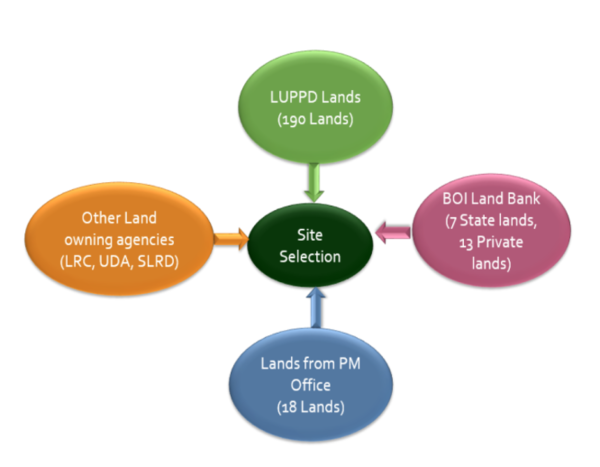
Having identified the problem, the Land Team began gathering information on available lands for investment projects. It was noted that the state owns over 80% of land in Sri Lanka, though this ownership is spread over at least ten different Ministries and Departments. The team met with many of these bodies, ultimately creating a database of over 600 available lands (Figure 1).
Figure 1: Lands from multiple GoSL bodies considered
The list of over 600 sites was then restricted to those with more than 50 hectares in extent (with later work focusing on the smaller sites). Next, an assessment based on satellite imagery (Google Maps) was conducted to determine each land’s suitability for further investigations. Based on this assessment, over 70 field visits were conducted to gather field data for final assessment. This field data, as well as sector expertise, formed the inputs for the analysis of land suitability for target sectors, conducted according to a sector-location methodology developed by the Team (Figure 2).
Figure 2: Stages of the site evaluation and selection process
Assessing the Sector Requirements: A Sector-Location Methodology was developed to assess the suitability of the lands for an investment in a priority sector. First, the hard and soft asset requirements for each priority sector were obtained from the Targeting Team asset competitiveness analysis, in which sectors with a higher requirement for a land characteristic received a higher weightage. However, the Team also added new land characteristics that were required equally by all sectors, such as topography and development cost.1 Accordingly, an overall weightage was given to each land characteristic; these fell into four categories: hard asset availability (45% of total weightage), soft asset availability (18%), general conditions (14%), and accessibility (13%).
Assessing the Land Characteristics: Next, a set of scoring criteria was developed for each land characteristic, seen in Table 6. Each site was assigned a score between 1 to 5, considering field-level observations, available district-level data (for labour characteristics), and expertise of the Team members. For example, if a particular land is more than 400 acres in extent, then a score of 5 was assigned, whereas a land with 75 acres or less was given a score of 1. This matrix was filled for each land identified for the assessment, which included existing BOI Zones as well.
Then the two matrices – land characteristics and sector requirement – were multiplied to generate a final scoring for each land for each sector. The scoring was between 1 and 5: a score of 5 signals that the land is a perfect match for the sector in terms of the land characteristics the sector requires; scores under 3 were taken to mean that the land is not suitable for the sector. The average score of each land for the T Team’s top 12 full sectors were calculated. Based on this analysis, 29 sites with an average scoring value above 3 were identified and were prioritized.
The Outcome: Out of the prioritized lands, the top-ranking locations were recommended for development into EPZs (Figure 3). A separate detailed report (focusing on the list of lands given by the Prime Minister’s Office) was also submitted, prioritizing the suitability of those lands for investment projects. Ultimately, the 2018 Budget allocated funding for zones, and development is underway in four identified sites so far (including one as a PPP).
Figure 3: Locations of lands in development (green) and other top-ranked lands (black)
PDIA in Sri Lanka: Attracting Anchor Investors in Solar Panel Manufacturing
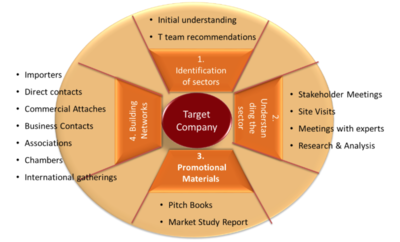
Based on the Targeting Team (T team) findings on sector targeting, Solar Panel Manufacturing was identified as a potential sector for investment in Sri Lanka. The “I Team,” consisting of dedicated officers for investment promotion, was assigned to promote Sri Lanka as an attractive destination for this and other priority sectors and attract key “anchor investors.” The timeframe given for this task was period of one year. Solar Panel Manufacturing would be a pioneer sector for Sri Lanka. There were no existing manufacturers in the country except one player who was under construction status. Thus, this was a new technology for the country, unfamiliar to Sri Lanka’s workers, suppliers and government bodies. This formed a challenge for the I Team, but with trainings from CID, the team crafted a four-step strategic approach (Figure 1), combining existing BOI investment promotion methods with a more proactive targeting of key sectors, countries and companies.
Figure 1: Strategic Approach of I Team in Investor Engagement Targeting Sectors for FDI Attraction & Export Promotion
Identification of sectors: The I Team began their consideration of sectors to be promoted based on their understanding and experience; this was coupled with the technical sector targeting mechanism of the T Team. As a result, “Solar Panel Manufacturing” was selected as one of five subsectors to be promoted for investment.
Understanding the sector: The I Team strongly believed that, prior to approaching investors, the team should understand the sector very well. The team started with desk research to gather information on the global and local scenarios of the solar panel manufacturing sector. Subsequently, they arranged meetings with sector experts, professionals, university academics, relevant ministries, and others. In addition, the team visited a small-scale solar panel assembling plant, gaining an initial understanding of the manufacturing process. All these activities made the team knowledgeable in the field of solar panel manufacturing. Soon, they were confident enough to engage with investors, and could begin to identify target companies to be attracted.
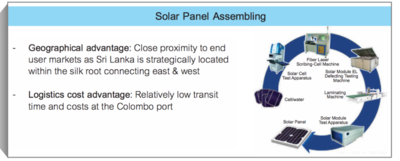
Promotional Materials: With the understanding of the sector, the team prepared a “pitch book” which could be used as a promotional material at the time of engaging with investors (Figure 2). This pitch book consisted of sector-specific positive factors given in an attractive and summarized manner, which could build a positive first impression of Sri Lanka as a preferred destination for investment. The next step taken was to prepare a “Market Study Report” with detailed information on the Solar Panel Manufacturing sector, which could be distributed among the potential investors.
Figure 2: Excerpt from I Team Pitch Book for Solar Panel sector investment
Building Networks and Engaging with Investors: The final step of the I Team was building a network for direct and indirect engagement with investors. Several contact nodes were identified to engage with target investors such as commercial attaches, business councils, importers, associations, chambers, international gatherings, and others (Figure 3).
Figure 3: Building networks to engage with potential anchor investors
One company, a top Chinese solar manufacturer, was among the top of the target companies of the I Team for the Solar Panel Manufacturing sector. The company had done its initial feasibility studies and visited Sri Lanka to investigate the potential for establishing a solar panel assembling plant there. Its executives met with the top management of BOI along with the I Team members. The I Team received the opportunity to deliver knowledge gathered through their four-step strategic approach and convince them to submit a solid proposal for investment in Sri Lanka. The team arranged a site visit to Mirigama Export Processing Zone (MEPZ), and the company selected MEPZ as their preferred location for the investment project.
The investment proposal consisted of the details of the planned project along with requested policy changes. The I Team immediately acted on these requests and submitted a policy paper for Cabinet Committee on Economic Management (CCEM), chaired by the Honourable Prime Minister. The CCEM granted approval for all the recommendations made, and the investors are now in the process of initiating the investment project in Sri Lanka.
In addition to this investor, there are other solar companies in the queue, from expressions of interest to pre-application. Most importantly, there now exist officers at the BOI with expertise in proactive targeting and engagement of top solar investors (and in other key sectors).
[[{“fid”:”3971895″,”view_mode”:”default”,”type”:”media”,”attributes”:{“height”:”360″,”width”:”480″,”alt”:”PDIA in Sri Lanka: Interview with Ganga Palakatiya on YouTube”,”title”:”PDIA in Sri Lanka: Interview with Ganga Palakatiya”,”class”:”media-element file-default”}}]]
What It’s Like Working as a Research Fellow at the Growth Lab
CID’s Growth Lab is a dynamic program driven by faculty, fellows, and research assistants who are seeking to understand the facets of economic development and to uncover how countries, regions, and cities can move into more productive activities. Our Research Fellows are integral to the success of the Growth Lab: the role’s responsibilities range from research in Cambridge to field work across the globe, and interactions with government officials.
Led by Ricardo Hausmann and a diverse, interdisciplinary team of research fellows, our work takes us around the world. Current projects include Albania, Ethiopia, Mexico, Saudi Arabia, and Venezuela.
What led you to CID’s Growth Lab? Why did you want to work here?
Shreyas Matha: After graduating with my masters, I was looking to work at a place that addresses public policy questions but did not restrict itself solely to techniques in traditional economics. What appealed to me most about working at the Growth Lab was that the place is open to embracing experiments in newer techniques such as natural language processing and machine learning.
Semiray Kasoolu: The Growth Lab is a place of independent thinkers who are not afraid to use a holistic methodology to diagnose different development problems. And to me that freedom of research meant a lot. Another thing that really impressed me was the efficiency of deployment of those research findings to developing countries and to the counterparts in those countries. And that also really impressed me because that is very different from what I know about other development institutions.
What stands out about the Fellows role at the Growth Lab? What is your level of engagement with policymakers?
Tim Cheston: The fellows really are the front line of applying these ideas in the field, and they have a range of expertise and specialties and analyzing different data sets and applying them to different policy purposes. Traveling to Colombia, Mexico, Indonesia, Saudi Arabia and Ethiopia, and working hand in hand with ministers and technical staff across all of those countries has been a real privilege, to see both the larger struggles that unite all of those countries but also the unique features of each one of those places.
SK: The role of a fellow at the Growth Lab is unique in that it combines three things. One is using quantitative methods to discover and probe for development problems. The second one is to validate those with field work and field trips. And the third one is to use those the first two to come up with policy implications and inform of policy work.
Ljubica Nedeloska: I had the opportunity to engage with policymakers on both the technical level and the policymaking level and also on a variety of issues such as employment strategy, disapora relations, fiscal projections, employment projections, fiscal policy among other things. This experience gave me a very interesting chance to see inside how governments work. And I think this is very unique to the GL and I don’t think it would have been possible to learn if I would have stayed in solely academia.
Nikita Taniparti: You’re doing research–you’re reframing the way that governments and policy makers ask questions… You get to interact with the minister or the government, and you hear why they can’t just do the easiest policy option that you might think they should be doing.
What is your favorite part about working at the Growth Lab?
LN: What I like most about working at the Growth Lab is the interdisciplinary teams of highly motivated and highly talented fellows. I also enjoy working with some of the most brilliant minds in the field of economic development. This place has high energy and also high optimism which I enjoyed very much. And last but very important, I recently became a mom and the Growth Lab specifically offered very reasonable conditions for work/life balance.
SM: I’d say my favorite part about working at the Growth Lab is that I get to work with a floor full of postdocs and Ph.D. students who are all interested in working on questions in public policy but also coming at them from new and interesting perspectives.
NT: The Growth Lab is where you get this chance to use your intellectual curiosity to ask the questions that really matter. You’re not just working on a really small part of something where you don’t know the outcome. Our research questions that can be very theoretical are all driven by something that’s happening in the world. We know exactly who we’re working for, whether it’s farmers on the ground or foreign workers in a different country. You know why you’re asking the question and why you’re asking it the way you do.
Miguel Santos: I like arriving in a location you know very little about, with a team of highly qualified people that challenge you constantly, and gradually learning about that place. This process of learning the nuances of a country and translating that into policy, and having the capacity to surprise people who have been there a long time, that’s my favorite part of the job.
This Q&A was edited for clarity and brevity.
What It’s Like Working as a Research Assistant at the Growth Lab
Harvard’s Growth Lab is a bustling hub of faculty, fellows and staff working to understand the dynamics of economic growth and uncover how countries, regions, and cities can move into more productive activities.
Led by Ricardo Hausmann and a diverse, interdisciplinary team of research fellows, our work takes us around the world. Current projects include Albania, Ethiopia, Mexico, Saudi Arabia, Sri Lanka, and Venezuela.
Research Assistants also play a fundamental role on our team. Not only do they provide research support by analyzing and managing datasets, they also collaborate with our high-level counterparts, offering comparative analysis of policies.
What led you to CID’s Growth Lab? Why did you want to work here?
Sehar Noor: CID is really at the frontier of a lot of the topics that I was interested in as an Economics major in undergrad. Everything from growth diagnostics to complexity work, it’s looking at diversification from a unique perspective, and I was drawn to both the faculty and the research that is produced by the fellows here.
Bruno Zuccolo: What I really liked about the Growth Lab was the intersection of researchers working on the very academic side of learning about growth, but also a very dedicated team of fellows and research assistants applying that research in country projects. The country projects are varied and work through very different economies; when I first joined I was working on projects in Albania and Argentina, and I was working on issues of growth in all those countries. I think this was a fantastic opportunity to learn about countries that I didn’t know that much about and to be able to apply rigorous methodology and statistical analysis.
What stands out about the Research Assistant role at the Growth Lab?
Ana Grisanti: I have many responsibilities, ranging from data cleaning and the visualization of the data, to finding out who we want to interview in the field and going into the field and engaging in interviews with counterparts. One of the states within Mexico that we were working on was Baja, California, and we were doing a growth diagnostics and complexity analysis in the state. The second time I traveled to Baja, I had the opportunity to present our findings to our counterparts, which was a thrilling experience for me. I think that’s unique for the RA position at CID and one I would not have at any other center.
BZ: What I like about being an RA at CID’s Growth Lab is that you’re working on multiple projects at once, and that means you get to explore a lot of issues specific to each country. So in Albania, where I’ve worked for the past year, we work on issues of agriculture, macro growth, trade, and tourism, and as an RA you don’t always get the opportunity to delve into as many issues as this. The other thing about being an RA that’s fantastic is going to the field. At CID, the RAs really travel and represent the whole of CID in meetings with high level government officials. I remember during my second trip to Albania, we met with several of the Ministers, and I had one-on-one meetings with high level officials in the Ministry of Finance, and that’s just a unique opportunity that I couldn’t imagine having anywhere else.
What is your favorite part about working at CID’s Growth Lab?
SN: I think my favorite part is definitely the people. You have postdocs, fellows, and developers who are experts in their fields and so generous with their time. They make sure that I’m not just getting my work done, but that I’m also building skills that I can use in my future. I think it’s a place where people invest in you, and it’s not just for that deadline or for that project, but in the long run.
BZ: What I’ve most enjoyed about working at CID is how much I’ve learned while applying all of it to concrete policies in the countries we work in. I’ve learned numerous statistical methods, I’ve learned how to code in computer languages, I’ve learned how to work with the counterparts.
AG: This can be a cliché, but my favorite part about working at CID is the people and the attitude that everyone has toward the work. Everyone is willing to help when you have questions or ideas that you think are worth exploring. I can confidently say that I’ve made a lot of great friends here.
Email us at growthlab@hks.harvard.edu if you’re interested in becoming a Research Assistant at the Growth Lab and visit our Jobs page for a list of available opportunities.
This Q&A was edited for clarity and brevity.
The Case for the Albanian Investment Corporation
To support the growth strategy of Albania, to improve employment rates and the general well-being of its society, the Government of Albania (GOA) has been working since fall 2017 to develop a mechanism that could ensure timely preparation of needed investment projects and their financing under adequate conditions.
After a thorough due diligence process during 2018, and careful evaluation of different options, the GOA has opted for the creation of a new institution, the Albanian Investment Corporation (AIC), as a new capability to transform development ideas and initiatives into bankable projects that can elicit the interest of high-quality private investors.
In this video, CID Director Ricardo Hausmann explains the need for the AIC, how it will coordinate functions with ministries and public sector agencies, the mechanisms to mitigate risks regarding its governance and mission, and more.
Re-visiting the “Sector Targeting” study: Assessing the study’s impact
Author: Neluni Tillekeratne, Sri Lanka Project Officer
Part 2: Assessing the impact of the report compiled by the “Sector Targeting Team”
Just over one and a half years ago, Sri Lanka’s Board of Investment (BOI) and Export Development Board (EDB) collaborated with the Center for International Development at Harvard University (CID) to study economic sectors for their investment and export potential.
Twenty officials from the BOI and EDB formed a “Sector Targeting Team” (or “T-Team”). The team assessed 30 sectors – all tradable activities (goods and services) of the private sector – and finally ranked their top sectors for investment and recommended strategies for promoting them. Using the Problem Driven Iterative Adaptation (PDIA) approach of CID’s Building State Capability program, the T-Team met weekly, working continuously over a three-month period. The resulting study represents the hard work of these dedicated government officials.
The previous post described the methodology of this study. It explored the numerous stages in which raw data across multiple indicators was analyzed, ultimately deriving a final list of subsectors with the highest potential of succeeding in the export market as products from Sri Lanka.
This post will explore if this detailed research effort went on to catalyze impact in Sri Lanka’s efforts towards export-promotion.
The team shared that despite the study being released just a short while back, it has impacted BOI across multiple tiers of strategy, action and influence. In particular, they described how the study has catalyzed impact in 8 different ways.
To document the tangible outcomes that emerged as a result of this study, I met with the lead authors (and beneficiaries) of this research initiative at the BOI: Mrs Champika Malalgoda (Executive Director, Research and Policy Advocacy), Mrs Priyanka Samaraweera (Director, Research and Policy Advocacy), and Mrs Ganga Palaketiya (Deputy Director, Research).
The team shared that despite the study being released just a short while back, it has impacted BOI across multiple tiers of strategy, action and influence. In particular, they described how the study has catalyzed impact in 8 different ways.
1. Informed strategy Strategies derived from the BOI-EDB-Harvard study were incorporated into the BOI 2017-2020 corporate plan. The document, also known as the strategic plan, defines key targets for the institution, specifically in terms of:
stating the BOI’s broad objectives and strategies,
setting specific targets such as for FDI, exports, employment creation, export as a percentage of national GDP,
identifying countries to focus on, in terms of top sources of outward investments, counties who have come to the region, and how we could approach them.
Mrs Malalgoda commended the corporate plan as the most comprehensive in the recent history of BOI, in part due to its identification of “target sectors”. The BOI focused on the top sectors recommended in the BOI-EDB-CID study, since the report predicted a high probability of returns for the investment of effort and time into these specific sectors.
2. Renewed plan of action Given that the new corporate plan altered routine strategies of the BOI, the action plan of the institution was also revised. BOI incorporated new activities based on recommendations made by the BOI-EDB-Harvard study. The new action plan actively pursued the potential of target sectors.
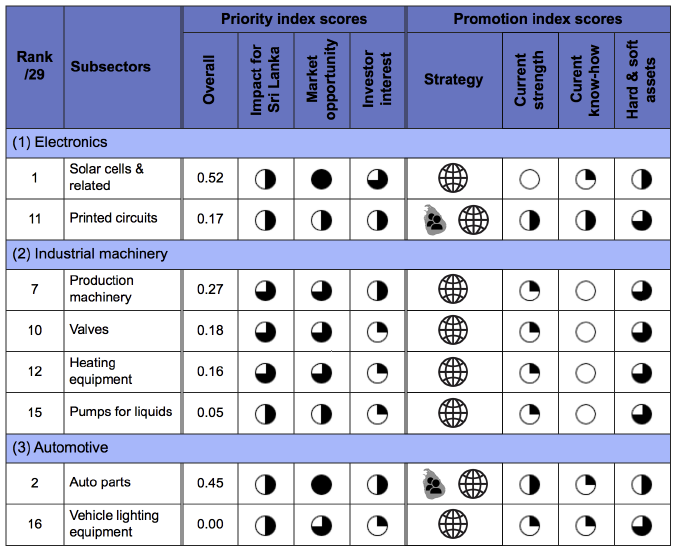
The team immediately took to studying the top sectors. Mrs.Ganga was an active member of a team which acted on requirements of the action plan. Out of the identified sectors, “Electronics”, suggested “solar panels” as the highest scoring sub-sector with the highest potential of attracting a foreign investor (see figure 5).
The team identified the solar panels sector as a target sector, it was actively explored as an option by the Investor Engagement Team (I-Team). The I-Team was set up to specifically study the potential of solar panel manufacturing and other promising sectors, create pitch books, and promote the potential of the sectors to foreign investors. The team immersed themselves in practical study methods including, site visits and meeting with potential/past investors to understand the exact process through which an investor could be convinced and supported to launch a solar manufacturing initiative in SL through an FDI.
3. Reforming outdated policies The implementation team discovered a significant number of challenges when navigating policies which governed the process of facilitating FDI and so the BOI attempted to advocate for new policies which accommodated interests of the investor and the government. Coordination with the top levels of the government helped the team secure approvals to change policies.
4. Securing investment for the “Solar panel” sector. Investor confidence was increased as a result of such efforts. The team was ultimately responded to by one of the largest solar manufacturers in the world. Negotiations are currently underway for an FDI with this – a reward for months of dedication.
The investment was secured as a result of the team investing 6 months to study the sector. The pitch books created through the process proved to be a success.
The success of pitch books has encouraged the government to train 40 officials (from BOI and EDB) to be specialists in 10 more sectors, in hopes of finding the same success enjoyed by the I-Team in securing a much needed FDI for the country. The pitch books will be distributed to Sri Lankan Embassies and multinational companies who could potentially invest in Sri Lanka.
5. Ensuring oversight of a Coordinating Committees A common challenge in the government structure is the existence of multiple ministries and line-agencies whose functions overlap each other. When coordinating with these agencies, 36 line agencies were identified in the process of approving all grants needed to secure an FDI for the solar sector with each line agency needing up to 12 approvals. The process is a constraint which discourages interested investors. The T-Team addressed the clear need for a coordinating committee to overlook and administer the approvals process by facilitating the formation of a committee to coordinate line agencies, in January this year.
“The study shows the need for exports and investments to be a national endeavour with multiple stakeholders in different tiers of investor promotion” – Mrs. Champika Malalgoda
6. Informing Sri Lanka’s National Export Strategy Mrs Malalgoda shared that the prioritization of sectors suggested in the report was used to support the formulation of the recently launched National Export Strategy (NES) of the EDB. The integration of research into initiatives across the government is an example of knowledge sharing across institutions.
7. Facilitating the launch of new industrial zones in SL for the first time in 15 years The BOI even addressed crucial bottlenecks in FDI promotion, especially the availability of land for industrial zones. Mrs Priyanka Samaraweera was part of the land team which set out to understand the issues around the lack of suitable land for new manufacturing plants. The following success story of the land team was shared as one of the most rewarding results of the T-Team report.
“Access to land for new ventures is considered a bottleneck in the process of securing investor confidence. More than 80% of land in the country is owned by the government, and the government’s export processing zones are for the most part fully occupied; as a result, interested investors often turn away due to the lack of suitable industrial locations. To further understand the land constraints, an L-Team (land team), engaged in a research exercise. They compiled a comprehensive database on potential plots of land which could be used as Industrial zones. The team conducted a land analysis and matched the available facilities in vacant plots of land, to the specifications required by an investor of a targeted sector, with the preliminary analysis assessing over 80 plots of land.
It was interesting to note that when ideal requirements for an industrial zone were assessed, the newly identified lands offered conditions comparable to the BOI’s existing zones such as in Katunayke and Biyagama. Finally, 25 lands were identified as potential industrial zones” – Mrs. Priyanka Samaraweera
Three lands have now been identified by the government to be developed into industrial zones, including Mawathagama, Bingiriya and Milleniya, an initiative by the government for the first time in over 15 years. This is one of the most impactful results of the study. This progress is a direct result of the BOI-CID study. Coordination toward establishing a new industrial zone improved through the identification of new sectors through the study.
Will this impact continue to multiply? Mrs. Malalgoda believes the study will go on to inform a policy framework which will support new zones. The policy will be designed to maximize the output and facilitate efficient administration of each zone.
“The final outcome is a rich resource in which any potential investor, researcher, or another interested party can obtain over sixty data points on any sector, as well as aggregated index scores for six major factors. We also hope that by providing access to this research, it may serve as a model for other economic development institutions as well.” – Mrs. Champika Malalgoda
A number of institutions supported the hard-working team at the BOI including the Department of Census and Statics and the Department of Customs who provided in-depth, high-quality data to support the research initiative. The report informed many stakeholders who work towards a common goal of reviving the Sri Lankan economy. We look forward to visiting this team again in a year or so, to hear more stories of the impact of the T-Team report.
“I have realized why by observing this team in Sri Lanka: they are more committed to the work than any outside consultant I have ever seen (because it is their country, and the result of today’s diversification efforts will have a huge impact on the team members’ children) and bring vital contextual know- how to the job better than any outside consultant” – Matt Andrews, Senior Lecturer in International Development, Harvard Kennedy School Faculty Associate, Harvard Center for International Development
Re-visiting the “Sector Targeting” study: Why BOI and EDB opted for sector targeting
Author: Neluni Tillekeratne, Sri Lanka Project Officer
It has now been 9 years since Sri Lanka’s three-decade-long civil conflict came to an end. In the period following the end of violence, Sri Lanka saw a surge in economic growth, due in part to increased investment in infrastructure. However, this surge was not sustained, and the economy’s growth rate has slid back to moderate levels. As described in a recent lecture by Professor Ricardo Hausmann, Sri Lanka’s growth is ultimately limited by a few factors, especially due to insufficient export diversification and lack of FDI.
Given the need for a new approach to attracting FDI’s and maximizing the potential of export earnings, the Sri Lankan government has been exploring new strategies to make informed decisions on how best the goals of investment attraction, promotion and export diversification, could be achieved.
The Board of Investment (BOI) and the Export Development Board (EDB) are two key government institutions in this regard. These two institutions, with support from the Center for International Development at Harvard University (CID), tried and tested “Sector Targeting” as a new approach to addressing the above-mentioned challenges. The initial research report was compiled with support from CID’s Building State Capability program.
The approach has been tried, tested and proven effective, based on findings over a period of two years. The following post will look at the Sector Targeting Program and its impact.
Part 1: Why BOI and EDB opted for sector targeting
What is “Sector Targeting” and why target? Sector targeting is the act of governments pro-actively studying market opportunities, determining a short list of sectors which could be accommodated through existing public infrastructure and approaching potential investors. The “targeting exercise” allows government officials to be well-informed of a sector and approach interested investors by making an initial correspondence. This method of attracting FDI is in contrast to the more traditional approach of responding to interested investors who initiate correspondence with the government.
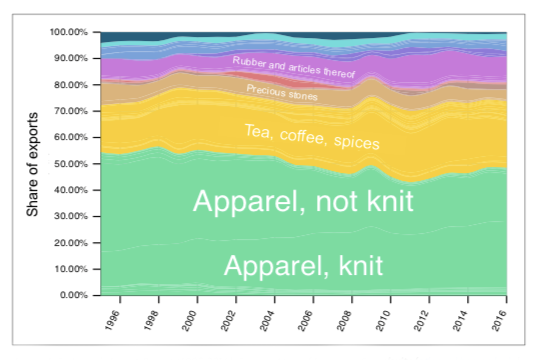
Despite being a pioneer in adopting open economic policies as early as 1978, Sri Lanka’s foreign direct investment (FDI) inflows have been insignificant over the last 3 decades. Unsatisfactory performance in attracting export-oriented FDI has a direct bearing on a country’s export performance, resulting in a small basket of primary exports for over two decades, which is stagnating or in a declining phase. In fact, it can be noted that more than 60% of the total merchandise exports of Sri Lanka has been generated by three major product categories, namely Apparel and Textiles, Tea, and Rubber. (Excerpt from the report: Targeting Sectors for Investment and Export Promotion in Sri Lanka)
The current strategy for investment promotion in Sri Lanka is to focus on improving incentives for investors. Despite decades of attempts at perfecting this approach, Sri Lanka was not attracting a competitive number of FDI’s compared to peer countries in the region. Recent reviews of these incentives revealed that a fundamental issue is the lack of a valid scientific basis upon which sectors were identified to be promoted to investors, with ad-hoc criteria being used. The approach was not “targeted” in terms of identifying competitive sectors through evidence-based research. Sri Lanka does not match up to the FDI’s attracted by countries who used a targeted approach in promoting investments. Considering the downward trend of FDI attraction, the BOI used the opportunity of collaborating with Harvard University to deduce a sector targeting strategy for GOSL.
Report on “Targeting sectors for Investment and Export Promotion in Sri Lanka” by the “Sector Targeting Team” The report was compiled as a joint effort by 20 officials from the BOI and EDB who formed a “Sector Targeting Team” (T-Team). The team assessed 30 sectors – all tradable activities (goods and services) of the private sector – and finally ranked their top sectors for export promotion and strategies for promoting them.
The conceptual framework followed to compile the research was an iterative process as seen in the diagram below (Figure 2). The team began by determining targeting criteria of sectors. Once the criteria were determined, data collection and analysis along multiple tiers led to two outcomes a) determining sectors that should be a priority when approaching investors and b) promotional strategies for these sectors.
Figure 2: Conceptual framework of study (source: Targeting Sectors for Investment and Export Promotion in Sri Lanka)
Taking a closer look at the study methodology The Targeting Team first developed three key indices to determine the top sectors which should be prioritized for more in-depth analysis. The indices were
Market opportunity
Investor interest
Impact to the economy
An overview of the indices and sub-indices used in this initial assessment is seen in the diagram below (Figure 3).
Figure 3: Template used for evaluating sectors (source: Targeting Sectors for Investment and Export Promotion in Sri Lanka)
Each of these key indices was composed of multiple subindices (Figure 3), which in turn were composed of quantitative variables from various datasets. The following image (Figure 4) is an example of variables used to assess one such indicator, the Impact for Sri Lankan Economy index. This index measures job creation, job quality potential, potential beyond western province and new linkages potential. Each such sub-indices looked at multiple variables eg: Job quality potential was measured using five variables; average wage (comparing Sri Lanka, Peer Countries and USA), Youth Employment and Female Employment.
Figure 4: Variables used to build the “Impact for Sri Lankan Economy” index (source: Targeting Sectors for Investment and Export Promotion in Sri Lanka)
The analysis led to identifying 6 high-potential sectors with 16 subsectors. Once these top sectors were identified, the sectors were further assessed to identify an appropriate promotional strategy for each, by considering:
current strengths of Sri Lanka,
sectors’ feasibility (based on the country’s current knowhow),
availability of needed hard and soft assets.
Results: Sector rankings and promotional strategies The top sectors, with their respective promotion strategies, are shown in Figure 5. Based on their capacity to offer benefits to the economy, six sectors (and 16 subsectors) were identified as priority sectors for promotion: electronics, industrial machinery, automotive, tourism (not shown), electrical equipment, and fabricated metal products. For each of these, promotional strategies were deduced as follows: 1. Attracting FDI: priority sectors that could benefit from new knowhow from abroad; 2. Promoting exports: priority sectors with established and emerging exporters to support.
Figure 5: Index scores of top priority subsectors (source: Targeting Sectors for Investment and Export Promotion in Sri Lanka).
Problem Driven Iterative Adaptation (PDIA) CID used the PDIA technique to facilitate the government to take ownership of research studies by ensuring that government officials lead their research. This sense of ownership was to ensure that the research is navigated to serve a specific research question of the government while building government capacity on trade-related research.
The PDIA process In Sri Lanka, the Prime Minister had asked the BOI, EDB and the Sri Lanka Tourism Development Authority to focus their efforts on increasing investment and exports. The team worked with experts from Harvard Center for International Development (CID) through a Problem Driven Iterative Adaptation (PDIA) program (Andrews, Pritchett and Woolcock, 2013) lasting for six months, from August 2016 to January 2017. The PDIA process consists of few steps, starting with identifying problems that team members wish to solve, and deciding what are the initial actions to be taken to solve it. For this purpose, those agencies convened seven teams of officers (including the Targeting Team). Each team was given a task – such as developing a targeting mechanism – but was allowed to choose its own solutions. At weekly meetings, each team discussed their progress towards solving the problem, and what additional steps were needed in the next weeks. These teams were meant to be temporary, bound to specific problems: after six-month increments, each team decided whether to continue their work, or to switch to a different task, or to dissolve. (source: “Targeting Sectors for Investment and Export Promotion in Sri Lanka”)
A 2017 report detailing the complete PDIA methodology and results is published here.
Agritourism in Albania: Trends, Constraints, and Recommendations
Albania is currently enjoying strong growth in both its agriculture and tourism sectors, but there is significant space for the acceleration of growth and job creation in both areas.
CID intern and Harvard Kennedy School student, Neetisha Besra, spent several months exploring recent developments in Albania at the intersection of these two sectors: agritourism. This exploration included working across numerous departments that are aiming to support the agritourism industry in Albania, traveling across the country to assess a range of emerging business cases, and traveling to both Italy and Greece to benchmark emerging trends in Albania against the development of mature agritourism industries in these two countries.This summary report details agritourism trends in Albania and assesses the main constraints to more rapid and sustainable development of the industry. The report concludes with several specific recommendations for how Albania can capitalize on its potential through culinary tourism, the emergence of farm stays, and improvement in its broader tourism and agriculture ecosystems.


 Investments are considered a main source of sustainable growth, yet developing countries often lack the management capacity and knowhow to develop their assets. This is where structures such as investment agencies, granted that they are set up properly, can be instrumental in realizing investment potential. Over the summer, Damian worked with the government to lay the groundwork for the development of an
  Setting up systems for continuity is important and helps address many of the issues associated with short-term engagement. To accommodate the academic schedule, the Growth Lab internship lasts for eight to ten weeks and create a wide range of challenges including condensed time to get to know systems and stakeholders and limited influence on policies after the internships end. In this context, good policy in practice means laying the groundwork for environments that are conducive to implementation of policies and creating systems and records to ensure that knowledge is not lost once engagement ends. This is true not only for internships and short-term engagements but for government offices as well.