
Working with the Sri Lankan Tourism Development Authority to Develop Resources for Creating and Analyzing Tourism Policy
Author: Ceylan Oymak, HKS MPP Student
Sri Lanka tends to conjure up a range of ideas by would-be tourists: its deeply intriguing history and relation to colonial powers, a 26-year civil-war with the Tamil Tigers, or, more simply, the paradisiac beaches, beautiful landscape, warmth of the people and the rich cuisine. I believe each of these things contribute differently to Sri Lanka becoming one of world’s top tourist destinations in the past few years.
High demand among foreigners to visit Sri Lanka surely presents wide opportunities for the country’s growing economy, while also revealing certain constraints for further development. Tourism is the third largest source of foreign currency into the Sri Lankan economy. However, the industry still does not live up to its full potential when compared with other countries offering similar experiences. Currently, the Sri Lanka Tourism Development Authority (SLTDA) is working with donor organizations, external consultants and development specialists to achieve a set goals laid out in the 2020 Strategic Tourism Plan, in order for Sri Lankan tourism to overcome the existing barriers to growth.
The overarching aims of SLTDA included in the Strategic Plan are 1) Increasing coordination in tourism between public and private sector organizations, 2) Improving the tourist experience and moving away from being known as a ‘cheap’ tourist destination, and 3) Expanding the technical capacity to gather and analyze data in order to better understand tourists’ preferences and patterns as they navigate the country and accurately quantify the contributions of tourism the overall economy.
I felt very lucky to be working at SLTDA for 10 weeks during the summer of 2018, where projects and proposals falling under these overarching goals were being drafted or implemented in a strict timeline in order to fulfill the plan set out for 2020. The most valuable part of my experience of working with SLTDA was that it captured different aspects of the ongoing work as I spent some time working with different people who come from various backgrounds, with different interests.
During the first two weeks, I was involved in the negotiations procedure for a large loan they are expecting to receive by next year for investing in tourism-related infrastructure and skill development in the hospitality sector. The loan will be invested in projects at the provincial level according to the needs and capacities of each of the province(s) the donor organization chooses (Note: Sri Lanka is divided into nine provinces where each province is represented by a local administrative government). These two weeks allowed me to gain exposure to the work needed to done on the ‘receiving end’ of a donor loan. Furthermore, as I attended the presentations of regional councils who are in a way competing for the loans, it further exposed me to the natural and cultural diversity of Sri Lanka and the variety of experiences it can offer to foreigners.
Another ongoing area of work was to review and edit the SLTDA Statistical Reports – which are geared towards policy-makers and other entities, both public and private sector who are involved in the tourism industry. These annual reports are designed to provide key information to various stakeholders on tourists’ experiences in Sri Lanka, including the demographic of tourists, travel patterns and how they prefer to spend money. The data presented in these reports is based on the Airport Departure Survey and Immigration Services. These reports gave me a strong idea of which indicators are most valuable to make policy-relevant decisions in the tourism sector, including how to provide incentives to the private sector while balancing environmental considerations. At the same time, it revealed that SLTDA could further enhance its data capacity and become more equipped to gather data from different resources.
Finally, most of my weeks were spent on developing measures for how to quantify the economic contributions of tourism. Under this question, I mainly focused on employment generated by the tourism sector. While we can’t be completely certain, our preliminary work suggested that tourism-based employment directly affects 5% of total employment in Sri Lanka. In order to model how many jobs are available in the tourism sector, I relied heavily on the practices and systems used in other developing and developed countries. As I delved more into this work, again I realized that the main challenge was the scarcity of data and lack of coordination between SLTDA and other public-sector entities that can collect relevant data on behalf of SLTDA. For example, a common practice in countries with comprehensive tax record systems is to rely on administrative data to gather information on businesses that provide tourism as well as household and business surveys to measure employment. Then, further technical expertise is used to integrate these different data sources in order to arrive at a consistent measure for employment. However, in Sri Lanka, there were two main obstacles: widespread informality in the sector and the lack of a coordinated and consistent way of collecting data at both the household and establishment level. Thus, we spent time in looking at data sources from other government entities that SLTDA can rely on and how to increase coordination with such government branches. The overall aim is to build a Tourism Satellite Account, a mechanism adopted throughout the world by both developed and developing countries that provides standardized methods to measure tourism’s contributions to the national income and employment.
Once immersed in the tourism sector from a policy perspective, it is obvious how valuable it can be for a country’s social and economic development and the scale of investment required from various stakeholders in order to fulfill this potential. Furthermore, it becomes apparent that the process of designing tourism-related policies can also provide tremendous insight to other sectors and industries facing development constraints. In general terms, a sustainable tourism policy will be characterized by strong collaboration between the private and public sectors, environmental protection measures for the majority of tourism-related investments, and investment in skill development. The knowhow required for a successful tourism policy, which allows both the tourism economy and the overall economy to thrive while protecting natural assets and vulnerable households, can be a valuable tool for any country that is aiming to reap benefits from the development path that the Sri Lankan government has set for the country.
Overall, Sri Lanka’s tourism sector is moving in a positive direction. The 2020 Strategic Plan is dedicated to improve the touristic experience Sri Lanka currently has to offer- there are projects to expand the road accessibility of certain key destinations, develop accommodation options that are limited in areas that receive high numbers of tourists (for example, Anuradhapura, a UNESCO World Heritage Site but mostly offers homestay or small hotels as options for accommodation) or increase the number of trained guides offering cultural or wildlife tours. One of the main goals behind improving and facilitating how tourists experience the country is to rebrand Sri Lankan tourism and move away from the common perception that Sri Lanka is a low-cost destination for foreigners. Furthermore, the country’s recent political and economic improvements are playing a positive role in attracting donor organizations and foreign investors, introducing further growth opportunities for sectors with large contributions to the overall economy. At the same time, the main challenges faced by the Tourism Development Authority are institutional problems which do not only concern tourism. The government branches need to collaborate in a systematic manner to make use of available administrative and census data to make evidence-driven decisions. The coordination between public and private sector organizations could also be improved to design policies that will improve the quality of services offered by both parties and ensure private sector development in a sustainable manner.
Finally, in order for Sri Lankan citizens to benefit from the promising future of tourism, the government should promote employment and careers in the industry and collaborate with the private sector on workforce development by improving the policies and regulations on diversity, compensation and labor conditions. The government strategy should be to increase the attractability of tourism-based employment for underrepresented groups and maintain a motivated, engaged workforce, which in return will inevitably improve the quality of establishments providing services to tourists.
INTERVIEW: Keeping Government Priorities on Track
 nment priorities as approved by the current government, under the leadership of Prime Minister Rama.
 Does the Sri Lankan Economy Need More University Graduates?
By Ljubica Nedelkoska, Tim O’Brien and Daniel Stock
Download PDF | Listed to the podcast interview
SUMMARY OF FINDINGS
Sri Lanka has exceptionally low rates of tertiary education admission and graduation for its level of economic development. Many have identified this as a roadblock to Sri Lanka’s economic competitiveness. Using six years of Sri Lanka’s Labor Force Survey, we study the evidence of shortages of tertiary educated workers. Our analysis casts doubt on the existence of a general shortage of university graduates in spite of the low university admission and graduation rates. We find that the majority (77%) of university graduates are employed by the public sector (government and semi-government), where they enjoy job security and other benefits but earn wages that are only a fraction of what is paid in the private sector. On average, college graduates in the private sector earn 1.6 times higher wages than college graduates in the public sector. Moreover, the wages of college graduates in the public sector are only between a quarter and a third higher than those of A-level graduates in the same sector. A minority (23%) of college graduates are employed by the private sector, where they earn significantly more than those with only A-levels – 66% in the case of men and 128% more in the case of women. These very high wage premiums in the private sector, combined with very low unemployment rates of college graduates, suggest shortages of particular types of tertiary education. This seems to be the case with ICT professionals and ICT technicians, business professionals, science and engineering professionals, and various managerial occupations. This suggests that education policy should focus on addressing the shortages in these areas, as opposed to expanding tertiary education more generally. A general expansion of higher education without a focus on these fields could actually further lower the already low returns to a tertiary degree in the public sector, without addressing any issues of Sri Lanka’s economic competitiveness.
BACKGROUND
Sri Lanka’s gross enrollment ratio (GER) in tertiary education reached close to 20% in 2015, placing it among the lowest rates of all middle-income countries. The average GER among middle-income countries is 33%, and all countries in the region, including India and Indonesia, have significantly higher tertiary education enrollment rates than Sri Lanka. This has led many to believe that Sri Lanka has too few individuals with tertiary education. In its flagship publication “Sri Lanka: State of the Economy 2017,” researchers at the Institute of Policy Studies in Sri Lanka identified skill gaps in the educational system as one of the key roadblocks towards higher competitiveness of the Sri Lankan economy. The report reads: “As of 2014, only 5 percent of 20-24-year olds were enrolled in a university, while another 8 percent were enrolled in other educational institutions and only 3 percent of the same age group were enrolled in technical education and vocational training (TVET) courses.” It goes on to explain that the main reasons for these low enrollment rates are capacity constraints of the state university system together with the low level of development of private sector education and the TVET system. In the same vein, the Government of Sri Lanka agrees that “education and skills development are currently inadequate to sustain growth through knowledge-based, competitive economic activities” and plans to increase access to secondary and tertiary education (Vision 2025).
While education serves various important roles such as intellectual enrichment, social mobility and social status, the primary purpose of education from an economic perspective is to make us more productive on the labor market. Most economists believe that the positive returns to education (i.e., the wage premium associated with an extra year of education keeping other factors constant) observed worldwide suggest that education helps companies become more productive and, in return, these companies are willing to pay higher wages for better-educated employees.
If too few university graduates is a key constraint to higher competitiveness of the economy of Sri Lanka, we would expect to see companies in the private sector fiercely competing for those few new graduates that emerge each year from Sri Lanka’s higher education institutions. As a result of this competition, we would expect the unemployment rates of university graduates to be low, and the wage premium they are paid to be high. These two characteristics would together give a clear signal that Sri Lanka is facing shortages of tertiary education graduates.
ARE SRI LANKAN UNIVERSITY GRADUATES EASILY FINDING JOBS?
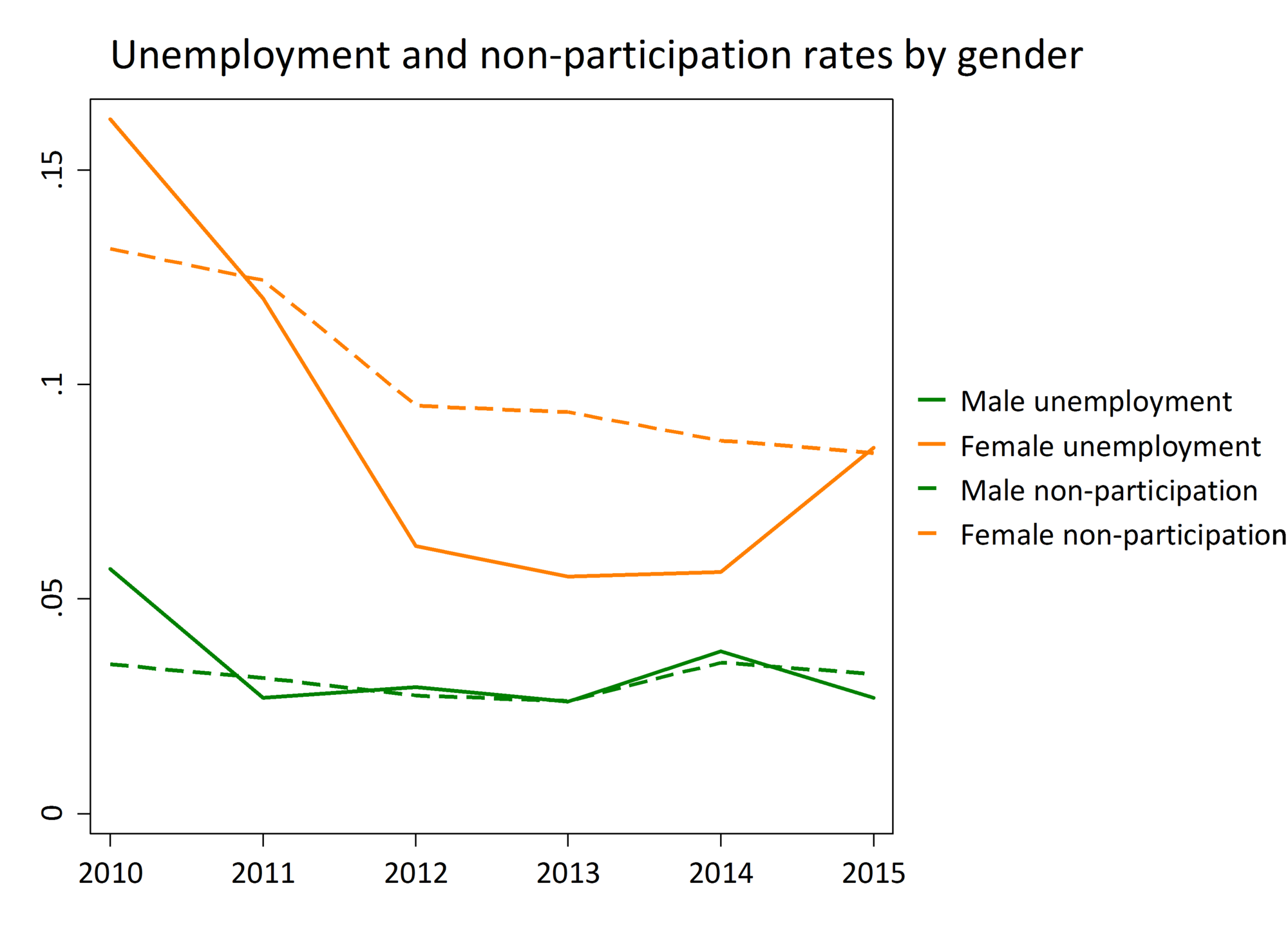
The average annual rate of net university graduates inflows into the labor market between 2011 and 2015 based on Labor Force Survey (LFS) data was around 23,000. On the aggregate, there were about as many net new jobs created for these graduates over the same time period, suggesting a very high job placement rate. As a result, the employment rates for highly educated men remained very high (about 94%), while those of highly educated women even increased, from 73% in 2010 to 84% in 2015 (Figure 1). These aggregate patterns indeed suggest that the labor market of university graduates is tight.
Figure 1: Unemployment and non-participation rates of university graduates and postgraduates by gender
Source: Labor Force Survey (LFS) Sri Lanka 2010-2015. Note: Includes 15-65 year olds, all higher education levels and institutions.
DO UNIVERSITY GRADUATES RECEIVE HIGH WAGE PREMIUMS AT THE JOB?
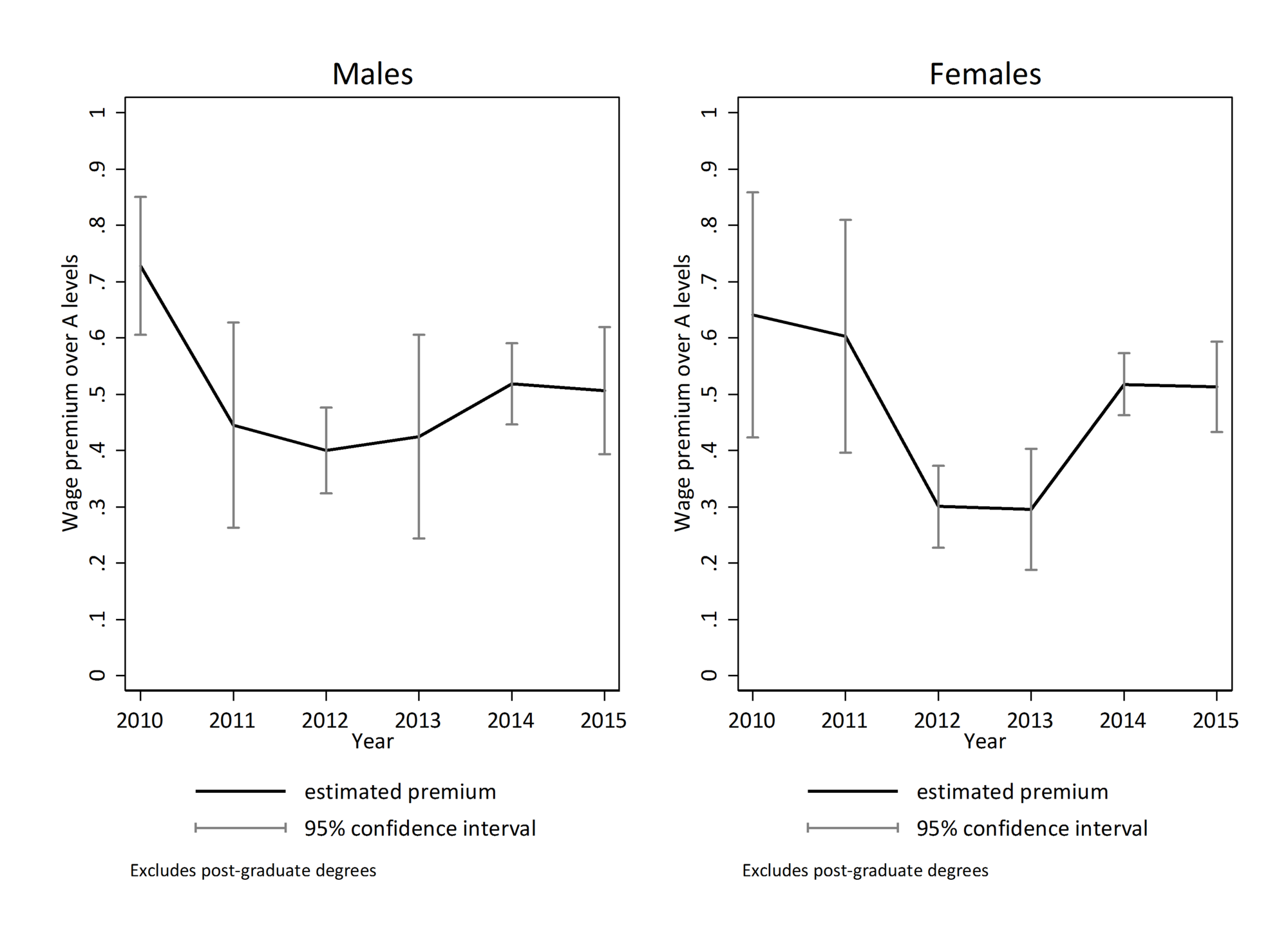
As a reference, a college graduate in OECD countries, where the supply of tertiary educated is significantly higher than in Sri Lanka, earns about 57% more than a counterpart with no more than a high school education. The United States has earnings premium on the high end at 77%. In Sri Lanka, across all sectors, the premium to tertiary education over A-levels was 51% in 2015 (Figure 2), which is decent, but below the OECD average. Given the low supply and high rate of employment of university graduates, one would expect to see higher wage premiums. This leaves us somewhat puzzled: why should a country with drastically lower supply of university graduates than OECD countries have lower than average returns to tertiary education? Such pattern could indicate that the education obtained through the university system is not particularly valuable to the employers. The average premium could also disguise important differences in the returns to a tertiary degree among different groups of graduates. We think that the group distinction that will help us best explain the above patterns is the one between university graduates who opt to work in the public sector and those who opt to work in the private sector.
Figure 2: Premium of a college degree over A-levels
Source: Labor Force Survey (LFS) Sri Lanka 2010-2015
Note: Includes 15-65 year olds. To keep the group of college graduates homogenous, the premium is estimated for those with Bachelor’s degrees only, i.e., we exclude those with post-graduate degrees. Each estimate is the coefficient of a dummy variable indicating whether a person completed a Bachelor’s degree from a Mincer regression that controls for potential work experience and labor market entry cohort effects. Separate regressions were run for each year and gender combination. The reference educational category is those with completed A levels. The dependent variable is the log of the real hourly wage.
In 2015, the private sector only employed 23% of all university graduates, while the government and the semi-government sector employed the other 77%. This casts a doubt on the claim that the private sector is hungry for university graduates in general. The patterns of premiums to a college degree by sector introduce another layer of complexity to the story. The premium is low in the public sector, where college-educated men earned a 36% premium over A-levels and college-educated women earned a 25% premium over A-levels in 2015. Whereas in the private sector, college-educated men earned a 66% premium over A-levels and college-educated women earned a whopping 128% premium (Figure 3). A further comparison of the university graduates in the public versus the private sector shows that a male university graduate, on average, earned 1.5 times more per month in the private sector than in the public sector, while a female university graduate, on average, earned 1.7 times more.
Figure 3: Premiums to tertiary education by sector and gender

Source: Labor Force Survey (LFS) Sri Lanka 2010-2015.
Note: Includes 15-65 year olds. To keep the group of college graduates homogenous, the premium is estimated for those with Bachelor’s degrees only, i.e., we exclude those with post-graduate degrees. Each estimate is the coefficient of a dummy variable indicating whether a person completed college education from a Mincer regression that controls for potential work experience and labor market entry cohort effects. Separate regressions were run for each year, sector and gender combination. The reference educational category is those with completed A levels. The dependent variable is the log of the real hourly wage.
WHY IS THE PRIVATE SECTOR EMPLYING FEW UNIVERSITY GRADUATES BUT PAYING SIGNIFICANT PREMIUMS, WHILE THE PUBLIC SECTOR IS EMPLOYING MANY BUT PAYING LOW PREMIUMS?
Why don’t more university graduates go to the private sector where wages are high, and capture some of these earnings differences? There can be different reasons for this, but here we will focus on one very important reason. The types of university graduates that the private sector needs are quite specific. They are different from those employed by the public sector and different from the majority of graduates produced by the university system. The most common professions for university graduates in the private sector are: managers and production managers (25%), science and engineering professionals (14%), business administration associate professionals (10%), teaching professionals (9%), business and administration professionals (6%), ICT professionals (5%) and science and engineering technicians (5%). The most common professions for university graduates in the public sector are: teaching professionals (45%), business administration associate professionals (18%), clerks (8%), and health professionals (8%) (Figure 4).
Figure 4: Occupational composition of university graduates by sector

Source: Labor Force Survey (LFS) Sri Lanka 2010-2015.
Note: Includes 15-65 year olds. The estimated shares are averages over 6 years. Sorted by share of employees in the private sector. Includes the 17 (out of 38) largest occupations in the private sector. All excluded occupations contribute less than 1% of employment in both the private and the public sector.
WHICH PROFESSIONS ARE MOST LIKELY IN SHORT SUPPLY?
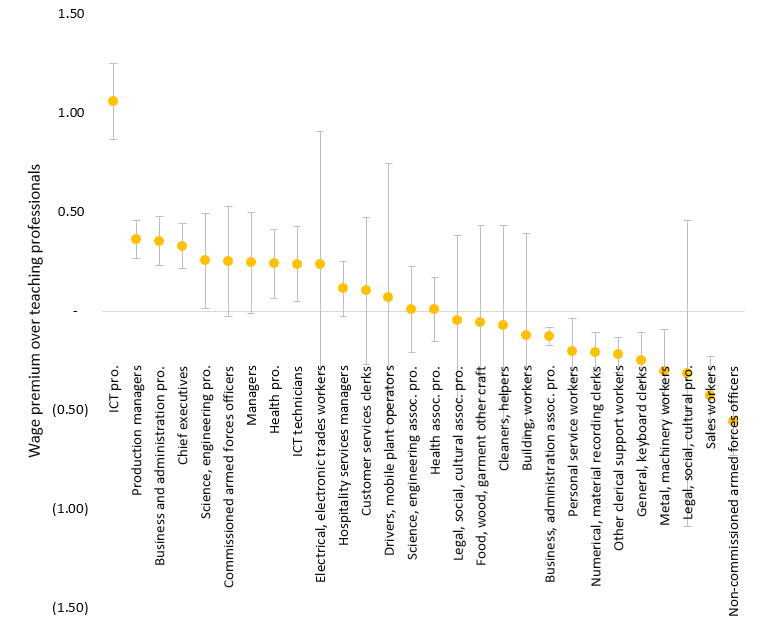
We compare the hourly wages of university graduates in various occupations, regardless of whether public or private sector, to the hourly wages of the teaching professionals (the largest group among university graduates). We control for the level of labor market experience, gender, cohort effects, and for whether one has a post-graduate degree, to ensure that we compare the wages of individuals that are otherwise similar. ICT professionals earn 106% more than teaching professionals; production managers and chief executives earn 33-35% more; engineers earn 25% more; and health professionals and ICT technicians earn 24% more than teaching professionals (Figure 5). Having a post-graduate degree is associated with additional 20% premium. As anticipated, most of the professions with higher returns than the teaching profession are typically employed in the private sector. By paying wages significantly higher than the ones of the typical employee with tertiary education, the private sector is signaling that they need these specific professions and that they may have hard time finding such candidates in the Sri Lankan labor market. In other words, these are the professions/educational fields where an expansion of the tertiary education could most likely help relax a skill shortage constraint. Outside these professions, we find little evidence of educational shortages at the tertiary level.
Figure 5: Occupational premiums among university graduates
Source: Labor Force Survey (LFS) Sri Lanka 2010-2015.
Note: Includes 15-65 year olds, all sectors, tertiary graduates only. Results from a Mincer-like equation, but with occupational dummies instead of education. Controls include potential labor market experience and its square term, labor market cohort dummies, a gender dummy and a dummy for having a post-graduate degree. The whiskers correspond to the 95% confidence intervals. The dependent variable is the log of the real hourly wage.
CONCLUSIONS AND POLICY DISCUSSION
Using data from the Labor Force Survey of Sri Lanka (2010-2015), we study the claim that skill gaps resulting from the restrictive tertiary education system of Sri Lanka present a serious challenge to the economic competitiveness of Sri Lanka. Theoretically, skill gaps can restrain companies’ choice of employees, both in terms of numbers and quality. There are two straightforward tests that we perform in order to see whether such skill gaps exist. First, we check if college graduates have an easy time finding jobs in Sri Lanka, and second, we measure the returns to their college degrees. We expect that employment rates are high and returns to education are high for degrees that are in short supply. We find that this is the case only with a subset of occupations/educational fields at the university level: ICT professionals and technicians, managers and executives, business and administration professionals, science and engineering professionals, and health professionals. The majority of these are employed in the private sector where, the returns to a college degree are high. However, the private sector only employs 23% of all university graduates, while the public sector (government and semi-government) employ the other 77%. The public sector pays 40% less than the private sector wages paid to university graduates on average. Unless the public sector vastly compensates for this wage differential with more generous fringe benefits and higher job security, we have to conclude that we only find evidence for skill gaps in a fraction of Sri Lanka’s college majors listed above.
The Vision 2025 of the Government of Sri Lanka (GoSL) envisages an expansion of the tertiary education system. Our findings inform that, when doing so, GoSL should focus on the expansion of particular college majors, and not on the general expansion of the higher education system. Increasing the access to ICT, managerial, engineering, business and healthcare professions in particular would benefit the Sri Lankan economy as it will expand the companies’ choice of workers and enable them to grow faster that they can do now.
A question to explore further is whether the scope of this expansion should go beyond the system of higher education, and include the system of vocational training and secondary education. Previous research (Dundar et al. 2017) has shown that the capacity of science and engineering education at the tertiary level is restricted by the low capacity of the secondary education to equip the students with the basics of science, meaning that the expansion of tertiary education in these fields will need to be accompanied by expansion of science education at the secondary level. Moreover, Sri Lanka has a well-developed system of vocational training and it is worthwhile exploring whether the TVET could partially help bridge some of these gaps with strong participation of the private sector that is facing the skill shortages.
Finally, like most developing economies, Sri Lanka faces significant brain drain. Sri Lanka is a net exporter of many professions including engineers and engineering technicians (Growth Lab at CID 2018). Although Sri Lanka pays high wages for engineers relative to other professions in the country, Sri Lanka does not pay internationally competitive wages for their professionals. The salary of a mid-level engineer in Colombo for instance was among the lowest in Asia and Oceania in 2012 (JETRO 2013) – about half of what a mid-level engineer is paid in Beijing and only 16% of what the equivalent engineer is paid in Singapore. However, Sri Lanka does not have a choice but to further expand the supply of shortage professions. Only a supply push can help the existing industry expand and potentially attract further capital investments, including foreign investments in Sri Lanka.
My Summer Internship with the Central Bank of Sri Lanka
Author: Haiyang Zhang, HKS MPA/ID student
In a poetic reference, Sri Lanka is often described as “a teardrop of the Indian Ocean.” The island country is endowed with some of the world’s most scenic landscapes, a diverse culture, and a documented history that spans across three millennia. For a country that recently emerged from a 26-year-long civil war, Sri Lanka faces the challenge for transforming its short-lived “peace dividend” into sustainable growth.
Following the end of the civil war in 2009 and the presidential election in 2015, Sri Lanka has made impressive progress in social and economic development. The country has seen poverty reduction in large parts of its geography. The government has made commendable efforts towards health and education delivery, as measured by life expectancy and adult literacy, respectively.
Meanwhile, the challenge for Sri Lanka is to sustain, and potentially accelerate, the current economic growth and to reduce its vulnerability to macroeconomic shocks that could potentially threaten the hard-won progress in social and economic development.
Both its achievements and challenges are reckoned by the Millennium Challenge Corporation (MCC), an independent U.S. foreign aid agency. At the end of 2016, MCC selected Sri Lanka as an eligible country for the assistance program, after the country had met the standards on 13 of the 20 policy indicators on MCC’s comprehensive scorecard. MCC made a special note on the improvement of democratic rights and the control of corruption, restoring Sri Lanka’s image as one of the oldest democracies in Asia. Since the first Parliament of Sri Lanka (then Ceylon) was elected and formed in 1947, the democratic institutions have been functioning in the island for over 70 years.
In the summer of 2017, through the Center for International Development at Harvard University, I had the opportunity to work in the Central Bank of Sri Lanka in Colombo.
The Central Bank of Sri Lanka, by law, is the advisor to the Government of Sri Lanka on economic affairs. During my time with the Central Bank, I had the opportunity to work on some most interesting assignments that are relevant to addressing the binding constraints to Sri Lanka’s long-term growth.
The complexity and uncertainty around tax policies have been a major impediment for Sri Lanka’s long-term economic growth. At the Central Bank, I took part in the discussion of an early draft of the proposed Inland Revenue Act, which would establish a broad-based tax system that also simplifies tax liabilities for foreign investors. The Act aims to create an investor friendly environment to attract more foreign investments. It is exciting to learn that the Act was adopted by the Parliament soon after my departure.
Transportation is a second bottleneck for sustainable economic growth. Sri Lanka faces the dual problem of congestion in cities and a lack of transportation infrastructure between many regions of the country. While the Western Province, where the capital is located, suffers traffic congestion, the rest of the country experiences the slow movement of people, goods and services. Interestingly, Sri Lanka has a high density of roads, compared to countries at a similar stage of development. But the lack of expressways and logistics centers prevents Sri Lanka’s exporting firms from accessing rapid and temperature-controlled transportation that is necessary for the transport of products like fish and perishable fruits. At the Central Bank, I was tasked to identify locations for planting cold chain logistics to facilitate exports from inland regions of Sri Lanka. It was a rewarding experience to take up important responsibility and contribute to solving a binding constraint.
A lack of access to state-owned land by private firms is yet another obstacle to accelerate economic growth. Multiple Export Processing Zones (EPZs) are set up to house manufacturing firms, but these zones are mostly at capacity in the Western Province, which accounts for 42 percent of the country’s GDP. Outside the EPZs, however, there exists a classic coordination failure where multiple government agencies share jurisdictions over the state-owned land. Land transactions are often costly and opaque. Thus, the lack of access to land becomes a binding constraint for private firms to invest and formalize. While in Sri Lanka, I had the opportunity to not only interact with policy experts on land issues, but also observe firsthand the inefficiencies in land markets that hinder the formalization of private firms outside the EPZs.
The opportunity to involve oneself in the inner functions of the central bank in a developing country is both exciting and challenging. And the potential to leave a tiny positive mark on its people’s pursuit of sustainable growth is a truly rewarding yet humbling experience. Nothing makes me happier than the slight possibility to contribute to the common aspiration of economic and social development of a beautiful nation with a poetic reference as “a teardrop of the Indian Ocean.”
Reference:
Sri Lanka Growth Diagnostic Executive Summary (2018). Harvard Center for International Development.
Sri Lanka Growth Diagnostic Analysis (2018). Harvard Center for International Development.
Congressional Notification on Sri Lanka 609 (g) CN (2017). Millennium Challenge Corporation
Congressional Notification on Sri Lanka 609 (g) CN – Phase Two (2017). Millennium Challenge Corporation
Video: Government Strategies for Diaspora Engagement – A Conversation with Pandeli Majko, Minister of Diaspora of Albania
Pandeli Majko, Albania’s Minister of Diaspora, visited Harvard’s Kennedy School in early February and shared newly set strategies to engage Albania’s diaspora for political and economic development, and transform migration into an added value.
Minister Majko also debuted this video which showcases Albania’s tourism and culture:
About the speaker:
Pandeli Majko was born in Tirana on November 15, 1967. He graduated from the University of Tirana, Faculty of Mechanical Engineering (1986-1992). He also completed his studies at the Faculty of Law at the same university (1994-2000).
Mr. Majko has an extensive political career. From 1992 to 1995, Mr. Majko served as President of the Euro-Socialist Youth Forum of Albania (FRESSH). He served two terms as Secretary-General of the Socialist Party of Albania and as Head of its Parliamentary Group. He also held twice the post of Minister of Defense when the Socialist Party was in power. His political career culminated in 1998-1999 when he became Prime Minister of Albania. In 2002, he became once again Prime Minister for eight months. Additionally, he was member of the Parliamentary Committee for drafting of the Albanian Constitution (1997-1998).
Mr. Majko served as a Member of Parliament of Albania for six consecutive terms. He has also served as Chairman of the Albanian delegation of the NATO Parliamentary Assembly as well as member of the Committee on Legal Affairs, Public Administration and Human Rights. Mr. Majko is fluent in English and Italian.
PDIA in Sri Lanka: Learning to Engage New Investors for Economic Diversification – Let’s Go Fishing!
Originally published in the Building State Capability blog – Anisha Poobalan
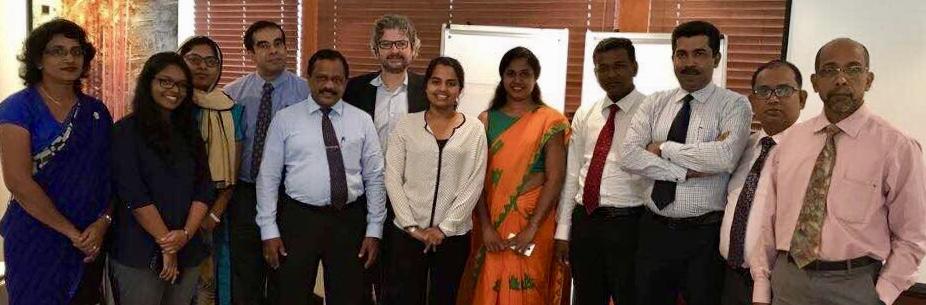
Meet the Investment Promotions team, a group of Sri Lankan government officials from various departments, experts in differing fields, and all novices at the daunting task ahead of them – attracting foreign investors to Sri Lanka. I had the privilege of working alongside the I-team as a coach and colleague for a year. This post is an introduction to the ‘I team’, the challenges faced, victories celebrated, and the learning and experience gained for all involved, coaches and team members alike.
The I-team journey began in September 2016. A group of six to seven officials were assigned to the team and met together for the first time at a Launchpad session organized by the PDIA team. In some ways, this team had the most challenging yet also exciting goal to achieve. They were the front-line team, tasked with identifying, hooking and reeling in the ‘big fish’. Although, it seemed quite straightforward at the onset, the team had no clue how or where to even start. Which sectors should they focus on? How would they differentiate desired investments from harmful investments? What did Sri Lanka have to offer? How does a mid-level state official even contact an anchor investor? Weren’t there experts doing this already? How was this team, with no experience in promotions, expected to succeed? The questions, doubts and overall skepticism was endless. But, and this became the game changing ‘but’, there were team members, one or two to begin with, who were willing to take on the challenge, and truly believed that this approach would yield something different. So, with this mix of skepticism and determination, the team embarked on a journey full of unpredictable difficulties, surprising results and in the process they learned capabilities to diversify and grow Sri Lanka’s economy.
The team’s first ‘aha’ moment took place at a Launchpad session in the second month of their work. The team had been struggling to choose diversified, beneficial sectors to grow the Sri Lankan economy. Once they picked a few, based on their own research and expertise, (a team of their peers, the T-team, were working on a tool to target sectors parallel to the I-team work) they had to strategize ways to attract these sector specific investors. There were many strategies out there but what was their first step and what were investors looking for? During a guest presentation at the Launchpad session, the leader of the I-team picked up on a method this guest investor was using to promote his business. The team adopted the strategy and within a month of dedicated, focused work had some solid sector-specific ‘pitchbooks’ to use as their bait.
Towards the sixth and seventh months of work, the team began to lose steam. The pitchbooks were close to completion and had been circulated with no promising responses. The team members began to feel their task was impossible. What was the point in pitch books if they weren’t able to engage foreign investors or spark interest in Sri Lanka’s economy? As a coach, this was the most difficult point in any team’s journey. Motivating each team is probably the most important role a PDIA coach can play and generally, almost every month, either a team member or an entire team would undergo paralyzing slumps in their pace and effort. After a few weeks of stagnancy, the team decided to identify strategies for contacting and engaging foreign investors. They used indirect and direct methods, identifying 5 key strategies: engaging key local players for introductions to foreign contacts, meeting local importers who would be able to share pitchbooks and make introductions to their foreign sellers, pursuing foreign investors directly through email and phone calls, requesting Sri Lankan commercial officers in targeted countries to engage directly with investors there – using promotional material and reliable information provided by the I-team, and finally the team engaged with any indirect personal contacts in the targeted sectors.
These new strategies revived the team and with a little structure and quantitative goals, provided by the PDIA coaches, members were able to focus their efforts better. Each sector pair committed to making at least five new contacts a week, while maintaining and following up with contacts from previous weeks. These could be through any of the direct or indirect strategies the team had identified. It is important to note that this work was in addition to their typical, daily responsibilities as government officials. Somehow, officials managed to find the time to research, make calls, write emails, respond to queries and travel far to meet with sector experts. Each pair would report their work to the team weekly, and soon enough their hard work paid off! The team engaged with and hooked some of the biggest and most innovative players in the global market; accomplishments they never could have imagined when they first began this work. If you are interested in reading more about the I-team’s journey, learnings and results, read the team’s working paper.
I would like to conclude with a few thoughts on what it was like to coach a team like the Investment Promotions team. The first challenge was maintaining attendance at their weekly meetings. Not only was the lack of attendance frustrating and discouraging for those who did show up, it reflected the low priority members had given to the initiative. Within a few weeks, through direct conversations and interventions from their authorizer, those who were genuinely not interested in continuing, left the team and new members were appointed. Team members soon realized the importance of their work and the expectations superiors had for this work. I observed a renewed energy and interest in achieving the teams’ goals.
I mentioned the necessity and importance of consistent motivation earlier on in this post. One extremely effective method of motivating members was having a ‘star player’ on the team. This member set the pace and raised the bar so that the rest of the team couldn’t make the typical ‘I was too busy’ excuse for missed deadlines. Realizing that a peer could achieve their weekly goals showed the others that this was possible, despite their daily schedules, and sometimes led to some exciting breakthroughs. As a coach, it was important to ensure the team took ownership of their work. The temptation to intervene and direct the team can be strong. Especially, when the team becomes complacent or disagrees on ways forward, both of which were common for the I-team. These are the times at which I had to force myself to allow the team to make their own decisions, take their own path and learn from their own mistakes. Ownership created responsibility, enthusiasm and ultimately, satisfaction from a job well done. This is exactly how the team felt when they attracted global players to Sri Lanka; a sense of disbelief and awe at their own achievements!
I soon learnt to check up on the team and individual members as often as I could. I would observe tensions during meetings and follow up with members who seemed disgruntled or disinterested. Most often, a quick check in and a little motivation can go a long way in getting a team member back on track. And finally, but most important, appreciate, appreciate, appreciate! This is key and generally not practiced enough. As coaches, we worked hard to appreciate any and all steps towards achieving the teams’ goals. We also celebrated small and big wins as much as possible. This motivated the whole team to continue the good work, and aim for greater wins and bigger fish!
Working alongside the remarkable members of the Investment Promotions team, experiencing their challenges and celebrating their victories, was a true honour. Our hope is that their story will encourage and motivate similar teams and government officials around the world, working hard to diversify and grow their own economy through foreign investment.
Anisha Poobalan worked with us on the PDIA Sri Lanka project from September 2016 to September 2017.
This is part of a blog series that is tagged “PDIA Journey,” written by people who have participated in a PDIA process.
Learning to improve Sri Lanka’s business and investment climate using PDIA
Originally published in the Building State Capability blog – Peter Harrington
This past week, the Building State Capability (BSC) program published two new papers about our work doing PDIA-in-practice in Sri Lanka.
The first paper is about working to improve Sri Lanka’s business and investment climate, and is the subject of this blog post. The second is about working to promote foreign direct investment in Sri Lanka, and will be covered in a separate post .
Both papers follow on from our paper published earlier this year called ‘Learning to Target for Economic Diversification’. They all tell the story of dedicated and difficult work done by teams of Sri Lankan government officials who, with our support, used PDIA to solve critical problems facing Sri Lanka in its path to economic diversification and sustainable growth.
The BSC work in Sri Lanka started in July 2016. The country was facing slowing GDP growth, a high current-account deficit, a decline in export performance and low diversification, as well as a low FDI inflows as a percentage of GDP when compared to countries like Vietnam and Malaysia. The Government of Sri Lanka asked CID to help the government design and then implement reforms to address these problems.
Having learned a lot about doing PDIA with governments in Albania and elsewhere, BSC took the opportunity to iterate again and we adapted our ‘Launchpad’ process (a 6-month intensive action-learning program where government teams tackle priority problems) for Sri Lanka. Five teams of Sri Lankan officials started Launchpad in September 2016, each focused on one of five problems related to the economic issues above, and to each other:
- how to identify new strategic sectors for Sri Lankan export and investment,
- how to attract FDI into those sectors,
- how to improve the business climate in Sri Lanka,
- how to stimulate key exports and
- how to improve performance in tourism.
The team that focused on the investment and business climate (3) was called the “C Team”. The C team was made up of officials drawn from Sri Lanka’s Board of Investment, and they are the subject and co-authors of the paper covered in this blog post.
As with the previous paper on targeting, our aim with the C Team narrative is to provide a rich, fine-grained and detailed account of the steps both small and large that the C Team took from week to week to tackle this problem, as well as a detailed depiction of how we do PDIA in practice to support such teams.
Starting with an initial workshop facilitated by the BSC team, the C team were first challenged to define the problem which they did thus: “Attraction of FDI is not treated as a national endeavor by state, which affects investor confidence to implement projects speedily.” They were also asked to define what would constitute ‘problem solved’ – i.e. the goal and outcomes. They defined these as: 1) A supportive investment climate to fast-track project approvals and implementation; 2) Increase in the number of projects; 3) Creation of employment and; 4) Improvements in living standards and income.
The team then broke down their headline problem into ‘branches’ and prioritised these. Breaking the work down in this way is based on the idea that significant time can be wasted developing detailed Gantt charts, logframes or project plans that rarely survive contact with reality and tend to assume a linear progression in the project that is quickly disrupted by factors that cannot be known or seen at the beginning.
As soon as these first steps were completed, we asked the team to formulate an action plan with their goals for the end of six months, the next two months, next month, and next two weeks, which was the next time that a BSC facilitator would meet with the team. The team focused their initial action plan in on three ‘entry point’ issues to start to work on:
- Lack of consultation with industry;
- Lack of research and accessible up-to-date information;
- Mismatch in labour training to improve productivity.
The rest of the six-month Launchpad process would be conducted using these two-week ‘push periods’ between progress meetings with a BSC facilitator, where the team would do its work and then ask, ‘what have we done, what have we learned, and what is next?’ Working in such bursts allows rapid iteration, regular checking in and course correction. This leads to the expectation that the assumptions in the initial action plan will be challenged by new information and lead to iteration and changes in the action plan. At the end of the initial workshop we pushed the C team into action quickly (as described in detail by Matt Andrews here) because starting aggressively with quick small steps (with a clear goal in sight) can help generate momentum.
Experience in doing PDIA indicates that big things emerge through small steps. This is especially the case when each ‘next step’ yields learning (with new information, and experiential lessons) and expands engagement (with new agents, ideas, and more). This is because the problems being addressed are complex, and are best addressed by expanding engagement and reach (which opens opportunities for coordination needed to confront complicated problems, and for interaction vital to tame complexity) and fostering learning (which is crucial in the face of the uncertainty and unknowns that typify complex problems).
The principle idea is that action leading to new learning and interaction fosters ‘emergence’, which is the key to finding and fitting solutions to complex problems. Any action can foster learning, and it is thus more important to get a team to act in small ways quickly than to hold them away from action until they can identify a big enough (or important enough) next step.
As they progressed through the first few push periods, the C team encountered a variety of challenges which required course correction. They sought to first engage with industry to validate their problem definition and ‘branches’. They designed a company survey, identified target firms and conducted the surveys. While they struggled to reach certain categories of firm, they managed to compile a large matrix of survey responses which they used to refine their initial problem set. Over the course of the six-month Launchpad process (a total of thirteen push periods), the C team continued to course-correct, refine their understanding and selection of the key problems. They ultimately chose six priority issues to solve, which were driven by the responses from firms themselves. These were:
- Simplification of the exchange Control systems affecting firms and Forex payments
- Issues faced by certain types of companies in relation to VAT
- The need to promote Sri Lanka as a destination for start-ups
- Lack of certain labour skills in the manufacturing sector
- Lack of a Special Economic Zone for industries with a high water requirement
- Need for better coordination of investment approvals process in the Board of Investment
As is evident, these formulations are very different in focus and specificity to the problems assumed at the beginning. This degree of focus was achieved over six push periods and involved considerable iteration, and listening to firms, and could never have been achieved ex ante. With very little support from the BSC facilitators, the C team went on to design solutions to these issues and seek authorisation for their proposed solutions. Along this journey the team sometimes lost their momentum, but regained it, sometimes with help from BSC, and sometimes internally. They encountered a multitude of obstacles, highs, lows, impasses and breakthroughs, all of which are openly chronicled. This is the reality of doing difficult, diligent work to solve complex problems in government – especially addressing real problems that firms face and care about, rather than seeking to merely improve a country’s Doing Business rankings.
In mid-March, the final Launchpad workshop took place in Colombo, marking the end of the 6-month period over which the teams had undertaken their work. Despite being consistently unsure of its progress and often low on momentum and motivation, the C team came closest to completing the work it cut out for itself. All of their selected problems were either effectively addressed or close to solution: 1) Regarding exchange controls, the Central Bank had given assurances that the required exemptions would be honoured; 2) for VAT exemptions – the proposal had gone to the Cabinet for approval; 3) regarding Sri Lanka as a start-up destination, the team’s proposals for a start-up incubator had been discussed at the BoI Board and these were being finalised; 4) Regarding Vocational Training their proposal to set up a new Vocational Training Facility had been approved; 5) Regarding a water based industrial zone – the team had identified a location, obtained a feasibility report and planned to initiate the land release process. Finally regarding 6) faster investment approvals, the team had presented a new proposal to the Director General, who asked the team to develop the proposal further but committed to approve it and send it to the screening committee.
In addition to this, some other important outcomes had been achieved. First, the firms that the team reached out to now perceive that they are served by a government (represented in this case by the BoI) that is interested in, and responsive to, their problems (and which takes action to resolve those problems, and then follows up to talk about it). This relational dimension, much harder to capture in any metric, deeply affects the confidence that business have that they can flourish under this climate and with this government as a partner.
The second result is perhaps the most important of all. So much of the thought and philosophy underpinning the PDIA approach is the acknowledgement that external interventions or expertise cannot solve a country’s or a government’s problems. Only the country or the government itself can do that. To do so, however, they need capability, and the most valuable outcome of work of this nature is the learning that the team gains in the process (about new capabilities). It is more important than the result (in fact failure is often the best teacher), and will enable the individuals and the institution to tackle similar problems effectively in future, without the need for external support.
We hope that this kind of under-the-hood narrative will help others interested in doing similar work, both on investment climate and PDIA in general. We also want it to display and pay tribute to the hard and often courageous work done by the C team and teams like them, work which shows that great leaps are achieved by committed individuals chipping away at problems with grit and perseverance sticking with it despite the many pressures. All the accomplishments belong to them.
Case Study: Delivering Customer Care and Cutting Corruption in Public Services
The shortcomings to Albania’s integration into the EU
By Ermal Frasheri
To countries like Albania, membership in the European Union is presented as the ultimate modernization project that will lift all boats and bring about greater prosperity and democratization.
However, more often than not, transition reproduces hierarchies and inequities that usually underpin relations between a prosperous center and a backward periphery.
Instead of being a cure, a solution to the political primitivism and underdevelopment, the story with Europeanization as a model of modernization suggests that despite noble intentions and goals, reforms in the name of the European Union end up foregrounding a security state apparatus, impose an ideological hegemony, and maintain a political culture that inhibits democratization, while discouraging and displacing the need for endogenous growth strategies.
Read more about my argument in my paper – Of Knights and Squires: European Union and the Modernization of Albania.
INTERVIEW: The Road to Citizen-Centric Public Service Delivery in Albania
An Interview with Dr. Milena Harito, Minister of Innovation and Public Administration of Albania
If you were a citizen of the Republic of Albania in need of a moderately complex public service in 2014, you were almost certain to enter a maze of public bureaucracy: dark and messy offices, long lines, vague instructions and procedures, and little opportunity for citizen feedback or tolerance for criticism. It’s no wonder that the uncertainty around these services forced most citizens to use their social and family connections, and in some cases, bribes, to ensure speedy and secure service delivery.
In 2014, on direction from the Prime Minister’s Office (PMO), the Minister for Innovation and Public Administration (MIPA) started a process of reinventing the way the public administration delivers service to its citizens. The objective was to create an administration that revolves around the needs of the citizens – a citizen-centric service. While the objective was clear, the path there was far from known. The view that the government could simply adopt a successful reform from a similar country was quickly abandoned, as the people at the forefront of the reform realized that Albania faced Albania-specific challenges.
Three years down the road, over 400 services (out of 1,400) offered by 10 public institutions in five municipalities and covering 60 percent of the total service volume to citizens and businesses have become a part of the reform. The processes behind each service were analyzed and reengineered and MIPA established the Agency for the Delivery of Integrated Services (ADISA). ADISA develops and ensures service standards, offers public services through one-stop-shop offices and monitors the performance of public sector service providers. The reform, among other things:
- Replaced old routines for standard transparent multi-chanel information and communications technology solutions;
- Established one-stop-shop offices which streamline citizen interaction;
- Trained professional front office personnel to respond in a customer-friendly manner;
- Holds the front office personnel accountable for ensuring timely and proper back office delivery;
- Eliminated redundant bureaucratic steps and incentives for corruption;
- Continuously monitors the service delivery and seeks feedback from its users.
The reform’s timing and success happened as a result of complex coordinated and innovative government initiative. We interviewed Dr. Milena Harito, Minister for Innovation and Public Administration and a frontrunner of the reform, in order to learn what it took to advance this agenda.


Center for International Development: Dear Minister, how did the initiative for this reform come about?
Dr. Milena Harito: The Reform of Public Services was one of the six government priorities under Prime Minister Edi Rama back in 2013, when this government stepped in. As a Minister of Public Administration, I was asked to lead the reform. Initially, it was envisioned as a process of service digitalization, but soon in the process we found out that the reform had to be much more than that if we were about to address the key problems we identified with respect to public service delivery.
CID: What are the main problems that this reform is addressing?
MH: There are several. Lack of transparency – citizens were never certain about the documentation they will be asked to present when requesting a service, nor did they know what to expect in terms of procedures. Lack of predictability – there was no guarantee that if one would request the same service twice, one would obtain the same result. Citizens were at the mercy of civil servants’ goodwill. Lack of accountability – timely service delivery was the exception rather than the norm. Civil servants were not penalized for violations, denial of service or delays. Bribes were common, too. Service standards were absent – citizens were missing a basic sense of what constitutes a public service. Some offices even lacked a service window which would signal that they are providing a public service. All this formed a culture of administrative prerogative and arrogance with little regard for customer needs.
CID: With so many issues to address, where did you start?
MH: The complexity of the task was quite terrifying. We first needed to learn the essential facts. We started by conducting an inventory of all public services and found that often the institutions providing them were not aware of all the services they provide. We surveyed around 1,400 services. Next step was to measure the frequency by which citizens use each service and decide which of them should become reform priorities. Then we turned to deciding on service standards. What does a good service look like? This part was developed following the French service model, with technical assistance from the EU. At this point we had to solve a problem that didn’t have a clear solution. The 400 focal services were distributed across 10 government agencies, each of which had different work routines and responded to different line ministries. How do we ensure adoption and longevity of the new ways of delivering a service across numerous entities? The game changer was the idea to create ADISA, an agency with two main objectives, the separation of the front office from the back offices and the creation and application of customer care standards. After establishing its legal basis, ADISA started the implementation of one-stop-shop offices, initially with the property office of Tirana, one of the busiest and notoriously corrupt agencies.
CID: In the USA in the 1990s, Bill Clinton launched a reform called “Reinventing Government.” As part of this process, lots of government services were consolidated and many went online. The government employment at the end of the Clinton Administration was a quarter less at its beginning. Is this reform of similar scale and does it have similar consequences?
MH: The situation in Albania is very different. Albania’s administration is very small – 90,000 people are providing service to about three million citizens. This is low administration to people ratio for regional standards. We didn’t suffer from having a large government, but from having an inefficient one. In most cases, the government agencies did not have front office employees for their services. Hence, instead of laying off workers, we hired new staff for ADISA. We focused heavily on their training, work ethic and service orientation.
CID: What is your vision of the public administration in Albania after completing this reform? How will the public administration differ then compared to its state in 2014?
MH: We probably need another two to three years to complete the reform in all Albanian municipalities. At the end of the reform, the public sector service will resemble the one of the private sector – think of modern banking or telecom services. The beauty of the front and back office separation is that by professionalizing the front office, we created a pressure on the back office to professionalize, too.
CID: What are some of the tangible benefits of this reform that the citizens of Albania are already experiencing today?
MH: One is the standardized application forms for services. This is not only important for equal treatment of the users, but also all involved government agencies receive an identical set of information about the service request. Another one is the call center with a centralized number for all public services 11-800, where citizens can obtain standard information about available services, the same on the e-albania portal. Moreover, the one-stop-shop offices allow citizens to apply for several services that are performed different government agencies at a single location.
CID: One of our observations when it comes to the public administration in Albania is that many departments have weak or inadequate knowledge about their job tasks and responsibilities. And yet, you managed to find the capable people to design and implement this very ambitious reform. Who provided the expertise and the examples for this reform?
MH: It was a mix of local ideas and ideas from other places. We started by visiting various countries that could provide good examples, such as Georgia and Azerbaijan, both of which have undergone public service delivery reforms. We borrowed the idea of a one-stop-shop and the knowhow about how to locate them and how to create user friendly space from Georgia. Back in Albania, we created a group of five local people in key administrative positions, who were knowledgeable about our public administration and were very dedicated to this reform. This group reviewed literature, models, and brainstormed about reform ideas. We started implementing the ideas, while still shaping them up. It was during this implementation process that we received support from international partners like the EU Commission and the World Bank. We borrowed the idea of customer care standards from private sector services.
CID: Although the reform borrows from experiences in other countries, it is unique and customized to the needs of the Albanian citizens. How difficult was it to strike the right balance between borrowing foreign ideas and responding to domestic idiosyncrasies?
MH: The idea of a front and back office separation is a local innovation. We added this to the one-stop-shop offices because we were solving a somewhat different problem than Georgia was at the time they started their reform. In Georgia, the reform started with one institution – the Ministry of Justice. Hence, there was no need of front and back office separation. Similar was the case with private companies which are a single entity, and not 20 institutions as it was our case. Moreover, the currently available digital solutions are more efficient than the ones available when Georgia started their reform ten years ago. We knew, for instance, that it is possible for the service clerks to access integrated databases of several organizations and hence we adjusted the approach to benefit from such technological solutions.
CID: What is your favorite innovation?
MH: From the citizens’ perspective, the most important innovation is the one-stop-shop. From the perspective of the administration, it is the separation of the front and the back office.
CID: What were the main challenges in translating the vision of the reform into actual implementation?
MH: The first challenge was to understand what is feasible, how great our ambitions should be, and what timelines we should work with. The second was finding the right set of partners in the government. We needed partners in the administration in order to make sure that the reform is being understood and accepted, but too many partners would have made the project coordination difficult. We also faced resistance for a number of reasons. Some simply feared to lose the power, the privileges or the income from bribes. Other insisted that we only focus on creating online services. Having a background in ICT, I knew that problems stemming from organizational dysfunction cannot be simply solved by transitioning to an online system. Moreover, only 60 percent of Albanian have today online access, and the digital litteracy for complex services is of course still an issue.
CID: Digitalization, automation and centralization of services are some of the main features of the reform. Were the jobs of some civil servants affected by these processes and if yes, how?
MH: The small initial size of the administration and the fact that our administration is relatively young and trained in using computer interface, makes the transition far less disruptive than in countries that implemented digital technologies in the 1990s. I’m not aware of a significant negative impact on the employees. We tend to make the administration more efficient through information technology.
CID: What is the permanent imprint of this reform that will ensure that the reform will outlive changes of government in Albania?
MH: The reform has been very well accepted among the citizens. From the opening of the first one-stop-shop in October 2015, the positive response was immediate. Worsening the level of service that citizens are experiencing through this reform would be politically very costly. I think that this is a major reason why future governments will be interested in sustaining the changes.
About Minister Milena Harito

Since September 2013, Dr. Milena Harito is the Minister of State for Innovation and Public Administration of the Republic of Albania. She has an extensive experience in the field of telecommunications and innovation.
Dr. Harito graduated with honours in Computer Science from the University of Tirana in 1989 and earned a Ph.D. from Paris VI University in 1997. Dr. Harito has substantial work experience as a senior manager in the telecommunications having worked during 15 years for Orange France, in Paris. She has been elected member of the Albanian Parliament in June 2013. Since she has been appointed State Minister for Innovation and Public Administration in September 2013, Dr. Harito has led important reforms for Albania in the process of European Union Integration: modernization of public administration through professionalization of civil service and extensive development of e-government, simplification of the relations with the citizens and improvement of public services delivery based on customer care principles.
RELATED CONTENT: Case Study: Delivering Customer Care and Cutting Corruption in Public Services