
What is the Binding Constraint to Growth in Albania?
By Tim O’Brien
About four years ago, at the onset of CID’s engagement in Albania, the country faced two issues that were threatening its macro-fiscal stability: a skyrocketing public debt and an insolvent, publicly-owned electricity distribution system that was plagued by theft and technical inefficiency. These two interlinked issues constrained both short-term economic growth and the ability of the country to develop new drivers of long-term growth. Over the subsequent years, the government was able to successfully respond to these constraints through a now-concluded IMF program and through a series of reforms in the electricity sector. With these constraints now relaxed, CID saw the need for a new analysis of the current and emerging constraints to growth in Albania. This analysis will guide future research and inform the government and non-government actors on emerging economic issues for prioritization.
While growth has accelerated over the last several years, to over 3% in 2016, this is not a pace that will allow for a rapid convergence of incomes and well-being in Albania with that of developed countries in Europe and elsewhere. This growth diagnostic attempts to identify the binding constraint to sustainably higher economic growth in Albania.
Recognizing that economic growth requires a number of complementary inputs, from roads to human capital to access to finance and many more, this report compares across eight potentially binding constraints using the growth diagnostic methodology to identify which constraint is most binding. This research was conducted throughout 2016, building on prior research conducted by CID and other organizations in Albania. Each constraint discussed in this report is cited by analysts within or outside the country as the biggest problem for growth in Albania. Through the growth diagnostic framework, we are able to evaluate the evidence and show that some constraints are more binding than others.
Despite serious issues in many other areas, we find that the binding constraint to stronger growth in Albania is a lack of productive knowhow. By “knowhow,” we mean the knowledge and skills needed to produce complex goods and services. Albania faces a unique knowhow constraint that is deeply rooted in its closed-off past, and the limited diversification that has taken place in the private sector can, in nearly all cases, be linked to distinct inflows of knowhow. The strongest sources of knowhow inflows into Albania have been through foreign direct investment and immigration, especially returning members of the diaspora who start new businesses or upgrade the productivity of existing businesses.
The evidence also points to particular failings in rule of law in Albania that play an important role in keeping Albania in a low-knowhow equilibrium. Weaknesses in Albania’s rule of law institutions, including frequent policy reversals and corruption in the bureaucracy and judiciary, increase the risk of investments and transaction costs of business. While it is difficult to separate perceptions from reality in this area, both perceptions of weak rule of law and actual rule of law failings appear to play critical roles in constraining more diversified investment in Albania. We find that while existing firms in Albania successfully navigate the rule of law weaknesses, and in some cases benefit from the system, potential new investors are acutely sensitive to rule of law issues.
New research studies effects of return migration
The recent Greek economic crisis hit the population of Albanian migrants in Greece particularly hard, spurring a wave of return migration which increased the Albanian labor force by 5% only between 2011 and 2014.
We study how this return migration affected the employment chances and earnings of Albanians who never migrated. We find positive effects on the wages of low-skilled non-migrants and overall positive effects on employment.
The gains partially offset the sharp drop in remittances in the observed period. The employment gains are concentrated in the agricultural sector, where most return migrants engage in self-employment and entrepreneurship. Businesses run by return migrants seem to pull Albanians from non-participation, self-employment and subsistence agriculture into commercial agriculture.
The Benefits of Regional Integration
How important is regional integration for an export oriented development strategy? Ermal Frasheri gave an interview at the 7pa5 morning show at VizionPlus TV where he discussed the benefits of regional integration in the context of the Nis Summit between Serbia and Albania.
Q&A with Ditmir Bushati, Albania’s Minister of Foreign Affairs
On Sunday, September 18, the Embassy of the Republic of Albania to the US and the Center for International Development at Harvard University hosted a panel discussion, “Albania and Diaspora: A New Communication” with the Honorable Ditmir Bushati, Minister of Foreign Affairs of the Republic of Albania.
Following the panel, Minister Bushati sat down with CID Events and Outreach Manager Andrea Hayes and discussed the panel, the Albania diaspora, and other foreign policy topics.
What are your impressions from this panel?
We had the opportunity to discuss the need to further streamline cooperation between the Albanian state institutions and our diaspora, especially here in the U.S. We are going to organize in November the first ever Diaspora Summit and we have set out relevant policy documents and areas of cooperation. There are many success stories, and we need to build on that in order to structure the cooperation between Albanian state institutions and our diaspora in different aspects.
As you know, the Center for International Development has worked for some time now to emphasize the benefits of engaging the Albania diaspora with social and economic development in Albania. How do you see the relevance of this type of work for the Albanian government and the Albanian community, especially here in the United States? How do you see Diaspora’s contribution to Albania?
This is very important for us, especially if one takes into account that one-third of Albanians are living abroad. The Albanian community in the US is quite solid in terms of knowledge, expertise, but also financial resources. There have been several waves of migration to the United States and now it’s time to consolidate the bridges between Albania and our diaspora for the sake of social and economic development and transformation of the country. I would like to commend the work done by CID’s team of experts. Their expertise has been really valuable for the work we are doing in defining the areas of cooperation with our diaspora but also by looking into successful models of cooperation that other countries have implemented.

Panel: Ermal Frasheri, CID Research Fellow; Min. Bushati; Alma Jani, International Organization of Migration in Albania; and Mark Kosmo, chairperson of the Massachusetts Albanian American Society.
In November, the Albanian government will hold its first summit on diaspora. What are your expectations for that event?
It is going to be the first time policymakers and representatives from different Albanian institutions will sit together with diaspora representatives from more than 38 countries around the globe. We want to be able to cluster our interplay in different areas of cooperation that we will jointly define based on the policy document that is anticipating the summit. Our ultimate goal is to transform this initiative into a sustainable form of cooperation with government institutions. We want to transfer the ownership of this initiative to diaspora representatives themselves and have them initiate this event next year. We would like to come up with concrete ideas and projects, and then see how these projects are implemented. So the key message during the summit will be “participation, participation, participation” of Albanian diaspora in the democratic and socioeconomic development of Albania.
What are some of the main foreign policy issues that Albania is facing currently?
The main foreign policy issue is related to the EU accession process. This is not a classical type of foreign policy issue, because in the case of Albania and southeast European countries, it’s also a question of national priority, because it has to do with the democratic credentials and socioeconomic development of the country. As you might be aware, Albania is an EU candidate country, and with the reform path, especially in the rule of law related areas, we expect the European Commission to come up this fall with a recommendation for the opening of accession talks. This would be a defining moment for Albania, because it will give us a positive sign towards the opening of accession talks. And when I speak about recommendation for opening of EU accession talks, we speak about a complicated process where the country is going through a very serious set of reforms.
What have been some of the major achievements and challenges to the accession process?
Albania is in better shape if one assesses rule of law related reforms. Albania is projecting democratic stability in the region. Security-wise, it is a pivot in Adriatic Europe, often acting as a mentor for other countries that aspire to join NATO. Albania is a promoter of reconciliation in our region, and it’s also a promoter of flagship infrastructure and energy projects that would connect the region and people in the region.
You have been active in promoting Albania abroad, especially with regard to investment opportunities. How do foreign partners see the potential of Albania?
The potential is there. The process of accession into the European Union is moving ahead with all relevant economic rule-of-law related reforms. As a consequence the business climate is improving. Also, geography has been very generous with Albania, in terms of clear access on the Adriatic and Ionian seas. Through our constant engagement with regional and EU partners but also international financial institutions, we have managed to make of Albania an epicenter of the connectivity projects that will be implemented under the framework of the Berlin Process1 in our region.
You will be in New York City for the United Nations General Assembly (Sept. 19-26). What can you tell us about the discussions that you will be holding with your colleagues and partners there?
The menu of discussions is indeed very rich this year due to the many crises we’re facing around the globe – terrorism, migration, economic crisis. And as it happens, the UN General Assembly is an ample opportunity to take part in many regional initiatives and important summits, but also to meet bilaterally with lots of colleagues. My goal is, of course, to advance Albania’s agenda in terms of EU accession process, but we will have, also, an opportunity to discuss security issues, especially in the migration, terrorism, radicalization nexus. Albania has invested a lot over the past few years on dealing with these challenges and we can already measure some success we would like to share with partners and allies.
1Berlin Process: a process launched by German Chancellor Angela Merkel to enhance regional cooperation through flagship projects and help accelerate the integration of the Western Balkans in the European Union.
Alternatives to Economic Growth: A Collaboration with St. Gallen
Growth was at the forefront of the 2016 St. Gallen Symposium – an annual gathering of global leaders in Switzerland. Some 800 present and future leaders debated, “Growth: The Good, the Bad, and the Ugly,” from May 11-13, 2016 in St. Gallen, Switzerland.
The question “What are Alternatives to Economic Growth?” was posed as a topic for the symposium’s annual essay competition. The six essay competition finalists were brought together with research fellows of Harvard University’s Center for International Development (CID) to analyze, elaborate, and stress-test some of the ideas.
Four major themes emerged from their analysis:
- the need to contextualize any discussion of economic growth
- new models of consumption may reduce the importance of growth in developed markets
- the rising level of inequality in many countries is a major concern
- the digitalization trend is changing what growth means
Overall, the authors conclude that the nature of economic growth as we know it is changing and these changes present governments and their citizens with an unprecedented set of opportunities and challenges.
To read more about their findings, download the:
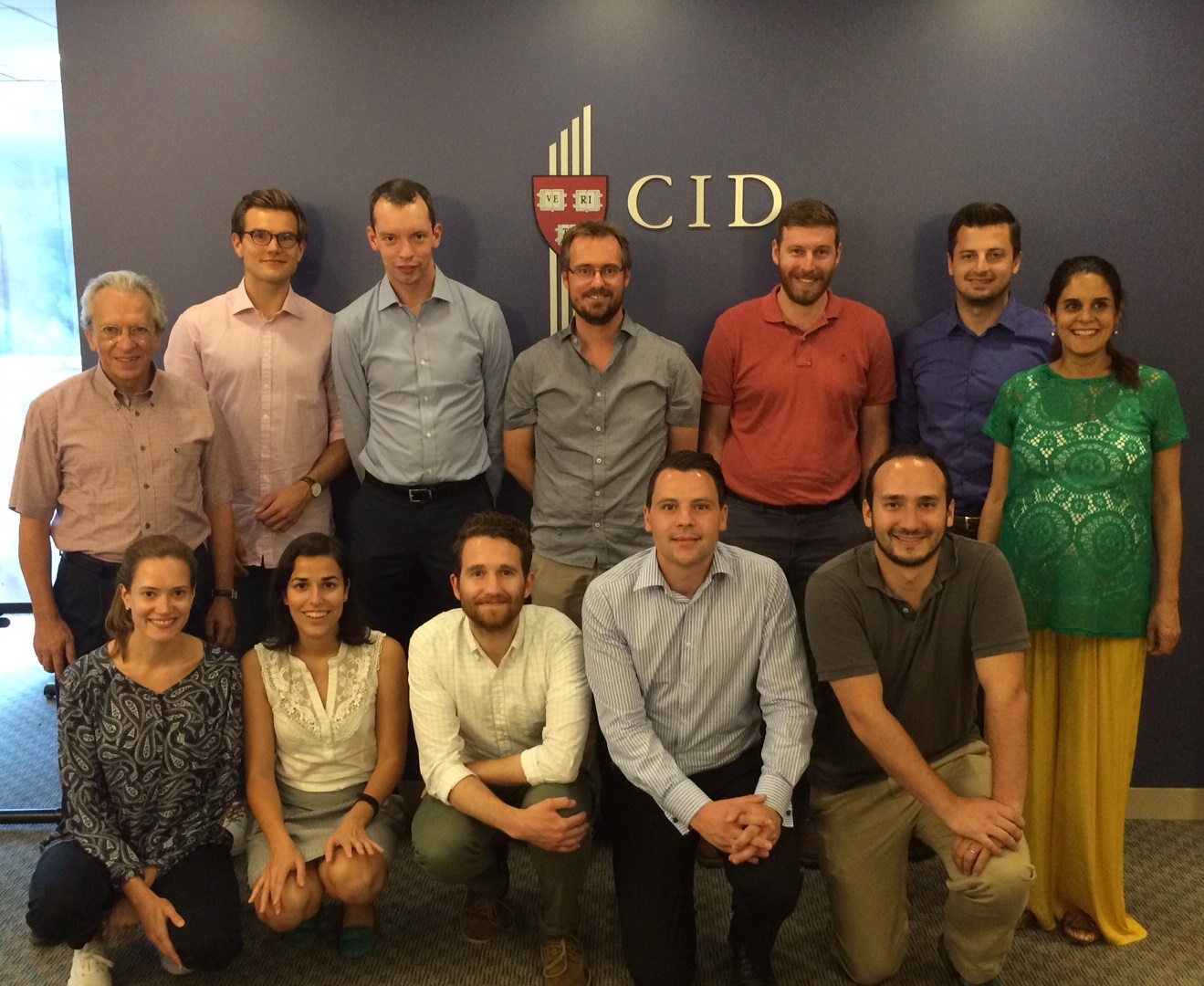
CID Research Fellows and St. Gallen Symposium essay finalists during their working session at Harvard Kennedy School on July 25, 2016.

Increasing Exports of Albania’s Cultivated Fish
By Alejandra Jimenez
Albania is rich in water resources and both inland and marine aquaculture have potential for growth and development. In the past two decades European and Mediterranean countries have seen their freshwater aquaculture decrease while marine aquaculture, especially of European Seabass and Gilthead Seabream, has increased. In 2000, Albanian aquaculture producers started to turn their attention to seabass and seabream production and their cultivation in cages in the Ionian Sea increased dramatically. Albanian production, however, represents only 0.38% of European marine aquaculture of seabass and seabream and its productivity rate is below that of neighboring countries. If the country were to operate its current facilities at the average cultivation rates of Greece, production would increase threefold. If the country were to operate currently available waters at a suggested rate of 15kg/m3, its aquaculture production could increase to 40 times the current size.
Three main barriers stand in the way of achieving this goal:
- High costs of production caused by the need to import cages, fingerlings, and feed; all of which are basic inputs for production that the country cannot currently produce for lack of technology and investment
- Lack of formality in the marketing and trade of fish products
- Lack of clarity in the regulatory framework, which is an issue common to aquaculture in Mediterranean countries, where legislation guiding the activity is usually contradictory.
In Albania’s case the main regulatory piece for the industry, the Law on Aquaculture, is being drafted. Passing this law should bring some clarity to aquaculture businesses.
Reducing the costs of production requires lowering taxes and requirements for fingerling and feed imports, in the short run, and initiating national production of these two inputs in the long run. Government can incentivize research and development in aquaculture to increase technical capacity for fingerling and feed production and it can also provide better financing choices for the acquisition of cages for aquaculture farms. The marketing of fish products requires the establishment of a formal fish market that would be close to the main production ports and aquaculture sites and that would comply with all the standards to ensure the quality of the final product. Consumers are very sensitive to the quality of the fish they buy and complying with quality standards and ensuring food safety conditions should be a priority to increase consumption and guarantee the highest possible price.
As regulation for the aquaculture sector is clarified and drafted, the Albanian government is looking to define Allowable Zones for Aquaculture (AZA) with all interested actors. It would be ideal that these AZA secure property rights for a period of minimum 10 years allowing companies to recuperate their investments. Other factors that could be included in the regulation to incentivize the aquaculture industry are the conditions for sustainable operation and the mechanisms for the acquisition and enforcement of licenses and for inspections to ensure product quality. Definition on the government part of the minimal requirements for a legal operation in the business should help the private sector to achieve more security and effectiveness in production. The private sector, on the other hand, can also create better conditions for the development of the industry by initiating producer organizations that would promote the interests of aquaculture producers.
Now Seeking Interns for 2016 Summer Program in Albania
The Summer Internship Program of the Economic Growth in Albania Project is now recruiting Master’s level students to spend summer in Albania.
The Center for International Development (CID) under the direction of Professor Ricardo Hausmann is conducting a four-year project with the Government of Albania. CID helped the government develop an economic growth strategy, based on increasing economic productivity, fostering regional integration, and positioning the government on sound financial footing. Under the supervision of Professor Matt Andrews, CID has put in place government teams to implement elements of this strategy.
For a third year, the project is recruiting interns to spend a summer in Albania working in areas that may include but are not limited to:
- FDI/trade with the Ministry of Economy
- Public finance with the Ministry of Finance
- Energy with the Ministry of Energy and Industry
We are looking for students who are interested in working at various government ministries for ten weeks, from end of May to end of July. The students will work closely with Albanian senior officials to conduct research as well as policy and regulatory analysis. They will also receive close supervision by CID’s faculty and research fellows involved in the project. Familiarity with economic development theories and methods, and legal research and analysis are helpful for the internship. Familiarity with the country or fluency in Albanian is not required.
Assignments to students will be given by CID and their Albanian counterparts. In the last years, the interns presented their findings before the Prime Minister and relevant cabinet members at conferences organized by CID and the Albanian Government at the end of the internship program.
The internship is ideal for those who want to discover an unfamiliar country, work in an environment where politics, policy, economics and law are all intertwined, and be part of joint endeavor with CID in assisting a country in transition. The placement of students in various ministries will be done based on preferences and matching of skills with needs.
Financing
The internship comes with a scholarship of USD 2,500 for ten weeks, USD 1,400 for a return flight, and separate amount (to be estimated) for accommodation in Tirana, Albania. The scholarship does not pay for travel or health insurance.
How to apply
Please email your CV and cover letter to Ljubica Nedelkoska or Ermal Frasheri no later than February 29th (Monday). Throughout spring, CID staff will be available to provide continuous information and answer any questions that you may have. Please do get in touch with us!
Past experience
The internship experience of the last two years was fruitful and beneficial for the students, CID, and the Albanian Government. You can meet last year’s team and read some of their experiences in our blog.
Integration in the Balkans: Albania and Kosovo
Despite their historic and ethnic ties, trade and investment between Albania and Kosovo remains underdeveloped. To be sure, even if fully developed, Kosovo is unlikely to play a major role in Albanian external economic relations. Nonetheless, increased economic integration between the two countries can serve as the basis not only for enhancing the ties between the two countries, but also for spurring the measures that could act as a springboard for Albania’s integration with respect to other countries in the Balkans as well as with the EU.
In this report, we examine the state of play in the trade in goods, trade in services, movement of workers and movement of capital in order to identify potential issues and offer recommendations that could help unbind institutional constraints and as such facilitate the process of deeper integration between Albania and Kosovo.
The scope of this type of endeavor is rather large, and with this introductory report, we would like to raise key questions and themes that we hope would generate feedback from the government, private actors and other public sector representatives in order to turn an idea into an action plan.
Davos16: Latin American countries hit by low commodity prices but their performance is diverging
By Ricardo Hausmann
The World Economic Forum in Davos last week gave me the opportunity to reflect on Latin America, its predicament and the lessons we should extract from the region’s recent experience. I was asked to moderate a panel of Ministers from the region. Argentina was represented by my friend, colleague and co-author Federico Sturzenegger, the recently appointed President of the Central Bank. Brazil was represented by the newly appointed Minister of Finance Nelson Barbosa. Chile, Colombia and Peru were represented by my old friends and ministers of finance Rodrigo Valdés, Mauricio Cárdenas and Alonso Segura. One reason why I know these people so well is that they all have PhDs in Economics from top universities: two from MIT (Sturzenegger and Valdés), Berkeley (Cardenas), Penn (Segura) and the New School (Barbosa). That means that I know them from the time they were all academics.
The session was on economic resilience in light of current events. All countries had been seriously hit by the collapse in their export prices. Copper (important for Chile and Peru) is down by 55% since 2011. Iron ore (Brazil) is down to 1/5 of its 2011 peak. Soy beans (Argentina and Brazil) are at half their 2012 average price and oil (Colombia and my own country, Venezuela) is down to less than 1/3 its 2013 price.
Interestingly, Chile, Colombia and Peru have all maintained positive growth between 2 and 3 percent, not as rapid as during their previous period, but a remarkable performance given the magnitude of the shock. How did they achieve this? Part of this was the prudence with which they managed the boom: they all reduced their debt/GDP ratios and improved their credit ratings. Chile famously put money aside in its copper fund and its budget institutions were ideally designed to deal with commodity booms and busts. Nevertheless, it was forced to tighten fiscal policy in the downturn, although less than what it would have otherwise required.
Peru has been much more resilient than I expected it to be, given the importance not just of mining exports but also of mining investments, which are now being drastically cut back. It has been able to use fiscal stimulus to lessen the impact, while maintaining fiscal and external deficits at modest levels.
Colombia has been able to keep growing although it has had to do more fiscal adjustment than the others. The tax contribution of the oil industry this year will be zero and to keep the deficit within the fiscal rule the government has had to tighten. Growth will be stimulated by significant investments in infrastructure that will be executed through PPPs and by continued private housing construction, with some public incentives. However, the current account deficit remains very wide. In spite of its many trade agreements, non-oil exports have not yet responded, suggesting that more thinking needs to be dedicated to this issue. Part of the problem is that Colombia’s two main neighbors and natural markets (Ecuador and especially Venezuela) have been imploding.
All three countries benefited from their currency regime: floating with inflation targets: they have allowed their currencies to depreciate a lot (~30-%) without jacking up interest rates and with very small inflationary effects. This has also cushioned exporters from the decline in their dollar price. In sum, not bad given the tough times. They all need to do more to stimulate non-resource based exports with productive development policies that they have yet to deploy fully.
At the other extreme, Brazil is in a very vulnerable spot. It is in a vicious circle of low growth, higher fiscal deficits (because of low growth), higher interest rates (because of the large fiscal deficit), leading to lower growth and higher fiscal deficits (because of the higher interest rates and debt service). Tax rates and revenue are at record highs for a developing country meaning that further tax increases may not be the right long-term solution, although the government is trying to bring back the tax on financial transactions. The government has been cutting discretionary spending but constitutionally or legally mandated spending is going up, making it very difficult for the government to rein in the deficit without legal changes. But here, Dilma’s political weakness makes the situation that much more difficult as it is unlikely that she can muster the support to approve any new laws. Barbosa argued that this would be the first time since the 1930s that the country undergoes to years of negative growth each in the 3 to 4% range and that this may force politicians to cooperate. How did Brazil get into this pickle? By wasting its commodity and political capital boom in a public consumption spree that did not address the country’s problems. It now is forced into a contractionary pro-cyclical adjustment.
Argentina has already seen 4 years of no growth and the IMF projects negative growth in 2016. But Federico Sturzenegger thinks that the unification of the exchange rate and the elimination of chavista-like controls on the economy will cause capital to come back and investment to boom. There was certainly a lot of excitement in Davos about the new possibilities in Argentina.
As a Venezuelan, all of these performances are so much better than what is is store for my country in 2016, where an economic collapse and a humanitarian crisis remain the baseline scenario.
What lessons can we extract of all this? What is clear is that there is a certain anti-market Latin American left that looked attractive during the boom but that has bequeathed a mess. The Kirchners, Lula-Dilma and Chavez appeared not only right politically but also right economically for a long time. They grew more than their predecessors and described their better performance as caused by their superior ideology and social concerns. The 1990s was all caused by the rise of a bad ideology: neo-liberalism. In reality, their predecessors had to deal with an environment which was as tough or tougher than the present and had to make difficult choices. Now we know that the Kirchners, Lula-Dilma and Chavez were only wasting a boom and bequeathing a mess that will also require difficult choices. The approach followed by Chile, Colombia and Peru now looks, with hindsight, as the socially progressive and responsible thing to do. May we all learn from these experiences.
Looking back on the 2015 economic reforms and the forecast for 2016
By Ermal Frasheri
I appeared on VizionPlus TV earlier this week and discussed Albania’s economic reforms in 2015 and the forecast for 2016, along with investments, and regional cooperation.