Student Stories: Data Tracking and Infrastructure in Albuquerque, New Mexico
Erina Nishizaki is a second-year MPP student at Harvard Kennedy School. She was accepted into the Growth Lab’s 2026 Summer Internship Program and contributed to our North American Cities research agenda, where we are applying our City Growth Diagnostics framework to understand the unique economic challenges of these urban environments.
Why did you apply to the Growth Lab Summer Internship? With three years of experience at the Japanese Ministry of Finance, I increasingly perceived a disconnect from the entirety of the policy cycle. As a ministry official, I became adept at distilling policy implementation using data from private-sector counterparts and at facilitating coordination across departments within the Ministry and with other ministries in Tokyo. However, I lacked the technical proficiency to independently compile and analyze data. I believe any public official should possess the expertise to formulate policy, the competencies to execute it, and the communication skills to articulate it. I was especially motivated to contribute at the subnational level, to actively engage with the PDCA cycle, and to invest in my development as a policymaker.
What did you work on? In Albuquerque, New Mexico, I completed an eight-week graduate internship with the Economic Development Department. While learning the city’s key economic incentives through the Local Economic Development Act (LEDA) and Industrial Revenue Bond (IRB), as well as through site visits and stakeholder meetings, I discovered the city lacked a comprehensive, reliable dataset on these incentives. With my supervisor’s endorsement, I initiated a project to compile a definitive list of all LEDA and IRB projects authorized since their inception and to create an analytical slide deck to visualize the findings. I tracked IRB projects from 1979 and LEDA projects from 2004 through 2026, recording approval dates, company names, approved amounts, and other pertinent data. After assembling two Excel sheets for each incentive, I synthesized my findings into a slide deck of more than 20 pages. The central insight was that the city requires a more robust data infrastructure to fully comprehend these incentives.
In what ways were you challenged? For IRB projects authorized prior to 1999, I had to rely on departmental paper records, which often contained fragmented and inconsistent information. Consequently, I adjusted the project’s scope from tracking project execution to tracking authorizations. Achieving a comprehensive execution status will necessitate cross-departmental collaboration, and I intended this summer project to serve as an initial milestone toward broader progress in the upcoming months.
What was your most exciting/surprising experience? The internship underscored the significance and inherent complexity of data tracking. At the Ministry, our department frequently generated slides to visualize data sourced from private-sector partners. This summer, I engaged directly in data collection, which illuminated the necessity for a streamlined and systematic tracking mechanism in policy execution. Regardless of country or governmental tier, robust data is essential to substantive policy rationales and to garner widespread public support.
What advice would you give future Growth Lab interns? It is crucial to clearly define the skills or experiences you aim to acquire during the internship and recalibrate your objectives as necessary. Articulate your personal motivations for investing time away from a hectic school life, and demonstrate strong initiative in steering your internship experience toward successful completion.
What’s next for you? I see my project deliverables as a foundation for ongoing progress for both the city and me. With the city’s IRB program, in particular, facing increasing scrutiny, there is a pressing need for a data-driven, comprehensive strategy. A key lesson from this internship was the striking parallelism between the city and Japan regarding policy mechanisms and socioeconomic challenges. The department and I are eager to continue advancing this project to catalyze further progress.
Student Stories: Analyzing Productive Development Programs in the Province of Córdoba
Martin Finkelstein is a second-year MPA student at Harvard Kennedy School. He was accepted into the Growth Lab’s 2026 Summer Internship Program and contributed to the Growth Lab’s research in Córdoba, Argentina.
Why did you apply to the Growth Lab Summer Internship? I first became interested in the Growth Lab internship after seeing the work the Lab carried out, following Professor Ricardo Hausmann’s class. I have always been interested in what governments can do to grow more sustainably over time—an experience I hope to apply to my own country. That’s why the Growth Lab’s agenda immediately caught my attention. When I saw the opportunity to work in my own country, I knew I wanted to take it.
What did you work on? I worked on the analysis of productive development programs in the province of Córdoba, mapping and analyzing existing programs to identify areas for improvement, redundancies, and gaps. This involved close collaboration with the Secretariat of Economic Policy of Córdoba and the Growth Lab team, as well as participation in field visits to a wide range of stakeholders across the province, including the private sector, universities, various ministries, and state agencies.
In what ways were you challenged? One of the main challenges was engaging with people who have extensive experience in their fields and understanding how to add value through my internship in a very short timeframe.
What was your most exciting/surprising experience? One highlight was gaining an immersive understanding of Córdoba’s productive landscape in a short time. This included numerous in-person interviews and visits to factories, energy plants, plantations, and facilities in sectors such as automotive, consumer goods, and the space industry, as well as visits to universities and government ministries. Two experiences I particularly enjoyed were spending a week with the Growth Lab team during their fieldwork in Córdoba and being invited to a two-day course on productive development, where I met future leaders from across the province.
What advice would you give to future interns? Time flies. If something isn’t clear, or if there are activities you’d like to join or spaces you’d like to contribute to, speak up and be proactive. Make the most of the time and opportunities outside of the internship as well. In my experience, people were extremely friendly, genuinely curious about the experience of Harvard students, and happy to engage outside of the workplace.
What’s next for you? I am excited to begin my second year at Harvard Kennedy School, where I look forward to continuing to expand my expertise through coursework and being part of different teaching teams across HKS. I also plan to stay involved in student organizations such as the Latin American Policy Association. As for what comes after graduation, I am beginning to think about how to pursue opportunities to work toward the development of my country and my region.
Student Stories: Tourism and Economic Development in the Navajo Nation
Kishaya Delaney is a second-year MPP student at Harvard Kennedy School. She was accepted into the Growth Lab’s 2026 Summer Internship Program and contributed to the Four Corners project.
Why did you apply to the Growth Lab Summer Internship? I came to HKS after working as a lawyer in Australia, and my first year gave me skills I hadn’t yet had the opportunity to use in practice. I sought a summer internship where I could take those tools out of the classroom and test them against an actual problem.
As a proud Indigenous Wiradjuri woman, much of my career has focused on enhancing the participation of Indigenous people in legal, political, and economic systems in Australia, so the opportunity to work with the Navajo Nation made it a clear priority for me. It was a chance to see how a tribal government works from the inside, which was something I was really interested in. I had also never worked directly within a government department before. I’d always been on the periphery, and I wanted to see what it looked like from within.
What did you work on? My primary research focus was completing a preliminary tourism diagnostic for the Navajo Nation. I spent my first weeks learning about the Nation itself: its government structures, its major visitor sites, and how decisions move through Navajo processes. After that, my work centered on stakeholder engagement. I interviewed tour operators and others connected to the sector and reviewed existing reports and available materials to begin applying the Growth Lab’s diagnostic framework. This is the opening stage of a twelve-month engagement, so the goal was to lay the groundwork to inform future work on the project. I also worked with a group of Navajo college interns who researched other parts of the project.
In what ways were you challenged? Research within a government that spans multiple states and counties makes many routine tasks difficult. The data limitations changed the direction of the work, as I had to prioritize relationship-building and qualitative research. The second challenge was establishing trust. Being there in person mattered a lot, but it was difficult given the size of the Navajo Nation, so communication styles were important when I had to rely on a phone call. I was also fortunate to have colleagues in the Division of Economic Development who helped me understand cultural norms and communication styles, which allowed me to understand the insights I’d collected in a different way.
What was your most exciting/surprising experience? The Navajo Nation Economic Summit, hosted by the Division of Economic Development at Twin Arrows Resort, was such a highlight for me. It was a fast, substantive introduction to how the Nation approaches economic development, and it put me in a room with people I wouldn’t have met otherwise, including business owners and government officials from across the nation, such as President Buu Nygren.
The Summit also took me to a different part of the Nation, where I experienced the strength of Navajo culture, song, and collaboration. At one point, I watched as many people rolled the Little Sister Rug (a massive, historic traditional Navajo rug used as a backdrop during the summit) with such respect and care that it instantly reminded me of the unrolling of the Uluru Statement from the Heart in Australia. It was a poignant moment when I reflected on the similarities between our cultures, despite the many differences.
What advice would you give future Growth Lab interns? Don’t hold too tightly to your expectations of what the project will be. Stay resilient and adaptive as things shift, because they will. A summer isn’t long, but it’s long enough to contribute something meaningful, especially when your work sits inside a longer engagement. Make the most of it and contribute wherever you can.
What’s next for you? I’m heading into my second and final year of the MPP. I’m looking forward to applying what I learned this summer and taking on opportunities that build on the skills I learned through my internship with the Navajo Nation.
Student Stories: Investigating the Housing Crisis in Wyoming
Yunxiao Han is a second year MPA/ID student at Harvard Kennedy School. He was accepted into the Growth Lab’s 2023 Summer Internship Program and contributed to the Pathways to Prosperity project, which touches upon the numerous challenges and opportunities facing Wyoming and western states.
Why did you apply to the Growth Lab Summer Internship? I applied to the Growth Lab Summer Internship for several reasons. First, I have always been interested in economic development in less-advanced areas. I had several years of experience in poverty alleviation before entering the MPA/ID program. After working on poverty reduction in Asia, I became more curious about what people could do for economic development in an industrialized country like the United States. Therefore, I applied to the Wyoming project to better understand poverty and economic issues in an advanced country’s context. Second, I knew that the Growth Lab offers great skills training, including data collection, report drafting, R coding, etc. I wanted to improve my abilities by attending the program. What’s more, I thought it was a good opportunity to add to my experiences by traveling to a place that I had not been to before and researching the socioeconomic situations there.
What did you work on? I worked on the housing problem in Wyoming. Due to some political and administrative constraints, development of new housing is limited. Since the cities could not grow up or grow out, Wyoming also lacked enough housing for workers and labor. This shortage only worsened during Covid, driving up housing prices. I was working on how to solve this problem and proposed policy recommendations to local authorities.
In what ways were you challenged? I was challenged in various ways. First, I struggle with data processing, and my R coding skills needed improving. Second, I had not been to Wyoming before and needed time to get to know the people and the surroundings. Lastly, my research involved studying foreign housing policy patterns, including Japanese and French policies. Therefore, I needed to read some Japanese and French papers and materials, which were new languages to me.
What was your most exciting/surprising experience? My most surprising experience was watching a rodeo show on the night I arrived in Casper. It was fascinating, and I think nearly half of the people in the town were there. It was a new and interesting experience for me, and I got to know the different events that make up a rodeo. The riders were excellent and performed well on the horses. I think it is a typical mid-western American event and could represent the western spirit of the United States. I would recommend going to a rodeo to whoever travels to Wyoming. You will not be disappointed.
What advice would you give to future interns? First of all, I would say enjoy yourself. You needn’t worry too much about your abilities or your work. With the instruction of senior researchers, you will be fine. Just enjoy yourself and dive deep into your research topics. Second, it’s a fun journey but, do plan ahead. You will need to be prepared to experience a lot. Third, I think it is important for you to improve your skillset during the internship. You will have a lot of opportunities to learn. Moreover, please be aware that you need to be ready to work in a new environment and do some preparation work for it. I experienced beautiful scenery, delicious food, etc., but also deepened my understanding of economic development and housing market in Wyoming. From every perspective, I could say it was a great internship.
What’s next for you? I will return to my MPA/ID program to finish my second year of study. I will further develop my knowledge and skills needed for economic research. I aim to work for a multilateral development bank or continue research on economic issues.
Student Stories: Navigating Wyoming’s Energy Dilemma
Namita Gupta is a second-year MPA student at the London School of Economics. She was accepted into the Growth Lab’s 2023 Summer Internship Program and contributed to the Pathways to Prosperity project, which touches upon the numerous challenges and opportunities facing Wyoming and western states.
Why did you apply to the Growth Lab Summer Internship? I applied specifically to the Energy workstream within the Wyoming project at the Growth Lab, because my interest in the climate change and just transition domain aligned well with the internship’s focus. I was fascinated by the opportunity to work on an issue as complex and challenging as the energy transition for a coal-dependent state like Wyoming. Crucially, I was drawn to the commitment of the Lab to applied research and policymaking grounded in evidence and data.
My internship was based out of the towns of Casper and Cheyenne, Wyoming. The focus of my internship was understanding and addressing the complexities of Wyoming’s energy economy in the context of global decarbonization efforts. I collaborated with government counterparts, including the Strategy Officer at the Wyoming Business Council and the Director of the Wyoming Energy Authority. I also consulted with other state agencies, academic experts and private sector counterparts such as electric utilities, to gauge the different perspectives and challenges. I helped develop an “opportunity scan framework” and a knowledge repository to shed light on the market and regulatory uncertainties in the emerging energy technologies, to help guide the decision-making process in this evolving landscape.
In what ways were you challenged? The internship presented challenges that were both intellectually stimulating and professionally enriching. It was interesting to take a challenge as broad-based as the energy transition and break it up into more comprehensible and actionable research areas. I had to navigate the technical intricacies of various energy technologies, including nuclear, carbon capture, and wind energy; the market dynamics, and regulatory landscapes. Maintaining a balance between diving deep into specific technical areas without losing sight of the big-picture overview was a constant challenge. I was also challenged at a personal level. Having lived all my life in big cities like Mumbai, Delhi, and London, the life of a relatively small town in Wyoming was very new to me. Over the ten weeks, I grew to appreciate the calmness of life in Wyoming and particularly grew to love the easy access to so many beautiful mountains, lakes and waterfalls!
What was your most exciting/surprising experience? One of the most exciting experiences during my internship was the opportunity to engage with a diverse range of stakeholders, including government and private-sector representatives. Their insights and perspectives added depth to my research and expanded my network. It was both frustrating and exciting to understand that some of the questions we encountered had no easy answers, emphasizing the complexity of the issues we were addressing. I also went solo hiking a lot (including a visit to the Yellowstone National Park), which made for some exceptional highlights of the summer!
What advice would you give to future interns? I would advise future interns to proactively seek clarity on the project’s context and their role and develop a foundational understanding early on, in order to maximise the opportunity. Embrace the complexity and uncertainty of the work, as it’s a valuable learning experience. Lastly, try to maximise engagement with a variety of stakeholders, as their insights can greatly enrich the research. And make the most of exploring your internship location!
What’s next for you? I am keen on continuing my career in the climate change domain with organizations that prioritize applied research and government advisory with an academic rigor. I aim to work towards a ‘just transition,’ to ensure that marginalised communities are not adversely affected by the push towards decarbonisation.
LEG in Practice: Exploring Growth Opportunities and Renewable Energy in Western Australia
Guest Blog by Warner Priest, LEG ’22
In many cases, I find when faced with a challenge it is difficult to know where to start and what to do and I find myself procrastinating. The step-by-step approach to Problem Driven Iterative Adaptation (PDIA) has become a useful tool to getting whatever challenge I am faced with underway. Breaking down the problem into its root cause, looking for possible solutions, identifying entry points then taking action, reflecting upon what was learned, adapting and then going through the process again – gets the process or journey underway.
I like the fluidity of this process with the small successes along the way that help build authority, acceptance and legitimacy, providing one with the feedback that ultimately leads to a solution that suits.
I found the ATLAS tool very powerful and useful, being able to understand what our countries exports are made up of, whether our exports have evolved over time and what we as a country produce and the complexity of our products.
Through the ATLAS tool I discovered to what extent the Australian economy relies on the export of just a few of its natural resources like Iron Ore, Coal and Natural Gas. And whilst Australia up until COVID had experienced 27 years of uninterrupted growth, the economy is on a knife-edge due to the likely disruption in fossil fuels, its reliance on China for its export commodities and its lowering complexity index due to the closing down of it manufacturing sector and its lack of diversity.
My growth challenge, working with InterContinental Energy, our large-scale renewable energy projects to produce green fuels at Oil & Gas scale, provides Australia, in particular Western Australia with a unique opportunity to diversify its economy by manufacturing green products using very cheap renewable electricity and hydrogen as its key competitive advantage to do so.
Over the last 10 weeks I’ve had an initiative underway with the Western Australian State Government on the concern around our economies lack of diversity. I have been using the processes and tools I learned on this program to initiate the engagement, garner the interest and to cut through the bureaucratic red tape of government.
Just recently, we submitted an application to government detailing our vision and what needs to be done between the government and the private sector to take advantage of this unique opportunity in the renewables sector. It is clear that there is interest, but that this is just the very beginning of a long journey.
This is a blog series written by the alumni of the Leading Economic Growth Executive Education Program at the Harvard Kennedy School. 71 Participants successfully completed this 10-week online course in May 2022. These are their learning journey stories.
LEG Learnings: Inclusive Growth and Redistributive Inequality in Namibia
Guest Blog by Charlotte Tjeriko-Katjiuanjo, LEG ’22
The growth problem I chose to look at for Namibia is a lack of a diversified sector, which has caused high unemployment and low economic growth. The country has a high and increasing public debt, limited fiscal space, fiscal consolidation, increasing unemployment with limited product space.
The course has taught me to look at the problem with a different eye, distinguishing between the actual cause of the growth problem to the symptoms of the growth. This was quite a revelation to me, that sometimes as a country, we think something is a problem while the problem is something completely different. This made sense as to why the country was failing to the growth problem into positive trajectory after so many good policies were introduced, because they were diagnosing a problem that didn’t exist. Looking at the 3 As (ability, authority and acceptance) and asking the 5 why’s was quite an eye-opener.
The fishbone diagram was quite an eye-opener, because at times we already have the solutions (mainly from a laundry list of reforms we got from some index), and in most cases this means diagnosing a non-existent problem. What I learned from the fishbone diagram was the need to ask why a problem is a problem, getting the underlying and real cause of the issue.
In the course we learned about product space and the importance of a diversified economy, this was not something new because a few years ago, during the Bank of Namibia annual symposium, we had a speaker from the Asian Development Bank (Dr. Felipe), who said the exact same thing. However, as a country, we took this to mean that we needed to add value to our raw materials, not knowing that we do not always have the set of skills needed for this value addition. What I learned from the course was that we needed to work with the set of skills already in abundance in the country.
What was most interesting to me during the course was the inequality part. As a country with one of the highest inequality in the world, it was quite interesting learning about the different types of inequality. Ultimately, the course taught us the difference between redistributive inequality which was scarce resources being dedicated to redistribution, compensating those with low-productivity for low productivity, from inclusive growth, which should aim to better include low-productivity workers in high-productivity activities. Inclusive growth calls for a rethink of the role of transportation and urban policy. As a country, we have been more focused on redistributive inequality, which, to a certain degree, is understandable due to the nature of how the inequality was formed (apartheid). This tends to create a bit of division between the citizens and doesn’t actually fix the inequality problem.
Creating a sense of us has always been at the back of our minds, but that some policies could be lacking because there isn’t a sense of us (or sufficient) was interesting to learn.
I am also glad that we had quite a diversified team from Namibia that went through the course, which was commissioned by the Namibian government, this means we have at least some acceptance and authority from the government. What we plan to do as the team from Namibia is to come together and go through what we have learned over the 10-week duration and how we can address the issues in the country and come up with strategies from our fishbone diagrams. What we have done throughout the course was to have weekly meetings on Fridays to go through the material and help each other understand it better.
The course was all-around interesting and worth the time and effort. I am thankful to all the faculty members for their outstanding work and patience with us. I am also very thankful to our group (Go with the Flow), it was interesting to see the diversity in the group, the care and patience they showed, and their willingness to give advice on our different problems. I am also grateful to my TA, Anne, her advice to the assignments assisted me to understand the problem better and look at avenues that I did not think of before.
This is a blog series written by the alumni of the Leading Economic Growth Executive Education Program at the Harvard Kennedy School. 71 Participants successfully completed this 10-week online course in May 2022. These are their learning journey stories.
Applying LEG Insights to Growth Challenges in Azerbaijan
Guest Blog by Anar Azimov, LEG ’22
I have come across to the Leading Economic Growth quite by chance. We were discussing with my colleague’s various capacity building options and resources, and one of our colleagues referred to this particular course at the Harvard Kennedy School. Of course, it goes without saying that quality and professionalism of Harvard Schools is a brand. I have read about the course consulted with wide range of colleagues and made decision to take it. After the 10 weeks of course, I can confidently say that it was right decision. First of all, the curriculum, materials provided, lecturers and live Q&A sessions was very well articulated and suited for learning the content of the course.
The major takeway from the course is identification of growth challenge in my country and my job, as well as the process of development of Problem Driven Iterative Adaptation concept, fish bone exercise, economic complexity and Atlas of economic complexity, moreover the network of professional colleagues from all over the world. I have gained the insight of my current challenge which is related to the development of agricultural extension service.
At the beginning of the course I had more broad challenge which I decided to narrow down to the problem which can be solved and contribute to the more higher-level problems. Actually, I’ve identified agricultural extension as an entry point, where I could immediately start working to solve the growth problem. Instead of thinking of a policy for every cause, I narrowed my thinking down to the sub-cause which is the most promising. This entry point I can start, based on my work/capabilities and on current authority.
I will definitely employ the knowledge which I gained in the course in my work and will try to share this experience with my management colleagues and subordinates. Actually, I have already started to apply the fish bone diagram with my colleagues and they all found it quite instrumental. In fact, I will continuously refer to the material in the Canvas and ensure iteration with adaptation.
Finally, I will miss the jargon and funny comparison of serious development items with monkeys, trees and letters, which was used by our respected professors. This is good memories and in fact interesting tools to remember and simplify the complex issues.
This is a blog series written by the alumni of the Leading Economic Growth Executive Education Program at the Harvard Kennedy School. 71 Participants successfully completed this 10-week online course in May 2022. These are their learning journey stories.
From Chips to Beyond: Taiwan’s Need for Economic Diversification
The fate of Taiwan’s economy hangs in the balance as the semiconductor industry encounters mounting geopolitical pressures from the United States and China. Although Taiwan’s dominance in the chip market provides a short-term advantage, it also exposes the economy to vulnerabilities. Taiwan must diversify into other industries in order to achieve a more stable path of growth and development and protect itself against the fluctuations of the chips industry.
Taiwan’s rise to dominate the IC industry
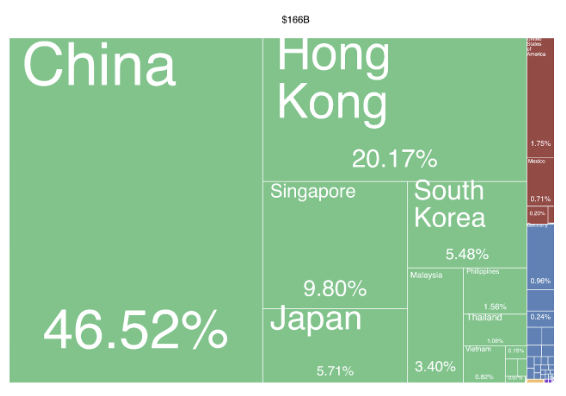
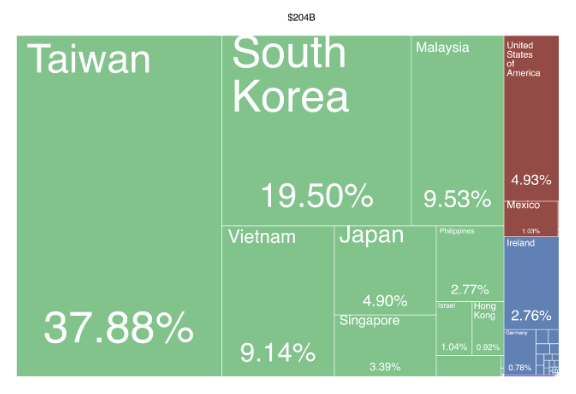
Taiwan is the leading producer of digital monolithic integrated circuits (ICs), exporting $164B annually or 23% of the entire world’s export supply. ICs, also known as microchips or chips, are the essential component of any electronic device, from smartphones to washing machines to cars and fighter jets, and powers the world’s digital infrastructure.
Figure 1: Electronic Integrated circuit (ICs) Exports by Country, 2020
(Source: Atlas of Complexity)
As China and many other countries attempt to close the gap in the global chip race, Taiwan remains home to more than 90% of the manufacturing capacity for the world’s advanced ICs.
The root of Taiwan’s chip manufacturing success can be traced back to the founding of the Industrial Technology Research Institute (ITRI), a government-supported nonprofit with the goal of promoting industrial technology development, in the 1960s. The institute worked with foreign partners to acquire IC technology and fund the incubation of the world’s top semiconductor foundries today: Taiwan Semiconductor Manufacturing Company (TSMC) and United Microelectronics Corporation (UMC).
Given budgetary constraints, TSMC and UMC operated fabrication plants that produced ICs for other companies, instead of designing its own products. This low-cost model, also known as the pureplay foundry model, began the interdependence of these Taiwanese IC suppliers and their international customers. It created specific knowledge areas in the IC and semiconductor industries, grew IC exports and drove Taiwan’s economic development.
Figure 2: Gross chip exports over time (left), Share of world’s chip exports (right)
(Source: Atlas of Complexity)
Why Taiwan’s stronghold in chip manufacturing is risky
Today, ICs comprise 41.5% of all Taiwanese exports and 25% of GDP. This dependence has made Taiwan’s economy susceptible to a number of recent economic and political shifts, including China’s increased military exercises and TSMC production moves to the United States.
Moreover, the growing semiconductor chip race between the United States, Europe, and Asia have made the future of Taiwan’s semiconductor chip production unpredictable. Each economy or regional block attempts to control the semiconductor production and not overly rely on the other for vital technology and materials.
What is Taiwan’s diversification story?
As these risks intensify, the question of diversification for Taiwan is less straightforward. Taiwan has reached the forefront of technology by producing and exploiting nearly all of the major products currently available. IC and semiconductor production, along with other electronics and machinery products have played a significant role in making Taiwan’s economy highly complex.
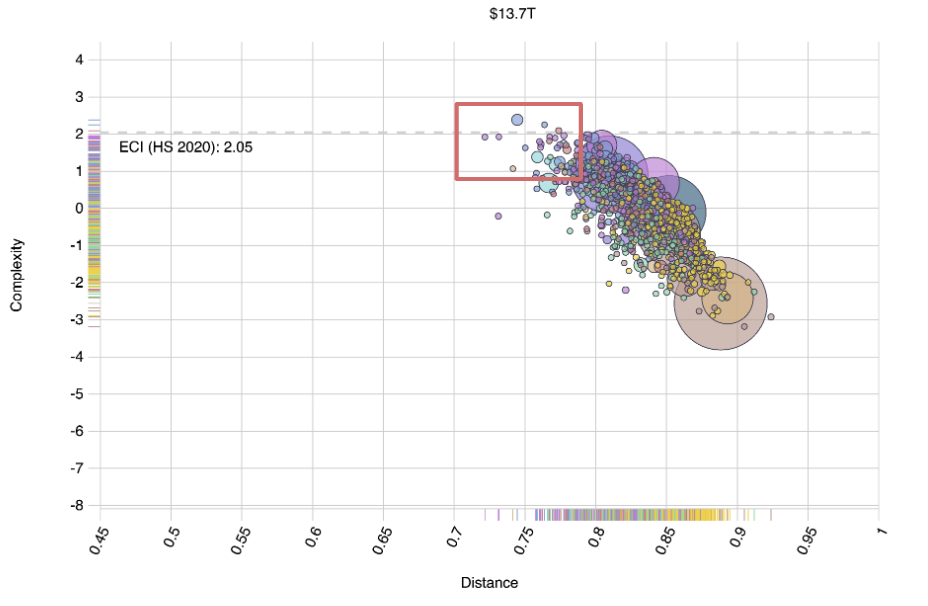
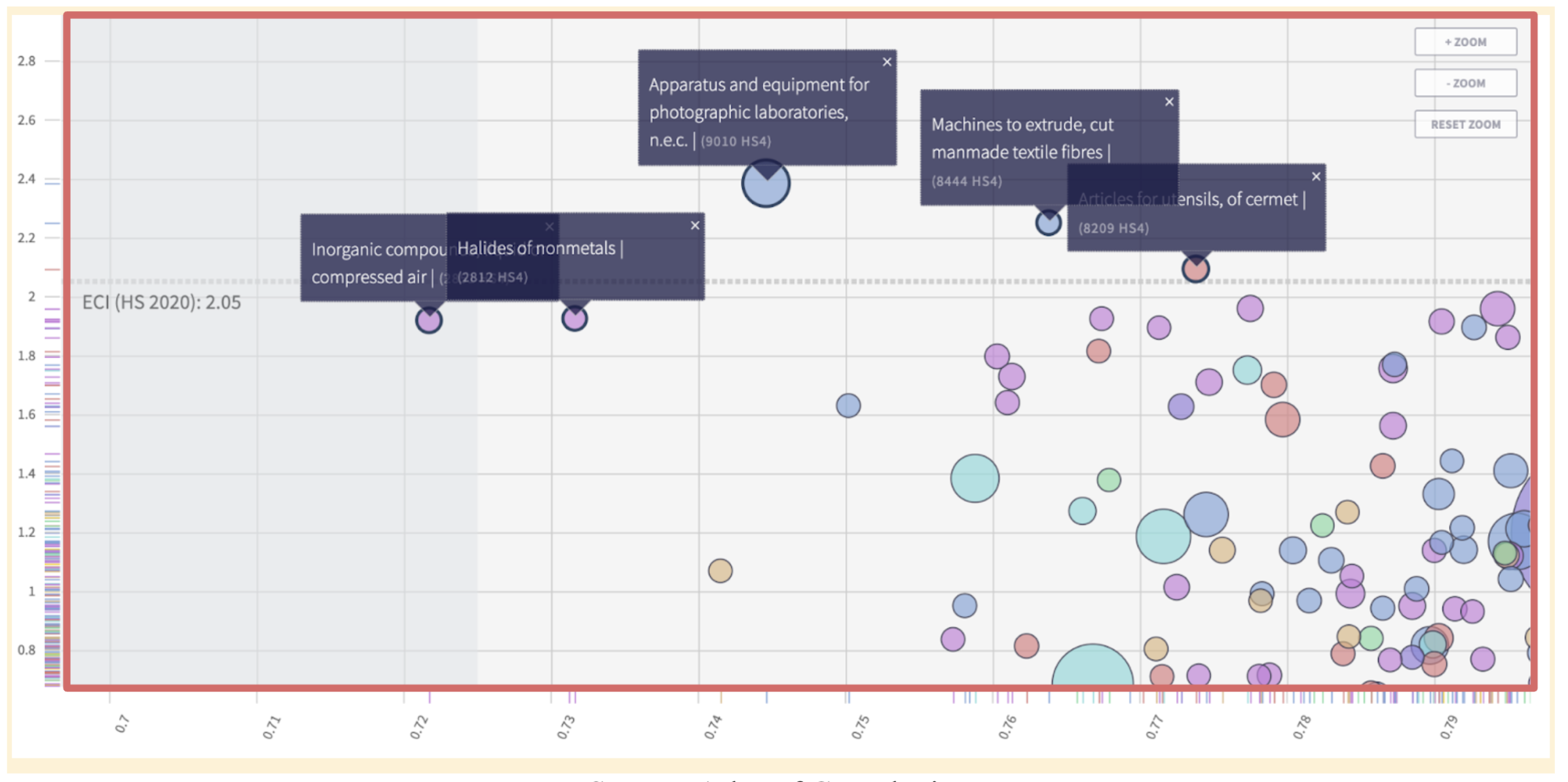
Taking a closer look at Taiwan’s Feasible Opportunities, we identify several potential products that are “closer” in distance and have relatively high complexity and could serve as potential candidates for economic diversification.
Figure 5: Taiwan’s Feasible Opportunities Graph Highlighting Several Products
(Source: Atlas of Complexity)
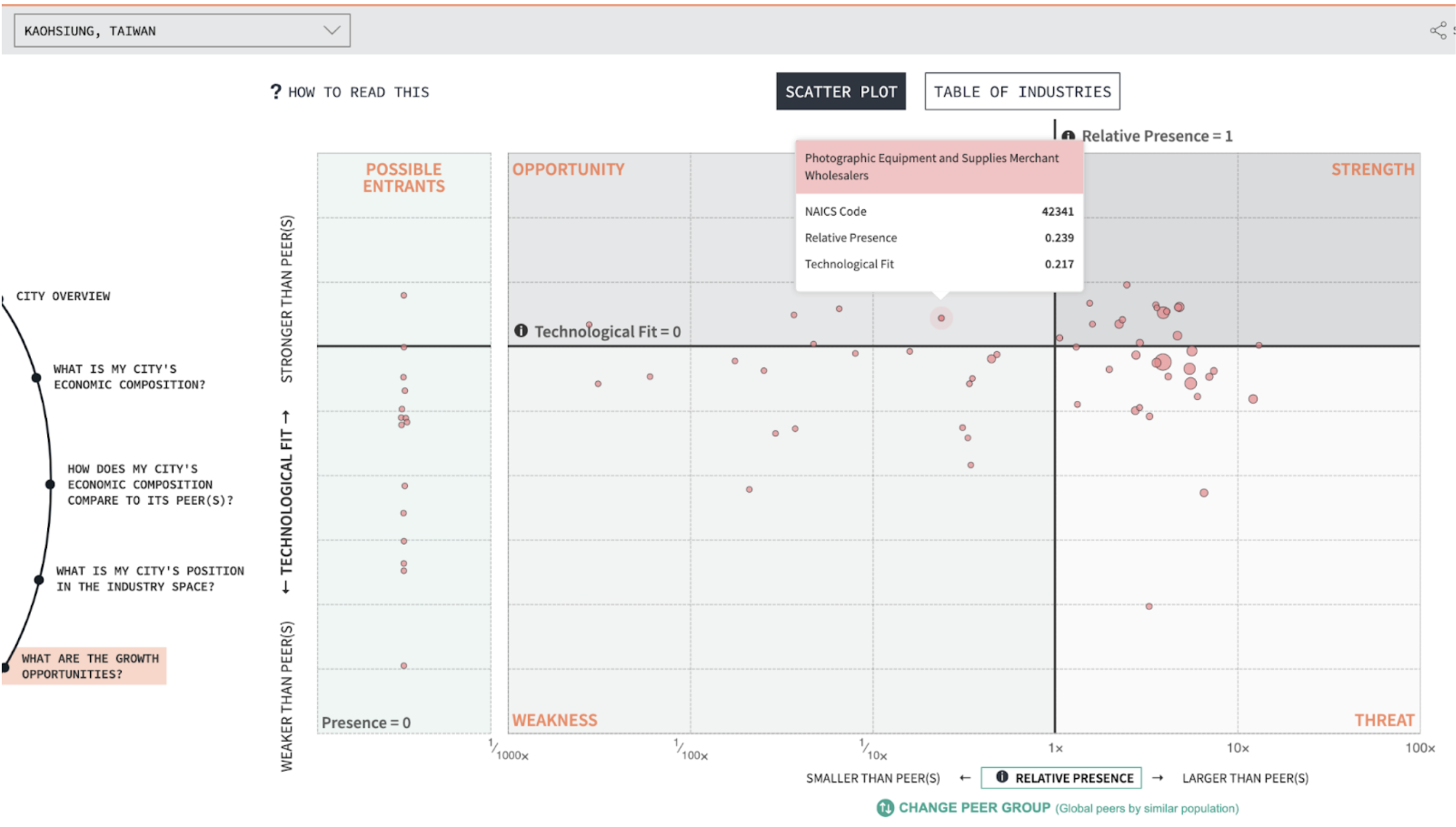
Apparatus and equipment for photographic laboratories could be promising new entrants for Hsinchu, Tainan and Zhuanghua City. This industry is a better technological fit to these cities than that of their selected peer groups. Photographic equipment and supplies merchant wholesalers also presents an opportunity in Hsinchu and Kaohsiung’s trade and transportation sectors.
Figure 6: Kaoshiung Feasible Opportunities
(Source: Metroverse)
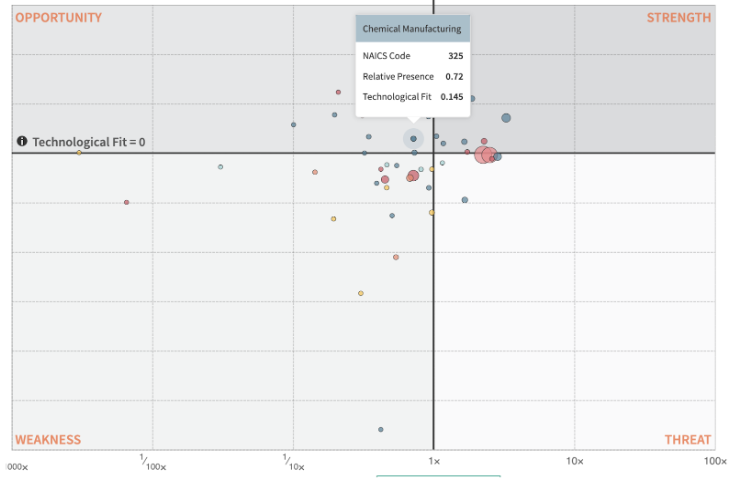
Chemical manufacturing is also an opportunity in the New Taipei Metropolitan Area, which aligns well with Taiwan’s suggested export opportunities in halides of nonmetals, inorganic compounds, and petroleum resins as indicated by Taiwan’s Feasible Opportunity graph.
Figure 7: New Taipei Metropolitan Area Feasible Opportunities
(Source: Metroverse)
However, when we look at potential products Taiwan could export overall in Figure 5, most of the opportunities are “far” away from Taiwan’s current capabilities, given the large minimum distances from Taiwan’s Economic Complexity Index (ECI) line, or the measure of how diversified and complex Taiwan’s total export basket is. It may take a few strategic jumps for Taiwan to diversify into these new products. The bulk of these feasible products are low in complexity, which may not be favorable to a highly complex economy. Therefore, diversification for Taiwan may mean promoting innovation and inventing new products.
Can a better story of diversification be illustrated at the city level?
Metroverse makes visible what a city is good at today to help understand what it can become tomorrow. Analyzing Taiwan’s diversification prospects at the city level yields a clearer picture of which industries have the highest potential based on the city.
The Telecommunications, Apparel Manufacturing, and Printing and Related Support Activities industries provide economic opportunities in most cities. Nonetheless, each city should focus on different specializations and pursue distinct diversification strategies. National policies could assist, but city-specific policies may have a more significant impact.
Figure 8: “Opportunity” Industries based on City
(Source: Metroverse)
A case study for opportunities in the medical industry
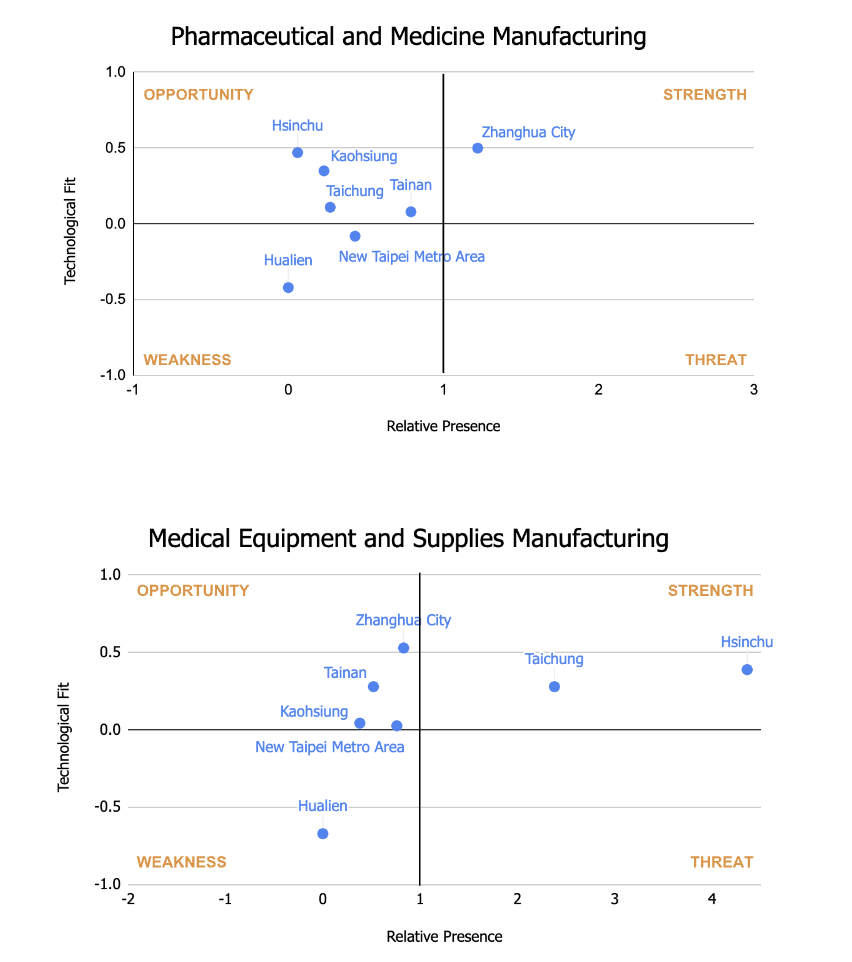
Hsinchu, Kaohsiung, Taichung, Tainan, Taipei Metropolitan Area, and Zhuanghua are six major cities in Taiwan that have opportunities in either the Pharmaceutical/Medicine Manufacturing or the Medical Equipment/Supplies Manufacturing industries. As it turns out, these cities also have existing strengths in the semiconductor, IC, and electronic component manufacturing industries.
Figure 9: Growth Opportunities in Pharmaceutical Manufacturing (Top), Medical Equipment and Supplies Manufacturing (Middle), Semiconductor and other Electronic Component Manufacturing (Bottom)
(Source: Metroverse)
The potential for growth in the Pharmaceutical/Medicine Manufacturing and Medical Equipment/Supplies Manufacturing industries reflects Taiwan’s strategic goal of positioning itself as a worldwide hub for pioneering research and development in the fields of biomedical and life sciences. The government’s 2018 “5+2 Industrial Innovation Plan” indicates that biotechnology is one of seven key high-tech initiatives that will “serve as the central driver of Taiwan’s industrial growth into the next era.”
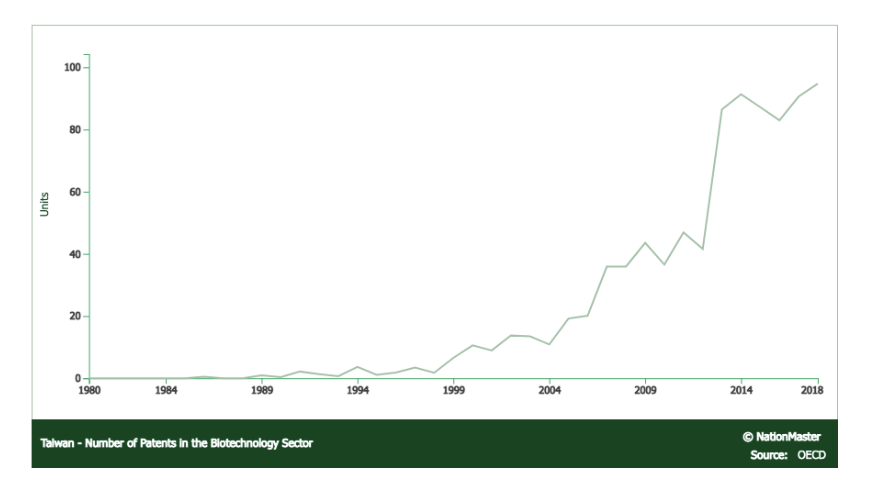
Taiwan has established biotechnology research parks in several cities, equipped with laboratory facilities, office space, and business development services, to support companies in the biotech and medtech sectors. The government has also streamlined market approval and R&D reimbursement timelines and made it easier for small companies to go public. As a result, the total market capitalization of local biotech companies has increased 700% since 2008, and patent data suggests a 1.9% year-on-year increase in biotech innovation.
Figure 11: Number of Patents in the Biotechnology Sector
(Source: OECD)
Looking forward
To lessen its dependence on the semiconductor industry and diversify its economy, Taiwan should explore further opportunities in industries, such as Telecommunications, Apparel Manufacturing, and Printing and Related Support Activities. These industries offer growth opportunities across several major cities.
In particular, the Telecommunications industry has great potential, and its three major providers, Chunghwa, Taiwan Mobile, and FarEasTon, could significantly contribute to this progress. They can do this by extending their 5G services, creating inventive IoT applications in areas such as smart homes, smart cities, and healthcare, emphasizing cybersecurity, promoting public-private partnerships, and investing in talent development.
Some experts suggest that Taiwan should broaden the geographic scope of TSMC’s operations and the semiconductor fabrication industry to other locations as part of its diversification strategy. However, this may not necessarily safeguard Taiwan’s economy. Therefore, apart from supporting broader national initiatives, Taiwan should consider implementing more targeted policies to cater to the unique needs and opportunities of each city’s industry growth potential.
Learnings from LEG & Exploring Growth Challenges in El Salvador
Guest Blog by Abdi Aguirre, LEG ’22
When I enrolled in the Leading Economic Growth Program of the Harvard Kennedy School, I thought that I was clear about the economic challenge I wanted to address along the course. As part of the admission process, they ask you to write some lines about it, so I believed that what I had stated there was a good starting point. However, after the first weeks in the program I realized that addressing such economic challenges is not a merely a “complicated journey,” but a “complex task;” in the first one you just have to follow a certain path or set of instructions to solve it (solution-oriented approach), but the second implies an iterative process to address the problem.
When talking with colleagues from my work group we all faced that iterative process in practice. Every week we had to adjust the definition of our economic growth challenges, it turned to be a continuous learning process for understanding what the real problem was. As a result, some of the main takeaways of the course lay around problem construction (and deconstruction!): it is important to ask the right questions to get to the roots of the problem, and some tools like the fishbone diagram are useful to have a better understanding of it.
One has to keep in mind that this can be a data-intensive process, but the use tools such as the growth diagnostics, help to identify what are the real constraints that are limiting growth in a country. By the way, I was really excited to know that this methodology was first developed for El Salvador by professors Ricardo Hausmann and Dani Rodrik.
In terms of how to jump from diagnostics to practice, I found really useful the approach of identifying small entry points to start making some progress toward the solution of the problem, rather than trying to implement a 5-year strategy or trying to comply with a set of predefined “desirable policies”, which tend to be the most common approach that governments follow. The practice has been to pursue policies to improve doing business rankings for instance, or building infrastructure to trigger economic activity only to find out this was not the real constraint for economic growth. I am certain that all lessons about PDIA (Problem based iterative adaptation) method lectured by Professor Matt Andrews will be a useful tool to address complex matters going forward.
Last but not least, I can say that the whole course has challenged some traditional conceptions and approaches to economic growth. I found of particular interest, the reflections of professor Ricardo Hausmann regarding the “Scrabble theory”, a metaphoric and ingenious way of thinking about development: a country can grow by accumulating capabilities (the letters in Scrabble game!) which allows it to develop not only more activities but more complex activities (more words and longer words!).
It has definitely been a 10-week journey full of new learnings from other countries cases and experiences, and I am sure this learning will continue with the implementation of the given tools.
This is a blog series written by the alumni of the Leading Economic Growth Executive Education Program at the Harvard Kennedy School. 71 Participants successfully completed this 10-week online course in May 2022. These are their learning journey stories.