Over the past ten weeks, this course challenged the way I understand economic growth, public policy, and the hidden mechanics that keep countries like Peru stuck. I came in thinking our biggest challenge was “informality.” I leave understanding that informality is not the problem, but a symptom of deeper constraints, institutional gaps, and missing know-how.
Ideas That Shifted My Thinking
Idea 1: Growth is Not About Doing More — It’s About Doing What Matters
I used to view growth strategies as long lists of reforms. The course flipped that logic: successful countries focus on the binding constraint, the one bottleneck holding the system back. For Peru, it’s not all labor regulation, education gaps, credit barriers, and informality at once — it’s the specific institutional and coordination failures that make formalization unprofitable.
Idea 2: Knowhow Moves Through People, Not Policies
This single insight broke a huge misconception for me. We can train forever, legislate endlessly, or invest in schools. Yet new know-how spreads through migrated talent, diaspora networks, firm spinoffs, and private-sector problem-solvers, not classrooms. That explains why Peru’s informal economy struggles to upgrade — the know-how does not flow where it is needed.
Idea 3: Economic Complexity Is a Compass, Not a Scoreboard
Before the course, I read complexity indicators as static “rankings.” Now I understand them as guiding maps that help identify feasible diversification paths. Peru’s problem is not only low complexity — it is that we are stuck on the periphery of the product space, making small moves instead of strategic leaps.
Idea 4: A Binding Constraint Is Revealed Through Prices, Not Wish Lists
Ricardo Hausmann’s insistence on price signals reshaped how I interpret data. High interest rates for small firms, high costs of compliance, and the wage-productivity gap are all price hints of scarcity — not failures of effort. Prices tell the truth that policy narratives are often obscure.
Idea 5: Change Happens Through Iteration, Not Master Plans
This was the biggest mindset shift. Instead of designing the perfect reform, the course taught me to design learning-driven strategies, test ideas at a small scale, engage many actors, and build solutions adaptively. Growth is not a blueprint — it is a process of discovery.
Taken together, these five ideas left me with one powerful conclusion: Peru will not grow by trying harder — it will grow by learning faster.
Progress on My Growth Challenge: What Changed in 10 Weeks
I began with a broad goal: reducing informality to boost productivity. As the weeks passed, this challenge became clearer, sharper, and grounded in real diagnostics.
Week 1–3: Breaking Down the Problem
Building the fishbone diagram forced me to deconstruct informality into its underlying causes: weak institutions, costly regulations, low trust, lack of know-how, disconnected skills, and inadequate infrastructure. I learned that informality persists because it is often rational for workers and firms under current constraints.
Week 4–6: Identifying Binding Constraints
Using Atlas data and price-based logic, I found the binding constraint is not low skills or lack of credit per se, but weak institutional coordination and a high-cost, low-value regulatory environment that makes formalization unattractive. This insight reframed the growth challenge.
Week 7–8: Defining Entry Points
I realized that countries win by choosing specific green niches and developing ecosystems around them. For Peru, this means leveraging existing strengths (minerals, biodiversity, energy potential) while investing in know-how to move up green value chains. The key insight from these weeks were that the transition is fundamentally a competition for capabilities, and early movers can turn it into long-term productive transformation.
Week 9–10: Building a Strategy
I learned that measurement is a strategic tool that guides learning and course-correction, not an administrative task. What matters is detecting early signs of transformation—new capabilities, greener production, stronger networks, more sophisticated exports. These weeks taught me that progress must be measured through evolving capabilities, not static indicators.
In short, the challenge I started with became a strategic agenda grounded in problem-driven, evidence-based learning.
Using What I Learned: Five Practical Applications
1. Designing Policies as Experiments, Not Decrees
I will advocate for small pilots to test reforms before scaling them, especially in labor formalization.
2. Using Complexity Maps to Guide Sectoral Policy
Sector diversification efforts will focus on adjacent possible products where Peru already has partial knowhow.
3. Building High-Bandwidth Teams
I now understand which institutions are low vs. high bandwidth and how to help them work as learning systems.
4. Using Diaspora and Private Networks to Move Knowhow
Instead of relying solely on public training, I will push for strategies that bring people with knowhow into Peru, especially for green industries, digital services, and advanced manufacturing.
5. Measuring Inclusion and Productivity Together
I will combine complexity indicators with labor informality, wage-productivity gaps, and firm productivity metrics to monitor Growth + Inclusion.
As I move forward, I find myself grappling with a set of interconnected questions that will shape how I continue exploring economic growth and public policy. I wonder how policymakers can design interventions that remain adaptive in environments defined by uncertainty, limited state capacity, and political volatility—and, just as importantly, how evidence can be translated into decisions when institutions struggle to absorb complexity. This leads me to ask whether behavioral insights, incentive design, and implementation science can meaningfully close the persistent gap between policy intention and real-world outcomes.
At the same time, I am curious about how countries like mine can foster innovation and productivity while confronting structural barriers such as informality, governance limitations, and uneven access to opportunities.
Finally, I keep returning to a broader, unresolved question: how can we balance the pursuit of growth with social legitimacy, ensuring that reforms not only generate economic value but also earn the trust and participation of citizens? These questions will guide my next stage of learning, pushing me to move beyond frameworks and toward a deeper understanding of what it truly takes for societies to grow.
This course changed the way I see Peru, growth, and the role of government. I now understand that growth is not a matter of political will, financial resources, or designing the right reform package. Growth is a process of discovery, fueled by collective learning, new know-how, and the capacity to adapt.
I leave this experience convinced that Peru has the potential to grow — but only if we build institutions capable of listening, experimenting, coordinating, and iterating. The path to prosperity is not linear. It is a network of opportunities waiting to be uncovered by teams who learn faster than the problems evolve.
Economic growth is not something we impose on a country. It is something we learn our way together.
This is a blog series written by the alumni of the Leading Economic Growth Executive Education Program at the Harvard Kennedy School. 63 Participants successfully completed this 10-week online course in December 2025. To read more learning journey stories, visit the Building State Capability program blog.
Reversing New Mexico’s Brain Drain Through Economic Diversification
Guest blog by Rita Gaurin, LEG ’25
Over the past ten weeks, I’ve immersed myself in understanding one of New Mexico’s most pressing challenges: the persistent out-migration of our educated workforce and the struggle to diversify our economy beyond extractive industries. This journey has fundamentally shifted how I think about economic development, moving me from viewing problems through a single lens to understanding the intricate web of factors that either enable or constrain regional growth.
At the start of this journey, we were told “your group is your gift,” and those words proved profoundly true. Working alongside teammates from China, Morocco, and Nigeria revealed that while our contexts differed, the fundamental challenges of regional economic growth connected us all. This cross-continental collaboration reinforced that solutions to local problems can arise from examining how others navigate similar complexities in vastly different settings.
My first major insight came from recognizing that New Mexico’s growth challenges aren’t simple problems with straightforward solutions. The state faces “complicated and complex problems” with issues involving multiple stakeholders, evolving circumstances, and interconnected systems.
New Mexico’s per capita income has consistently lagged the national average, and economic growth has remained slow and inconsistent for decades. As of 2024, the state’s per capita personal income ranked as the fourth lowest of all 50 states, at 87.3% of the US level. This isn’t just about numbers; it represents real families struggling to build prosperous lives in their communities.
The PDIA Approach vs. Traditional Methods
One of my most transformative learnings came from understanding Problem-Driven Iterative Adaptation (PDIA) as an alternative to the Solution- and Leader-Driven Change (SLDC) model. The PDIA method resonated deeply because it requires continuous learning, rapid experimentation, and the ability to pivot when strategies don’t work. It’s messy, iterative, and fundamentally more honest than pretending we have all the answers upfront. Living in New Mexico, the Land of Enchantment, I find myself embracing the “enchantment of the unknown” through PDIA.
The Binding Constraint Framework
Learning to identify binding constraints transformed how I analyze policy options. Rather than pursuing a scattered “laundry list” of reforms, effective strategy requires pinpointing the single most restrictive factor holding back growth—then relentlessly focusing resources there.
For New Mexico, I’ve come to believe the binding constraints include:
Limited know-how and workforce development due to an insufficiently diversified economy
Weak partnerships between universities and local employment needs
Quality of life factors, including inadequate urban amenities and limited social infrastructure
Negative perception fueled by narratives suggesting better opportunities exist elsewhere
Reframing the Problem
Initially, I viewed the challenge simply as “graduates leaving the state.” Through the course, I evolved to see it as “retaining talent through economic diversification” and recognizing that we can’t just convince people to stay; we must create compelling reasons for them to remain.
The data tells a sobering story. Since 2010, nearly 19,000 educated professionals have left New Mexico—a devastating loss for a small-population state. The economic impact extends far beyond individual departures. Each leaving graduate represents lost tax revenue, missed entrepreneurial ventures, and fewer role models for the next generation. This know-how drain creates a “self-perpetuating cycle”: fewer skilled workers mean fewer companies locate here, which means even fewer opportunities, accelerating further outmigration.
From Problems to Entry Points
Using the fishbone diagram, the course taught me to think about “entry points”—where to begin engaging the system to create momentum. Additionally, the practice of repeatedly asking “why” will be a valuable tool in my problem analysis. Each answer digs deeper, uncovering the real root cause rather than stopping at the symptoms. I identified five accessible entry points:
Fostering university-industry partnerships through existing infrastructure like Los Alamos National Lab
Development projects in downtown areas to enhance community vibrancy
Implementing targeted initiatives like speaker series and success story campaigns
Developing tax incentives for companies hiring and retaining recent graduates
Establishing regional talent retention task forces with cross-sector stakeholders
These entry points share a common thread: they can be initiated without extensive legislative hurdles and generate visible momentum while building coalition support for larger structural changes.
Building Information-Intensive Organizations
One powerful insight involved rethinking how government organizes around talent retention. Rather than housing initiatives within siloed institutions, there is tremendous value in creating collaborative teams with representatives from education, business, and government sectors. This team would have authority to allocate resources based on evidence identifying effective graduate retention strategies.
Implementing a dashboard to monitor outcomes—graduate migration patterns, employer demands, intervention effectiveness—would provide the continuous feedback loop essential for adaptive strategy. This moves us from guessing to knowing, from ideology to evidence.
The Iterative Strategy Approach
The course emphasized an action-learning framework that I’ve found extremely valuable. Rather than developing perfect five-year plans destined for shelves, the iterative approach involves:
Rapid learning through small experiments that test assumptions
Fostering new interactions between previously disconnected stakeholders
Collaborative problem-solving that surfaces local knowledge
Quick pivots when strategies aren’t working
Uncovering hidden opportunities through continuous discovery
The iterative method’s greatest strength is that it minimizes risks while maximizing learning. Quick feedback enables course corrections before significant resources are wasted. It creates early buy-in from stakeholders who feel ownership over solutions they’ve helped create. However, we need to be prepared for potential challenges, as some stakeholders may resist uncertainty and favor more predictable outcomes. The iterative approach could be viewed as a failure if there isn’t a strong political commitment to experimentation. If progress isn’t maintained, initiatives risk losing their momentum and support.
An important concept learned was the notion of the “sense of us.” The collective identity and shared purpose that binds a community or region together. Without a strong sense of us, regions may struggle to coordinate, build trust among stakeholders, and sustain the collaborative efforts needed for long-term development. As Professor Haussman pointed out, the term “us” carries a profound beauty, with its meaning often understood implicitly among those engaged in the conversation. The individuals involved inherently grasp who is included in that collective “us”. The concept is like a vital ingredient in a recipe; without it, the intended flavor cannot be achieved.
For New Mexico, this insight hit home. Perhaps the brain drain isn’t about better job opportunities elsewhere; perhaps it reflects a missing “sense of us,” an imagined community, where educated workers don’t see themselves as part of New Mexico’s future story. Building prosperity requires cultivating this essential ingredient where diverse communities, industries and individuals see their fates as interconnected and the state’s success as their own.
This course has convinced me that reversing New Mexico’s brain drain and achieving economic diversification requires moving beyond traditional approaches. We need:
Evidence-based iteration rather than ideological commitment to predetermined plans
Cross-sector collaboration that brings education, business, and government into genuine partnership
Determining the binding constraint rather than scattered initiatives
Continuous learning that embraces experimentation and honest assessment of what works
The path forward isn’t about finding the “one solution” but about building adaptive capacity—creating systems that can learn, adjust, and continuously improve. It’s about fostering an environment where young professionals see New Mexico not as a place to settled for, but as a place offering vibrant arts, safe neighborhoods, competitive salaries, diverse career paths, and communities worth staying for.
New Mexico has a unique opportunity to achieve both economic diversification and workforce retention simultaneously through a “grey to green” energy transition. With significant solar, wind, geothermal potential, and copper mining the state can leverage existing energy infrastructure and expertise while evolving towards clean energy. Going from grey to green addresses core challenges: it diversifies the state’s economy beyond extractive industries, creates competitive careers that give young professionals a reason to stay, and builds on capabilities that the state already has.
New Mexico is the “Land of Enchantment.” My hope is that through strategic, iterative, collaborative economic development, we can help the current and next generations discover economic opportunities they haven’t yet imagined right here in our own backyard. Opportunities that not only match but surpass those available in other states, making the choice to stay in New Mexico not just feasible, but truly enchanting!
This is a blog series written by the alumni of the Leading Economic Growth Executive Education Program at the Harvard Kennedy School. 63 Participants successfully completed this 10-week online course in December 2025. To read more learning journey stories, visit the Building State Capability program blog.
LEG in Practice: Exploring Growth Opportunities and Renewable Energy in Western Australia
Guest Blog by Warner Priest, LEG ’22
In many cases, I find when faced with a challenge it is difficult to know where to start and what to do and I find myself procrastinating. The step-by-step approach to Problem Driven Iterative Adaptation (PDIA) has become a useful tool to getting whatever challenge I am faced with underway. Breaking down the problem into its root cause, looking for possible solutions, identifying entry points then taking action, reflecting upon what was learned, adapting and then going through the process again – gets the process or journey underway.
I like the fluidity of this process with the small successes along the way that help build authority, acceptance and legitimacy, providing one with the feedback that ultimately leads to a solution that suits.
I found the ATLAS tool very powerful and useful, being able to understand what our countries exports are made up of, whether our exports have evolved over time and what we as a country produce and the complexity of our products.
Through the ATLAS tool I discovered to what extent the Australian economy relies on the export of just a few of its natural resources like Iron Ore, Coal and Natural Gas. And whilst Australia up until COVID had experienced 27 years of uninterrupted growth, the economy is on a knife-edge due to the likely disruption in fossil fuels, its reliance on China for its export commodities and its lowering complexity index due to the closing down of it manufacturing sector and its lack of diversity.
My growth challenge, working with InterContinental Energy, our large-scale renewable energy projects to produce green fuels at Oil & Gas scale, provides Australia, in particular Western Australia with a unique opportunity to diversify its economy by manufacturing green products using very cheap renewable electricity and hydrogen as its key competitive advantage to do so.
Over the last 10 weeks I’ve had an initiative underway with the Western Australian State Government on the concern around our economies lack of diversity. I have been using the processes and tools I learned on this program to initiate the engagement, garner the interest and to cut through the bureaucratic red tape of government.
Just recently, we submitted an application to government detailing our vision and what needs to be done between the government and the private sector to take advantage of this unique opportunity in the renewables sector. It is clear that there is interest, but that this is just the very beginning of a long journey.
This is a blog series written by the alumni of the Leading Economic Growth Executive Education Program at the Harvard Kennedy School. 71 Participants successfully completed this 10-week online course in May 2022. These are their learning journey stories.
LEG Learnings: Inclusive Growth and Redistributive Inequality in Namibia
Guest Blog by Charlotte Tjeriko-Katjiuanjo, LEG ’22
The growth problem I chose to look at for Namibia is a lack of a diversified sector, which has caused high unemployment and low economic growth. The country has a high and increasing public debt, limited fiscal space, fiscal consolidation, increasing unemployment with limited product space.
The course has taught me to look at the problem with a different eye, distinguishing between the actual cause of the growth problem to the symptoms of the growth. This was quite a revelation to me, that sometimes as a country, we think something is a problem while the problem is something completely different. This made sense as to why the country was failing to the growth problem into positive trajectory after so many good policies were introduced, because they were diagnosing a problem that didn’t exist. Looking at the 3 As (ability, authority and acceptance) and asking the 5 why’s was quite an eye-opener.
The fishbone diagram was quite an eye-opener, because at times we already have the solutions (mainly from a laundry list of reforms we got from some index), and in most cases this means diagnosing a non-existent problem. What I learned from the fishbone diagram was the need to ask why a problem is a problem, getting the underlying and real cause of the issue.
In the course we learned about product space and the importance of a diversified economy, this was not something new because a few years ago, during the Bank of Namibia annual symposium, we had a speaker from the Asian Development Bank (Dr. Felipe), who said the exact same thing. However, as a country, we took this to mean that we needed to add value to our raw materials, not knowing that we do not always have the set of skills needed for this value addition. What I learned from the course was that we needed to work with the set of skills already in abundance in the country.
What was most interesting to me during the course was the inequality part. As a country with one of the highest inequality in the world, it was quite interesting learning about the different types of inequality. Ultimately, the course taught us the difference between redistributive inequality which was scarce resources being dedicated to redistribution, compensating those with low-productivity for low productivity, from inclusive growth, which should aim to better include low-productivity workers in high-productivity activities. Inclusive growth calls for a rethink of the role of transportation and urban policy. As a country, we have been more focused on redistributive inequality, which, to a certain degree, is understandable due to the nature of how the inequality was formed (apartheid). This tends to create a bit of division between the citizens and doesn’t actually fix the inequality problem.
Creating a sense of us has always been at the back of our minds, but that some policies could be lacking because there isn’t a sense of us (or sufficient) was interesting to learn.
I am also glad that we had quite a diversified team from Namibia that went through the course, which was commissioned by the Namibian government, this means we have at least some acceptance and authority from the government. What we plan to do as the team from Namibia is to come together and go through what we have learned over the 10-week duration and how we can address the issues in the country and come up with strategies from our fishbone diagrams. What we have done throughout the course was to have weekly meetings on Fridays to go through the material and help each other understand it better.
The course was all-around interesting and worth the time and effort. I am thankful to all the faculty members for their outstanding work and patience with us. I am also very thankful to our group (Go with the Flow), it was interesting to see the diversity in the group, the care and patience they showed, and their willingness to give advice on our different problems. I am also grateful to my TA, Anne, her advice to the assignments assisted me to understand the problem better and look at avenues that I did not think of before.
This is a blog series written by the alumni of the Leading Economic Growth Executive Education Program at the Harvard Kennedy School. 71 Participants successfully completed this 10-week online course in May 2022. These are their learning journey stories.
Applying LEG Insights to Growth Challenges in Azerbaijan
Guest Blog by Anar Azimov, LEG ’22
I have come across to the Leading Economic Growth quite by chance. We were discussing with my colleague’s various capacity building options and resources, and one of our colleagues referred to this particular course at the Harvard Kennedy School. Of course, it goes without saying that quality and professionalism of Harvard Schools is a brand. I have read about the course consulted with wide range of colleagues and made decision to take it. After the 10 weeks of course, I can confidently say that it was right decision. First of all, the curriculum, materials provided, lecturers and live Q&A sessions was very well articulated and suited for learning the content of the course.
The major takeway from the course is identification of growth challenge in my country and my job, as well as the process of development of Problem Driven Iterative Adaptation concept, fish bone exercise, economic complexity and Atlas of economic complexity, moreover the network of professional colleagues from all over the world. I have gained the insight of my current challenge which is related to the development of agricultural extension service.
At the beginning of the course I had more broad challenge which I decided to narrow down to the problem which can be solved and contribute to the more higher-level problems. Actually, I’ve identified agricultural extension as an entry point, where I could immediately start working to solve the growth problem. Instead of thinking of a policy for every cause, I narrowed my thinking down to the sub-cause which is the most promising. This entry point I can start, based on my work/capabilities and on current authority.
I will definitely employ the knowledge which I gained in the course in my work and will try to share this experience with my management colleagues and subordinates. Actually, I have already started to apply the fish bone diagram with my colleagues and they all found it quite instrumental. In fact, I will continuously refer to the material in the Canvas and ensure iteration with adaptation.
Finally, I will miss the jargon and funny comparison of serious development items with monkeys, trees and letters, which was used by our respected professors. This is good memories and in fact interesting tools to remember and simplify the complex issues.
This is a blog series written by the alumni of the Leading Economic Growth Executive Education Program at the Harvard Kennedy School. 71 Participants successfully completed this 10-week online course in May 2022. These are their learning journey stories.
Learnings from LEG & Exploring Growth Challenges in El Salvador
Guest Blog by Abdi Aguirre, LEG ’22
When I enrolled in the Leading Economic Growth Program of the Harvard Kennedy School, I thought that I was clear about the economic challenge I wanted to address along the course. As part of the admission process, they ask you to write some lines about it, so I believed that what I had stated there was a good starting point. However, after the first weeks in the program I realized that addressing such economic challenges is not a merely a “complicated journey,” but a “complex task;” in the first one you just have to follow a certain path or set of instructions to solve it (solution-oriented approach), but the second implies an iterative process to address the problem.
When talking with colleagues from my work group we all faced that iterative process in practice. Every week we had to adjust the definition of our economic growth challenges, it turned to be a continuous learning process for understanding what the real problem was. As a result, some of the main takeaways of the course lay around problem construction (and deconstruction!): it is important to ask the right questions to get to the roots of the problem, and some tools like the fishbone diagram are useful to have a better understanding of it.
One has to keep in mind that this can be a data-intensive process, but the use tools such as the growth diagnostics, help to identify what are the real constraints that are limiting growth in a country. By the way, I was really excited to know that this methodology was first developed for El Salvador by professors Ricardo Hausmann and Dani Rodrik.
In terms of how to jump from diagnostics to practice, I found really useful the approach of identifying small entry points to start making some progress toward the solution of the problem, rather than trying to implement a 5-year strategy or trying to comply with a set of predefined “desirable policies”, which tend to be the most common approach that governments follow. The practice has been to pursue policies to improve doing business rankings for instance, or building infrastructure to trigger economic activity only to find out this was not the real constraint for economic growth. I am certain that all lessons about PDIA (Problem based iterative adaptation) method lectured by Professor Matt Andrews will be a useful tool to address complex matters going forward.
Last but not least, I can say that the whole course has challenged some traditional conceptions and approaches to economic growth. I found of particular interest, the reflections of professor Ricardo Hausmann regarding the “Scrabble theory”, a metaphoric and ingenious way of thinking about development: a country can grow by accumulating capabilities (the letters in Scrabble game!) which allows it to develop not only more activities but more complex activities (more words and longer words!).
It has definitely been a 10-week journey full of new learnings from other countries cases and experiences, and I am sure this learning will continue with the implementation of the given tools.
This is a blog series written by the alumni of the Leading Economic Growth Executive Education Program at the Harvard Kennedy School. 71 Participants successfully completed this 10-week online course in May 2022. These are their learning journey stories.
Broadening the Sense of ‘Us’: Exploring LEG Principles in Western Australia
Guest Blog by Pippa Hepburn, LEG ’22
When we started Leading Economic Growth (LEG) ten weeks ago, I was confused by the repeated assertions from Keisha and the teaching staff that they were ‘excited’. I figured, like any good laconic Australian, that they would surely tire of this pretence and I would eventually see the real people behind the energetic façade.
Ten weeks later, I’ve stopped waiting for any masks to slip. Week after week, I have been privileged to learn from brilliant, passionate people who care about their work and the communities they work for. There is no sign that the LEG team is anything other than deeply committed to economic growth for the greater good of humanity.
We are told that leadership is by example, and we should try to embody the principles we most admire. I have experienced the LEG team lead us by example to a better way of approaching our work and understanding our economic environment. They live it and they teach it – and it was obvious from the final course presentations that they have a profound effect on their students.
I was born outside Australia and raised here by rather un-Australian parents. No sports or meat pies were consumed in my household. My sense of the Australian ‘Us’ has been informed by years of careful study of my fellow citizens and I have retained a suspicion that I am not quite ‘one of Us’. However, while I completed LEG and talked with my beautiful team members Jorge, Mauro, Olivier, Sisay and Beto, I discovered just how Australian I am. I also realised that my thinking has become parochial and complacent. These realisations have opened my mind to many possibilities for personal growth and development. Far from being scared by this, I am encouraged to try harder and learn more.
In my application to LEG, I described my love for the small inland towns of the Great Southern region of Western Australia, and my concern regarding their ever-dwindling populations. I was focused on the lack of opportunities for these communities, and the vicious cycle of opportunity loss leading to emigration and further population decline.
Now that I have completed the course, I might express my concern that these small towns exist in a regional economy that is insufficiently complex, with only a few simple exports and poor access to the inputs that provide opportunities for growth. I might also risk offering the opinion that economic growth in Western Australia is not inclusive and there is insufficient State investment to improve access to these inputs in my region.
I might further suggest that, if the binding constraints such as water supply, power grid access and digital connectivity are relieved, and new industries are developed, the people in these small towns will need to ensure their own growth is inclusive. To have a truly prosperous region, we need to broaden the sense of ‘Us’ to embrace diversity and harness the knowhow that exists in the new, different, and marginalized sectors of our population. We need to stop importing people for labour and ignoring their talents and ambitions. We need to value Others and make them Us.
However, this is only my opinion. Instead of telling people what I think, I want to gather a group of representatives from around the region and ask them to join me in seeking the truths behind our situation. I will try (and fail) to muster the eloquence and vitality of Matt Andrews when discussing the complex nature of our problem. I will introduce tools such as fishbone diagrams and growth diagnostics to analyse our problem. Our group members will be inspired to reach out to others and form their own groups, expanding the circles of connection and knowledge and seeking information from many people in a coordinated yet non-hierarchical manner.
We will document our progress and achievements on this journey because we will need to build and maintain legitimacy and authorisation for the work. My aim is for the work, and the lexicon, to become a common understanding in my agency, and the PDIA approach a business-as-usual activity (fitted between more tedious activities such as grant administration and hosting soirees for visiting dignitaries).
On our journey, I will introduce some shorthand terminology, because I desperately need to discuss hippos in the desert with people around me (I have been seeing them everywhere!). I also need everyone to devour the juicy Atlas of Economic Complexity and comprehend the product space. It will help us to understand that distributing random extra letters into our economy isn’t going to propel us into a paradise of complex exports. Instead, we should strategically invest in a few new words using our existing letters and the considered introduction of new ones. I’m also going to enjoy challenging the (widely held) assumption that we must ‘value add’ to our raw materials. After all, we can go beyond wheat, sheep and wine. However, I won’t be able to explain any of this with the intellectual panache and charm of Ricardo.
I will seek to demonstrate, and inspire others to believe, that information must be sought at every opportunity. This may be from agencies, experts, industries, businesses, hippos… monkeys… well, you know what I mean. I also want to demonstrate that data must be gathered and analysed to critically assess our ideas. As part of this data gathering, we will work together to create and monitor key metrics for our success; these might include job creation in new industries, gross regional product growth outside the primary production sector, uptake of tertiary education and growth in populations of families with school-age children. Finally, once we have progressed and effected change, people will tell us they are excited to be moving their family into the region because of all the opportunities it presents to them.
Yesterday, I found myself chatting on the phone with an aquaculture business and asking them about barriers to their development in the region, scribbling away at my notes as I muttered ‘oh that’s very interesting, mmm yes, very interesting…’. It started as a conversation about their supply of fish for an event I was organising and became a vital data point on my journey of discovery.
I appreciated the insight we were given into Ricardo’s journey of discovery when the Sense of Us was discussed. As always when I meet interesting people, my outstanding questions for the LEG team are more personal and philosophical – what makes us who we are? How did the Growth Lab and Building State Capability teams come to be? Are you all philanthropists? Is anyone ever not excited about their work? Do any of you sleep or is it a 24-hour cycle of wide-eyed enthusiasm?
I can’t wait to continue my own journey with my colleagues (at first), followed by representatives from industry, government and community, expanding further and further to people outside the region, the State and the country.
I will tell everyone, with absolute sincerity, that I am excited to be working with them. They might take a while to believe me – but we’ll get there.
Thank you Matt and Ricardo – Salimah, Keisha and Claudia – and of course, the International Growth Geeks – for leading me to a better way of viewing the world and working for my clients.
To learn more about Leading Economic Growth (LEG) watch the faculty video, and visit the course website. This blog was originally published by the Building State Capability program. Visit their blog for more learning journey stories.
Using a problem-driven approach in Ethiopia
Guest blog by Abdu Nuru
This is a blog series written by the alumni of the Leading Economic Growth Executive Education Program at the Harvard Kennedy School. 65 Participants successfully completed this 10-week online course in May 2021. These are their learning journey stories.
It was my director in my department who sent the email to us briefing us about the program. It specifically addressed those who were in a more senior leadership level as it would be more important. I read the whole email and I knew it wasn’t meant for me because it said case team leaders and blah blah blah. And I thought who said that? The last thing I could get is rejection and if I am accepted, it would be a great experience. I applied and I was admitted.
That was my journey to the first formal online program, and it ended up being a very important course especially to people who work in a similar sector to me. From defining a regional or national growth problem to devising a high level and inclusive strategy, Leading Economic Growth offered miraculous insights and approaches on how to solve complex problems.
I work at the Ethiopian Agricultural Transformation Agency, Analytics Department as an Analyst. We usually work in a group of 4-6 people to solve complex and challenging problems, address major constraints in the agricultural sector, and propose creative and adaptive solutions. Although we have a structured approach to solving different kinds of cases, we never usually have the chance to be problem-driven as in the LEG way. A problem or challenge is provided to us and some causes for that, and we try to solve these problems. We don’t examine if these factors or constraints caused the given problem.
In LEG, constructing and deconstructing your economic growth challenge gives you full insight into how to approach your challenge. Diagnosing your growth challenge to reach the exact syndromes, constructing a fish-bone diagram to have a visual of your challenge, identifying your binding constraints give you a real-world experience of addressing growth challenges.
The peer learning session and live Q&A session have given me a new perspective on how to look at the economic complexity of the largest country to the smallest state. I have gained a good share of knowledge on measures of economic complexity, import and export factors, and the relationship between know-how and growth.
Although I didn’t attend all, the deep dive sessions have been thorough on the topics raised. It becomes very clear to someone who even learns it for the first time. The individual assignments on our growth challenge were very important as they were the motivations to read the materials and watch the videos provided to us on Canvas. We shared our assignments in the peer learning group, gave constructive feedback to each other, re-iterated and refined our works to the last time. Every group member was very engaged, supportive, and has been throwing challenging questions with everyone.
I live in Ethiopia, and as you have already known, I am in a complex situation for now. When things get smooth and cool, the first thing I want to do is take a course at the HKS on-campus. I hope that will give me a great experience more than the online program. Thank you so much for your continuous support.
To learn more about Leading Economic Growth (LEG) watch the faculty video, and visit the course website. This blog was originally published by the Building State Capability program. Visit their blog for more learning journey stories.
Analyzing Wyoming’s economic growth process and challenges using LEG tools
Guest blog by Marcio Paes-Barreto
This is a blog series written by the alumni of the Leading Economic Growth Executive Education Program at the Harvard Kennedy School. 65 Participants successfully completed this 10-week online course in May 2021. These are their learning journey stories.
When I got my first job in the field of economic development I started reading everything I could about it. I started noticing a stark difference in the rationale and methodologies proposed by the books I was reading. After a while, it was possible for me to separate what I was going to read (even before I got deep in the book) into two categories: strategy/marketing books and development economics/economics books.
In my professional life, I had my fair share of experiences with marketing and the readings of Porter, Kotler, and Chernev. So the second category was the one that disappeared quickly as I learned interesting new things from the thoughts of economists like Acemoglu, Mazzucato, Duflo, and Moretti. And, of course, from the usual suspects like Adam Smith, David Ricardo, and Joseph Schumpeter. I felt ready for my first day of work.
Well, no plan survives contact with reality. The struggle in the regions I was working with were real and the resources that people had available to deal with their challenges did not seem appropriate. Pre-packed solutions from consultants abounded and nobody seemed to be talking about economics when trying to understand the root cause of their problems. Lucky me. I met a Senator from my region with an economics background and working experience with the U.S. Agency for International Development (USAID), World Bank, and the Inter American Development Bank (IDB). There was so much to learn from these experiences.
In order to keep making sense of all this, I reviewed economic development literature looking for best practices. In my research, I found at the IDB website the paper “Smart Development Banks” (Fernández-Arias, Hausmann, Panizza – 2019). This paper put me in touch with innovative minds and novel ways to address perplexing growth issues. By that time I started encountering frameworks and tools that I needed to tackle some of the complex challenges related to economic growth in my region. Then COVID-19 started and I led several “special” projects for a while.
Around the United States, major economic challenges have been met either with investments in infrastructure or with the use of marketing best practices to segment, target and communicate value (assets) of a community. Nothing inherently wrong with that. However, for example, using a SWOT analysis to identify strengths, weaknesses, opportunities, and threats of a business to determine which investments to make or what to market is a relatively simple task when compared to doing the same for a region and its economy.
While in economies with significant growth, the prevalent approach relied on the application of development economics and of economic principles to create specific growth-oriented policies and programs. Are marketing-based solutions so common in the USA due to unique economic development challenges? Do we still believe in elaborate versions of “if you build it, they will come”?
It is easy to assume in the richest nation where opportunity abounds and institutions are strong, that a region is in economic distress because of the market failure referred to as “information asymmetry.” Other times the immediate assumption for failure to grow is of missing infrastructure (buildings, industrial parks, etc.). However, these assumptions are not precise enough and proper identification of market failures is not a simple task. Also, investments in infrastructure can be ineffective and very costly.
The development story of the United States of America is unique in many ways and can provide more insights into this issue. Previous to the transportation and communication revolutions, the economic challenges of the early American republic (1780-1830) were like the challenges developing countries face today, which, in many cases, can be summarized by people and communities producing goods for their own consumption and/or providing raw materials to others to add value.
However, the investments made around the 1800s in transportation and communication created thousands of miles of new railroads, canals, and telegraph lines opening up the productivity of vast regions of the USA to new markets. After this significant infrastructure build up, rural producers could turn what they produced beyond their own consumption into cash. The new material wealth allowed access to things previously out of reach to improve their lives.
Investments were also made in innovative technologies, productivity increased, and more wealth was generated. This quest for productivity led to an explosion in the number of new patents. Entrepreneurs and the state also developed contractual infrastructure where property rights, labor, equity, and debt rules mitigated investment risks.
“Little else is requisite to carry a state to the highest degree of opulence from the lowest barbarism, but peace, easy taxes, and a tolerable administration of justice; all the rest being brought about by the natural course of things.” – Adam Smith
With these foundations in place and the promise of economic opportunity for all, immigrants from all over the world came to the USA in the late 1800s and early 1900s. The influx of new brains (knowhow – tacit knowledge) and the industrial revolution (tools, machines, and patents – codified knowledge) created a great ecosystem. Businesses flourished everywhere, and continued productivity gains created significant wealth in many regions.
So, if this is the American development story, why is it so hard to replicate? Why are businesses not continuing to flourish everywhere in America? Why are some rural economies struggling? And why does the productivity inequality between the metropolitan areas and rural areas continue to increase?
I was trying to piece all this together and learn about what was being done in the USAID, Harvard’s Growth Lab, and MIT’s development economics practices, but I had mixed results and slow progress.
Things really changed when I attended the course Leading Economic Growth (LEG) at Harvard Kennedy School. The course was co-led by Professors Ricardo Hausmann and Matthew Andrews, with a team from Harvard’s Center for International Development (CID), including members of the Growth Lab and Building State Capabilities teams.
This course organized in a comprehensive and easy way what I needed to analyze Wyoming’s growth process and growth challenges. The course also provided me with a framework to engage entrepreneurs, local governments, and stakeholders in effective ways to find solutions to long lingering economic challenges. It also allowed me to better construct and deconstruct a regional growth challenge and identify what the constraints to growth are, instead of relying on pre-packaged solutions or solutions that are best suited for the private sector.
Here are a few of my takeaways from this learning experience:
· Start with a growth-related problem, ask good questions, build a team, develop solutions, iterate, and keep moving. Harvard’s Building State Capability program calls that approach Problem Driven Iterative Adaptive (PDIA). It is like Agile for economic developers. More information here: PDIA Toolkit
· Development is dependent on productive knowhow and growing your economy depends on increasing it. You can gain insights about your existent productive knowhow using what Harvard’s Growth Lab describes as Product Space. Both Atlas of Economic Complexity, Metroverse, and Observatory of Economic Complexity are excellent tools to start understanding your product space and productive knowhow.
· Relevant data and economic models coupled with analytical capability are as important as stakeholder engagement and agility (as in Agile iterations). Integrating the two takeaways described above is crucial to accurately diagnose your growth syndrome and find your growth path.
· Finally, you need discipline and rigor to properly identify your growth syndrome and that starts with a differential diagnosis remarkably similar to the diagnosis used in medicine. And just like in medicine your relationship with your patient (industries and businesses) is critical for a proper assessment.
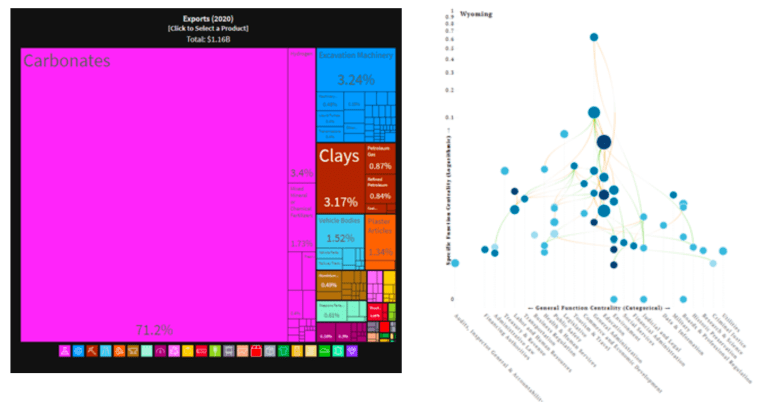
Export basket and State Capacity – What is the correlation between economic complexity and public goods? Source: Observatory of Economic Complexity and Functional structures of US state governments (Kosack, 2018)
This course also advanced my understanding of economic development by exposing me to growth problems that impacted and still impact other regions of the world. As I mentioned above, the development story in the US is unique. However, learning about international challenges (and solutions) helped me to understand that eliminating binding constraints is the most effective development action that someone can take. As many regions of the world don’t have resources to spare, they need to be very specific about the levers they will use to grow their economies.
HKS’s Leading Economic Growth does not provide you with a silver bullet or answers for all your challenges. Instead, you will have at your hands several frameworks and models to better understand and address your region’s growth constraints.
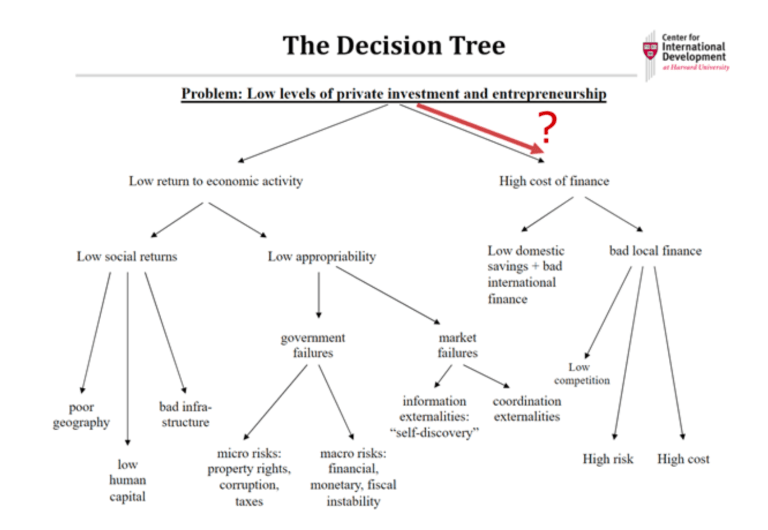
Identifying constraints – Why do you have low levels of private investment and entrepreneurship? Source: Course Material – Hausmann LEG 2021 – Wk6S1 – Growth Diagnostics in Practice
We know that investments in infrastructure are capital intensive and the current repertoire of tools used by economic developers are not changing the situation in the regions of the USA that need economic growth the most. So, maybe we should look beyond our borders, and learn how Singapore increased its GDP 10-fold since the 1990’s? Or examine how to do economic development when you don’t have funds to create incentives? And what can we learn from the interesting fact that, Germany and Canada have fewer regional disparities than the United States, but the United Kingdom has the same disparities as the US?
I was impressed with the amount of applicable knowledge and on-the-job training that the LEG course provided. As a former experiential educator, I can say that is no small feat. In a true Harvard spirit, the course discussions and assignments provided me more than the course content.
“The great difficulty of education is to get experience out of ideas.” George Santayana
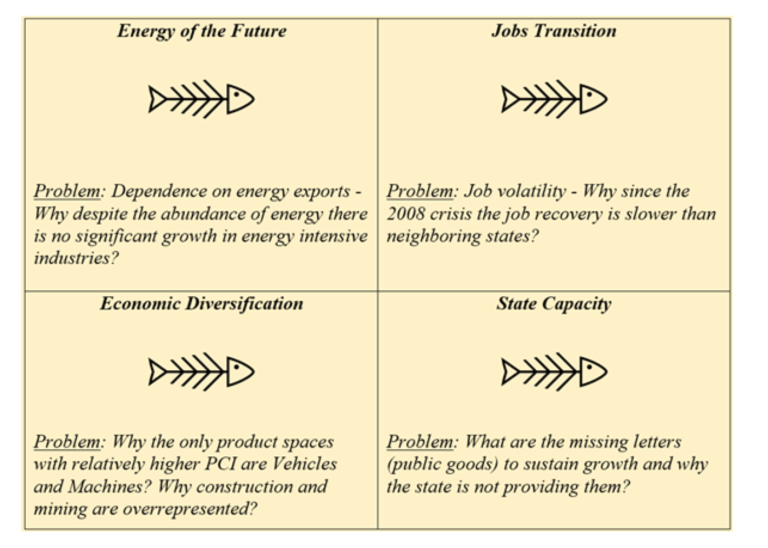
The beginning of constructing and then deconstructing some of our problems Source: Course Weekly Assignment – LEG 2021
Lucky me round two. During all this journey including the “special” projects time, I had the chance to test some of these ideas with local legislators, elected officials and agency leads. One specific Representative from my region started asking really good questions and we worked together to see how we could apply some of this to our state and in the United States.
I still have lots of questions on my mind, and, as I review my course resources and notes, I feel well equipped to move forward. However, it would be great to continue to engage with Harvard’s CID and other proponents of this approach to discuss how to improve our national economic development practices.
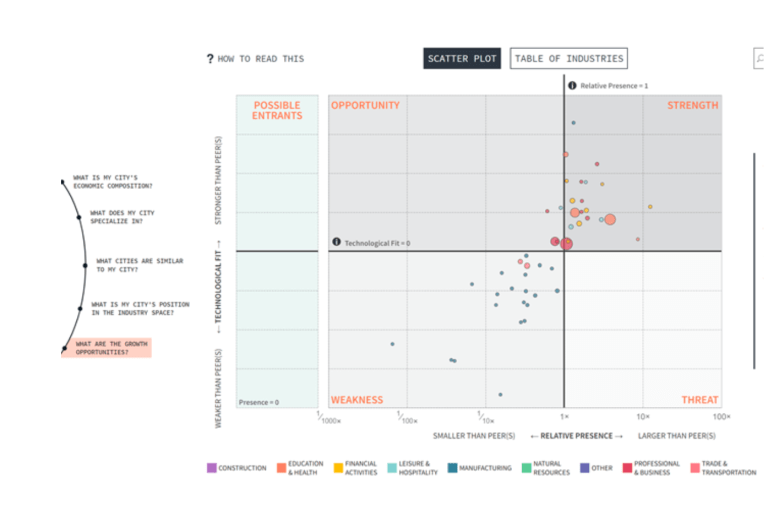
From economic composition to industry space, and to growth opportunities – New ways of generating a SWOT for a CEDS Source: Metroverse – LEG 2021 exercise with Denver Metropolitan area
Here are a few ideas I would like to explore: How to improve the creation of the Comprehensive Economic Development Strategy (CEDS) required by the Economic Development Administration (EDA)? How to turn Targeted Industry Studies (a new trend around the US) into a more precise tool to attract foreign (and in some cases domestic) direct investments? How to involve other practitioners in this conversation and bring analytical innovation to economic development around the USA?
Are you up to the task? Let me know!
Thanks to the diverse and fantastic participants of the LEG 2021. It was possible to learn from experiences in economic development from South Africa, Venezuela, Mongolia, Mexico, United Kingdom, Afghanistan, Brazil, and both Wyoming and Oregon, USA.
Many thanks to the Harvard Kennedy School, Growth Lab, and Building State Capability teams for putting together such an amazing learning experience. Special thanks to Eric Protzer for all the awesome things he brings to this space.
To learn more about Leading Economic Growth (LEG) watch the faculty video, and visit the course website. This blog was originally published by the Building State Capability program. Visit their blog for more learning journey stories.
Economic growth strategies in North Macedonia
Guest blog by Jones Anthony
This is a blog series written by the alumni of the Leading Economic Growth Executive Education Program at the Harvard Kennedy School. 65 Participants successfully completed this 10-week online course in May 2021. These are their learning journey stories.
– Growth challenge: Slower economic growth compared to neighboring countries
– Country/region/municipality: North Macedonia (NM)
What are some key ideas/learnings that you will take away from this course?
I gained a deep understanding of several key economic growth and public policy ideas from the course. The Product Space analysis is a game-changer for my work on all future targeted industry strategies. Instead of focusing primarily on the industry concentrations and their growth rates (Location Quotients) for a country/region/city, I am now equipped to target those more complex industry sectors that will have the biggest impact on advancing economic growth and increasing the knowhow of the economy. I am also eagerly awaiting the City/Region Complexity Index in May, which I believe will be transformational for local economic development practitioners across the globe.
The PDIA toolkit has articulated public policy dynamics that I have experienced throughout my career, but lacked a thorough understanding to navigate. The Change Space, Policy Design Space, and Authorizing Environments have been extremely enlightening for me and will help me guide the policy development process for all future economic growth projects. Focusing on problems instead of presenting existing solutions (Asymmetric Mimicry) has shifted my approach for future consulting proposals and I look forward to the opportunity to craft a Fishbone diagram with a group of key stakeholders during my next project. In addition, utilizing the Searchframe approach, compared to the Logframe approach, is a target that I hope to utilize for upcoming project opportunities with various donor agencies.
The Growth Diagnostic process was fascinating, but I have to continue to read the research provided to more effectively facilitate answering the question tree and properly identifying the most binding constraint to growth for my target community. I believe I understand the principles and theory behind the growth diagnostic framework, but I need to work more on implementation and data analysis to effectively put this theory into practice.
What progress did you make or what insights did you have about your growth challenge throughout the 10-week time period?
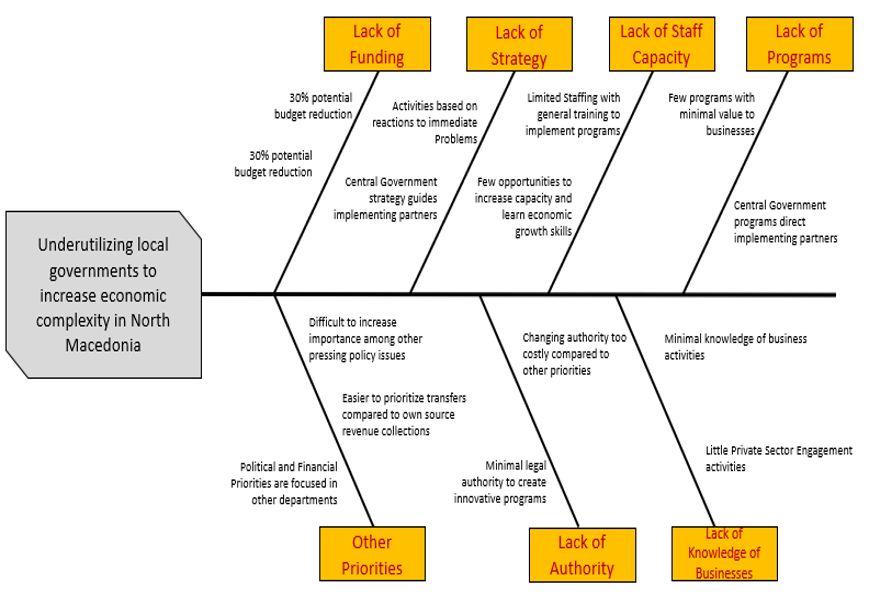
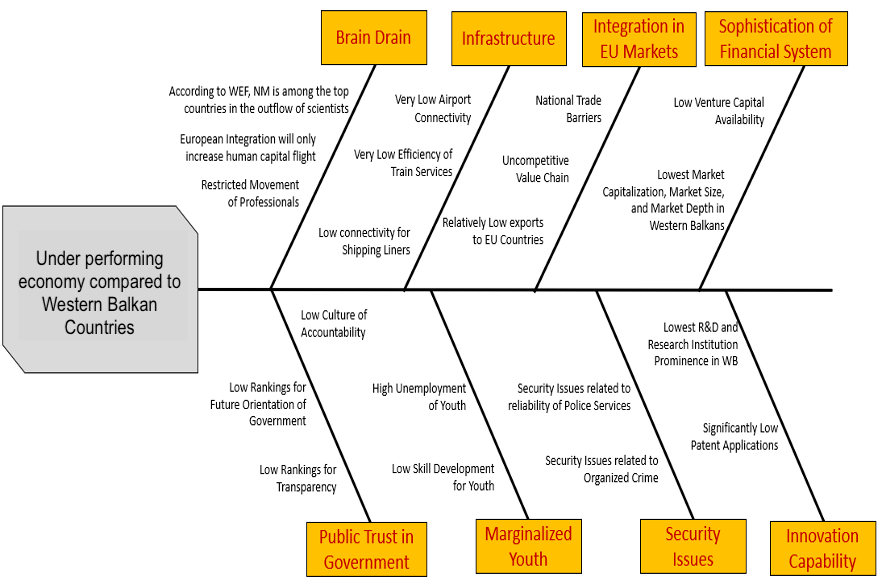
I made strong progress on my growth challenge throughout the course. The more research I did, the more I modified my Fishbone Diagram. Having a project that is not within my existing country nor within an existing employment position made it more difficult to engage with stakeholders to get a better understanding of the problem. But I utilized as many data sources as possible to expand my understanding and frequently completed desktop research on existing donor programs and research to inform my problem definition. This was a very fruitful exercise because it would be the same activity I would complete if put on assignment for an economic growth project in NM.
The ‘sense of us’ discussion was challenging because NM continues to struggle in this area. Their efforts to become integrated into the European Union have been negatively impacted on two separate occasions by two separate countries. Their ‘sense of us’ is being challenged in regard to their name and language, which are core components to a country’s identity. This challenge is going to be difficult to overcome, but the research provided from the course is going to be helpful in understanding opportunities for advancement.
How are you using or will you use what you have learned in this course?
As previously referenced, I have already incorporated the PDIA approach into proposals for economic growth strategies throughout the state of Ohio and for USAID projects in North Macedonia and Sri Lanka. Leveraging the PDIA policy development process with the economic complexity framework has been instrumental for me in making innovative proposals that incorporate these approaches when implementing economic growth strategies.
I plan to continue researching and analyzing the literature provided by the course to continue growing in my understanding of the material and concepts. I’m hopeful to also proselytize the value of City/Region Complexity Index for communities throughout the USA through my membership with the International Economic Development Council and the Ohio Economic Development Association.
What open questions do you have that you wish the next course could answer?
I found the program to be very generous in regard to providing available research material on a wide variety of topics. I sincerely appreciate that fact because my professional experience has shown me that obtaining academic research can be cost-prohibitive when doing public policy development work.
I would like to better understand the econometric theory used to create the Product Space. This would allow me to better understand the connections between products, which would be helpful to gain buy-in from economic development policymakers. I also think it would be helpful to provide additional examples of what data sets and data gathering activities can be utilized to complete the decision tree for a Growth Diagnostic.
Feel free to add photos of your fishbone diagrams, assignments, meetings, or whatever you think is relevant (video/audio).
After thoughtful discussions with my classmates and teaching assistants, I realized that I was trying to facilitate a pre-existing solution when I made my initial problem definition. My first and last fishbone diagrams are below that show the change from Week 3 to Week 9 of the program. I feel I progressed in my thinking on how to promote economic growth in NM and look forward to the opportunity for implementation!
To learn more about Leading Economic Growth (LEG) watch the faculty video, and visit the course website. This blog was originally published by the Building State Capability program. Visit their blog for more learning journey stories.