
Re-visiting the “Sector Targeting” study: Why BOI and EDB opted for sector targeting


INTERVIEW: Keeping Government Priorities on Track
 nment priorities as approved by the current government, under the leadership of Prime Minister Rama.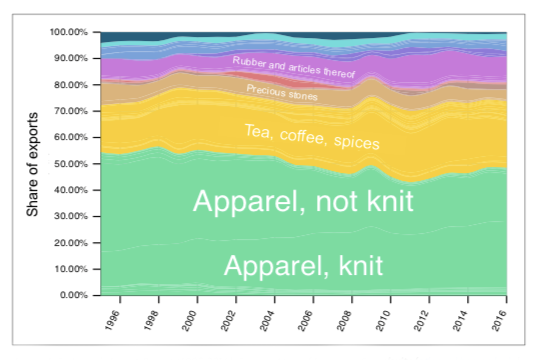
Video: Government Strategies for Diaspora Engagement – A Conversation with Pandeli Majko, Minister of Diaspora of Albania
Pandeli Majko, Albania’s Minister of Diaspora, visited Harvard’s Kennedy School in early February and shared newly set strategies to engage Albania’s diaspora for political and economic development, and transform migration into an added value.
Minister Majko also debuted this video which showcases Albania’s tourism and culture:
About the speaker:
Pandeli Majko was born in Tirana on November 15, 1967. He graduated from the University of Tirana, Faculty of Mechanical Engineering (1986-1992). He also completed his studies at the Faculty of Law at the same university (1994-2000).
Mr. Majko has an extensive political career. From 1992 to 1995, Mr. Majko served as President of the Euro-Socialist Youth Forum of Albania (FRESSH). He served two terms as Secretary-General of the Socialist Party of Albania and as Head of its Parliamentary Group. He also held twice the post of Minister of Defense when the Socialist Party was in power. His political career culminated in 1998-1999 when he became Prime Minister of Albania. In 2002, he became once again Prime Minister for eight months. Additionally, he was member of the Parliamentary Committee for drafting of the Albanian Constitution (1997-1998).
Mr. Majko served as a Member of Parliament of Albania for six consecutive terms. He has also served as Chairman of the Albanian delegation of the NATO Parliamentary Assembly as well as member of the Committee on Legal Affairs, Public Administration and Human Rights. Mr. Majko is fluent in English and Italian.
PDIA in Sri Lanka: Learning to Engage New Investors for Economic Diversification – Let’s Go Fishing!
Originally published in the Building State Capability blog – Anisha Poobalan
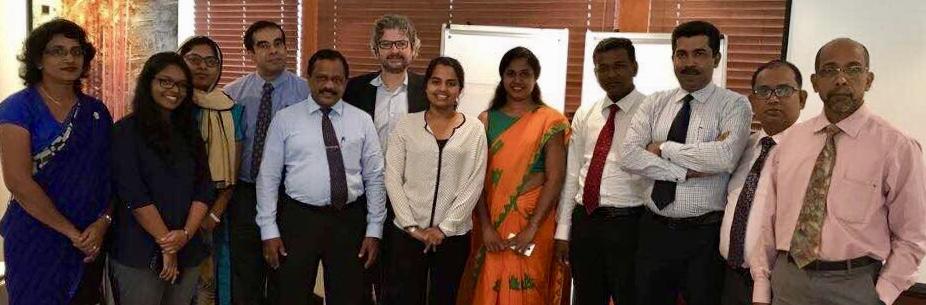
Meet the Investment Promotions team, a group of Sri Lankan government officials from various departments, experts in differing fields, and all novices at the daunting task ahead of them – attracting foreign investors to Sri Lanka. I had the privilege of working alongside the I-team as a coach and colleague for a year. This post is an introduction to the ‘I team’, the challenges faced, victories celebrated, and the learning and experience gained for all involved, coaches and team members alike.
The I-team journey began in September 2016. A group of six to seven officials were assigned to the team and met together for the first time at a Launchpad session organized by the PDIA team. In some ways, this team had the most challenging yet also exciting goal to achieve. They were the front-line team, tasked with identifying, hooking and reeling in the ‘big fish’. Although, it seemed quite straightforward at the onset, the team had no clue how or where to even start. Which sectors should they focus on? How would they differentiate desired investments from harmful investments? What did Sri Lanka have to offer? How does a mid-level state official even contact an anchor investor? Weren’t there experts doing this already? How was this team, with no experience in promotions, expected to succeed? The questions, doubts and overall skepticism was endless. But, and this became the game changing ‘but’, there were team members, one or two to begin with, who were willing to take on the challenge, and truly believed that this approach would yield something different. So, with this mix of skepticism and determination, the team embarked on a journey full of unpredictable difficulties, surprising results and in the process they learned capabilities to diversify and grow Sri Lanka’s economy.
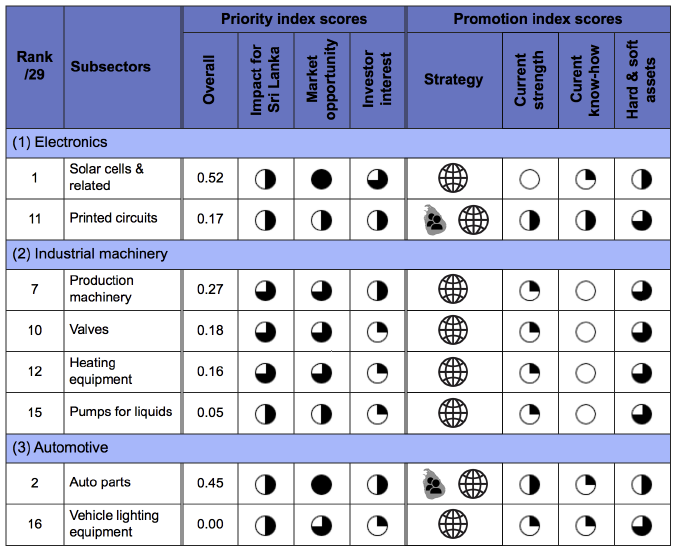
The team’s first ‘aha’ moment took place at a Launchpad session in the second month of their work. The team had been struggling to choose diversified, beneficial sectors to grow the Sri Lankan economy. Once they picked a few, based on their own research and expertise, (a team of their peers, the T-team, were working on a tool to target sectors parallel to the I-team work) they had to strategize ways to attract these sector specific investors. There were many strategies out there but what was their first step and what were investors looking for? During a guest presentation at the Launchpad session, the leader of the I-team picked up on a method this guest investor was using to promote his business. The team adopted the strategy and within a month of dedicated, focused work had some solid sector-specific ‘pitchbooks’ to use as their bait.
Towards the sixth and seventh months of work, the team began to lose steam. The pitchbooks were close to completion and had been circulated with no promising responses. The team members began to feel their task was impossible. What was the point in pitch books if they weren’t able to engage foreign investors or spark interest in Sri Lanka’s economy? As a coach, this was the most difficult point in any team’s journey. Motivating each team is probably the most important role a PDIA coach can play and generally, almost every month, either a team member or an entire team would undergo paralyzing slumps in their pace and effort. After a few weeks of stagnancy, the team decided to identify strategies for contacting and engaging foreign investors. They used indirect and direct methods, identifying 5 key strategies: engaging key local players for introductions to foreign contacts, meeting local importers who would be able to share pitchbooks and make introductions to their foreign sellers, pursuing foreign investors directly through email and phone calls, requesting Sri Lankan commercial officers in targeted countries to engage directly with investors there – using promotional material and reliable information provided by the I-team, and finally the team engaged with any indirect personal contacts in the targeted sectors.
These new strategies revived the team and with a little structure and quantitative goals, provided by the PDIA coaches, members were able to focus their efforts better. Each sector pair committed to making at least five new contacts a week, while maintaining and following up with contacts from previous weeks. These could be through any of the direct or indirect strategies the team had identified. It is important to note that this work was in addition to their typical, daily responsibilities as government officials. Somehow, officials managed to find the time to research, make calls, write emails, respond to queries and travel far to meet with sector experts. Each pair would report their work to the team weekly, and soon enough their hard work paid off! The team engaged with and hooked some of the biggest and most innovative players in the global market; accomplishments they never could have imagined when they first began this work. If you are interested in reading more about the I-team’s journey, learnings and results, read the team’s working paper.
I would like to conclude with a few thoughts on what it was like to coach a team like the Investment Promotions team. The first challenge was maintaining attendance at their weekly meetings. Not only was the lack of attendance frustrating and discouraging for those who did show up, it reflected the low priority members had given to the initiative. Within a few weeks, through direct conversations and interventions from their authorizer, those who were genuinely not interested in continuing, left the team and new members were appointed. Team members soon realized the importance of their work and the expectations superiors had for this work. I observed a renewed energy and interest in achieving the teams’ goals.
I mentioned the necessity and importance of consistent motivation earlier on in this post. One extremely effective method of motivating members was having a ‘star player’ on the team. This member set the pace and raised the bar so that the rest of the team couldn’t make the typical ‘I was too busy’ excuse for missed deadlines. Realizing that a peer could achieve their weekly goals showed the others that this was possible, despite their daily schedules, and sometimes led to some exciting breakthroughs. As a coach, it was important to ensure the team took ownership of their work. The temptation to intervene and direct the team can be strong. Especially, when the team becomes complacent or disagrees on ways forward, both of which were common for the I-team. These are the times at which I had to force myself to allow the team to make their own decisions, take their own path and learn from their own mistakes. Ownership created responsibility, enthusiasm and ultimately, satisfaction from a job well done. This is exactly how the team felt when they attracted global players to Sri Lanka; a sense of disbelief and awe at their own achievements!
I soon learnt to check up on the team and individual members as often as I could. I would observe tensions during meetings and follow up with members who seemed disgruntled or disinterested. Most often, a quick check in and a little motivation can go a long way in getting a team member back on track. And finally, but most important, appreciate, appreciate, appreciate! This is key and generally not practiced enough. As coaches, we worked hard to appreciate any and all steps towards achieving the teams’ goals. We also celebrated small and big wins as much as possible. This motivated the whole team to continue the good work, and aim for greater wins and bigger fish!
Working alongside the remarkable members of the Investment Promotions team, experiencing their challenges and celebrating their victories, was a true honour. Our hope is that their story will encourage and motivate similar teams and government officials around the world, working hard to diversify and grow their own economy through foreign investment.
Anisha Poobalan worked with us on the PDIA Sri Lanka project from September 2016 to September 2017.
This is part of a blog series that is tagged “PDIA Journey,” written by people who have participated in a PDIA process.
Case Study: Delivering Customer Care and Cutting Corruption in Public Services
INTERVIEW: The Road to Citizen-Centric Public Service Delivery in Albania
An Interview with Dr. Milena Harito, Minister of Innovation and Public Administration of Albania
If you were a citizen of the Republic of Albania in need of a moderately complex public service in 2014, you were almost certain to enter a maze of public bureaucracy: dark and messy offices, long lines, vague instructions and procedures, and little opportunity for citizen feedback or tolerance for criticism. It’s no wonder that the uncertainty around these services forced most citizens to use their social and family connections, and in some cases, bribes, to ensure speedy and secure service delivery.
In 2014, on direction from the Prime Minister’s Office (PMO), the Minister for Innovation and Public Administration (MIPA) started a process of reinventing the way the public administration delivers service to its citizens. The objective was to create an administration that revolves around the needs of the citizens – a citizen-centric service. While the objective was clear, the path there was far from known. The view that the government could simply adopt a successful reform from a similar country was quickly abandoned, as the people at the forefront of the reform realized that Albania faced Albania-specific challenges.
Three years down the road, over 400 services (out of 1,400) offered by 10 public institutions in five municipalities and covering 60 percent of the total service volume to citizens and businesses have become a part of the reform. The processes behind each service were analyzed and reengineered and MIPA established the Agency for the Delivery of Integrated Services (ADISA). ADISA develops and ensures service standards, offers public services through one-stop-shop offices and monitors the performance of public sector service providers. The reform, among other things:
- Replaced old routines for standard transparent multi-chanel information and communications technology solutions;
- Established one-stop-shop offices which streamline citizen interaction;
- Trained professional front office personnel to respond in a customer-friendly manner;
- Holds the front office personnel accountable for ensuring timely and proper back office delivery;
- Eliminated redundant bureaucratic steps and incentives for corruption;
- Continuously monitors the service delivery and seeks feedback from its users.
The reform’s timing and success happened as a result of complex coordinated and innovative government initiative. We interviewed Dr. Milena Harito, Minister for Innovation and Public Administration and a frontrunner of the reform, in order to learn what it took to advance this agenda.


Center for International Development: Dear Minister, how did the initiative for this reform come about?
Dr. Milena Harito: The Reform of Public Services was one of the six government priorities under Prime Minister Edi Rama back in 2013, when this government stepped in. As a Minister of Public Administration, I was asked to lead the reform. Initially, it was envisioned as a process of service digitalization, but soon in the process we found out that the reform had to be much more than that if we were about to address the key problems we identified with respect to public service delivery.
CID: What are the main problems that this reform is addressing?
MH: There are several. Lack of transparency – citizens were never certain about the documentation they will be asked to present when requesting a service, nor did they know what to expect in terms of procedures. Lack of predictability – there was no guarantee that if one would request the same service twice, one would obtain the same result. Citizens were at the mercy of civil servants’ goodwill. Lack of accountability – timely service delivery was the exception rather than the norm. Civil servants were not penalized for violations, denial of service or delays. Bribes were common, too. Service standards were absent – citizens were missing a basic sense of what constitutes a public service. Some offices even lacked a service window which would signal that they are providing a public service. All this formed a culture of administrative prerogative and arrogance with little regard for customer needs.
CID: With so many issues to address, where did you start?
MH: The complexity of the task was quite terrifying. We first needed to learn the essential facts. We started by conducting an inventory of all public services and found that often the institutions providing them were not aware of all the services they provide. We surveyed around 1,400 services. Next step was to measure the frequency by which citizens use each service and decide which of them should become reform priorities. Then we turned to deciding on service standards. What does a good service look like? This part was developed following the French service model, with technical assistance from the EU. At this point we had to solve a problem that didn’t have a clear solution. The 400 focal services were distributed across 10 government agencies, each of which had different work routines and responded to different line ministries. How do we ensure adoption and longevity of the new ways of delivering a service across numerous entities? The game changer was the idea to create ADISA, an agency with two main objectives, the separation of the front office from the back offices and the creation and application of customer care standards. After establishing its legal basis, ADISA started the implementation of one-stop-shop offices, initially with the property office of Tirana, one of the busiest and notoriously corrupt agencies.
CID: In the USA in the 1990s, Bill Clinton launched a reform called “Reinventing Government.” As part of this process, lots of government services were consolidated and many went online. The government employment at the end of the Clinton Administration was a quarter less at its beginning. Is this reform of similar scale and does it have similar consequences?
MH: The situation in Albania is very different. Albania’s administration is very small – 90,000 people are providing service to about three million citizens. This is low administration to people ratio for regional standards. We didn’t suffer from having a large government, but from having an inefficient one. In most cases, the government agencies did not have front office employees for their services. Hence, instead of laying off workers, we hired new staff for ADISA. We focused heavily on their training, work ethic and service orientation.
CID: What is your vision of the public administration in Albania after completing this reform? How will the public administration differ then compared to its state in 2014?
MH: We probably need another two to three years to complete the reform in all Albanian municipalities. At the end of the reform, the public sector service will resemble the one of the private sector – think of modern banking or telecom services. The beauty of the front and back office separation is that by professionalizing the front office, we created a pressure on the back office to professionalize, too.
CID: What are some of the tangible benefits of this reform that the citizens of Albania are already experiencing today?
MH: One is the standardized application forms for services. This is not only important for equal treatment of the users, but also all involved government agencies receive an identical set of information about the service request. Another one is the call center with a centralized number for all public services 11-800, where citizens can obtain standard information about available services, the same on the e-albania portal. Moreover, the one-stop-shop offices allow citizens to apply for several services that are performed different government agencies at a single location.
CID: One of our observations when it comes to the public administration in Albania is that many departments have weak or inadequate knowledge about their job tasks and responsibilities. And yet, you managed to find the capable people to design and implement this very ambitious reform. Who provided the expertise and the examples for this reform?
MH: It was a mix of local ideas and ideas from other places. We started by visiting various countries that could provide good examples, such as Georgia and Azerbaijan, both of which have undergone public service delivery reforms. We borrowed the idea of a one-stop-shop and the knowhow about how to locate them and how to create user friendly space from Georgia. Back in Albania, we created a group of five local people in key administrative positions, who were knowledgeable about our public administration and were very dedicated to this reform. This group reviewed literature, models, and brainstormed about reform ideas. We started implementing the ideas, while still shaping them up. It was during this implementation process that we received support from international partners like the EU Commission and the World Bank. We borrowed the idea of customer care standards from private sector services.
CID: Although the reform borrows from experiences in other countries, it is unique and customized to the needs of the Albanian citizens. How difficult was it to strike the right balance between borrowing foreign ideas and responding to domestic idiosyncrasies?
MH: The idea of a front and back office separation is a local innovation. We added this to the one-stop-shop offices because we were solving a somewhat different problem than Georgia was at the time they started their reform. In Georgia, the reform started with one institution – the Ministry of Justice. Hence, there was no need of front and back office separation. Similar was the case with private companies which are a single entity, and not 20 institutions as it was our case. Moreover, the currently available digital solutions are more efficient than the ones available when Georgia started their reform ten years ago. We knew, for instance, that it is possible for the service clerks to access integrated databases of several organizations and hence we adjusted the approach to benefit from such technological solutions.
CID: What is your favorite innovation?
MH: From the citizens’ perspective, the most important innovation is the one-stop-shop. From the perspective of the administration, it is the separation of the front and the back office.
CID: What were the main challenges in translating the vision of the reform into actual implementation?
MH: The first challenge was to understand what is feasible, how great our ambitions should be, and what timelines we should work with. The second was finding the right set of partners in the government. We needed partners in the administration in order to make sure that the reform is being understood and accepted, but too many partners would have made the project coordination difficult. We also faced resistance for a number of reasons. Some simply feared to lose the power, the privileges or the income from bribes. Other insisted that we only focus on creating online services. Having a background in ICT, I knew that problems stemming from organizational dysfunction cannot be simply solved by transitioning to an online system. Moreover, only 60 percent of Albanian have today online access, and the digital litteracy for complex services is of course still an issue.
CID: Digitalization, automation and centralization of services are some of the main features of the reform. Were the jobs of some civil servants affected by these processes and if yes, how?
MH: The small initial size of the administration and the fact that our administration is relatively young and trained in using computer interface, makes the transition far less disruptive than in countries that implemented digital technologies in the 1990s. I’m not aware of a significant negative impact on the employees. We tend to make the administration more efficient through information technology.
CID: What is the permanent imprint of this reform that will ensure that the reform will outlive changes of government in Albania?
MH: The reform has been very well accepted among the citizens. From the opening of the first one-stop-shop in October 2015, the positive response was immediate. Worsening the level of service that citizens are experiencing through this reform would be politically very costly. I think that this is a major reason why future governments will be interested in sustaining the changes.
About Minister Milena Harito

Since September 2013, Dr. Milena Harito is the Minister of State for Innovation and Public Administration of the Republic of Albania. She has an extensive experience in the field of telecommunications and innovation.
Dr. Harito graduated with honours in Computer Science from the University of Tirana in 1989 and earned a Ph.D. from Paris VI University in 1997. Dr. Harito has substantial work experience as a senior manager in the telecommunications having worked during 15 years for Orange France, in Paris. She has been elected member of the Albanian Parliament in June 2013. Since she has been appointed State Minister for Innovation and Public Administration in September 2013, Dr. Harito has led important reforms for Albania in the process of European Union Integration: modernization of public administration through professionalization of civil service and extensive development of e-government, simplification of the relations with the citizens and improvement of public services delivery based on customer care principles.
RELATED CONTENT: Case Study: Delivering Customer Care and Cutting Corruption in Public Services
Q&A with Ditmir Bushati, Albania’s Minister of Foreign Affairs
On Sunday, September 18, the Embassy of the Republic of Albania to the US and the Center for International Development at Harvard University hosted a panel discussion, “Albania and Diaspora: A New Communication” with the Honorable Ditmir Bushati, Minister of Foreign Affairs of the Republic of Albania.
Following the panel, Minister Bushati sat down with CID Events and Outreach Manager Andrea Hayes and discussed the panel, the Albania diaspora, and other foreign policy topics.
What are your impressions from this panel?
We had the opportunity to discuss the need to further streamline cooperation between the Albanian state institutions and our diaspora, especially here in the U.S. We are going to organize in November the first ever Diaspora Summit and we have set out relevant policy documents and areas of cooperation. There are many success stories, and we need to build on that in order to structure the cooperation between Albanian state institutions and our diaspora in different aspects.
As you know, the Center for International Development has worked for some time now to emphasize the benefits of engaging the Albania diaspora with social and economic development in Albania. How do you see the relevance of this type of work for the Albanian government and the Albanian community, especially here in the United States? How do you see Diaspora’s contribution to Albania?
This is very important for us, especially if one takes into account that one-third of Albanians are living abroad. The Albanian community in the US is quite solid in terms of knowledge, expertise, but also financial resources. There have been several waves of migration to the United States and now it’s time to consolidate the bridges between Albania and our diaspora for the sake of social and economic development and transformation of the country. I would like to commend the work done by CID’s team of experts. Their expertise has been really valuable for the work we are doing in defining the areas of cooperation with our diaspora but also by looking into successful models of cooperation that other countries have implemented.

Panel: Ermal Frasheri, CID Research Fellow; Min. Bushati; Alma Jani, International Organization of Migration in Albania; and Mark Kosmo, chairperson of the Massachusetts Albanian American Society.
In November, the Albanian government will hold its first summit on diaspora. What are your expectations for that event?
It is going to be the first time policymakers and representatives from different Albanian institutions will sit together with diaspora representatives from more than 38 countries around the globe. We want to be able to cluster our interplay in different areas of cooperation that we will jointly define based on the policy document that is anticipating the summit. Our ultimate goal is to transform this initiative into a sustainable form of cooperation with government institutions. We want to transfer the ownership of this initiative to diaspora representatives themselves and have them initiate this event next year. We would like to come up with concrete ideas and projects, and then see how these projects are implemented. So the key message during the summit will be “participation, participation, participation” of Albanian diaspora in the democratic and socioeconomic development of Albania.
What are some of the main foreign policy issues that Albania is facing currently?
The main foreign policy issue is related to the EU accession process. This is not a classical type of foreign policy issue, because in the case of Albania and southeast European countries, it’s also a question of national priority, because it has to do with the democratic credentials and socioeconomic development of the country. As you might be aware, Albania is an EU candidate country, and with the reform path, especially in the rule of law related areas, we expect the European Commission to come up this fall with a recommendation for the opening of accession talks. This would be a defining moment for Albania, because it will give us a positive sign towards the opening of accession talks. And when I speak about recommendation for opening of EU accession talks, we speak about a complicated process where the country is going through a very serious set of reforms.
What have been some of the major achievements and challenges to the accession process?
Albania is in better shape if one assesses rule of law related reforms. Albania is projecting democratic stability in the region. Security-wise, it is a pivot in Adriatic Europe, often acting as a mentor for other countries that aspire to join NATO. Albania is a promoter of reconciliation in our region, and it’s also a promoter of flagship infrastructure and energy projects that would connect the region and people in the region.
You have been active in promoting Albania abroad, especially with regard to investment opportunities. How do foreign partners see the potential of Albania?
The potential is there. The process of accession into the European Union is moving ahead with all relevant economic rule-of-law related reforms. As a consequence the business climate is improving. Also, geography has been very generous with Albania, in terms of clear access on the Adriatic and Ionian seas. Through our constant engagement with regional and EU partners but also international financial institutions, we have managed to make of Albania an epicenter of the connectivity projects that will be implemented under the framework of the Berlin Process1 in our region.
You will be in New York City for the United Nations General Assembly (Sept. 19-26). What can you tell us about the discussions that you will be holding with your colleagues and partners there?
The menu of discussions is indeed very rich this year due to the many crises we’re facing around the globe – terrorism, migration, economic crisis. And as it happens, the UN General Assembly is an ample opportunity to take part in many regional initiatives and important summits, but also to meet bilaterally with lots of colleagues. My goal is, of course, to advance Albania’s agenda in terms of EU accession process, but we will have, also, an opportunity to discuss security issues, especially in the migration, terrorism, radicalization nexus. Albania has invested a lot over the past few years on dealing with these challenges and we can already measure some success we would like to share with partners and allies.
1Berlin Process: a process launched by German Chancellor Angela Merkel to enhance regional cooperation through flagship projects and help accelerate the integration of the Western Balkans in the European Union.
Alternatives to Economic Growth: A Collaboration with St. Gallen
Growth was at the forefront of the 2016 St. Gallen Symposium – an annual gathering of global leaders in Switzerland. Some 800 present and future leaders debated, “Growth: The Good, the Bad, and the Ugly,” from May 11-13, 2016 in St. Gallen, Switzerland.
The question “What are Alternatives to Economic Growth?” was posed as a topic for the symposium’s annual essay competition. The six essay competition finalists were brought together with research fellows of Harvard University’s Center for International Development (CID) to analyze, elaborate, and stress-test some of the ideas.
Four major themes emerged from their analysis:
- the need to contextualize any discussion of economic growth
- new models of consumption may reduce the importance of growth in developed markets
- the rising level of inequality in many countries is a major concern
- the digitalization trend is changing what growth means
Overall, the authors conclude that the nature of economic growth as we know it is changing and these changes present governments and their citizens with an unprecedented set of opportunities and challenges.
To read more about their findings, download the:
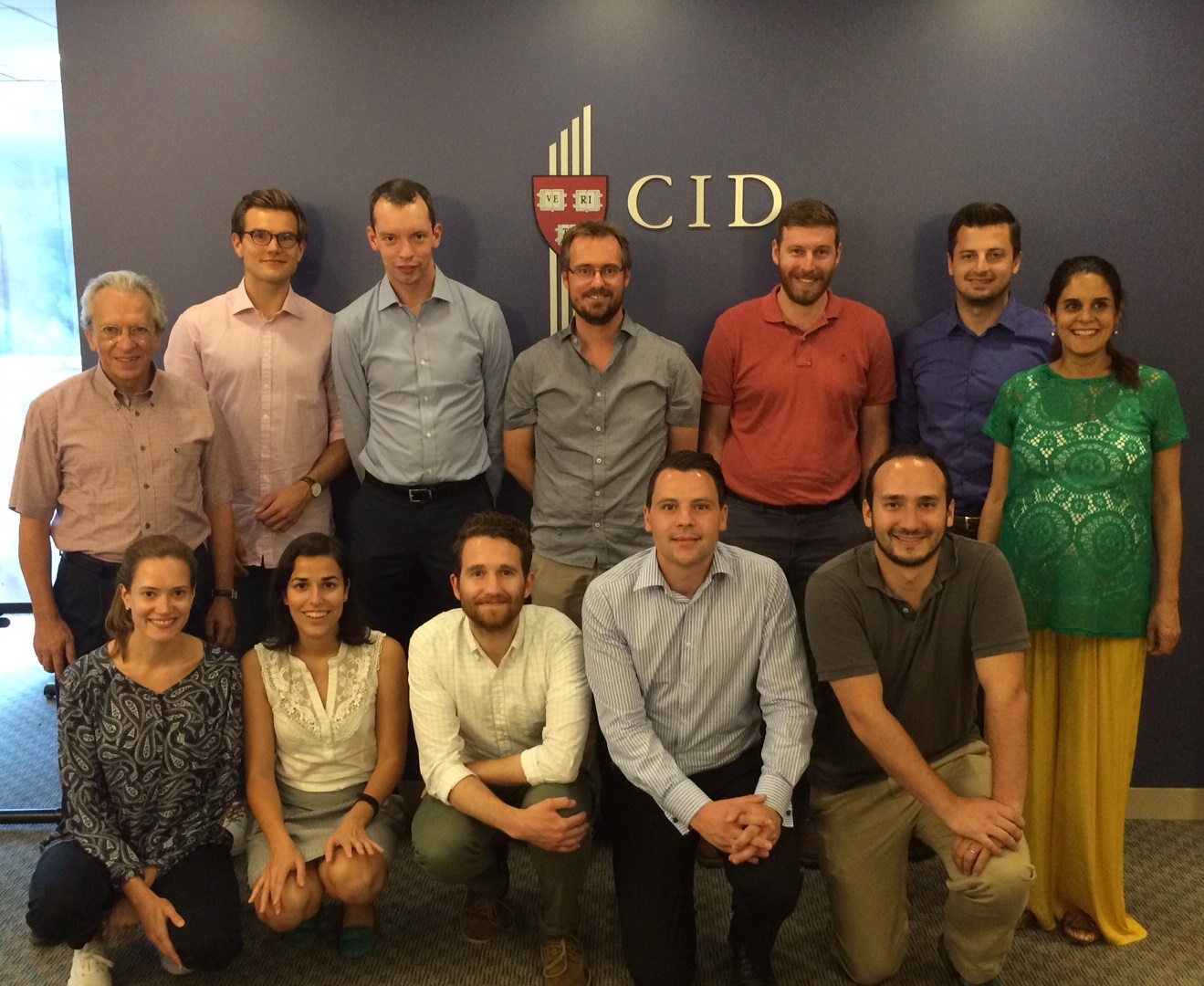
CID Research Fellows and St. Gallen Symposium essay finalists during their working session at Harvard Kennedy School on July 25, 2016.

An insider’s view on being CID’s Executive Coordinator
Harvard’s Center for International Development is looking for an Executive Coordinator, someone who will be an integral part of the Center’s activities and become a liaison between the Center’s faculty, fellows, staff, students, and important contacts from around the world.

Are you interested in learning more about what this position has to offer and know if you would make a good fit? Who better than the person doing the job, Karen Vanderwillik, to tell you about the great advantages and challenges of being CID’s Executive Coordinator?
Karen has worked in the Center for almost 2 years and will be going on maternity leave very soon. In this interview, she provides an insider perspective on the job and shares details about her exciting experience at CID.
CID: So Karen, what attracted you to this position in the first place?
KV: I was attracted to the opportunity to work at a leading economic development think-tank at one of the world’s most renowned universities, in a position that would allow me to learn another side of academia – how research centers operate, how think-tanks get funding and how new research ideas are disseminated to larger audiences. At the time I was volunteering with CID in Albania and I could see the impact its research has on real public policy and economic issue. I was interested in supporting the center and its staff in continuing this work.
CID: What are the advantages of working alongside Harvard Kennedy School faculty, fellows and staff?
KV: HKS is a very dynamic school and there are plenty of opportunities to get involved and meet people from different research centers. The position gave me the opportunity to interact with high profile policy makers, like Albania’s Prime Minister and Mexico’s Minister of Finance. CID’s team is also very interdisciplinary, and it’s fascinating to see how they bring alternative perspectives to tackling development and policy challenges. The job itself is very time-consuming, which means I don’t have a lot of spare time to attend seminars and classes, but I have learned a lot from supporting staff and faculty in preparing publications and presentations, and from participating in CID events and talks.
CID: What would you say are the some of the key skills for someone in this role?
KV: This role definitely requires strong organizational skills, attention to detail, and effective time-management. But it also requires someone who can make effective judgment calls, maintain calm in a sometimes stressful and fast-paced environment, and someone who can see the big picture beyond the daily tasks of scheduling, coordinating and organizing. In this role it is important to be aware of CID’s key stakeholders and research projects so that you can help make important connections between faculty, fellows and students, maintain good relations with key donors, and identify new potential opportunities.
CID: What are the main challenges of a being in a position like yours?
KV: CID is a very busy place and there are a lot of people wishing to engage with the center and its directors. This position involves managing constant and often competing requests for support, for meetings, for interviews, and for assistance. It requires learning to prioritize, making effective judgment calls on what can and cannot be done, and balancing competing demands on your limited time.
CID: What are the main learnings you take from this position – and you believe are applicable to your professional future?
KV: The position involves a lot of scheduling and administrative work, but it also has allowed me to directly support important goals for CID’s ongoing growth. Working closely with the directors provides a unique opportunity to learn about the more strategic and operational aspects of a leading research center. I have learned a lot about effectively engaging with governments and donors, developing research and funding strategies, and disseminating complex research ideas to broader audiences.
CID: And finally, who would you recommend this position to?
KV: I would recommend this position to someone who is interested in the operational aspects of a research center or think-tank, someone who doesn’t mind dealing with constantly changing schedules, and someone who enjoys engaging with a wide variety people – students, faculty, government officials, researchers, and development practitioners. CID is one of the fastest-growing research centers at Harvard and is making a significant impact in development research and practice. Our team is highly-motivated and engaged, and they are great people to work with. Overall it’s a light and fun environment to work in and we do all sorts of team building activities throughout the year. Which reminds me: volleyball skills will come in handy as our summer tournament approaches!
An alternative index for economic development
By Andres Gomez and Juan Tellez
One of the highlights of this year’s World Economic Forum was the urgency of a new economic measure, able to capture adequately the economic situation of a country. Gross Domestic Product (GDP) is not rising up to the challenges of the 21st century.
In Davos, Nobel Prize winner Joseph Stiglitz, IMF Head Christine Lagarde, as well as MIT Professor Erik Brynjolfsson, agreed on this issue and emphasized the value of finding a better measure of progress. Even though this is not the first time this concern has been raised, the increase of inequality, the worldwide crisis on immigration, the susceptibility of emerging markets to the volatility of commodity prices, the economic slow-down of China, the imminent collapse of Venezuela, and Brexit among others, have called the attention of academics and practitioners around the world to put urgently the discussion back again in the world agenda. Several reasons are brought up in this debate, but we specifically want to point out the necessity of a better measure of the economy that allows understanding the dynamics of growth and elucidates economic differences between places (countries, cities, regions).
There is a general trend to suggest alternative measures for economic development using statistical techniques that aggregate various indicators with the idea that adding more information is better. Some problems arise due to the strong assumptions that some of these methods require or the difficulty to interpret the final value of the index. An example in which a community has steered away from this trend is the recent health literature, in which the hemoglobin level, as a single indicator, has been preferred over the mix of many factors because this one alone is a global representation of a general health status and its interpretation is clear and straightforward. The fact is that averages are mathematical operations that eliminate information. They give the illusion of understanding and can miss relevant information about how the system works. What we need in economics is not an indicator that summarizes several statistics, but one that measures the main driver behind economic progress.
Evidence that an economy’s diversity of know-how is a determinant of economic growth has started to accumulate. In particular, the notion of the division of labor, emphasized by Adam Smith, has started to be replaced by a notion stressing the division of information within a population. Crucially, this idea has not been limited to the empirical literature on economic development. It is an idea rooted in the latest advances in cultural anthropology and human evolutionary biology. These disciplines have established that the size and complexity of a society’s cultural repertoire are what have allowed them, and their individuals, to be best adapted to their environments.
When the bag of cultural know-how that a society has is large and complex, its individuals become smarter since more tools for problem solving become available. More possibilities for novel recombination of ideas emerge, innovation at a societal level is enabled, and the more opportunities for human flourishing are opened.
While anthropologists can only proxy the complexity of a culture’s know-how in ancient societies by counting the number of different tools they were able to manufacture, we now have much better access to the complete diversity of activities and know-how that workers, firms, and cities do and have. Know-how is relatively easy to track, and the effects of its diffusion easy to measure.
The Economic Complexity Index (ECI), developed at the Center for International Development at Harvard University, is a first step in quantifying the division of know-how in a society, and stands as a great alternative to GDP. It is a measure of the diversification of a country, which takes into account the complexity of the exported products. We believe an internationally organized program that investigates how to quantify the complexity of places should be installed. The number of industries, occupations, products and technologies a place has, and its impact on its economic progress should be carefully examined.
The ECI is easily constructed and has several interesting implications. It is interpreted as the underlying capabilities that a society possesses. In other words, it is the collective know-how that supports the economy of a country, city, or region. Besides, the index is the best growth predictor in the literature, better than standard education, institutional and political variables. Currently, ECI is to the health of economies what the hemoglobin level is to the health of human subjects.
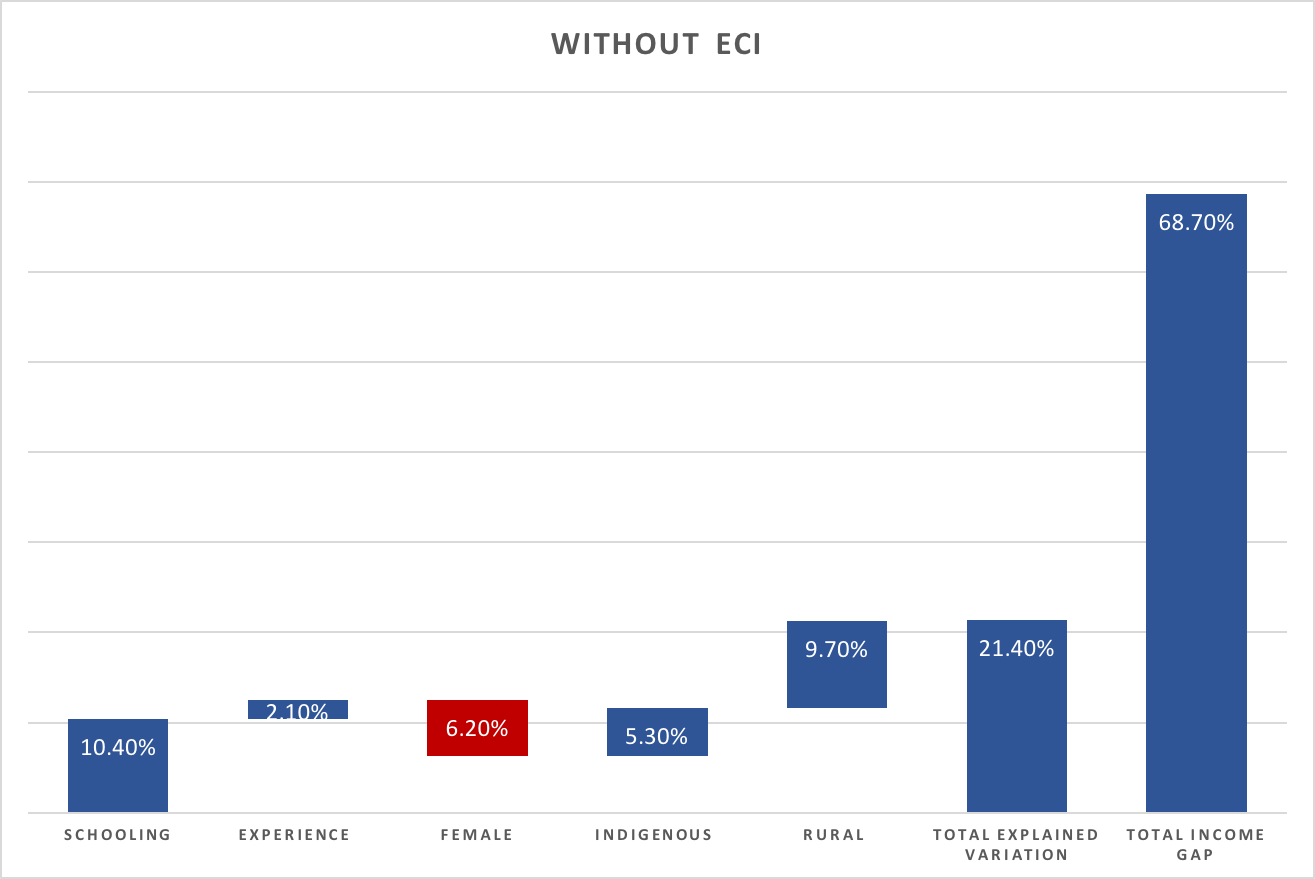
Source: Constructed from Table 4a in D. Levy, R. Hausmann, M.A. Santos, L. Espinoza and M. Flores, “Why is Chiapas Poor?”, CID Working Paper No. 300, July 2015.
A recent CID study of Chiapas, a state in Mexico, showed that a worker’s average income in the rest of the country is approximately 1.69 times higher than the average income in Chiapas. Education, gender, ethnicity and being rural account for 31% of this income difference (see Graph Without ECI). When the ECI is included in the analysis, this percentage rises to 53% (see Graph with ECI). ECI is not only explaining a lot, it is the factor that explains the most. These results indicate that economic complexity acts through channels that are not addressed by other variables such as years of schooling, professional experience, or other demographics.
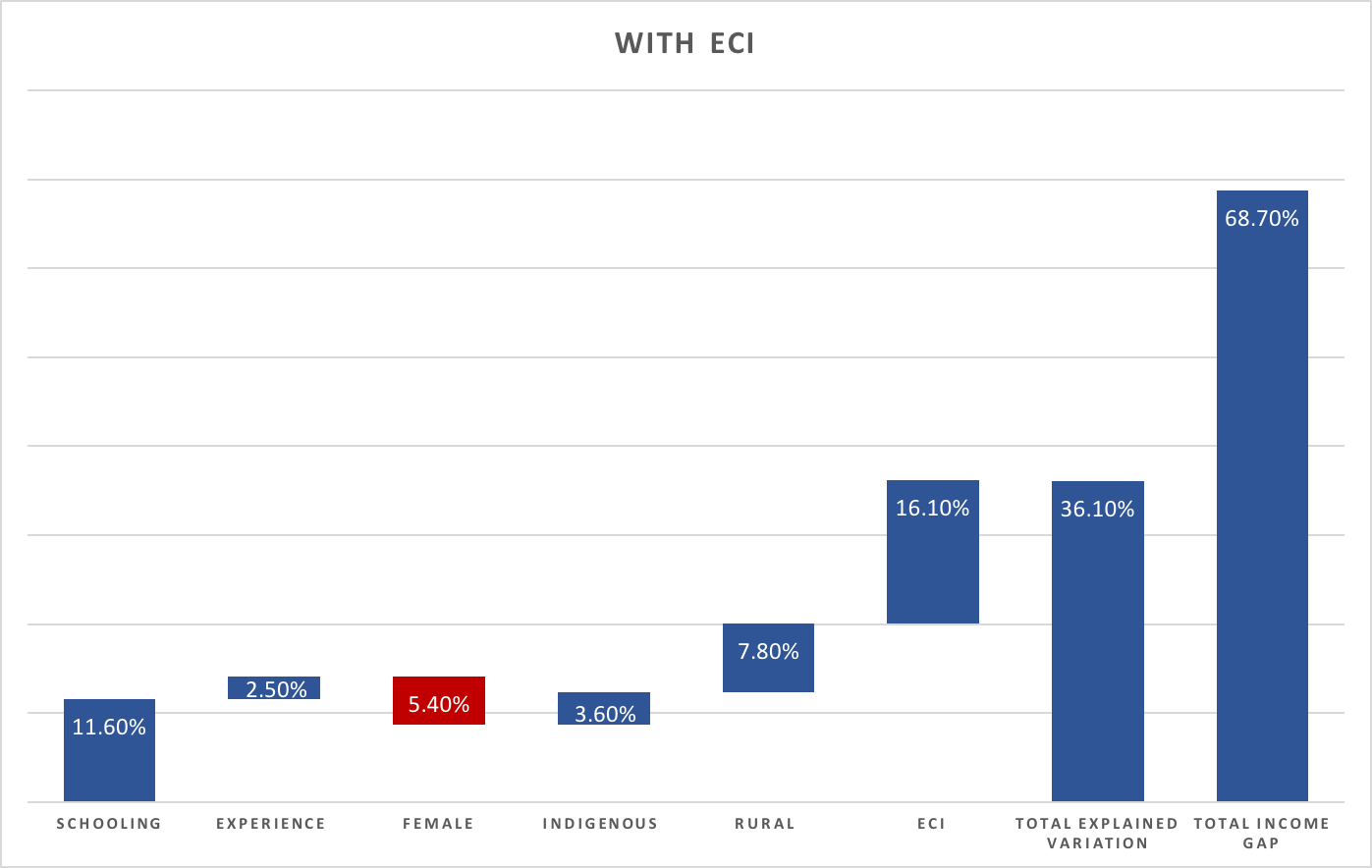
Source: Constructed from Table 4b in D. Levy, R. Hausmann, M.A. Santos, L. Espinoza and M. Flores, “Why is Chiapas Poor?”, CID Working Paper No. 300, July 2015.
Bottom line is that when it comes to the economic welfare of a society, and in a world that is increasingly connected, we need measures that capture collective properties. There are no perfect measures, and additional corrections to ECI, or perhaps complementary measures, should also be considered. For example, we hope similar efforts are put into developing measures that capture environmental degradation and intra-firm wage inequality.