
Winning the Super Bowl of Economic Development: How Hyundai Metaplant America Landed in Savannah
This case study offers valuable lessons for economic developers, site selectors, and policymakers worldwide. The story of Hyundai Motor Group Metaplant America’s (HMGMA) decision to locate in Savannah, Georgia, illustrates how large-scale manufacturing site selection depends on local and state stakeholders working together to overcome challenges and coordinate across multiple institutions.
In this study, we document how the local economic development community created the conditions for Hyundai’s investment, highlight the key success factors, outline the company’s site selection process, describe the economic development agreement, and analyze the project’s regional economic impact. The economic development vision of the Savannah Harbor-Interstate 16 Corridor Joint Development Authority (JDA) allowed the community to transform a group of pine farms into one of the most significant investments in the EV supply chain in the U.S., bringing long-lasting prosperity for the region.
Innovation Capabilities Outlook 2026
Knowledge is expanding globally, yet most countries struggle to harness this growth effectively. Global innovation remains strikingly concentrated: a small number of leading economies account for the vast majority of scientific publications, patents, trademarks, and advanced exports, whereas most contribute less than 1 percent to any innovation dimension. Success does not require a big push in all fields, but instead lies in strategically diversifying into complex skills while at the same time maintaining intensity in high-value areas – a balancing act that only the most sophisticated innovation ecosystems have mastered.
Mapping the global innovation landscape
The Innovation Capabilities Outlook (ICO) 2026 analyzes 2,508 innovation capabilities across four dimensions – science, technology, entrepreneurship, and production – using comprehensive datasets spanning 2001–2023. The analysis reveals that innovation emergence depends critically on connections between these four dimensions, with the most sophisticated capabilities emerging only in highly diversified ecosystems able to support complex, interdependent knowledge networks.
A tale of two innovation worlds
Global innovation output has expanded dramatically, yet this growth remains highly uneven and concentrated in no more than 30 percent of the world’s economies. Asian economies – led by China, India and Viet Nam – have mastered sophisticated capability development strategies, consistently achieving both smart diversification (gaining breadth and complexity simultaneously) and smart capability management (intensifying focus on high-value skills while protecting them with complementary knowledge). In contrast, many established and emerging economies struggle with this dual challenge: 46 percent of ecosystems have not meaningfully diversified, and complexity gains remain elusive for 70 percent of economies.
Strategic opportunities
The ICO 2026 identifies substantial untapped potential – only 10 percent of economies fulfill their technological potential. Ecosystems collectively underperform by 339,000 technological innovations annually. Regional patterns reveal distinct strategic pathways: Europe possesses strong foundations, but struggles with technological translation; Asia shows balanced capabilities, but faces entrepreneurial commercialization challenges; and Africa should focus on foundational capability building while gradually targeting more complex activities.
Policy implications
Innovation policy cannot rely on one-size-fits-all approaches. Success requires tailoring strategies to regional development levels, existing capability portfolios, and institutional contexts. Countries that align innovation investments with these evidence-based insights can break traditional development constraints and accelerate a transition toward knowledge-based competitiveness. The systematic nature both of diversification constraints and untapped potential suggests that targeted, level-appropriate interventions yield the highest probability of success.
The Innovation Capabilities Outlook 2026 was developed through a partnership between WIPO and Harvard University’s Growth Lab (HGL), under the general direction of Daren Tang (Director General) and Marco Alemán (Assistant Director General). The report was supervised by Carsten Fink (Chief Economist) and Ricardo Hausmann (founder and Director of HGL), prepared by a team led by Julio Raffo (Head of Innovation Economy Section, WIPO) and Muhammed A. Yildirim (Director of Academic Research, HGL). The team included Christian Chacua, Matte Hartog, Shreyas Gadgin Matha, and Federico Moscatelli.
Catalysing Economic Growth Through Powershoring
In a trend called powershoring, energy-intensive industry will locate closer to renewable energy sources, driven by cheap renewable energy (which is difficult to transport), and the need to decarbonise. Regions’ renewable energy resources and industrial capabilities shape the types of energy-intensive industries they can attract: some regions are best placed to produce very energy-intensive commodities (like green steel and green ammonia), while other regions are best positioned to host more complex industries that still require good clean energy supplies (like battery manufacturing or datacentres). Similarly, some powershoring industries have many spillovers and open up new pathways for regional economic growth, while other energy-intensive industries have fewer spillovers or open up fewer development pathways. This contribution explores these trends to help policymakers develop contextually aware powershoring strategies that can catalyse their best opportunities for economic development.
Childcare Supply in Wyoming
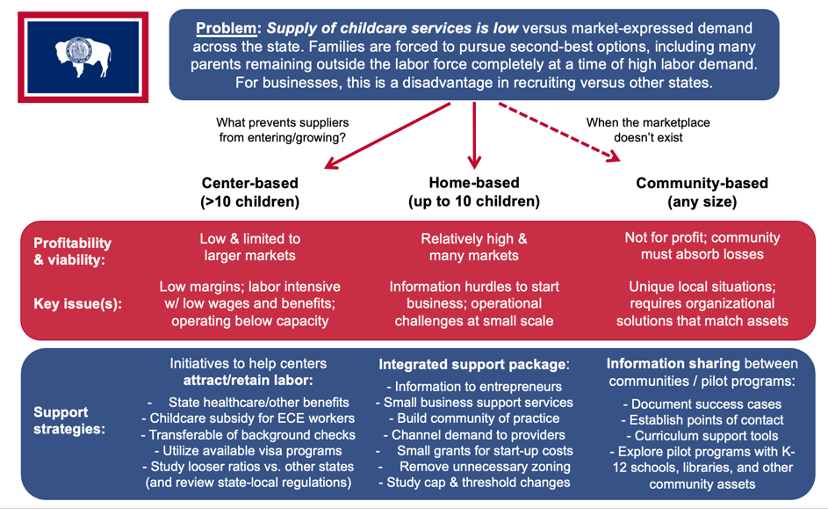
This white paper summarizes Growth Lab research on the childcare market in Wyoming, where supply of childcare slots systematically falls short of demand. This nationwide problem is prevalent across Wyoming, including in both its larger population centers and smaller communities. The low population of many Wyoming communities adds to the challenge. Research that is summarized in the white paper identify differential constraints affecting childcare centers and home-based childcare facilities. Centers make up most childcare slots in the state and are plagued by a staffing challenge derived from low business margins and low wages that centers can afford under “reasonable” fee structures for the market, which cause many to operate below capacity despite widespread wait lists and demand. Home-based providers, which are particularly important for lower-population settings in Wyoming that cannot support larger centers, face operational challenges typical of very small businesses and new providers face a few solvable start-up hurdles.
Through collaboration with an interagency working group in Wyoming, this white paper identifies a set of targeted initiatives for enabling business entry and childcare slots through both centers and home-based facilities. The focus of these initiatives is on expanding supply as opposed to subsidizing demand through subsidies to parents and families. Though an expansion of funding in this form would be useful, and the state government dramatically underspends on early childhood education in comparison to its longstanding focus on high K-12 spending, the focus is on low-cost and impactful ways to enable the market to better expand supply to meet high expressed demand.
The following diagram summarizes the diagnosis and key strategies. Over the second half of 2024, the interagency working group and partners across Wyoming have focused on implementing a subset of these action points.
Related: Pathways to Prosperity in Wyoming project
Economic Growth and Complexity in the UAE: Summary Report
This document summarizes high-level findings on the United Arab Emirates’ (UAE) growth trajectory, economic diversification record, and future prospects. It is based on the work carried out as part of an ongoing collaboration between Harvard’s Growth Lab and the UAE Ministry of Economy (MoE). This collaboration aims to produce novel research-based inputs to inform an ambitious, forward-looking economic policy agenda. Over the last year, it has entailed research on various topics. These have included documenting the country’s past growth path and potential for the future, understanding UAE’s short-run macroeconomic and inflation dynamics, studying trade patterns and free-trade agreements, and looking into labor markets and productivity dynamics.
This document provides a summary of some of the research stemming from the first phase of work, drawing especially on two reports: Elements of a Growth Diagnostic: The United Arab Emirates (Brenot et al, unpublished) and Economic Complexity: The United Arab Emirates (Tapia et al, 2023). These two reports together lay out research on the UAE’s growth model over the last two decades and use an “economic complexity” lens to analyze where future sources of diversification and growth might come from. The Elements of a Growth Diagnostic report mainly focuses on the past. It examines the UAE’s growth performance between 2000 and 2019 (prior to the COVID-19 pandemic) to understand the drivers of the UAE’s growth model and document the changes in the UAE economy during this time. Economic Complexity: The United Arab Emirates looks at the performance of the UAE’s exports and industrial diversification using a “knowhow” and complexity lens, pioneered by Hidalgo & Hausmann (2009), and also suggests high-potential activities for further diversification.
As part of a broader research agenda, this summary document is meant as a companion piece to more than a year of past research, but also as a starting point for the next phase of collaboration between the Growth Lab and the MoE. In addition to this summary document and the reports it draws on, there is also a companion Inputs for Policy Design – Tools for Economic Diversification report. The report makes a more policy-oriented contribution, discussing more in-depth three concrete tools to achieve further economic diversification: foreign direct investment (FDI), Free Zones, and Sovereign Wealth Funds (SWFs).
This summary document highlights the key themes and insights gathered during this past year, while also laying out a set of questions for future research. The rest of this document is structured as follows. Section 2 summarizes key themes of the UAE’s past growth performance and its key drivers at an aggregate, national level. Section 3 goes deeper to describe the current state of the UAE economy by geography and sector, and documents the way the economy has already begun to diversify into non-oil activities. Section 4 further examines the UAE’s diversification path using a complexity approach to better shed light on the UAE’s future diversification prospects. Finally, Section 5 concludes with a set of key takeaways and themes for further research.
Accelerating Growth in Albania through Targeted Investment Promotion
The investment promotion process in Albania is underperforming versus its potential. Between 2014 and 2018, the Albanian economy saw accelerating growth and transformation, which has been tied to the arrival of foreign companies. However, Albania has the potential to realize much more and more diversified foreign direct investment (FDI), which will be critical to accelerating growth in the period of global recovery from the COVID-19 pandemic. As the Albanian economy weathers the storm of COVID-19, it is critical to look to the future by enhancing the investment promotion process to be more targeted and proactive such that Albania can attract transformative global companies aligned with the country’s comparative advantages. This is not only a critical step toward faster and more resilient economic growth in Albania; it also happens to have very high returns in comparison to the limited fiscal spending required to implement the actions required.
The targeted investment promotion approach discussed in this note would capitalize on Albania’s many existing comparative advantages for attracting efficiency-seeking FDI. It would not displace Albania’s Strategic Investment Law nor the activities of the Albanian Investment Corporation (AIC), which aim to expand the country’s comparative advantages. Efficiency-seeking FDI — global companies that expand into Albania to serve global markets because it makes them more productive — do not need extensive tax incentives, regulatory exemptions, or other subsidies. In fact, an overreliance on these approaches can crowd out firms that do not want or need to rely on government support. Adding targeted investment promotion to Albania’s growth strategy would lead to more jobs, better quality jobs, more inclusive job growth, faster convergence with the income levels of the rest of Europe, and ultimately less outmigration.
This note summarizes the Growth Lab’s observations of the investment promotion process in Albania, over the last year in particular, and lays out recommendations to capture widespread opportunities for economic transformation that have been missed to date. The recommendations provided at the end of this note provide a roadmap for building an enhanced network for targeted investment promotion that is specific to Albania’s context. These recommendations recognize the current constraints that the COVID-19 pandemic creates but also look past the pandemic to prepare for opportunities that will emerge during the global recovery.
Sri Lanka Growth Diagnostic
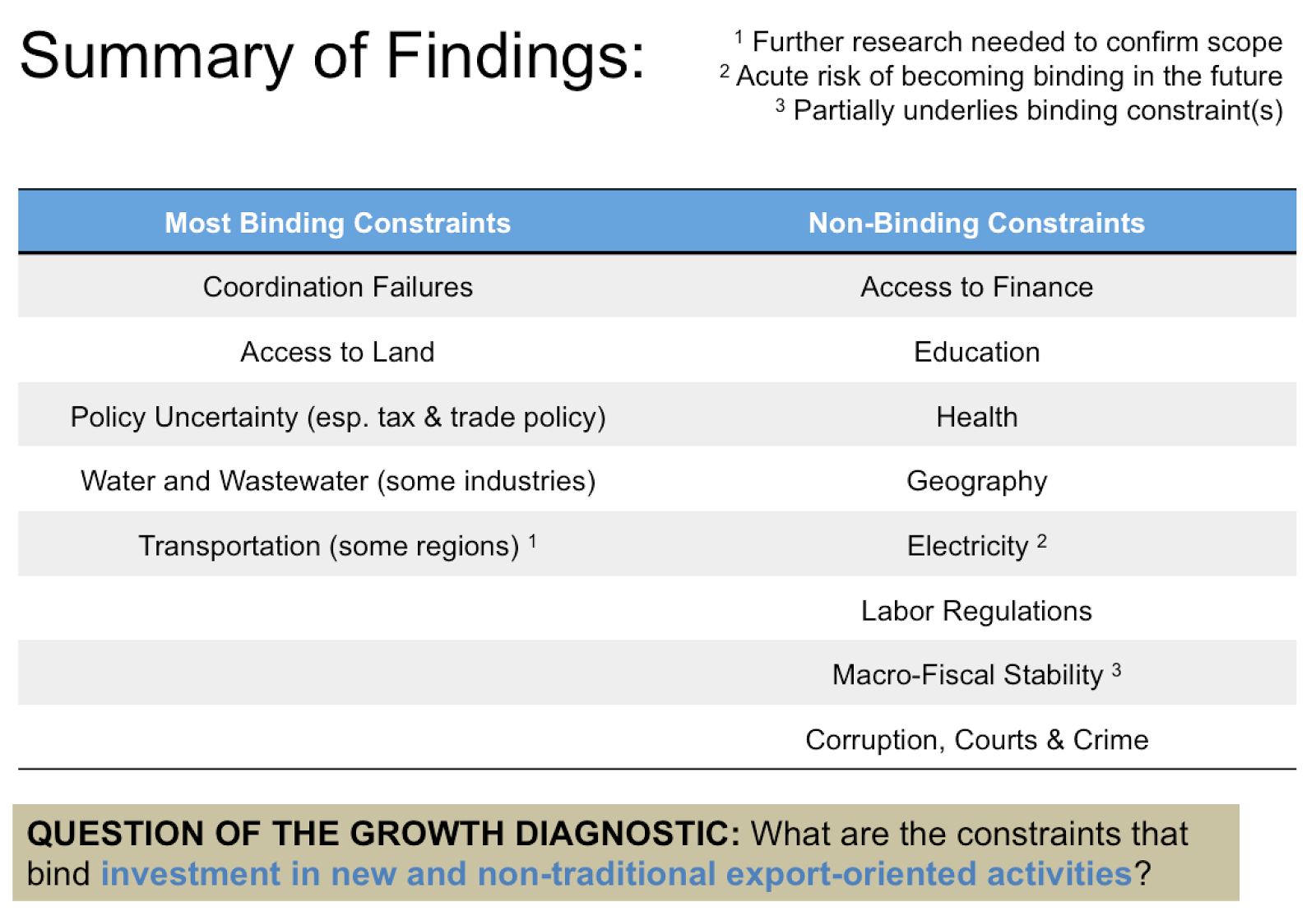
Throughout 2016, the Growth Lab at Harvard’s Center for International Development conducted a growth diagnostic analysis for Sri Lanka in collaboration with the Government of Sri Lanka, led by the Prime Minister’s Policy Development Office (PDO), and the Millennium Challenge Corporation (MCC). This presentation report aggregates collaborative quantitative and qualitative analysis undertaken by the research team. This analysis was originally provided to the Government of Sri Lanka in April 2017 in order to make available a record of the detailed technical work and CID’s interpretations of the evidence. A written executive summary is provided as a complement to the detailed presentation report. Both the report and the executive summary are structured as follows. First, the analysis identifies Sri Lanka’s growth problem. It then presents evidence from diagnostic tests to identify what constraints are most responsible for this problem. Finally, it provides a summary of what constraints CID interprets as most binding and suggests a “growth syndrome” that underlies the set of binding constraints.
In brief, this growth diagnostic analysis shows that economic growth in Sri Lanka is constrained by the weak growth of exports, particularly from new sectors. Compared to other countries in the region, Sri Lanka has seen virtually no diversification of exports over the last 25 years, especially in manufactured goods linked through FDI-driven, global value chains. We found several key causes behind this lack of diversified exports and FDI: Sri Lanka’s ineffective land-use governance, underdeveloped industrial and transportation infrastructure, and a very high level of policy uncertainty, particularly in tax and trade policy. We believe that these issues trace back to an underlying problem of severe fragmentation in governance, with a critical lack of coordination between ministries and agencies with overlapping responsibilities and decision-making authority.



Targeting Sectors For Investment and Export Promotion in Sri Lanka
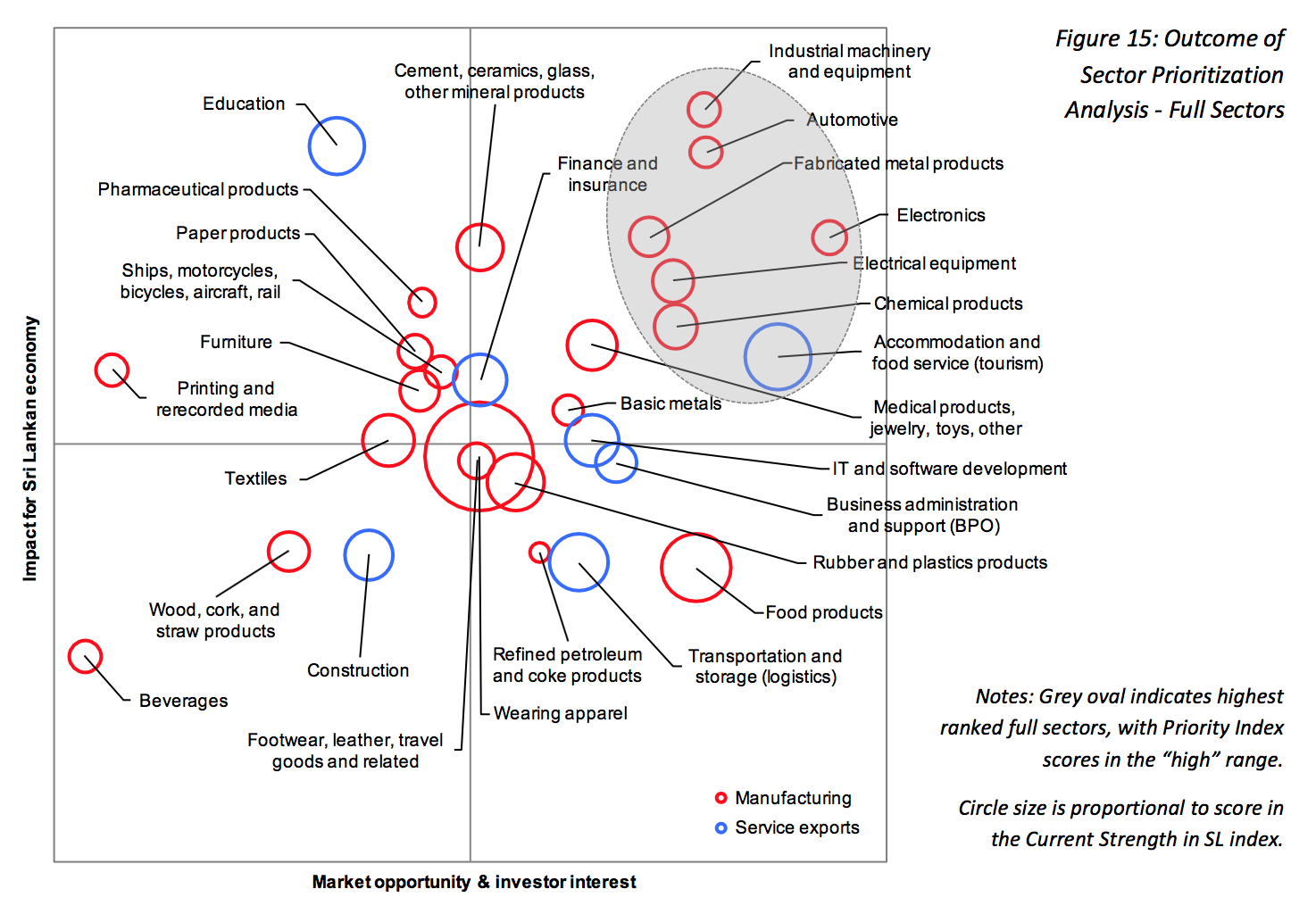
In August 2016, the Government of Sri Lanka (GoSL) and the Building State Capability program of CID convened five teams of civil servants, tasking them with solving issues related to investment and export promotion. One of these teams, the “Targeting Team,” took on the task of formulating and executing a plan to identify promising new economic activities for investment and export promotion in Sri Lanka. With the assistance of CID’s Growth Lab, the Targeting Team assembled and analyzed over 100 variables from 22 datasets, studying all tradable activities and 29 representative subsectors. Their analysis highlighted the potential of investment related to electronics, electrical equipment and machinery (including automotive products), as well as tourism. Ultimately, the team’s recommendations were incorporated in GoSL strategies for investment promotion, export development, and economic diplomacy; extensions of the research were also used to help plan new export processing zones and target potential anchor investors.
This report summarizes the methodology and findings of the Targeting Team, including scorecards for each of the sectors studied.
Recommendations for Trade Adjustment Assistance in Sri Lanka
Sri Lanka has an excessively complex tariff structure that distorts the structure of the economy in important ways. It is a priority for the Government of Sri Lanka (GoSL) to rationalize the system in order to facilitate a transition to greater economic diversification, stronger export growth, and the emergence of new, higher paying jobs. Sri Lanka’s New Trade Policy makes this tariff rationalization a priority. It also recognizes that tariff rationalization should go hand in hand with new trade adjustment assistance measures to support the adjustment of firms and of people. The New Trade Policy outlines the basic contours of tariff rationalization and trade adjustment assistance measures but does not provide a detailed roadmap.
This discussion paper was prepared at the invitation of the Ministry of Development Strategies and International Trade (MoDSIT) as part of the Center for International Development’s research project on sustainable and inclusive economic growth in Sri Lanka. The aim of the paper is to study policy tools that the GoSL could use to structure trade adjustment assistance in the context of tariff rationalization. In order to accomplish this aim, we begin by outlining the type of tariff rationalization that needs to take place in order to address key constraints to growth in a way that is sensitive to both government revenue needs and political economy considerations. We stress that tariff rationalization must be approached in a holistic way that treats the various tariffs and para-tariffs as interrelated, rather than an approach that attempts to address one part of the system at a time. A holistic approach would provide many degrees of freedom to solve the underlying problems in the system while increasing revenues and potentially generating strong public support. Critically, a holistic approach would allow for a single tariff rationalization plan to be phased in over a period of years in a predictable way, whereas attempts to rationalize the system one part at a time would lead to extreme uncertainty.
With the principles of smart tariff rationalization in place, we draw upon international lessons and Sri Lanka’s own institutional capabilities to recommend a two-tiered approach to helping industries and workers adjust. In each case, the first tier represents low-cost measures that can begin in the short term to help industries and workers, regardless of whether they will be negatively impacted by tariff rationalization, while the second tier of assistance applies only to trade-affected industries and workers and can be developed in the medium term. For industries, Tier 1 support involves the use of an innovative process of public-private problem solving of industry-specific constraints, and Tier 2 support involves the use of special safeguard measures to provide an objective and transparent process for determining which industries require longer phase out periods for tariff reductions versus the tariff rationalization plan. For workers, Tier 1 support involves improved access labor market information and training opportunities through the development of regional (or local) job centers. Tier 2 support provides government funding for training and job placement services. We conclude that this package of trade adjustment assistance measures could be used to complement a holistic tariff rationalization plan. But we caution that attempts to rush the implementation of these measures without careful design and communication could deeply undermine the potential for the reforms to work in solving underlying economic problems.
Pathways for Productive Diversification in Ethiopia
Ethiopia will need to increase the diversity of its export basket to guarantee a sustainable growth path. Ethiopia has shown stellar growth performance throughout the last two decades, but, in this period, export growth has been insufficient to finance the country’s balance of payments needs. As argued in our Growth Diagnostic report,1 Ethiopia’s growth decelerated as a result of the increasing external imbalances which have resulted in a foreign exchange constraint. This macroeconomic imbalance is now slowing the rate of economic growth, job creation and poverty alleviation across the country. Although export growth will not be rapid enough to address the foreign exchange constraint on its own in the short-term, the only way for the country to achieve macroeconomic balance as it grows in the longer term is to increase its exports per capita. With only limited opportunities to expand its exports on the intensive margin, the Government of Ethiopia (GoE) will have to strategically support the diversification of its economy to expand its exports base.
This report applies the theory of Economic Complexity in order to describe the base of productive knowhow and assess the opportunities and constraints to diversification in Ethiopia’s economy. The theory of Economic Complexity offers tools to capture and quantitatively estimate the diversity and sophistication of productive knowhow in an economy and to analyze the potential to develop comparative advantage in new industries. These tools provide valuable inputs for informing diversification strategies and the use of state resources by providing rigorous information on the risks and potential returns of government industrial policies in support of different sectors.