
Bolivia’s Economic Pivot: Main Findings and Reform Priorities
This publication synthesizes the main findings and recommendations from a series of reports on Bolivia’s Economic Pivot. We examine the origins of the current crisis and propose a strategy to restore macroeconomic stability while supporting long-term growth. Bolivia’s macroeconomic collapse is the most visible symptom of a much deeper crisis. While the contraction of natural gas production was a key trigger, the country’s crisis stems from a broader institutional breakdown that weakened private investment, export capacity, and productivity growth across the economy. In response, we outline a comprehensive reform plan based on 5 pillars: 1) a growth-enhancing and credible fiscal consolidation; 2) an effective and targeted social compensation network; 3) a restoration of external balance and monetary credibility; 4) renewed investment attractiveness and restored export potential in strategic sectors; and 5) a new institutional foundation for developing new productive capabilities.
Un Giro Económico para Bolivia: Un Diagnóstico de Crecimiento del Sector Turístico
El turismo representa una oportunidad estratégica para que Bolivia genere divisas y promueva un crecimiento más inclusivo. Este informe busca dimensionar esa oportunidad, identificar sus restricciones más vinculantes y proponer soluciones a ellas. Utilizando un modelo de gravedad del turismo internacional, encontramos que Bolivia tiene una brecha de más de 370 millones de dólares frente a su potencial. Nuestro diagnóstico identifica dos restricciones principales. A nivel nacional, la escasa conectividad aérea internacional limita el acceso de Bolivia a mercados clave. Recomendamos un paquete de reformas para mejorar la competitividad del sector aeronáutico y ampliar el acceso aéreo. A nivel local, las fallas de coordinación y los problemas de gobernanza dificultan la consolidación de ecosistemas turísticos, particularmente evidenciado en el circuito del Salar de Uyuni. Proponemos una nueva arquitectura de gobernanza a nivel de destino para facilitar la coordinación, alinear incentivos y generar mayores beneficios para las comunidades locales.
Bolivia’s Economic Pivot: A Growth Diagnostics of the Tourism Sector
Tourism represents a strategic opportunity for Bolivia to generate foreign exchange and support more inclusive growth. This report aims to quantify the opportunity, identify binding constraints and propose solutions. Using a gravity model of international tourism, we find that Bolivia performs significantly below its potential with an unrealized gap of more than USD 370 million. Applying Growth Diagnostics heuristics, we identify two constraints and suggest policy responses. At the national level, weak international air connectivity limits Bolivia’s access from key source markets. Accordingly, the report recommends a package of reforms to improve aviation competitiveness and air access. At the local level, coordination failures and governance issues hinder the emergence of strong tourism ecosystems, particularly in the Salar de Uyuni circuit. We propose a new destination-level governance architecture to facilitate coordination, align incentives, and deliver stronger benefits for local communities.
Childcare Supply in Wyoming
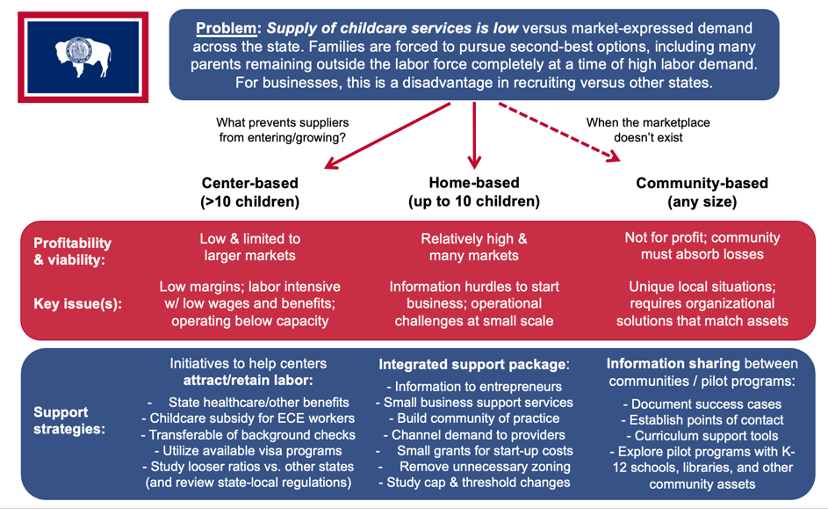
This white paper summarizes Growth Lab research on the childcare market in Wyoming, where supply of childcare slots systematically falls short of demand. This nationwide problem is prevalent across Wyoming, including in both its larger population centers and smaller communities. The low population of many Wyoming communities adds to the challenge. Research that is summarized in the white paper identify differential constraints affecting childcare centers and home-based childcare facilities. Centers make up most childcare slots in the state and are plagued by a staffing challenge derived from low business margins and low wages that centers can afford under “reasonable” fee structures for the market, which cause many to operate below capacity despite widespread wait lists and demand. Home-based providers, which are particularly important for lower-population settings in Wyoming that cannot support larger centers, face operational challenges typical of very small businesses and new providers face a few solvable start-up hurdles.
Through collaboration with an interagency working group in Wyoming, this white paper identifies a set of targeted initiatives for enabling business entry and childcare slots through both centers and home-based facilities. The focus of these initiatives is on expanding supply as opposed to subsidizing demand through subsidies to parents and families. Though an expansion of funding in this form would be useful, and the state government dramatically underspends on early childhood education in comparison to its longstanding focus on high K-12 spending, the focus is on low-cost and impactful ways to enable the market to better expand supply to meet high expressed demand.
The following diagram summarizes the diagnosis and key strategies. Over the second half of 2024, the interagency working group and partners across Wyoming have focused on implementing a subset of these action points.
Related: Pathways to Prosperity in Wyoming project
Grants in Wyoming: Constraints and Solutions
Wyoming communities are reliant on grants to fund local priorities, yet the grants system is not effectively meeting the needs of many communities across the state. This problem is central to the growth challenges of many rural economies across the state. Although this problem pre-dates the recent expansion of federal grant programs, the importance of this problem has grown in the last several years as the scale and complexity of federal grant opportunities — particularly discretionary grants — has increased. Wyoming communities are struggling to navigate and benefit from these federal funding opportunities. As of late 2023, the state is significantly underperforming many comparator states in the number of federal grants received and the distribution of federal grants across the state. Grant writers and administrators face a sometimes impossible task in navigating an ever-shifting grants landscape. This is a challenge for local governments across the country but may be especially important in Wyoming due to narrow local tax bases and the rural nature of the state.
Through an eight-month effort combining research and action, we have explored the causes of this problem to inform potential solutions. We have identified four principal constraints that are most to blame for Wyoming’s underperformance: (1) Lack of relationships between communities and funders; (2) Inability to follow changing grant opportunities (esp. federal); (3) Shortage of prioritized community needs and “grant ready” project plans; and (4) Overreliance on “local heroes” – especially for smaller communities. We argue that these challenges are “principal constraints” because they are binding for the largest number of communities, especially smaller communities. However, there are additional constraints that are critical for other communities, especially those that have more experience with accessing state and federal grants. This note summarizes key evidence we have found on each of these principal constraints. These constraints occur early in the grants process, meaning many potentially promising grant opportunities are never pursued. We find that many federal grant programs and discretionary award processes are inconsistent with the realities of scarce staff, resources, and bandwidth of local governments, especially in small communities. However, we find widespread examples and evidence that these constraints can be overcome through actions to enable a strong state-wide network that supports local leaders and grant administrators. Examples of success within the state and in other states show that building the capabilities of the network and enabling all communities to access the knowhow of the network can lead to much better grant outcomes.
The note closes with a discussion of how to target a network-enabling response to the grants problem. We outline a first-best option that centers on establishing regional officers who would be responsible for a set of tasks that would respond directly to the principal constraints identified. This approach would require annual funding, but preliminary analysis shows the return on investment overall would be very high and the approach would have the greatest benefits for smaller communities across the state. Very initial designs have been explored for how to establish such a system building on existing assets. Finally, we compare this first-best approach to alternative approaches that are closer to the current support actions underway in the state.
Housing in Wyoming: Constraints and Solutions
Quantitative evidence supports the contention that Wyoming’s housing market is constrained, to a greater degree than many other parts of the US. Prices are persistently above expectations given economic fundamentals in most parts of the state, and the supply of new housing in Wyoming is on average less responsive to price increases than in other US counties. This has undermined natural population growth and contributed to a low amount of population density close to city centers in Wyoming, as compared to other US cities with comparable population levels. Importantly, this phenomenon is not simply the result of pandemic-era economic frictions. The evidence shows that these constraints have durably persisted in Wyoming.
This housing constraint weighs heavily on the broader Wyoming economy, and chokes off growth in new industries that could add to the Wyoming economy beyond its natural resource base. Businesses consistently report a lack of access to workforce as a leading problem that ultimately results from a lack of housing. Some businesses have even tried to create their own housing for employees, and news reports abound of teachers and nurses who secure jobs in Wyoming communities but then have to leave because they cannot find housing.
Key problems behind Wyoming’s housing constraints include excessive regulations concerning housing density and insufficient investment in arterial infrastructure. For example, there is evidence that over-regulated minimum lot sizes in Wyoming are blocking the creation of supply to match free-market demand for houses with smaller amounts of land. Other areas of over-regulation include those concerning allowable housing types, building height, parking spaces per dwelling, and the housing approval process itself. This may be seen as surprising given Wyoming’s reputation as a low-regulation state, but Wyoming maintains restrictions that other states and countries have discarded as outdated and highly counterproductive. Besides outright restrictions on housing development, we find that the most common cost driver undermining the housing development has to do with low public investment in needed arterial infrastructure, especially water systems. Land supply as well as material and construction costs are not primary constraints to housing development across the state, but may matter for select communities.
We suggest a portfolio of policy changes for the state of Wyoming to explore in order to solve its housing constraints. One category of changes is regulatory, and focuses on deregulation, reducing bureaucratic overhead, and shifting from veto-cratic to democratic housing approval procedures. Another category is focused on investment on infrastructure to support housing, and exploration of state-local funding structures to facilitate continuous infrastructure improvement. If implemented, these changes will not only help to solve Wyoming’s housing constraints but also facilitate housing development in a way that combats urban sprawl, and in doing so protects open spaces outside of cities that Wyomingites value.
Related project: Pathways to Prosperity in Wyoming
The Connectivity Trap: Stuck between the Forest and Shared Prosperity in the Colombian Amazon
The Colombian Amazon faces the dual challenge of low economic growth and high deforestation. High rates of deforestation in Colombia have led to a perceived trade-off between economic development and protecting the forest. However, we find little evidence of this trade-off: rising deforestation is not associated with higher economic growth. In fact, the forces of deforestation of some of the world’s most complex biodiversity are driven by some of the least complex economic activities, like cattle-ranching, whose subsistence-level incomes are unable to meet the economic ambitions for the region. All the while, the majority of the Amazonian departments’ population works in non-forested cities and towns, at a distance from the agriculture frontier that forms the “arc of deforestation.” The relative urbanization of the Amazonian departments, despite the vast land mass available, recognizes that prosperity is achieved through close social-economic interactions to expand the knowledge set available to be able to produce more, and more complex activities. Achieving economic goals therefore relies on creating new productive opportunities in non-forested, urban areas.
The risk of deforestation reduces incentives to improve the connectivity of Amazonian departments with major cities and export markets. The remoteness of these departments increases the cost of ‘exporting’ goods to markets outside the departments. Poor connectivity contributes to the low economic complexity of the departments. In turn, the low complexity reduces incentives to coordinate new investments that would generate returns to greater connectivity. Coordination failures, which occur when a group of economic actors (e.g., firms, workers) could achieve a better outcome but fail to do so because they do not coordinate their actions, are widespread in all three of the Amazonian departments studied. This limits the creation of new capabilities and productive diversification to generate new jobs and higher incomes.
We posit that economic growth in the Colombian Amazonian is limited by a “connectivity trap” whereby the lack of external market connectivity restricts economic complexity, and, in turn, the low complexity fosters the coordination failures that limit returns to new diversification. Ultimately, low returns to diversification further reduce incentives to improve connectivity. Underpinning the connectivity trap is the belief that limiting the connectivity of Amazonian departments with large Colombian cities and the broader global economy will limit incentives for deforestation. Yet, deforestation has accelerated in recent years, despite the continued poor connectivity. We argue that Colombia must create a new national law to curb deforestation by eliminating the financial incentives for land speculation. Reclassifying forested lands under the control of national protection systems with severe restrictions on economic activities and strengthened enforcement, as detailed in an accompanying report, provides the needed legal clarity regarding land formalization. Within the law to eliminate incentives for deforestation, the national government should create a new development approach for the Colombian Amazon. This approach must move beyond a natural resource-based approach to the region, to center on the productive potential of its urban areas, and the carbon markets and tourism potential of its forested areas. One pillar of this approach is to build new public sector capabilities to coordinate investments into new, targeted productive sectors to create new national-local mechanisms of investment promotion. A second pillar is to improve connectivity to external markets through road and air investments between Caquetá, Guaviare, and Putumayo and major cities and ports.
La trampa de conectividad: cómo la Amazonía colombiana está atrapada entre la selva y la prosperidad compartida
La Amazonía colombiana enfrenta un desafío doble: bajo crecimiento económico y alta deforestación. Las altas tasas de deforestación en Colombia han llevado a que se crea que el desarrollo económico no puede tener lugar si se protege la selva. Nosotros no encontramos evidencia que sustente esa dicotomía: el aumento de la deforestación no está asociado a un mayor crecimiento económico. Las fuerzas detrás de la deforestación de una de las áreas con mayor biodiversidad en el planeta se sustentan en algunas de las actividades económicas menos complejas, como la ganadería extensiva, cuyos ingresos son incapaces de cumplir con las ambiciones económicas de la región. Al mismo tiempo, la mayoría de la población de los departamentos amazónicos trabaja en ciudades y pueblos desprovistos de selva, lejos de la frontera agropecuaria que forma el “arco de deforestación”. La relativa urbanización de los departamentos amazónicos, pese a la gran masa de tierra disponible, constituye un reconocimiento de que la prosperidad solo se logra mediante interacciones socioeconómicas que expanden el conjunto de conocimientos disponible para que se pueda producir más, y mediante actividades más complejas. Por lo tanto, para alcanzar las metas económicas hay que crear nuevas oportunidades productivas en las áreas urbanas sin selva.
El riesgo de deforestación reduce los incentivos para mejorar la conectividad de los departamentos amazónicos con las grandes ciudades y los mercados de exportación. El carácter remoto de estos departamentos aumenta el costo de “exportar” bienes a mercados que están fuera de estos departamentos. La conectividad precaria de la región contribuye a su baja complejidad económica, que a su vez reduce los incentivos para coordinar nuevas inversiones que podrían generar retornos a partir de una mayor conectividad. Las fallas de coordinación – que ocurren cuando un grupo de actores económicos (como empresas y trabajadores) podrían lograr un mejor resultado, pero no logran hacerlo pues no coordinan sus acciones respectivas – son extendidas en los tres departamentos amazónicos bajo estudio. Esto limita la creación de nuevas capacidades y la diversificación productiva que podrían generar nuevos empleos y mayores ingresos.
Planteamos que el crecimiento económico en la Amazonía colombiana está siendo limitado por una “trampa de conectividad” donde la falta de conectividad con los mercados externos restringe la complejidad económica, y a su vez la baja complejidad alienta las fallas de coordinación que limitan los retornos de una nueva diversificación. A fin de cuentas, los bajos retornos de la diversificación reducen aún más los incentivos para mejorar la conectividad. Como trasfondo de la trampa de conectividad está la creencia de que limitar la conectividad de los departamentos amazónicos con las grandes ciudades colombianas y el resto de la economía global limitará también los incentivos para la deforestación. Pero la deforestación se ha acelerado en los últimos años, mientras que la conectividad sigue siendo muy mala. Nosotros argumentamos que Colombia debe crear una nueva ley nacional para frenar la deforestación que elimine los incentivos financieros de la especulación con tierras, al reclasificar las áreas selváticas bajo control de los sistemas nacionales de protección para que tengan severas restricciones sobre las actividades que se puedan emprender en ellas, y se refuercen las labores de cumplimiento de la ley, como se comenta en detalle en el reporte siguiente. Con una ley que elimine los incentivos para la deforestación, el gobierno nacional debe crear un nuevo enfoque del desarrollo para la Amazonía colombiana. Este enfoque debe trascender el basado en los recursos naturales y centrarse en el potencial productivo de las áreas urbanas, así como en los mercados de carbono y el potencial turístico de las áreas selváticas. Un pilar de este enfoque es la construcción de nuevas capacidades en el sector público, que le permitan coordinar inversiones en nuevos sectores productivos específicos, para crear nuevos mecanismos locales y nacionales de promoción de inversiones. Un segundo pilar es la mejora de la conectividad con los mercados externos, mediante inversiones en carreteras y transporte aéreo entre Caquetá, Guaviare y Putumayo, y las grandes ciudades y los puertos.
A Growth Perspective on Wyoming
This report sets out to understand if the economy of the State of Wyoming is positioned to grow into the future. To do this, the report begins by investigating the past. To know where the state economy could be headed, and how that direction may be improved, it is critical to understand how the state developed the economic structure and drivers that it has today. Thus, Wyoming’s economic trajectory is explored over the long, medium, and short term. From this investigation, we find that Wyoming faces an overall growth problem, but we also find a high degree of variation in economic engines and growth prospects across the state. The problem that this report identifies is that the composition of economic activities is not positioned to sustain a high quality of life across all parts of the state.
“Across all parts of the state” is an essential part of the problem statement for Wyoming. While some local and regional economies in the state are growing and bumping up against identifiable constraints, other local and regional economies are experiencing sustained contractions and will require new sources of growth in order to retain (or expand) population and high quality of life. Since economic dynamics vary significantly across the state, analysis is conducted in as much geographic detail as possible. By combining historical and geographic dimensions of growth, this report aims to inform pathways for sustained and inclusive prosperity across Wyoming.
Related project: Pathways to Prosperity in Wyoming
Seeing the Forest for More than the Trees: A Policy Strategy to Curb Deforestation and Advance Shared Prosperity in the Colombian Amazon
Does economic prosperity in the Colombian Amazon require sacrificing the forest? This research compendium of a series of studies on the Colombian Amazon finds the answer to this question is no: the perceived trade-off between economic growth and forest protection is a false dichotomy. The drivers of deforestation and prosperity are distinct – as they happen in different places. Deforestation occurs at the agricultural frontier, in destroying some of the world’s most complex biodiversity by some of the least economically complex activities, particularly cattle-ranching. By contrast, the economic drivers in the Amazon are its urban areas often located far from the forest edge, including in non-forested piedmont regions. These cities offer greater economic complexity by accessing a wider range of productive capabilities in higher-income activities with little presence of those activities driving deforestation. Perhaps the most underappreciated facet of life in each of the three Amazonian regions studied, Caquetá, Guaviare, and Putumayo, is that the majority of people live in urban areas. This is a telling fact of economic geography: that even in the remote parts of the Amazon, people want to come together to live in densely populated areas. This corroborates the findings of our global research over the past two decades that prosperity results from expanding the productive capabilities available locally to diversify production to do more, and more complex, activities.