Serving From Hermosillo: Opportunities in Cross-Border Trade of Services
Technological advances have increased the general tradability of services, leading international trade in services to outpace trade in goods, especially after the global financial crisis and the COVID-19 pandemic. Services once considered less tradable due to the necessity of physical proximity between consumer and provider are now increasingly digitized and delivered remotely. Cross-border services now represent 79% of all internationally traded services, and digitally deliverable activities like engineering, accounting, database and other information services are experiencing yearly U.S. imports growth rates over 15%. This report analyzes how Mexico has been capitalizing on some of these trends over the past five years using the most granular data available. Then, we analyze opportunities from the perspective of Hermosillo.
Hermosillo is poised to benefit from this global expansion due to its comparative advantages and existing productive capabilities in potentially tradeable services. We estimate the revealed comparative advantage of Hermosillo in each tradeable service category and find that the city is better positioned than similarly rich and complex cities in Mexico to take advantage of several of these opportunities. This is because Hermosillo is currently intensive in these opportunities, and also because Hermosillo has other industries that are similar to the opportunities in terms of their occupational structure (which could potentially supply additional labor in case tradeable service industries were to expand rapidly). Moreover, Hermosillo’s wage differentials compared to the U.S. are significant for most industries and occupations, including all tradable service industries and teleworkable occupations. This provides a cost advantage for foreign firms seeking to outsource part of their operations. Hermosillo also boasts a well-educated workforce with high levels of schooling and a strong emphasis on STEM fields, positioning it well to meet a potential expansion in educated labor demand.
Some tradable services represent bigger opportunities for Hermosillo, but the city will need to develop new capabilities in cross-border service provision in order to take advantage of them. In particular, engineering services, database and other information services, business and management consulting, research and development, education, and accounting services require attention and further research to inform effective strategies. To realize these opportunities, local firms may need to overcome sector-specific challenges related to internationalization. Policymakers can play a pivotal role by fostering strategic partnerships, attracting multinational service providers to bring in knowhow, and creating supportive enabling environments for teleworking and digital service provision.
Childcare Supply in Wyoming
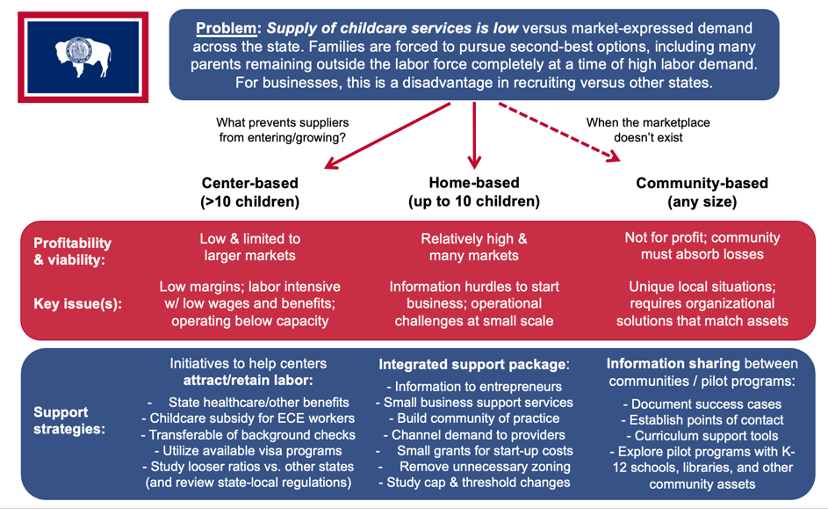
This white paper summarizes Growth Lab research on the childcare market in Wyoming, where supply of childcare slots systematically falls short of demand. This nationwide problem is prevalent across Wyoming, including in both its larger population centers and smaller communities. The low population of many Wyoming communities adds to the challenge. Research that is summarized in the white paper identify differential constraints affecting childcare centers and home-based childcare facilities. Centers make up most childcare slots in the state and are plagued by a staffing challenge derived from low business margins and low wages that centers can afford under “reasonable” fee structures for the market, which cause many to operate below capacity despite widespread wait lists and demand. Home-based providers, which are particularly important for lower-population settings in Wyoming that cannot support larger centers, face operational challenges typical of very small businesses and new providers face a few solvable start-up hurdles.
Through collaboration with an interagency working group in Wyoming, this white paper identifies a set of targeted initiatives for enabling business entry and childcare slots through both centers and home-based facilities. The focus of these initiatives is on expanding supply as opposed to subsidizing demand through subsidies to parents and families. Though an expansion of funding in this form would be useful, and the state government dramatically underspends on early childhood education in comparison to its longstanding focus on high K-12 spending, the focus is on low-cost and impactful ways to enable the market to better expand supply to meet high expressed demand.
The following diagram summarizes the diagnosis and key strategies. Over the second half of 2024, the interagency working group and partners across Wyoming have focused on implementing a subset of these action points.
Related: Pathways to Prosperity in Wyoming project
Growth Through Diversification in Hermosillo
In this report, we study Hermosillo’s economic performance and assess critical issues affecting the city’s ability to achieve stronger economic growth. Although Hermosillo is far from experiencing economic stagnation, it fell behind other cities that managed to become successful economic hubs between 2010 and 2020. The main reason behind this trailing growth is Hermosillo’s relatively low diversification and investment dynamics, especially in the manufacturing sector. We apply growth diagnostic testing on various potential constraints to economic growth: logistics, electricity, water, human capital, housing, and transportation. Although none of them have directly constrained economic growth in the past, some are explicit threats to increasing growth in the future, thus catching up with high-performing peers. Electricity, human capital, and logistics are comparative advantages, while water, housing, and transportation are threats.
In 2025, Mexico is expected to start a new period in its economic history marked by the promise of nearshoring and a new presidential administration. In the past, Mexico has gone through milestones that heavily impacted its economic development path, like the establishment of NAFTA and the China Shock (Hanson, 2010). The rise of Northern Mexico and other regions like El Bajío as global manufacturing hubs has resulted from greater integration with the North American market. This has brought foreign direct investments (FDI) targeted at establishing manufacturing sites primarily to cater to US demand and exports to the rest of the world. Mexico holds high expectations that nearshoring will bring opportunities of the same or greater magnitude. In that context, Hermosillo stands out as a city with the potential to exploit those opportunities and enhance its economic transformation. It is crucial to analyze its binding constraints for economic growth, comparative advantages, and potential concerns to understand how well-positioned Hermosillo is to take advantage of this momentum.
Following the introduction and a methodological overview, the report is divided into four main sections. Section 3 provides a growth perspective on Hermosillo; Section 4 presents an analysis of growth constraints; Section 5 explains the local diversification challenge in detail; and Section 6 describes strategic policy areas to accelerate growth that result from this growth diagnostic analysis.
Diagnosing Wyoming’s Workforce Challenges
Wyoming is facing two distinct labor market challenges: in the short-term low workforce availability is a constraint while in the long-term job and wage growth have stagnated. Currently, Wyoming’s labor market is characterized by tightness and employers are struggling to fill positions. However, the current tightness of the labor market is not a phenomenon that is specific to Wyoming but instead is prevalent across the country. What sets Wyoming apart is the lack of growth in employment and wages over the long-term. Understanding these differing dynamics is important because policy responses may attempt to address the short-term issue without considering the underlying structural causes of the long-term dynamics. This will likely be ineffective and not lead to lasting change. For lasting change, the structural issues of the long-term dynamic need to be addressed.
An often-discussed solution is to increase the supply of training and education – this has merits in its own right but will not solve the long-term labor market challenge facing Wyoming. Only 38% of all jobs in Wyoming require tertiary education, the second lowest of any US state. Additionally, our analysis shows that the returns to a tertiary degree in Wyoming are significantly below those of its peers. Unsurprisingly, the lack of demand for tertiary-educated workers leads many young Wyomingites with a tertiary degree to leave the state. Overall, however, Wyoming has become an exporter of well-trained young people. Increasing the supply of tertiary education will not address the underlying structural issues facing the labor market.
A main driver of Wyoming’s lagging performance has been the comparatively low labor productivity in the state. Most of Wyoming’s industries have a lower output per worker than the respective national industry and pay lower wages on average. Industries that fall into this category cover 82.8% of all employment in Wyoming. The few industries in which Wyoming is more productive than the rest of the US are mostly related to natural resource extraction. Wage dynamics of occupations in the state exert a similar pattern where STEM-related occupations have not seen much growth, indicating low demand in the state.
To address the long-term issue, Wyoming needs to create the conditions for a more complex economy that can use the potential of its human capital instead of excessively relying on its natural resources. The challenge is to attract and grow competitive companies in industries with strong demand. A critical factor in doing so is scale. Many more knowledge-intensive industries tend to develop in places that are larger urban agglomerations. Wyoming should focus on the positive forces of agglomeration to develop these industries and make use of the productive potential it has. Creating the conditions for this includes place-based investments and an enabling regulatory framework. In Wyoming, housing regulations have been an important barrier preventing further agglomerations, but efforts are underway to address this barrier.
In the short-term, solutions that are focused on increasing the available labor pool within the state appear most promising in easing the current constraint. This is especially true when they address structural barriers that could persist after the labor market cools off. Our work documents specific recommendations within the areas of childcare, justice-involved individuals, higher education, and out-of-state workers (Section 3.2) that aim to increase the participation from these labor pools in Wyoming’s workforce. These are labor pools that are significant in size and have underutilized potential in terms of labor force participation within the state.
Related project: Pathways to Prosperity in Wyoming
Grants in Wyoming: Constraints and Solutions
Wyoming communities are reliant on grants to fund local priorities, yet the grants system is not effectively meeting the needs of many communities across the state. This problem is central to the growth challenges of many rural economies across the state. Although this problem pre-dates the recent expansion of federal grant programs, the importance of this problem has grown in the last several years as the scale and complexity of federal grant opportunities — particularly discretionary grants — has increased. Wyoming communities are struggling to navigate and benefit from these federal funding opportunities. As of late 2023, the state is significantly underperforming many comparator states in the number of federal grants received and the distribution of federal grants across the state. Grant writers and administrators face a sometimes impossible task in navigating an ever-shifting grants landscape. This is a challenge for local governments across the country but may be especially important in Wyoming due to narrow local tax bases and the rural nature of the state.
Through an eight-month effort combining research and action, we have explored the causes of this problem to inform potential solutions. We have identified four principal constraints that are most to blame for Wyoming’s underperformance: (1) Lack of relationships between communities and funders; (2) Inability to follow changing grant opportunities (esp. federal); (3) Shortage of prioritized community needs and “grant ready” project plans; and (4) Overreliance on “local heroes” – especially for smaller communities. We argue that these challenges are “principal constraints” because they are binding for the largest number of communities, especially smaller communities. However, there are additional constraints that are critical for other communities, especially those that have more experience with accessing state and federal grants. This note summarizes key evidence we have found on each of these principal constraints. These constraints occur early in the grants process, meaning many potentially promising grant opportunities are never pursued. We find that many federal grant programs and discretionary award processes are inconsistent with the realities of scarce staff, resources, and bandwidth of local governments, especially in small communities. However, we find widespread examples and evidence that these constraints can be overcome through actions to enable a strong state-wide network that supports local leaders and grant administrators. Examples of success within the state and in other states show that building the capabilities of the network and enabling all communities to access the knowhow of the network can lead to much better grant outcomes.
The note closes with a discussion of how to target a network-enabling response to the grants problem. We outline a first-best option that centers on establishing regional officers who would be responsible for a set of tasks that would respond directly to the principal constraints identified. This approach would require annual funding, but preliminary analysis shows the return on investment overall would be very high and the approach would have the greatest benefits for smaller communities across the state. Very initial designs have been explored for how to establish such a system building on existing assets. Finally, we compare this first-best approach to alternative approaches that are closer to the current support actions underway in the state.
Housing in Wyoming: Constraints and Solutions
Quantitative evidence supports the contention that Wyoming’s housing market is constrained, to a greater degree than many other parts of the US. Prices are persistently above expectations given economic fundamentals in most parts of the state, and the supply of new housing in Wyoming is on average less responsive to price increases than in other US counties. This has undermined natural population growth and contributed to a low amount of population density close to city centers in Wyoming, as compared to other US cities with comparable population levels. Importantly, this phenomenon is not simply the result of pandemic-era economic frictions. The evidence shows that these constraints have durably persisted in Wyoming.
This housing constraint weighs heavily on the broader Wyoming economy, and chokes off growth in new industries that could add to the Wyoming economy beyond its natural resource base. Businesses consistently report a lack of access to workforce as a leading problem that ultimately results from a lack of housing. Some businesses have even tried to create their own housing for employees, and news reports abound of teachers and nurses who secure jobs in Wyoming communities but then have to leave because they cannot find housing.
Key problems behind Wyoming’s housing constraints include excessive regulations concerning housing density and insufficient investment in arterial infrastructure. For example, there is evidence that over-regulated minimum lot sizes in Wyoming are blocking the creation of supply to match free-market demand for houses with smaller amounts of land. Other areas of over-regulation include those concerning allowable housing types, building height, parking spaces per dwelling, and the housing approval process itself. This may be seen as surprising given Wyoming’s reputation as a low-regulation state, but Wyoming maintains restrictions that other states and countries have discarded as outdated and highly counterproductive. Besides outright restrictions on housing development, we find that the most common cost driver undermining the housing development has to do with low public investment in needed arterial infrastructure, especially water systems. Land supply as well as material and construction costs are not primary constraints to housing development across the state, but may matter for select communities.
We suggest a portfolio of policy changes for the state of Wyoming to explore in order to solve its housing constraints. One category of changes is regulatory, and focuses on deregulation, reducing bureaucratic overhead, and shifting from veto-cratic to democratic housing approval procedures. Another category is focused on investment on infrastructure to support housing, and exploration of state-local funding structures to facilitate continuous infrastructure improvement. If implemented, these changes will not only help to solve Wyoming’s housing constraints but also facilitate housing development in a way that combats urban sprawl, and in doing so protects open spaces outside of cities that Wyomingites value.
Related project: Pathways to Prosperity in Wyoming
A Growth Perspective on Wyoming
This report sets out to understand if the economy of the State of Wyoming is positioned to grow into the future. To do this, the report begins by investigating the past. To know where the state economy could be headed, and how that direction may be improved, it is critical to understand how the state developed the economic structure and drivers that it has today. Thus, Wyoming’s economic trajectory is explored over the long, medium, and short term. From this investigation, we find that Wyoming faces an overall growth problem, but we also find a high degree of variation in economic engines and growth prospects across the state. The problem that this report identifies is that the composition of economic activities is not positioned to sustain a high quality of life across all parts of the state.
“Across all parts of the state” is an essential part of the problem statement for Wyoming. While some local and regional economies in the state are growing and bumping up against identifiable constraints, other local and regional economies are experiencing sustained contractions and will require new sources of growth in order to retain (or expand) population and high quality of life. Since economic dynamics vary significantly across the state, analysis is conducted in as much geographic detail as possible. By combining historical and geographic dimensions of growth, this report aims to inform pathways for sustained and inclusive prosperity across Wyoming.
Related project: Pathways to Prosperity in Wyoming
Development in a Complex World: The Case of Ethiopia
This research compendium provides an explanation of Ethiopia’s fundamental economic challenge of slowing economic growth after an exceptional growth acceleration — a challenge that has been compounded by COVID-19, conflict, and climate change impacts. Ethiopia has experienced exceptional growth since the early 2000s but began to see a slowdown in the capacity of the economy to grow, export, and produce jobs since roughly 2015. This intensified a set of macroeconomic challenges, including high, volatile, and escalating inflation. This compendium identifies a path forward for more sustainable and inclusive growth that builds on the government’s Homegrown Economic Reform strategy. It includes growth diagnostics and economic complexity research as well as applications to unpack interacting macroeconomic distortions and inform diversification strategies. Drawing on lessons from past success in Ethiopia and new constraints, this compendium offers insights into what the Government of Ethiopia and the international community must do to unlock resilient, post-conflict economic recovery across Ethiopia.
The research across the chapters of this compendium was developed during the Growth Lab’s research project in Ethiopia from 2019 to 2022, supported through a grant by the United States Agency of International Development (USAID). This research effort, which was at times conducted in close collaboration with government and non-government researchers in Ethiopia, pushed the boundaries of Growth Lab research. The project team worked to understand to intensive shocks faced by the country and enable local capability building in the context of limited government resources in a very low-income country. Given the value of this learning, this compendium not only discusses challenges and opportunities in Ethiopia in significant detail but also describes how various tools of diagnostic work and economic strategy-building were used in practice. As such, it aims to serve as a teaching resource for how economic tools can be applied to unique development contexts. The compendium reveals lessons for Ethiopian policymakers regarding the country’s development path as well as numerous lessons that the development community and development practitioners can learn from Ethiopia.
What Will It Take for Jordan to Grow?
This report aims to answer the critical but difficult question: “What will it take for Jordan to grow?” Though Jordan has numerous active growth and reform strategies in place, they do not clearly answer this fundamental question. The Jordanian economy has experienced more than a decade of slow growth. Per capita income today is lower than it was prior to the Global Financial Crisis as Jordan has experienced a refugee-driven population increase. Jordan’s comparative advantages have narrowed over time as external shocks and responses to these shocks have changed the productive structure of Jordan’s economy. This was a problem well before the country faced the COVID-19 pandemic. The Jordanian economy has lost productivity, market access, and, critically, the ability to afford high levels of imports as a share of GDP. Significant efforts toward fiscal consolidation have further constrained aggregate demand, which has slowed non-tradable activity and the ability of the economy to create jobs. Labor market outcomes have worsened over time and are especially bad for women and youth. Looking ahead, this report identifies clear and significant opportunities for Jordan to strengthen new engines of export growth that would enable better overall job creation and resilience, even amidst the continued unpredictability of the pandemic. This report argues that there is need for a paradigm shift in Jordan’s growth strategy to focus more direct attention and resources on activating “agents of change” to accelerate the emergence of key growth opportunities, and that there are novel roles that donor countries can play in support of this.
Sri Lanka Growth Diagnostic
Throughout 2016, the Growth Lab at Harvard’s Center for International Development conducted a growth diagnostic analysis for Sri Lanka in collaboration with the Government of Sri Lanka, led by the Prime Minister’s Policy Development Office (PDO), and the Millennium Challenge Corporation (MCC). This presentation report aggregates collaborative quantitative and qualitative analysis undertaken by the research team. This analysis was originally provided to the Government of Sri Lanka in April 2017 in order to make available a record of the detailed technical work and CID’s interpretations of the evidence. A written executive summary is provided as a complement to the detailed presentation report. Both the report and the executive summary are structured as follows. First, the analysis identifies Sri Lanka’s growth problem. It then presents evidence from diagnostic tests to identify what constraints are most responsible for this problem. Finally, it provides a summary of what constraints CID interprets as most binding and suggests a “growth syndrome” that underlies the set of binding constraints.
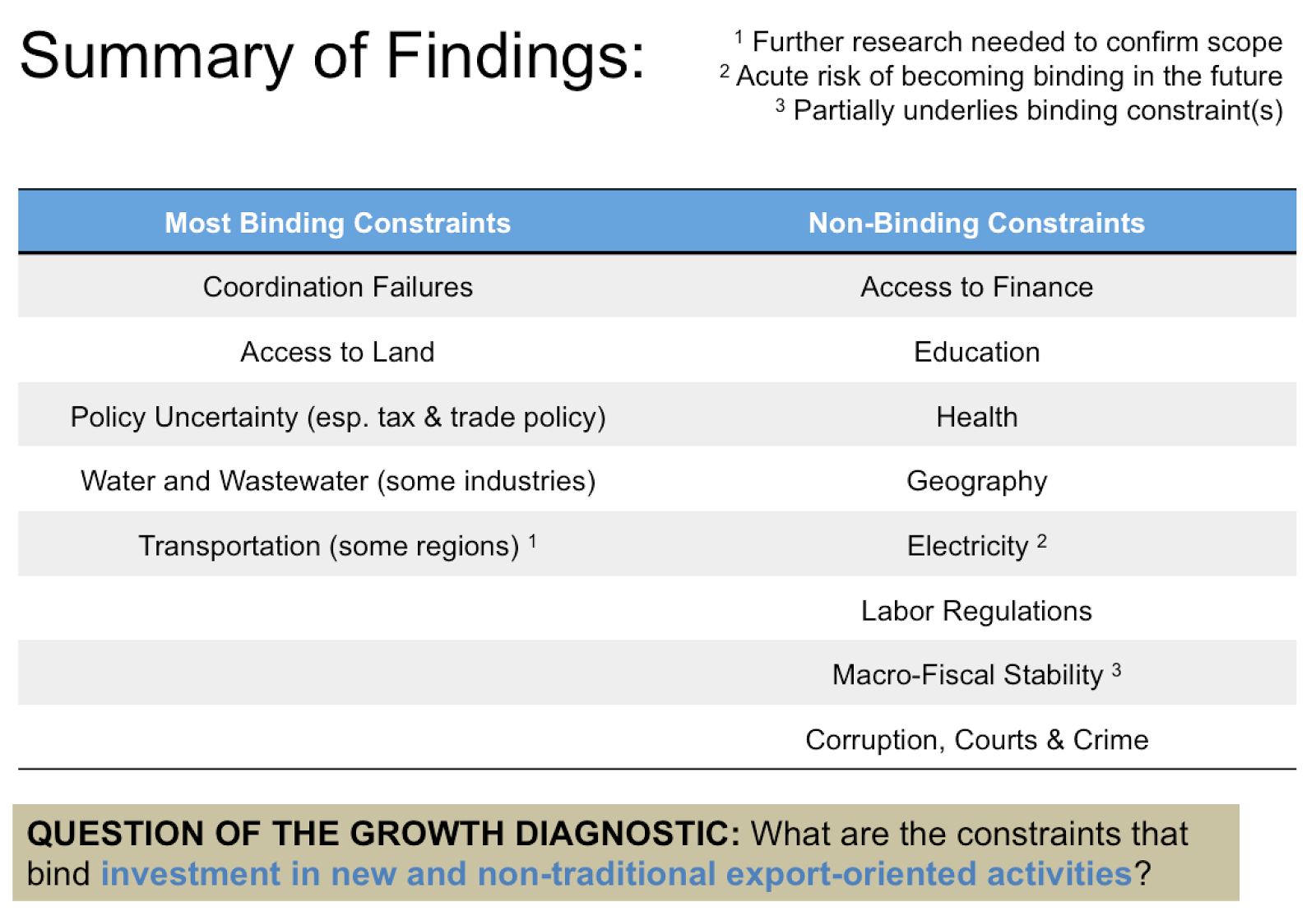
In brief, this growth diagnostic analysis shows that economic growth in Sri Lanka is constrained by the weak growth of exports, particularly from new sectors. Compared to other countries in the region, Sri Lanka has seen virtually no diversification of exports over the last 25 years, especially in manufactured goods linked through FDI-driven, global value chains. We found several key causes behind this lack of diversified exports and FDI: Sri Lanka’s ineffective land-use governance, underdeveloped industrial and transportation infrastructure, and a very high level of policy uncertainty, particularly in tax and trade policy. We believe that these issues trace back to an underlying problem of severe fragmentation in governance, with a critical lack of coordination between ministries and agencies with overlapping responsibilities and decision-making authority.