
Sri Lanka’s North Central Province: A Growth Diagnostic
In 2018, the Growth Lab team turned attention to diagnosing growth problems at the subnational level. The Prime Minister of Sri Lanka requested that the team start with the North Central Province, which had been experiencing recurring droughts, which had in turn been affecting national rice production. This presentation summarizes what the team found and presented to a local university in the North Central Province in September 2018. People in the province had long been working to escape from the vulnerability and low income levels of rice farming and the diagnostic found important areas for national-local coordination to support pathways to a stronger, and more connected, local economy.
Opportunity Analysis of Agriculture Products in Sri Lanka
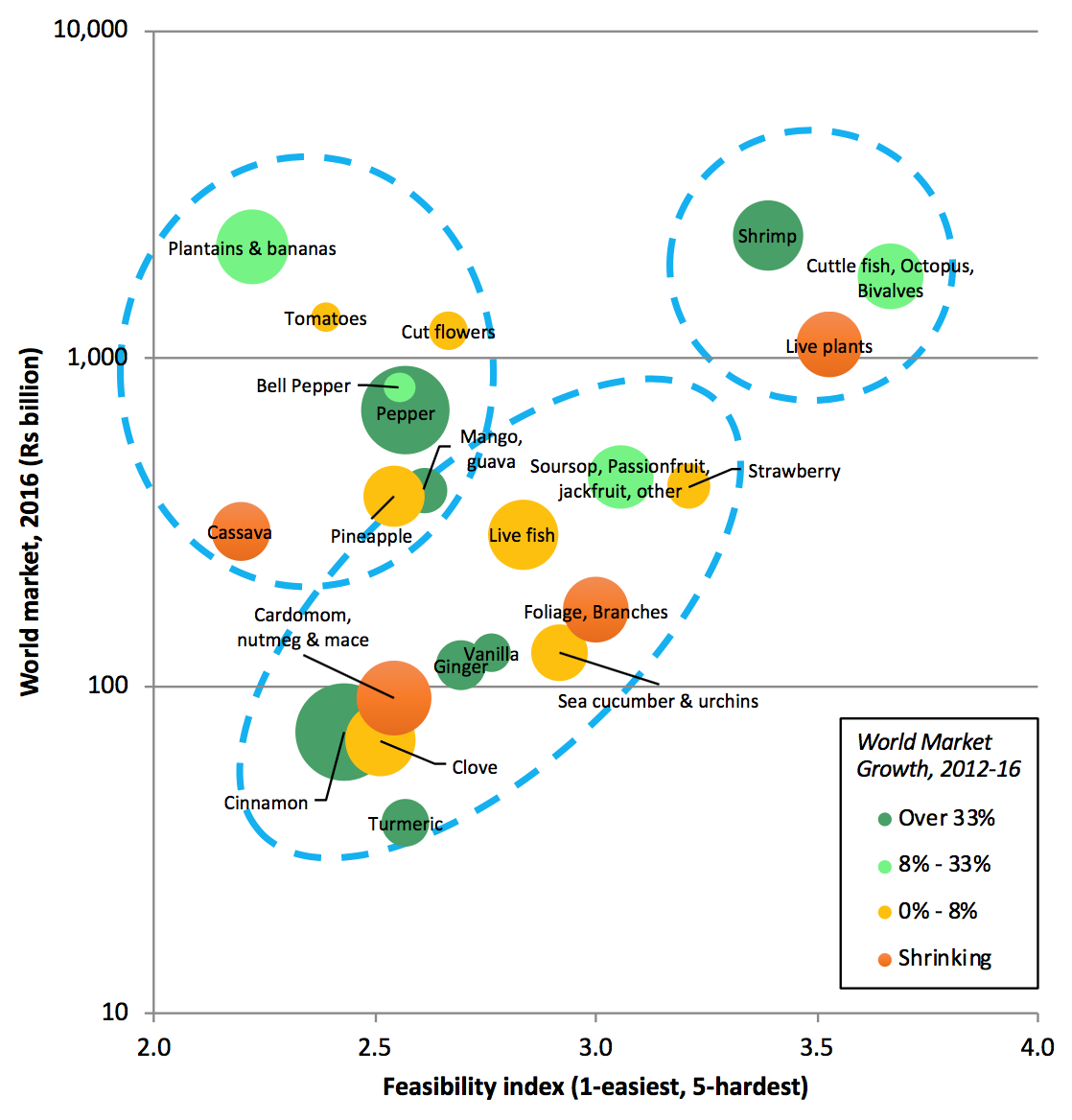
In August 2017, CID began focused work with Sri Lanka’s Ministry of Primary Industries (MPI), specifically with their Agriculture Sector Modernization Project (ASMP) team. MPI requested Harvard assistance in the analysis of constraints and opportunities in the agriculture and fisheries sector, specifically in non-plantation, export-oriented activities. As a first step, CID worked with MPI research officers to compare the more than twenty agricultural and fishery subsectors being considered under the ASMP. These subsectors were analyzed across over 53 quantitative and qualitative variables, measuring market demand, feasibility, current strength, and poverty considerations. The analysis ultimately identified spices (especially pepper), aquaculture (especially shrimp) and plantains and bananas as especially promising subsectors for future research and ASMP activities. More broadly, the analysis identified the basic market and feasibility considerations that can provide a starting point for value chain analyses and public-private strategic planning. This presentation was prepared jointly by MPI project officers and CID Growth Lab researchers in order to inform MPI initiatives, both within the ASMP and beyond.
Western Australia – Research Findings and Policy Recommendations
The Government of Western Australia (WA), acting through its Department of Primary Industries and Regional Development (DPIRD), invited the Growth Lab of the Center for International Development at Harvard University to partner with the state to better understand and address constraints to economic diversification through a collaborative applied research project. The project seeks to apply growth diagnostic and economic complexity methodologies to inform policy design in order to accelerate productive transformation, economic diversification, and more inclusive and resilient job creation across Western Australia.
This report is organized in six sections, including this brief introduction. Section 2 is an Executive Summary. Section 3 explains the methodologies of Growth Diagnostics and Economic Complexity, including its theoretical foundations and main concepts. Section 4 describes the main findings of the Economic Complexity Report, including a characterization of Western Australia’s complexity profile. This is done at the state, regional, and city levels. Additionally, this section identifies diversification opportunities with high potential and organizes them into groupings to capture important patterns among the opportunities. This section also contextualizes the opportunities further by identifying relevant viability and attractiveness factors that complement the complexity metrics and consider local conditions. Section 5 highlights the main findings of the Growth Perspective Report. This section describes the economic growth process of Western Australia — with a focus on the past two decades — and identifies several issues with the way that growth has occurred. This section highlights three key channels through which negative externalities have manifested: labor market imbalances, pro-cyclicality of fiscal policy, and a misalignment of public goods. The section provides perspectives on the ways in which each of these channels have hampered the quality of growth and explores the deep-rooted factors that underpin these adverse dynamics. Section 6 introduces a policy framework that can be leveraged by WA to capitalize on revealed diversification opportunities and address the factors that impact the quality of the growth process of the state.
Growth Perspective on Western Australia
The Government of Western Australia (WA), acting through its Department of Primary Industries and Regional Development (DPIRD), invited the Growth Lab of the Center for International Development at Harvard University to partner with the state to better understand and address constraints to economic diversification through a collaborative applied research project. The project seeks to apply growth diagnostic and economic complexity methodologies to inform policy design in order to accelerate productive transformation, economic diversification, and more inclusive and resilient job creation across Western Australia. As its name implies, this Growth Perspective Report aims to provide a set of perspectives on the process of economic growth in WA that provide insights for policymakers toward improving growth outcomes.
This Growth Perspective Report describes both the economic growth process of Western Australia — with a focus on the past two decades — and identifies several problematic issues with the way that growth has been structured. In particular, this report traces important ways in which policies applied during the boom and subsequent slowdown in growth over the last twenty years have exacerbated a number of self-reinforcing negative externalities of undiversified growth. The report analyzes three key channels through which negative externalities have manifested: labor market imbalances, pro-cyclicality of fiscal policy, and a misalignment of public goods. The report includes sections on each of these channels, which provide perspectives on the ways in which they have hampered the quality of growth and explore the reasons why problematic externalities have become self-reinforcing. In some cases, new issues have emerged in the most recent iteration of WA’s boom-slowdown cycle, but many issues have roots in the long-term growth history of WA.
Albania’s Industry Targeting Dashboard
This industry targeting tool is custom-made for Albania. Users can choose any of 272 industries (based on NACE Rev. 2 industry codes) from the above drop-down list and explore the industry’s match with Albania’s current productive capabilities and comparative advantages and disadvantages. The tool is designed for use by government and non-government entities that seek to attract foreign direct investment (FDI) to Albania to accelerate economic development. Harvard Growth Lab research in Albania shows that the long-term pace of economic growth will be determined by the pace at which the country can absorb new economic activities and productive capabilities from abroad. Detailed information on the methodology and data sources used in this tool can be found here. This tool can be used in combination with the Growth Lab’s Atlas of Economic Complexity to explore patterns in global trade in very high detail.
A Roadmap for Investment Promotion and Export Diversification: The Case of Jordan
Jordan faces a number of pressing economic challenges: low growth, high unemployment, rising debt levels, and continued vulnerability to regional shocks. After a decade of fast economic growth, the economy decelerated with the Global Financial Crisis of 2008-09. From then onwards, various external shocks have thrown its economy out of balance and prolonged the slowdown for over a decade now. Conflicts in neighboring countries have led to reduced demand from key export markets and cut off important trade routes. Foreign direct investment, which averaged 12.7% of gross domestic product (GDP) between 2003-2009, fell to 5.1% of GDP over the 2010-2017. Regional conflicts have interrupted the supply of gas from Egypt – forcing Jordan to import oil at a time of record prices, had a negative impact on tourism, and also provoked a massive influx of migrants and refugees. Failure to cope with 50.4% population growth between led to nine consecutive years (2008-2017) of negative growth rates in GDP per capita, resulting in a cumulative loss of 14.0% over the past decade (2009-2018). Debt to GDP ratios, which were at 55% by the end of 2009, have skyrocketed to 94%.
Over the previous five years Jordan has undertaken a significant process of fiscal consolidation. The resulting reduction in fiscal impulse is among the largest registered in the aftermath of the Financial Crises, third only to Greece and Jamaica, and above Portugal and Spain. Higher taxes, lower subsidies, and sharp reductions in public investment have in turn furthered the recession. Within a context of lower aggregate demand, more consolidation is needed to bring debt-to-GDP ratios back to normal. The only way to break that vicious cycle and restart inclusive growth is by leveraging on foreign markets, developing new exports and attracting investments aimed at increasing competitiveness and strengthening the external sector. The theory of economic complexity provides a solid base to identify opportunities with high potential for export diversification. It allows to identify the existing set of knowhow, skills and capacities as signaled by the products and services that Jordan is able to make, and to define existing and latent areas of comparative advantage that can be developed by redeploying them. Service sectors have been growing in importance within the Jordanian economy and will surely play an important role in export diversification. In order to account for that, we have developed an adjusted framework that allows to identify the most attractive export sectors including services.
Based on that adjusted framework, this report identifies export themes with a high potential to drive growth in Jordan while supporting increasing wage levels and delivering positive spillovers to the non-tradable economy. The general goal is to provide a roadmap with key elements of a strategy for Jordan to return to a high economic growth path that is consistent with its emerging comparative advantages.
Female Labor in Jordan: A Systematic Approach to the Exclusion Puzzle
Women in Jordan are excluded from labor market opportunities at among the highest rates in the world. Previous efforts to explain this outcome have focused on specific, isolated aspects of the problem and have not exploited available datasets to test across causal explanations. We develop a comprehensive framework to analyze the drivers of low female employment rates in Jordan and systematically test their validity, using micro-level data from Employment and Unemployment Surveys (2008-2018) and the Jordanian Labor Market Panel Survey (2010-2016). We find that the nature of low female inclusion in Jordan’s labor market varies significantly with educational attainment, and identify evidence for different factors affecting different educational groups. Among women with high school education or less, we observe extremely low participation levels and find the strongest evidence for this phenomenon tracing to traditional social norms and poor public transportation. On the higher end of the education spectrum – university graduates and above – we find that the problem is not one of participation, but rather of unemployment, which we attribute to a small and undiversified private sector that is unable to accommodate women’s needs for work and work-family balance.
Tim O’Brien
Tim O’Brien has managed Growth Lab applied research projects on five continents since joining the team in 2015.
He has led diagnostic work, capacity building, and execution of the Growth Lab’s overall research collaborations in South Africa, Ethiopia, Sri Lanka, Jordan, Albania, Western Australia, and Wyoming. Tim has also led the Growth Lab’s student engagement efforts, including the growth of its summer internship program, and works to build rich collaborations across Harvard Kennedy School research programs to target place-based challenges and practical research needs.
Before joining the Growth Lab, Tim completed the MPA/ID program at the HKS. He served as a Peace Corps volunteer in rural Malawi and holds a degree in mechanical engineering from Northwestern University.
Jordan: The Elements of a Growth Strategy
In the decade 1999-2009, Jordan experienced an impressive growth acceleration, tripling its exports and increasing income per capita by 38%. Since then, a number of external shocks that include the Global Financial Crisis (2008-2009), the Arab Spring (2011), the Syrian Civil War (2011), and the emergence of the Islamic State (2014) have affected Jordan in significant ways and thrown its economy out of balance. Jordan’s debt-to-GDP ratio has ballooned from 55% (2009) to 94% (2018). The economy has continued to grow amidst massive fiscal adjustment and balance of payments constraints, but the large increase in population – by 50% between 2008 and 2017 – driven by massive waves of refugees has resulted in a 12% cumulative loss in income per capita (2010-2017). Moving forward, debt sustainability will require not only continued fiscal consolidation but also faster growth and international support to keep interest payments on the debt contained. We have developed an innovative framework to align Jordan’s growth strategy with its changing factor endowments. The framework incorporates service industries into an Economic Complexity analysis, utilizing the Dun and Bradstreet database, together with an evaluation of the evolution of Jordan’s comparative advantages over time. Combining several tools to identify critical constraints faced by sectors with the greatest potential, we have produced a roadmap with key elements of a strategy for Jordan to return to faster, more sustainable and more inclusive growth that is consistent with its emerging comparative advantages.