
Research Seminar: Dynamic industrial policy for climate change
February 8, 2023 | 11:15 am – 12:30 pm
The Growth Lab Research Seminar series is a weekly seminar that brings together researchers from across the academic spectrum who share an interest in growth and development.
Speaker: Gregory Nemet, Professor at the University of Wisconsin–Madison
Abstract: We need a new approach to climate policy that puts innovation and adoption of low carbon technologies at the center. Unexpectedly large improvements in low-carbon technology over the past 20 years have made decarbonizing the world economy far more feasible; we can peak emissions soon, rapidly decline to zero, and do so in a way that enhances human well-being. At the same time, three decades of dithering on policy action combined with heightened estimates of climate sensitivity and their human impacts have made the climate problem more urgent. The extent of change required to the world economy is massive and robust public policy is necessary to accelerate sufficient change. Wind, solar, and batteries have improved by a combination of enabling science, supportive policies, and a variety of receptive markets, all of which have led them down the technology learning curve. That has made a transition to a low carbon economy far more affordable, on the scale of trillions in savings over the century. Further, other emerging technologies show strong potential to follow a similar learning curve leading to improved performance and low costs. In particular, electrolyzers, small scale direct air capture, and heat pumps could play central roles in a decarbonized world economy, especially if they improve like solar, wind, and batteries. General purpose technologies such as digitalization and synthetic biology can enhance these systems. I argue, we should focus our policy efforts on improving and adopting these technologies. The goal should be to expand the set of choices we will have in the future rather than on minimizing costs today. Successful examples indicate that this approach has a few core characteristics: it requires multiple ppolicy instruments, not one; it involves deeper engagement by the state in low carbon innovation; and goes beyond just the technology itself to elevate the role of social acceptance; and its goals reflect urgency and acceleration.
Whether attending in-person or virtually, please register in advance. Room attendance is limited to the Harvard community. Seating availability is based on a first-come, first-served basis. The Zoom webinar is open to the public.
About the Speaker: Gregory Nemet is a Professor at the University of Wisconsin–Madison in the La Follette School of Public Affairs. He teaches courses in policy analysis, energy systems, and international environmental policy. Nemet’s research focuses on understanding the process of technological change and the ways in which public policy can affect it. He received his doctorate in energy and resources from the University of California, Berkeley. His A.B. is in geography and economics from Dartmouth College. He received an Andrew Carnegie Fellowship in 2017 and used it to write a book on how solar PV provides lessons for the development of other low-carbon technologies: “How Solar Energy Became Cheap: A Model for Low-Carbon Innovation” (Routledge 2019). He was awarded the inaugural World Citizen Prize in Environmental Performance by APPAM in 2019. He is currently a Lead Author for the Intergovernmental Panel on Climate Change’s 6th Assessment Report. His research interests lie in innovation from both aspects of management and economics. His recent work investigated the impact of high-skilled human capital on regional entrepreneurship, the role of patents filed by government scientists in the diffusion of government science, and how academic science shapes corporate innovation.
Get to Know the Growth Lab: Research and Student Engagement Showcase
September 26, 2024 | 4:00 pm – 6:00 pm
Learn more about the Growth Lab’s mission and approach, our academic research and policy engagements, and student opportunities. You’ll hear directly from the Growth Lab’s senior leadership, fellows, and staff.
Speakers include:
Ricardo Hausmann – Director, Growth Lab; Rafik Hariri Professor of the Practice of International Political Economy, HKS
Tim Cheston – Senior Manager, Applied Research
Tim O’Brien – Senior Manager, Applied Research
Nikita Taniparti – Research Manager, Applied Research
Muhammed Yildirim – Research Director, Academic Research
RSVP is required. Contact Chuck McKenney with any questions.
Refreshments will be served.
Programming + Pizza // Visualizing Economic Data with Metroverse & Viz Hub
December 13, 2022 | 6:00 pm – 8:00 pm
**This event was originally scheduled for Oct. 25th**
Speakers: Annie White (Senior Product Manager), Steven Geofrey (Front-End Software Developer), Brendan Leonard (Back-End Developer and Data Specialist), and Nil Tuzcu (UX/UI & Data Visualization Designer) make up the Development & Design Team at the Growth Lab.
At this session of Programming + Pizza, Annie and her team will present on the design, development, data and product management that goes into Metroverse, their most recent economic visualization tool, along with other digital tools in their Viz Hub, including the Atlas of Economic Complexity. After their presentation, attendees will have plenty of time to work on the projects of their choice.
This event will be held in person, in the Library Commons (ground floor of Littauer, to the left of the HKS Library’s main entrance). Attendees must follow HKS’ COVID-19 protocols. Those without an HUID may enter via the Wexner security desk.
Programming + Pizza is a peer-to-peer mentoring group where those interested in programming tools and computational research can build skills and community.
Diversity in Development: Rethinking Approaches to Development
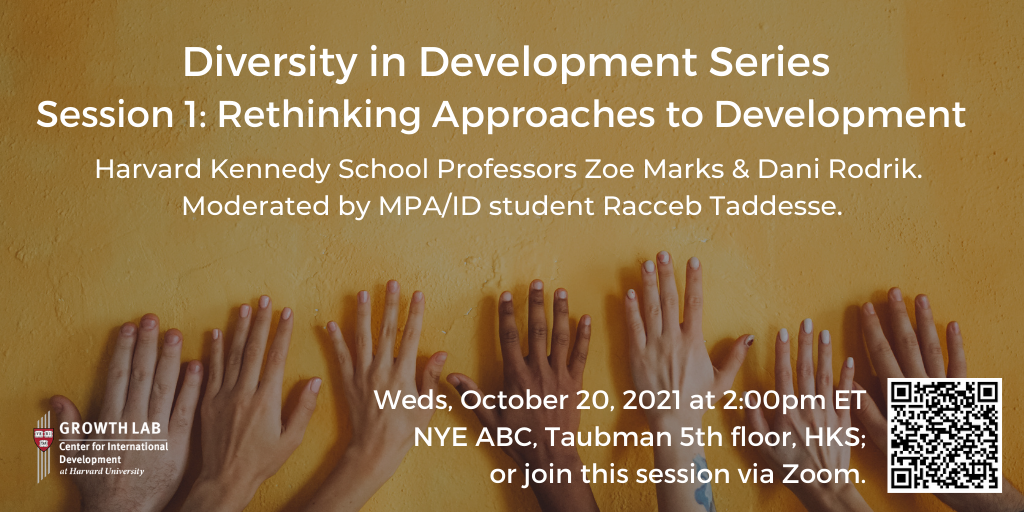
This event kicks off a series of events on “Diversity in Development.” The goal of this series is to better understand issues underlying discrimination and exclusion within the field of international development and identify collective steps that we can take to expand diversity in practice. This first session will discuss key facets of the problem and frameworks for understanding and action.
MPA/ID student, Racceb Taddesse, will guide a conversation with Harvard Kennedy School Professors Zoe Marks and Dani Rodrik. If you have a question, please submit it via the registration form.
This event will take place in-person for Harvard students and affiliates. It is also open to the public via Zoom, please register in advance to attend the Zoom session.
This series is hosted in coordination with the MPA/ID Program and the MPA/ID alumni community.
You Get What You Pay For: Sources and Consequences of the Public Sector Premium in Albania and Sri Lanka
March 6, 2020 | 1:00 pm – 2:00 pm

About the Talk: We study the factors behind the public sector premium in Albania and Sri Lanka, the group heterogeneity in the premium, the sources of public sector wage compression, and the impact of this compression on the way individuals self-select between the public and the private sector. Similar to other countries, the public sectors in Albania and Sri Lanka pay higher wages than the private sector, for all but the most valued employees. While half of the premium of Sri Lanka and two-thirds of it in Albania are explained by differences in the occupation-education-experience mix between the sectors, and the level of private sector informality, the unexplained part of the premium is significant enough to affect the preferences of working in the public sector for different groups. We show that the compressed distributions of public sector wages and benefits create incentives for positive sorting into the public sector among most employees, and negative sorting among the most productive ones. Work co-authored with Ricardo Hausmann and Sehar Noor.
Information Session: Inclusive Growth in India – A Cities Approach
February 14, 2020 | 10:30 am – 12:00 pm
Speaker: Amit Kapoor, CEO of Institute for Competitiveness, India
About the Event: The Government of India though the Ministry of Housing and Urban Affairs (MoHUA) and the Institute for Competitiveness (IFC) is embarking on a 5-year research initiative implementing the Growth Lab’s groundbreaking methodologies – economic complexity and growth diagnostics. Join Amit Kapoor, CEO of IFC, February 14th 2020, at 9.30am in L-382 (HKS) as he shares details of the project. MoHUA and IFC are building the India-based research team and will be here on campus looking for candidates. Taking advantage of the concurrent India Conference at Harvard, this session will be an informal gathering to learn about an exciting new opportunity to work on economic development and inclusive growth in India.
The research project will further the understanding of growth dynamics at the sub-national level in India, by providing research and tools to help policy makers, private sector representatives, academics, and think-tanks rethink their development strategies. The proposed research collaboration would be the first-of-its-kind at the sub-national level in India. This research engagement will yield inputs that will inform the Ministry, the IFC, and other relevant stakeholders, in their process of designing productive development policies (PDPs) aimed at accelerating growth by leveraging existing capacities at the regional level and country level.
Members of the Growth Lab will also participate in this session to help facilitate discussion. If you cannot join in person but are still interested in learning more, submit your name and email address and we’ll be in touch.
Impacts on Developing Countries from Recent Efforts to Align Trade and Sustainability Policies by the EU and the OECD
March 5, 2020 | 1:00 pm – 2:00 pm

Shunta Yamaguchi, OECD Paris
About the Seminar: Policies from developed countries aimed at promoting sustainability often carry consequences for developing countries, and one of the major channels for that is international trade. In 2019 the European Union launched a “green new deal” policy package to align actions on trade, climate and SDGs. Components of such package are likely to impact competitiveness, such as provisions to stimulate circular economy practices within and across the block.
Echoing developments at the EU level, and answering to longstanding calls for policy coherence, the OECD has been similarly active on work linking trade and environment, with special emphases on regional trade agreements, circular economy, climate change and environmental indicators. Recent modelling work from the OECD has explored climate change impacts on trade, and how trade flexibility could increase climate resilience.
This lunch seminar will explore the impact that sustainability policies in EU and OECD countries have or may have on the developing world.
Speakers will be at their personal capacity and not speaking officially on behalf of their institutions.
This seminar is part of a series of pre-events leading to the first Circular Economy Symposium at Harvard on March 6th (www.circularatharvard.org).
The Double Crisis: Insecurity and Humanitarian Plight at the Colombia-Venezuela Border
December 4, 2019 | 1:00 pm – 2:30 pm
Speaker: Annette Idler, Visiting Scholar, Weatherhead Center for International Affairs, Harvard University
About the Talk: Drawing on her book Borderland Battles: Violence, Crime, and Governance at the Edges of Colombia’s War (Oxford University Press, 2019) and her latest research findings, Annette Idler reveals why the Colombian-Venezuelan borderlands are enabling crucial but largely unacknowledged interactions between Venezuela’s devastating crisis and ongoing political violence in Colombia. She discusses how the so-called border effect has facilitated violence, undermined trust relationships, attracted numerous violent non-state groups including conflict actors, drug cartels, and gangs, and obscured the nuanced realities of multiple insecurities. Failure to tackle these issues could have serious long-term implications for stability in the region. This makes long-term plans for sustainable peace and security across and along the border an urgent necessity.
About the Speaker: Annette Idler is Visiting Scholar at Harvard University’s Weatherhead Center for International Affairs. She is also the Director of Studies at the Changing Character of War Centre, Senior Research Fellow at Pembroke College, and at the Department of Politics and International Relations, University of Oxford. She is Principal Investigator of The Changing Character of Conflict Platform and of the CONPEACE Programme at Oxford. Annette Idler has conducted extensive fieldwork in war-torn and crisis-affected borderlands, including in and on Colombia, Ecuador, Venezuela, Myanmar, and Kenya (on Somalia) analysing people-centred security dynamics.
BSC Builds: Action Theatre for Public Policy Challenges & Civic Engagement

Presenter: Arianna Mazzeo, Visiting Professor, Harvard School of Engineering and Applied Sciences
About the Workshop: Policymakers and citizens are struggling with big structural and complex problems such as climate change, cultural, economic and social inequality and the education gap between represented and underrepresented communities. In this workshop you will learn how to identify systemic challenges starting with your personal experience. Then in a group you will act and perform your challenge in a process of co-creation process with open-ended interpretations toward possible outcomes. You will learn how to understand performative behavior and decision-making for public policy challenges embodied by the problems and find outer creative expressions of co-production. Agency, Responsibility, and Civic Engagement will be the design principles to guide you in the experiential learning by doing through the body and the mind, toward a transformation. Come ready to engage and dress comfortably.
About the Presenter: Arianna introduces innovative design research and experimental pedagogies for social change. Through action theatre and multidisciplinary creative practice, she mobilizes systemic change to activate new pedagogies, addressing complex societal challenges and co-learning within underrepresented communities and place. She has worked in Cameroon, Mexico, Turkey, Armenia, and South Africa on social digital innovation programs and local government policy agenda, in order to re-design and re-think design education.
Development Beyond Crisis Response: The Evolution of the Growth Lab’s Involvement in Albania
November 19, 2019 | 2:00 pm – 3:20 pm

Speakers: Ricardo Hausmann, Rafik Hariri Professor of the Practice of International Political Economy; Director, Growth Lab
Ermal Frasheri, Senior Research Fellow, Growth Lab
Moderator: Ljubica Nedelkoska, Postdoctoral Fellow, Growth Lab
About the Talk: Since 2013, the Growth Lab has worked with the Government of Albania to identify policies that target country-specific binding constraints in order to promote strong, sustainable and inclusive economic growth. Join Ricardo Hausmann and the Growth Lab’s Albania team in a conversation on how long-term engagement has shaped the project’s goals and outcomes. What differentiates the Growth Lab work in Albania? How has it evolved in response to country needs over time? What impact has the work had? What lessons can be learned from the engagement so far? What comes next for the Growth Lab in Albania? This event will discuss what our continuing work in Albania means for both this project and country policy engagements as a whole.