
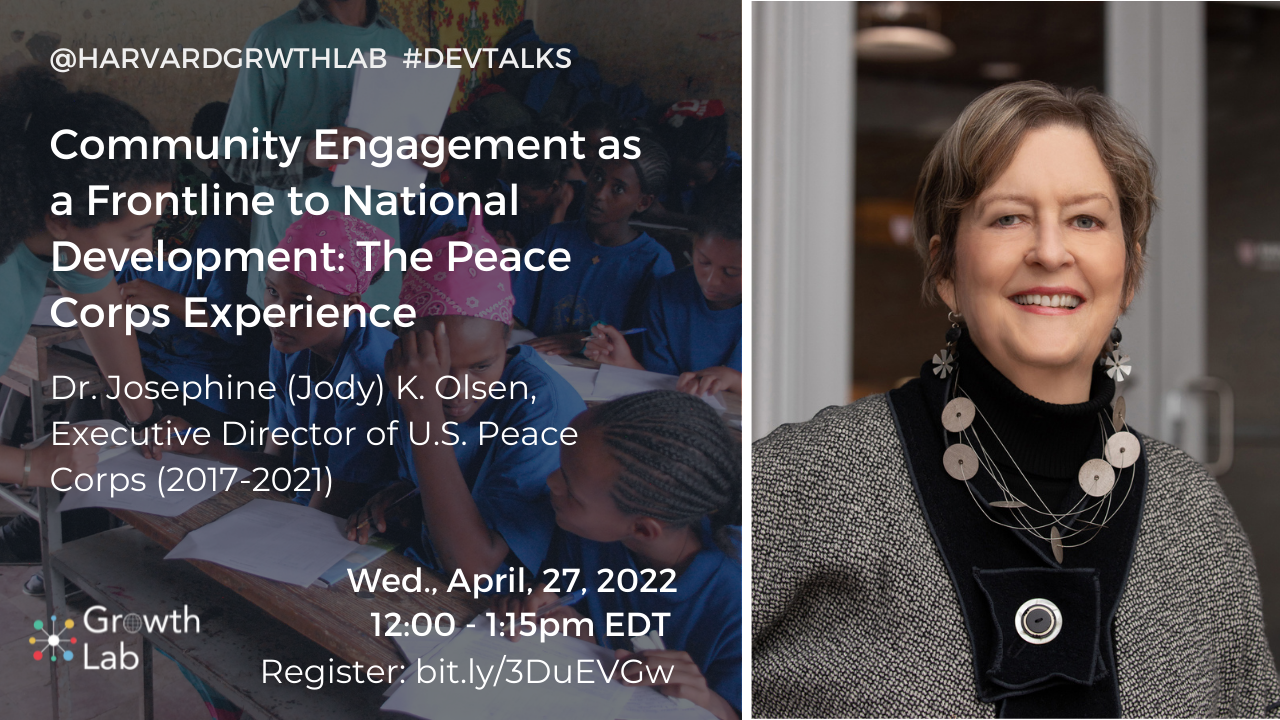
Development Talks: Community Engagement as a Frontline to National Development
April 27, 2022 | 12:00 pm – 1:15 pm
The Growth Lab’s Development Talks is a series of conversations with policymakers and academics working in international development. The seminar provides a platform for practitioners and researchers to discuss both the practice of development and analytical work centered on policy.
Topic: Community Engagement as a Frontline to National Development: The Peace Corps Experience
Speaker: Dr. Josephine (Jody) K. Olsen, Executive Director of U.S. Peace Corps (2017-2021)
Moderator: Tim Freeman, Research Fellow, Growth Lab
Whether attending in-person or watching over Zoom, please register in advance, and contact Chuck McKenney with any questions. Room attendance is limited to the Harvard community.
About the speaker:
Dr. Josephine (Jody) Olsen, PhD, served as the 20th Director of the Peace Corps from March 2018 to January 2021. In March 2020, at the beginning of the global COVID-19 pandemic, she led the nine-day evacuation back to the United States of all 7,000 Peace Corps Volunteers from 61 countries. During her tenure, she opened a new Peace Corps program in Viet Nam, championed global women’s economic empowerment, and led Peace Corps HIV/AIDS mitigation efforts in Africa. Read more
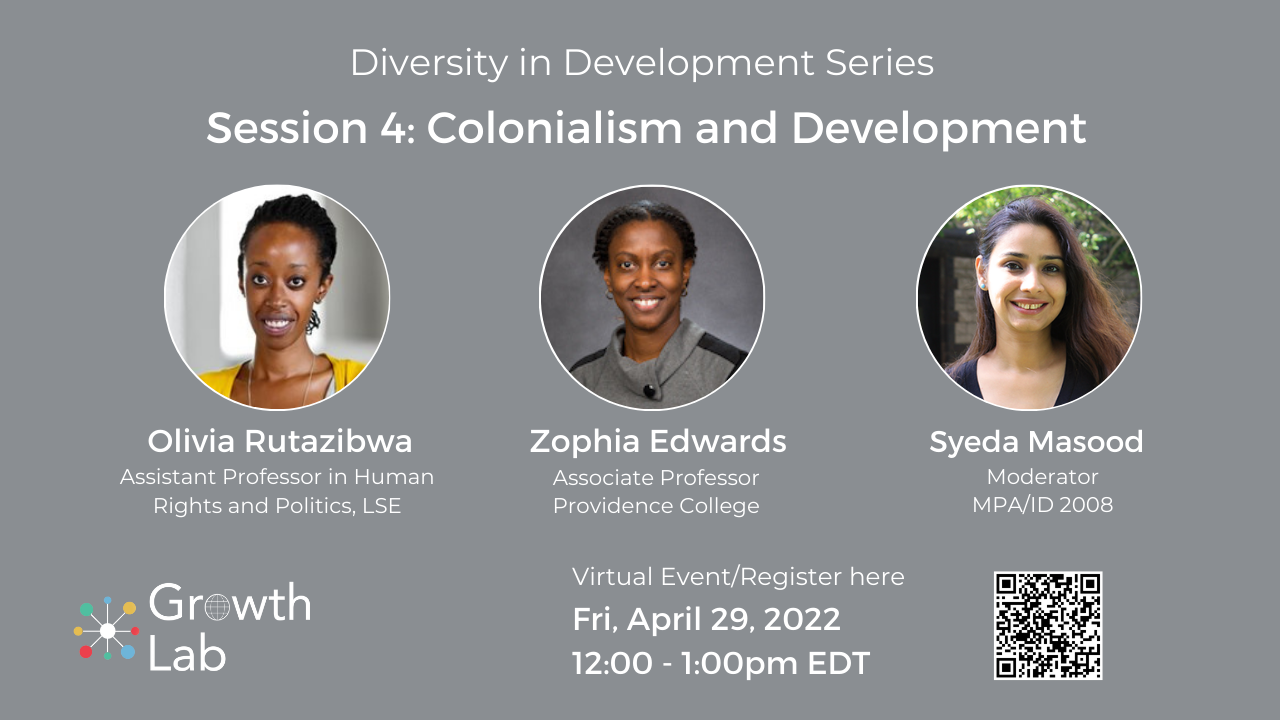
Seminar: Colonialism and Development
April 29, 2022 | 12:00 pm – 1:00 pm
This seminar is the fourth in our Diversity in Development series. This panel will investigate connections between the world history of colonialism and related racism within the international development sector. Further, the panelists, both female scholars of color, will discuss their visions of decolonizing the development sector.
Panelists:
Zophia Edwards, Associate Professor, Providence College
Olivia Rutazibwa, Assistant Professor in Human Rights and Politics, LSE
Moderator: Syeda Masood, HKS MPA/ID 2008
Please register in advance and contact Chuck McKenney with any questions.
This series is hosted in coordination with the MPA/ID Program and the MPA/ID alumni community.
Research Seminar: Organizational Frictions to Automation, and Its Effects on Firms, Workers, and Labor Markets
March 28, 2022 | 10:15 am – 11:30 am
Speaker: Daniel P. Gross, Assistant Professor, Duke’s Fuqua School of Business
Abstract: AT&T was the largest U.S. firm for most of the 20th century. Telephone operators once comprised over 50% of its workforce, but in the late 1910s it initiated a decades-long process of automating telephone operation with mechanical call switching—a technology first invented in the 1880s. This talk will cover results from two papers. In one, we study what drove AT&T to do so, and why it took one firm nearly a century to automate this one function. In the second, we study how automation affected the labor market for young women.
On the firm side, we find that interdependencies between call switching and nearly every other part of the business were obstacles: the manual switchboard was the fulcrum of a complex production system which had developed around it, and automation only began after the firm and automatic technology were adapted to work together. Even then, automatic switching was only profitable for AT&T in larger markets—hence diffusion expanded as costs declined and service areas grew. Automation supported AT&T’s continued growth, generating a positive feedback loop between scale and automation that reinforced AT&T’s high market share in local markets.
On the worker side, we find that although automation eliminated one of the most common jobs for young American women of this era, it did not affect future cohorts’ overall employment: the decline in operators was counteracted by reinstating demand in middle-skill clerical jobs and lower-skill service jobs. Incumbent (already-employed) telephone operators were most impacted by automation, and a decade later were more likely to be in lower-paying occupations or have left the labor force entirely.
Bio: Daniel P. Gross is an assistant professor at Duke’s Fuqua School of Business, which he joined in 2020 after several years on the faculty at Harvard Business School. His research has two primary branches: (1) crisis innovation policy and strategy, including the effects of crisis R&D efforts on post-crisis innovation, entrepreneurship, industry dynamics, and regional economies; and (2) the effects of automation on workers, firms, and labor markets. He previously also studied the use of incentives and other tools in managing creative workers within organizations. Professor Gross’ research frequently uses historical examples of industries and eras undergoing significant technological change as a lens into the present and future.
Please register in advance, and contact Chuck McKenney with any questions. The seminar will be hybrid, with Daniel presenting in-person for the Harvard community only in WEXNER W-G02.
Research Seminar: Technology Within and Across Firms
March 21, 2022 | 10:15 am – 11:30 am
Speaker: Diego Comin, Professor of Economics at Dartmouth College
Paper: Technology Within and Across Firms
Abstract: This study collects data on the sophistication of technologies used at the business function level for a representative sample of firms in Vietnam, Senegal, and the Brazilian state of Ceara. The analysis finds a large variance in technology sophistication across the business functions of a firm. The within-firm variance in technology sophistication is greater than the variance in sophistication across firms, which in turn is greater than the variance in sophistication across regions or countries. The paper documents a stable cross-firm relationship between technology at the business function and firm levels, which it calls the technology curve. Significant heterogeneity is uncovered in the slopes of the technology curves across business functions, a finding that is consistent with non-homotheticities in firm-level technology aggregators. Firm productivity is positively associated with the within-firm variance and the average level of technology sophistication. Development accounting exercises show that cross-firm variation in technology accounts for one-third of cross-firm differences in productivity and one-fifth of the agricultural versus non-agricultural gap in cross-country differences in firm productivity.
For virtual attendees, please register in advance and contact Chuck McKenney with any questions.
About the speaker:
Diego Comin is a Professor of Economics at Dartmouth College. He is also Research Fellow at the Center for Economic Policy Research and Faculty Research Fellow in the National Bureau of Economic Research’s Economic Fluctuations and Growth Program. Comin is a fellow for the Institute of New Economic Thinking (INET). Professor Comin has published multiple articles in top economic journals on the topics of business cycles, technology diffusion, economic growth and firm volatility. He has also authored cases studies published in the book Drivers of Competitiveness. Comin’s research has been supported by the Gates foundation, the National Science Foundation, the C.V. Star Foundation, the INET foundation and the Zentrum für Europäische Wirtschaftsforschung (ZEW).
Research Seminar: Achieving Power Sector Carbon Neutrality in a Low-cost Renewable Era
March 14, 2022 | 10:15 am – 11:30 am
Speaker: Gang He, Assistant Professor in the Department of Technology and Society at Stony Brook University
Abstract: Clean power transition is at the center to achieve mid-century carbon neutrality goals. The cost of solar and wind has plummeted in the past decade, and solar and wind electricity has been achieving grid parity. Low-cost renewables offer new perspectives for energy system decarbonization that was less visioned before. In this talk, Dr. He will discuss the pathways of clean power transition and their system impacts using high-resolution models, to reflect the need for integrating variable renewable energy and phasing out coal to achieve carbon neutrality in the power sector at a low-cost renewables era.
The talk will be based on the following papers:
- He, Gang, Jiang Lin, Froylan Sifuentes, Xu Liu, Nikit Abhyankar, and Amol Phadke. 2020. “Rapid Cost Decrease of Renewables and Storage Accelerates the Decarbonization of China’s Power System.” Nature Communications 11 (1): 2486. https://doi.org/10.1038/s41467-020-16184-x.
- Zhang, Chao, Gang He, Josiah Johnston, and Lijin Zhong. 2021. “Long-Term Transition of China’s Power Sector under Carbon Neutrality Target and Water Withdrawal Constraint.” Journal of Cleaner Production 329 (December): 129765. https://doi.org/10.1016/j.jclepro.2021.129765.
- He, Gang, Jiang Lin, Ying Zhang, Wenhua Zhang, Guilherme Larangeira, Chao Zhang, Wei Peng, Manzhi Liu, and Fuqiang Yang. 2020. “Enabling a Rapid and Just Transition Away from Coal in China.” One Earth 3 (2): 187–94. https://doi.org/10.1016/j.oneear.2020.07.012.
Please register in advance and contact Chuck McKenney with any questions.
About the speaker:
Dr. Gang He is an Assistant Professor on energy policy in the Department of Technology and Society at Stony Brook University. His work focuses on energy modeling, energy and climate change policy. He also studies other issues related to global climate change and the development of lower-carbon energy sources. He had worked for Stanford University Program on Energy and Sustainable Development from 2008 to 2010 and was a Cynthia Helms Fellow at World Resources Institute in 2008. He received his Ph.D. in Energy and Resources at the University of California, Berkeley, He also holds an M.A. from Columbia University on Climate and Society and a B.S. and M.S. from Peking University on Geography.
Knowledge Diffusion as a Cornerstone of Economic Recovery in the Post-COVID World
March 21, 2022 | 2:30 pm – 4:00 pm
The Growth Lab has recently collaborated with the School of Public Policy at the London School of Economics to launch the Growth Co-Lab at LSE. The strategic goal is to bring together the capacities, expertise, and reach of two top academic institutions to expand the activities of the Growth Lab globally.
In this public event marking the launch of the collaboration, a panel of high-level government officials and academic experts will discuss Knowledge Diffusion as a Cornerstone of Economic Recovery and Growth in the Post-COVID World.
Speakers/Moderators:
Arben Ahmetaj, Deputy Prime Minister of Albania.
Omar Al-Razzaz, former Prime Minister of Jordan.
Ann Bernstein, Executive Director of the Center for Development and Enterprise, South Africa.
Ricardo Hausmann, Director of the Growth Lab.
Isabel de Saint Malo, former Vice-President of Panama.
Miguel Angel Santos, Director of Applied Research at the Growth Co-Lab at LSE.
Andrés Velasco, Professor of Public Policy and Dean of the School of Public Policy at LSE.
Please register in advance, and contact Chuck McKenney with any questions.
Twitter Hasthag for this event: #LSEPostCOVID
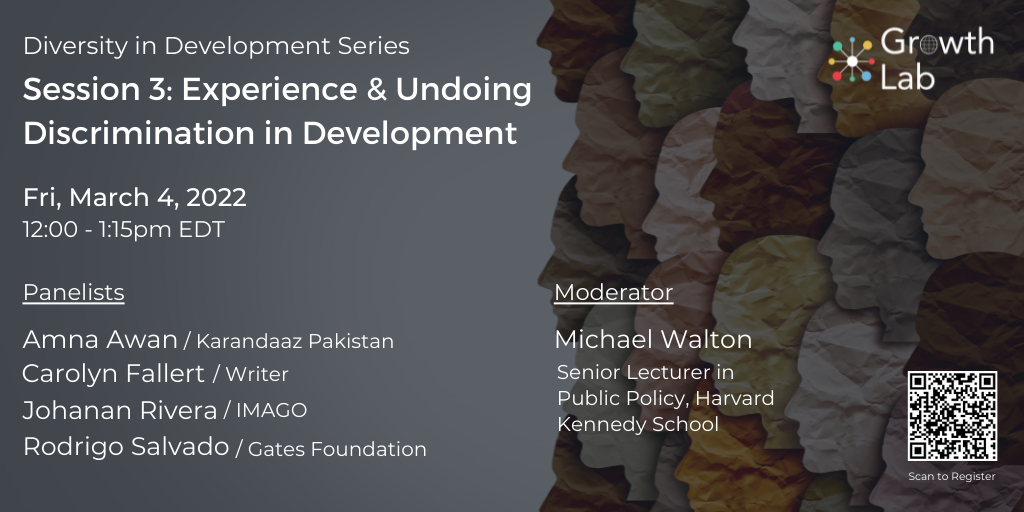
Alumni Panel: Experiencing & Undoing Discrimination in Development
The work of development is to improve quality of life and expand economic opportunity across diverse global communities, and graduate programs such as the MPA/ID program at HKS are enormously diverse in national origin, gender, and professional and lived experience. Yet, a 2020 survey of MPA/ID alumni revealed that roughly half of all respondents have encountered discrimination in some form (either being harmed by it, being complicit in it, or observing it).
In the Fall of 2021, the Diversity in Development series discussed the problems of limited diversity in the field of international development and introduced frameworks for understanding the problem. It also considered diverse approaches to the goals of “development,” including aspects of self-determination, capabilities, and justice, and the extent to which a vision of development is shared. These sessions laid the theoretical frameworks for thinking about the ultimate goals of international development approaches.
This Spring, we are turning the spotlight on MPA/ID alumni who are dealing with these issues on the ground every day. Specifically, we ask them to reflect and share: i) lived experiences with discrimination in the sector and ii) how they are elevating voices of those closest to the challenges they seek to solve. Join the alumni for a rich discussion of the complexities of these deeply rooted patterns and opportunities to shift power in international development.
Panelists:
Amna Awan, Gender Advisor at Karandaaz Pakistan
Carolyn Fallert, writer
Johanan Rivera, Manager of Programs, Environment; IMAGO
Rodrigo Salvado, Deputy Director, Development Policy and Finance; Bill & Melinda Gates Foundation
Moderator:
Michael Walton, Senior Lecturer in Public Policy, Harvard Kennedy School
All speakers will be virtual, but we’ve reserved WEX W-G02 (seating capacity of 40) as a viewing room. Please register in advance and contact Chuck McKenney with any questions.
Research Seminar: Vietnam’s role in the US-China trade war
March 7, 2022 | 11:15 am – 12:30 pm
Speaker: Karin Mayr-Dorn, Associate Professor, Department of Economics, Johannes Kepler University of Linz
Paper: Trade diversion and labor market adjustment: Vietnam and the US-China Trade War
Abstract: This paper investigates the effects of the U.S.-China trade war on trade diversion and the labor market in a third country, Vietnam. We exploit variation in Vietnamese exports to the U.S. across industries and districts based on the extent of the unexpected and exogenous U.S. tariff hikes on Chinese imports and provide evidence of an indirect effect on labor market outcomes in Vietnam. Vietnamese workers and districts that are more exposed to the trade war display higher employment, working hours, and wages as a result of the U.S.-China trade war. Our findings reveal that bilateral trade policy can have substantial offsetting effects on trade flows and labor markets in third countries.
Bio: Karin Mayr-Dorn is an Associate Professor at the Department of Economics at the Johannes Kepler University of Linz, Austria. Currently, she is a Visiting Professor at Malcolm Wiener Center for Social Policy at the Harvard Kennedy School. Her research interests are international economics, labor economics, and public economics. Before joining JKU Linz, Karin spent six years at the University of Vienna. She was also a research visitor at the University of Warwick, Trinity College Dublin, the University of California at Davis, and the University College London.
Please register in advance and contact Chuck McKenney with any questions.
Development Talks: A New Agenda for African Continental Integration
February 17, 2022 | 1:00 pm – 2:15 pm
The Growth Lab’s “Development Talks” is a series of conversations with policymakers and academics working in international development. The seminar provides a platform for practitioners and researchers to discuss both the practice of development and analytical work centered on policy.
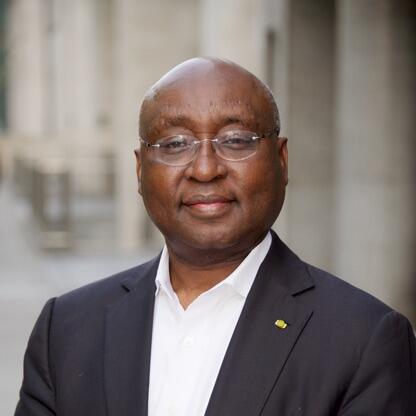
Speaker: Donald Kaberuka, President, African Development Bank (2005-2015)
Moderator: Tim O’Brien, Senior Manager, Applied Research, Growth Lab
Please register in advance to attend this webinar. Contact Chuck McKenney with any event-related questions.
About the speaker:
A Rwandan economist, Mr. Kaberuka is Chairman and Managing Partner of SouthBridge, a Pan-African financial advisory and investment firm. Previously, he served as the 7th President of the African Development Bank (AfDB), from 2005 to 2015, in which he is credited with the expansion of the reach and impact of AfDB. During his two terms as President, Mr. Kaberuka led from the front on infrastructure, promoted private sector development and economic integration. The Bank played a major countercyclical role during the 2008 financial crisis to enable African countries in weathering the crisis. Prior to joining AfDB, Mr. Kaberuka served as Rwanda’s Minister of Finance and Economic Planning from 1997 to 2005. Mr. Kaberuka is currently the African Union High Representative for the Peace Fund and Board Chair of The Global Fund to Fight AIDS, Tuberculosis and Malaria and also serves on the Board of the Rockefeller Foundation, the Mo Ibrahim Foundation, the Centre for Global Development and several other advisory boards.
Mr. Donald Kaberuka was educated at universities in Tanzania and Scotland. He holds a PhD in Economics from Glasgow University.
Venezuelan Migrants in Brazil: Children and Family Experiences with Education and Social Services
March 2, 2023 | 11:00 am – 12:30 pm
Speaker: Gabrielle Oliveira, Jorge Paulo Lemann Associate Professor of Education and of Brazil Studies, Harvard Graduate School of Education
Moderator: Sarah Dryden-Peterson, Associate Professor of Education, Harvard Graduate School of Education
An unprecedented number of Venezuelans have left behind the worsening economic and social crisis at home to look for better future prospects. Brazil is hosting about 261,000 Venezuelans as migrants, asylum seekers, or refugees, which, at 18 percent, constitutes the largest share of Brazil’s 1.3 million refugees and migrants population (World Bank, 2020). Many shelters in Brazilian cities are overcrowded, meaning children and families often end up living on the streets and unable to access government services including education. This presentation has two goals: the first is to present background data on both the legal conditions that impact Venezuelan immigrants in Brazil and the education barriers that exist for immigrant and refugee children in Brazilian public schools. The second goal is to present preliminary qualitative data on how public schools (teachers, administrators) are responding to the influx of Venezuelan children in elementary schools.
This event will be hybrid. To register for the in-person session, click here. To register for the virtual session, click here.
This event is co-sponsored by the David Rockefeller Center for Latin American Studies.