
Research Seminar: Which Workers Earn More at Productive Firms? Position Specific Skills and Individual Hold-up Power
February 28, 2022 | 11:15 am – 12:30 pm
Speaker: Justin Bloesch, Ph.D. Candidate in Economics, Harvard University
Paper: Which Workers Earn More at Productive Firms? Position Specific Skills and Individual Hold-up Power
Abstract: We argue that productive firms share rents with workers only in occupations where workers have individual hold-up power. We present a model of wage determination where firms produce using a novel generalization of Kremer (1993)’s O-ring production function. Workers have individual hold-up power if (i) labor is organized into distinct, differentiated positions (ii) the output of positions is individually complementary or “critical” in the production process, and (iii) skills are position-specific, i.e., skills are acquired on the job and are not transferable across positions or firms. If output losses from an unfilled position are larger at productive firms, incomplete contracts and on-the-job search incentivize productive firms to pay differentially high wages. We estimate individual worker hold-up power by occupation using the effect of worker deaths on firm profits in Danish administrative data and using a measure of within-firm, across-position task differentiation from US job posting data. High hold-up occupations exhibit both higher wage levels and higher long-run passthrough of permanent firm productivity innovations to wages, supporting the main model predictions. Accounting for heterogeneity in hold-up power across occupations has numerous implications for wage inequality: (1) greater employment of men in high hold-up occupations can account for one fifth of the Danish gender wage gap; (2) rising “superstar firms” increase wage inequality; (3) hold-up power decreases the responsiveness of wages to labor market slack.
Please register in advance and contact Chuck McKenney with any questions.
Research Seminar: How Immigration Grease is Affected by Economic, Institutional, and Policy Contexts: Evidence from EU Labor Markets
February 14, 2022 | 11:15 am – 12:30 pm
Speaker: Martin Kahanec, Professor and Head of the Department of Public Policy at the Central European University (CEU) in Vienna.
Abstract: (Paper)
Theoretical arguments and previous country-level evidence indicate that immigrants are more fluid than natives in responding to changing skill shortages across countries, occupation groups and industries. The diversity across EU member states enables us to test this hypothesis across various institutional, economic and policy contexts. Drawing on the EU LFS and EU SILC datasets, we study the relationship between residual wage premia as a measure of skill shortages in different occupation-industry-country cells and the shares of immigrants and natives working in these cells. We find that immigrants’ responsiveness to skill shortages exceeds that of natives in the EU15, in particular in member states with low GDP, higher levels of immigration from outside EU, and more open immigration and integration policies; but also those with barriers to citizenship acquisition or family reunification. While higher welfare spending seems to exert a lock-in effect, a comparison across different types of welfare states indicates that institutional complementarities alleviate the effect.
Please register in advance and contact Chuck McKenney with any questions.
Research Seminar: Colombia’s Structural Challenges for the Creation of New, Better and More Inclusive Jobs
February 7, 2022 | 11:15 am – 12:30 pm
Please register in advance and contact Chuck McKenney with any questions.
Speakers: Laura Pabón, Eliana Carranza, and Andreas Eberhard-Ruiz
Abstract:
In mid-2020, the Government of Colombia launched a labor reform consultation process (Misión de Empleo) in response to a deterioration in pre-Covid19 employment indicators and changing economic and labor market conditions. Based on a comprehensive review of Colombia’s labor market performance for the 2009-2019 period, this report seeks to provide analytical underpinnings to this process. At the macro level, the report shows that employment in Colombia is insufficiently diversified relying almost exclusively on job creation in the services sectors. This exposes the labor market to cyclical changes in internal demand that are typical for commodity rich economies like Colombia. At the worker level, the report shows that the economy generates too few formal employment opportunities for those with fewer skills and those living in rural areas, implying low earnings, high rates of self-employment, and high levels of informality. At the firm level, the report shows that the labor regulatory regime has contributed to strong increases in labor costs with important effects on entry and exit dynamics of firms contributing to a compositional shift towards larger, more capitalized, and more skill-intensive firms.
World Bank report citation:
Carranza, Eliana; Wiseman, William; Eberhard-Ruiz, Andreas; Cardenas, Ana Lucia. 2021. “Colombia Jobs Diagnostic : Structural Challenges for the Creation of New, Better and More Inclusive Jobs (Spanish).” Jobs Series; Issue No. 30 Washington, D.C. : World Bank Group.
Speaker bios:
Laura Pabón is the Director of Social Development of the National Planning Department of Colombia, and member of the Technical Secretary of Colombia’s Mision de Empleo. In 2020, she was recognized by the Presidency of the Republic and Civil Service as the best public servant in the country. Laura is an economist with a master’s degree in Economics from the Universidad de los Andes and a master’s degree in Public Policy from the University of Chicago.
Eliana Carranza is a Senior Economist at the World Bank Social Protection and Jobs Practice. She is also an Adjunct Lecturer at the Harvard Kennedy School, in the Master in Public Administration in International Development (MPA/ID) Program. Eliana works with national governments in the formulation of diagnoses, strategies and solutions to labor force and employment challenges. She holds an MPA in International Development and a PhD in Political Economy and Government (Economics) from Harvard University.
Andreas Eberhard-Ruiz is an Economist at the World Bank Jobs Group, where he works on jobs, growth, and structural change. Prior to joining the World Bank, he worked for the European Commission and for the Ugandan Finance Ministry as a Fellow of the UK’s Overseas Development Institute. His research focuses on trade and competitiveness, and regional market integration. He holds a PhD from the University of Sussex.
Research Seminar: Innovation Networks and Innovation Policy
January 31, 2022 | 11:15 am – 12:30 pm
Speaker: Ernest Liu, Assistant Professor of Economics at the Bendheim Center for Finance in Princeton’s Department of Economics
Paper: Innovation Networks and Innovation Policy
Abstract: We study the optimal allocation of R&D resources in an endogenous growth model with an innovation network, through which one sector’s past innovations may benefit other sectors’ future innovations. First, we provide closed-form sufficient statistics for the optimal path of R&D resource allocation, and we show that planners valuing long-term growth should allocate more R&D toward key sectors that are upstream in the innovation network. Second, we extend to an open-economy setting and illustrate an incentive for countries to free-ride on fundamental technologies: an economy more reliant on foreign knowledge spillovers has less incentive to direct resources toward innovation-upstream sectors, leading to cross-country differences in unilaterally optimal R&D allocations across sectors. Third, we build the global innovation network based on over 30 million global patents and establish its empirical importance for knowledge spillovers. Fourth, we apply the model to evaluate R&D allocations across countries and time. Adopting optimal R&D allocations can generate substantial welfare improvements across the globe. For the United States, R&D misallocation accounts for about 0.68 percentage points of missing annual growth since the 2000s.
Please register in advance and contact Chuck McKenney with any questions.
Development Talks: Confronting Post-COVID Macroeconomic Challenges in Namibia
January 26, 2022 | 1:00 pm – 2:15 pm
The Growth Lab’s “Development Talks” is a series of conversations with policymakers and academics working in international development. The seminar provides a platform for practitioners and researchers to discuss both the practice of development and analytical work centered on policy.
Speaker: Ipumbu W. Shiimi, Minister of Finance, Namibia
Moderator: Miguel Angel Santos, Director of Applied Research, Growth Lab
Please register in advance to attend this webinar. Contact Chuck McKenney with any event-related questions.
 Speaker’s bio:
Ipumbu Shiimi, an accomplished economist, is the Minister of Finance in the Republic of Namibia. Before his Ministerial appointment, Shiimi was Governor of the Bank of Namibia from 2010 to 2020, where he previously served as Assistant Governor and also occupied several positions from junior to senior level. During his working career, Shiimi participated in various research projects, co-authored multiple publications, and served on various Boards and Committees.
He holds a Master of Science in Financial Economics (1998) and a Postgraduate Diploma in Economic Principles (1995) from the University of London. He also has a Diploma in Foreign Trade and Management (1994) from the Maastricht School of Management, Netherlands, along with Honours in Economics (1993) and Bachelor of Commerce in Economics and Accounting (1992) degrees from the University of Western Cape, South Africa. He underwent specialized training in the Management Development Program at the University of Stellenbosch (2000) and Wits Business School, South Africa (2001).
Book Talk – Reclaiming Populism: How Economic Fairness Can Win Back Disenchanted Voters
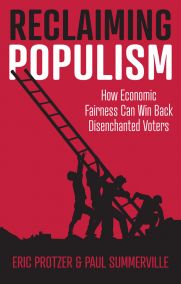
Reclaiming Populism contends that populist upheavals like Trump, Brexit, and the Gilets Jaunes happen when the system really is rigged. Citizens the world over are angry not due to immigration or income inequality, but economic unfairness: the sense of being held back from success because opportunity is not equal and reward is not according to contribution.
This forensic book demonstrates that illiberal populism strikes hardest when family origins decide success rather than talent and effort. The authors, Eric Protzer and Paul Summerville, propose a framework of policy inputs that instead support high social mobility, and apply it to diagnose the differing reasons behind economic unfairness in the US, UK, Italy, and France.
Author: Eric Protzer, Growth Lab Research Fellow
Moderator: Ricardo Hausmann, Director of the Harvard Growth Lab and Rafik Hariri Professor of the Practice of International Political Economy at HKS
Please register in advance. Contact Chuck McKenney with any questions.
Research Seminar: The Cushioning Effect of Immigrant Mobility
December 20, 2021 | 11:15 am – 12:30 pm
Speaker: Cem Özgüzel, Economist, Organization for Economic Co-operation and Development (OECD)
Abstract: During the Great Recession, immigrants reacted to the drop in labour demand in Spain through internal migration or leaving the country. Consequently, provinces lost 13.5% of their immigrants or -3% of the total labour supply, on average. Using municipal registers and longitudinal administrative data, I find that immigrant outflows slowed the decline in employment and wage of natives. I use a modified shift-share instrument based on past settlements to claim causality. Employment effects were driven by increased entries to employment, while wage effects were limited to natives that were already employed. These effects also persisted in the medium-term.
Speaker bio: Cem is an Economist at the Organization for Economic Co-operation and Development (OECD) and a Research Fellow at the Institut Convergences Migrations. He is an applied economist with a PhD in economics from the Paris School of Economics, and has research interests in international migration, labor markets and regional economics. Before joining the OECD, he worked as a Teaching and Research Fellow at the University of Paris 1 Panthéon-Sorbonne and as a Lecturer at the Paris Institute of Political Studies (Sciences Po). He was also a visiting scholar at Center for International Development at Harvard University, and the German Institute for Employment Research (IAB).
Please register in advance. Contact Chuck McKenney with any questions.
Research Seminar – Apollo’s Arrow: The Profound and Enduring Impact of Coronavirus on the Way We Live
December 13, 2021 | 11:15 am – 12:30 pm
Apollo’s Arrow offers a broad account of the impact of the coronavirus pandemic as it swept through American society in 2020 and of how the pandemic will unfold, and ultimately end, in the coming years. Using up-to-the-moment information, and drawing on epidemiology, sociology, medicine, public health, history, virology, and other fields, it explores what it means to live in a time of plague — an experience that is paradoxically uncommon to the vast majority of humans who are alive, yet deeply fundamental to our species. Unleashing new divisions in our society as well as new opportunities for cooperation, this 21st-century pandemic has upended our lives in ways that test our frayed collective culture. Apollo’s Arrow envisions what happens when the great force of a deadly germ meets the enduring reality of our evolved social nature.

Please register in advance and contact Chuck McKenney with any questions.
Research Seminar: Globalization and the Ladder of Development: Pushed to the Top or Held at the Bottom?
November 30, 2021 | 1:00 pm – 2:15 pm
Title: Globalization and the Ladder of Development: Pushed to the Top or Held at the Bottom?
Please register in advance. Contact Chuck McKenney with any questions.
Abstract: We study the relationship between international trade and development in a model where countries differ in their capability, goods differ in their complexity, and capability growth is a function of a country’s pattern of specialization. Theoretically, we show that it is possible for international trade to increase capability growth in all countries and, in turn, to push all countries up the development ladder. This occurs because: (i) the average complexity of a country’s industry mix raises its capability growth, and (ii) foreign competition is tougher in less complex sectors for all countries. Empirically, we provide causal evidence consistent with (i) using the entry of countries into the World Trade Organization as an instrumental variable for other countries’ patterns of specialization. The opposite of (ii), however, appears to hold in the data. Through the lens of our model, these two empirical observations imply dynamic welfare losses from trade that are small for the median country, but pervasive and large among a number of African countries.
Bio: Arnaud Costinot is Professor of Economics at MIT. He received his B.S. from Ecole Polytechnique in 2000, his M.A. from Ecole des Hautes Etudes en Sciences Sociales in 2001, and his Ph.D. from Princeton University in 2005. Professor Costinot has received numerous awards including the Prix Edmond Malinvaud, the Kiel Excellence Award in Global Economic Affairs, and an Alfred P. Sloan Research fellowship. He is a Fellow of the Econometric Society, a Faculty Research Associate for the National Bureau of Economic Research and a Research Fellow for the Center for Economic Policy Research. He also serves on the editorial boards of the American Economic Review and the Journal of International Economics. Specializing in international trade, he has published the American Economic Review, Econometrica, the Journal of Political Economy, the Quarterly Journal of Economics, and the Review of Economic Studies. His current research focuses on trade policy and the measurement of the welfare gains from trade.
Seminar: Macroeconomic Policy in South Africa
November 30, 2021 | 9:30 am – 11:00 am
On 30 November the Southern Africa – Towards Inclusive Economic Development (SA-TIED) programme will host an online seminar on macroeconomic policy in South Africa. This presentation is based on the report Macroeconomic Risks after a Decade of Microeconomic Turbulence, South Africa (2007–2021) by Ricardo Hausmann, Federico Sturzenegger, Patricio Goldstein, Frank Muci, and Douglas Barrios.
Federico Sturzenegger will present the report, which analyzes the performance of macroeconomic policy in South Africa from 2007 to 2020 and outlines challenges for policy in the coming decade. After remarkable economic growth in 1997–2007, South Africa’s progress slowed dramatically in 2009 with the global financial crisis (GFC). Real GDP growth decelerated more than in other emerging markets and mineral exporting peers and never recovered pre-crisis levels. In addition, the budget deficit that provided counter-cyclical support to the economy was never reigned in, leading to a rapidly rising public debt load.
The authors of the report assess three accounts of South Africa’s post-GFC growth and fiscal slump: 1) an external story; 2) a macro story; and 3) a microeconomic story. They find evidence of strong linkages between micro- and political developments and growth performance.
The seminar will also include a policy discussion featuring Thabi Leoka and moderated by Nikiwe Bikitsha.
Register for the seminar here.
About the speaker: Federico Sturzenegger is Full Professor of Economics and Business at Universidad de San Andrés in Buenos Aires and Honoris Causa Professor at HEC, Paris. He is also Visiting Professor of Public Policy at Harvard´s Kennedy School of Government. Between 2015 and 2018, he was the Governor of the Central Bank of Argentina. He has also held several positions in public service, including Secretary of Economic Policy, Member of Parliament in the Chamber of Representatives, and President of Banco Ciudad. He holds a PhD in Economics from MIT.