
Search Growth Lab
Search
Policy Area
Research Project
Content type
Country/Region
Research Type
Author
-

Project
Latin America
Economic Growth and Governance for Venezuela
Research initiative launched in 2015 to better understand the causes, magnitudes, and possible remedies of the Venezuelan crisis. -
Book Chapter
¿Cuánto puede tomarle a Venezuela recuperarse del colapso económico?
Fragmentos de Venezuela: 20 escritos sobre economía, 91-114.

-
Reports
Apocalypse Now: Venezuela, Oil and Reconstruction
Center on Global Energy Policy
Venezuela is at a breaking point. The political, economic, financial, social and humanitarian crisis that has gripped the country is intensifying. This unsustainable situation raises several urgent questions: Which path […]
Venezuela is at a breaking point. The political, economic, financial, social and humanitarian crisis that has gripped the country is intensifying. This unsustainable situation raises several urgent questions: Which path will the embattled OPEC country take out of the current turmoil? What type of political transition lies ahead? What short-term and long-term impact will the crisis have on its ailing oil industry, economy and bond debt? What would be the best and most effective prescription for oil and economic recovery under a new governance regime? To discuss these matters, the Center on Global Energy Policy brought together on June 19, 2017 a group of about 45 experts, including oil industry executives, investment bankers, economists and political scientists from leading think tanks and universities, consultants, and multilateral organization representatives. This note provides some of the highlights from that roundtable discussion, which was held under the Chatham House rule.
-
Working Papers
Escaping from Hardship, Searching for Comfort: Climate Matching in Refugees’ Destination Choices
Do refugees settle in destinations that are ecologically similar to their origins? We assess the relevance of “climate matching” theories of migration for Venezuelan refugees in South America. Leveraging social […]Do refugees settle in destinations that are ecologically similar to their origins? We assess the relevance of “climate matching” theories of migration for Venezuelan refugees in South America. Leveraging social media data, we build and validate the first local bilateral matrix of Venezuelan flows across the region. We measure bilateral ecological similarities in terms of temperature, precipitation, elevation, and distance to the coastline. Performing Poisson Pseudo-Maximum Likelihood gravity models of migration, we show that Venezuelan flows are more likely between ecologically similar areas. Model predictions explain independent measurements of Venezuelans’ settlement choices at both bilateral and destination levels.
-
Journal Articles
Expropriation risk and housing prices: Evidence from an emerging market
Journal of Business Research, 67, 935-942.
This paper examines the microeconomic determinants of residential real estate prices in Caracas, Venezuela, using a private database containing 17,526 transactions from 2008 to 2009. The particular institutional characteristics of […]This paper examines the microeconomic determinants of residential real estate prices in Caracas, Venezuela, using a private database containing 17,526 transactions from 2008 to 2009. The particular institutional characteristics of many countries in Latin America, and Venezuela in particular, where land invasions and expropriations (with only partial compensation) have been common threats to property owners, provide us with an opportunity to test the effects of these risks on housing prices using a unique database. The effect of these risks on property prices is negative and significant. To our knowledge, this is the first attempt to quantify these impacts in the Hedonic pricing literature applied to real estate. Size, the number of parking spaces, the age of the property, the incidence of crime, and the average income in the neighborhood are significant determinants of prices. Finally, this paper analyzes the microeconomic determinants of housing prices at the municipal level. -
Publication
Fool’s Gold: On the Impact of Venezuelan Devaluations in Multinational Stock Prices
This paper documents negative cumulative abnormal returns (CARs) to five exchange rate devaluations in Venezuela within the context of stiff exchange controls and large black-market premiums, using daily stock prices […]This paper documents negative cumulative abnormal returns (CARs) to five exchange rate devaluations in Venezuela within the context of stiff exchange controls and large black-market premiums, using daily stock prices for 110 multinationals with Venezuelan subsidiaries. The results suggest evidence of statistically and economically significant negative CARs of up to 2.07% over the ten-day event window. We find consistent results using synthetic controls to causally infer the effect of each devaluation on the stock prices of global firms active in the country at the time of the event. Our results are at odds with the predicaments of the efficient market hypothesis stating that predictable devaluations should not impact stock prices of large multinational companies on the day of the event, and even less so when they happen in small countries. We interpret these results as suggestive indication of market inefficiencies in the process of asset pricing.
-
Journal Articles
Fool’s Gold: On the Impact of Venezuelan Devaluations in Multinational Stock Prices
Economia LACEA , 19, 93-128.
This paper documents negative cumulative abnormal returns (CARs) to five exchange rate devaluations in Venezuela within the context of stiff exchange controls and large black-market premiums, using daily stock prices for 110 […]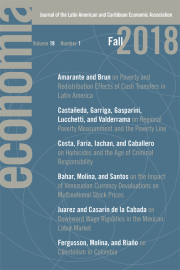 This paper documents negative cumulative abnormal returns (CARs) to five exchange rate devaluations in Venezuela within the context of stiff exchange controls and large black-market premiums, using daily stock prices for 110 multinational corporations with Venezuelan subsidiaries. The results suggest evidence of statistically and economically significant negative CARs of up to 2.07 percent over the ten-day event window. We find consistent results using synthetic controls to causally infer the effect of each devaluation on the stock prices of global firms active in the country at the time of the event. Our results are at odds with the predictions of the efficient market hypothesis stating that predictable devaluations should not affect the stock prices of large multinational companies on the day of the event, and even less so when they happen in small countries. We interpret these results as a suggestive indication of market inefficiencies in the process of asset pricing.
 -
Publication
From Financial Repression to External Distress: The Case of Venezuela
Recent work has supported that there is a connection between domestic debt level and sovereign default on external debt. We examine the potential linkages in a case study of Venezuela […]Recent work has supported that there is a connection between domestic debt level and sovereign default on external debt. We examine the potential linkages in a case study of Venezuela from 1984 to 2013. This unique example encompasses multiple financial crises, cycles of liberalization and policy reversals, and alternative exchange rate arrangements. The Venezuelan experience reveals a nexus among domestic debt, financial repression, and external vulnerability. Unlike foreign currency-denominated debt, debt in domestic currency may be reduced through financial repression, a tax on bondholders and savers producing negative real interest rates. Using a variety of methodologies we estimate the magnitude of the tax from financial repression. On average, this financial repression tax (as a share of GDP) is similar to those of OECD economies, in spite of much higher domestic debt-to-GDP ratios in the latter. The financial repression “tax rate” is significantly higher in years of exchange controls and legislated interest rate ceilings. In line with earlier literature on capital controls, our comprehensive measures of capital flight document a link between domestic disequilibrium and a weakening of the net foreign asset position via private capital flight. We suggest these findings are not unique to the Venezuelan case.
Last updated on 12/07/2021
-
Journal Articles
From Financial Repression to External Distress: The Case of Venezuela
Emerging Markets Finance and Trade, 1-30.
Recent work suggests a connection between domestic debt and external default. We examine potential linkages for Venezuela, where the evidence reveals a nexus among domestic debt, financial repression, and external […]Recent work suggests a connection between domestic debt and external default. We examine potential linkages for Venezuela, where the evidence reveals a nexus among domestic debt, financial repression, and external vulnerability. The financial repression tax (as a share of GDP) is similar to OECD economies, in spite of higher debt ratios in the latter. The financial repression “tax rate” is higher in years of exchange controls and legislated interest rate ceilings. We document a link between domestic disequilibrium and a weakening of the net foreign asset position via private capital flight. We suggest these findings are not unique to Venezuela. -
Book Chapter
Hiperinflación y cambios políticos: Democracia, transiciones en el poder y resultados económicos
Inflación e Hiperinflación: Miradas, lecciones y desafíos para Venezuela, 185-207.
