
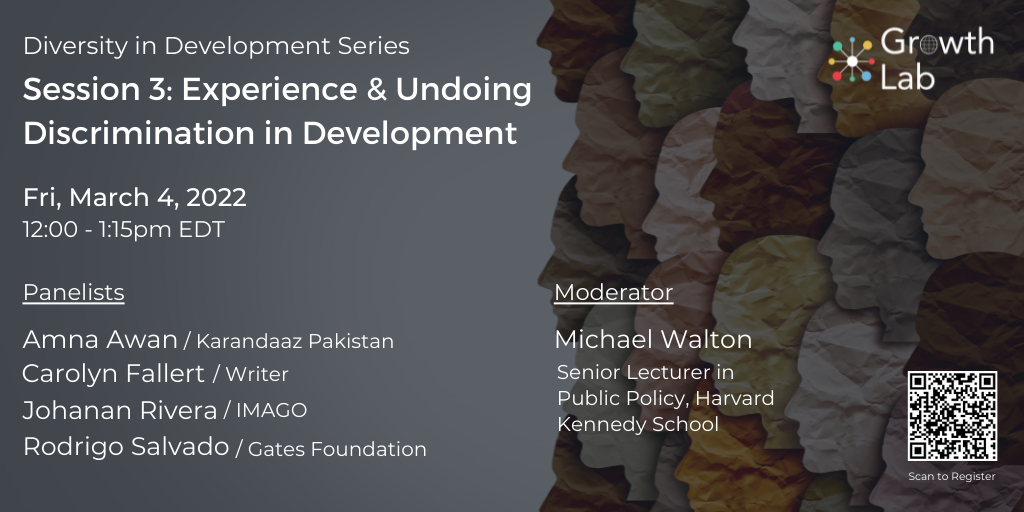
Alumni Panel: Experiencing & Undoing Discrimination in Development
The work of development is to improve quality of life and expand economic opportunity across diverse global communities, and graduate programs such as the MPA/ID program at HKS are enormously diverse in national origin, gender, and professional and lived experience. Yet, a 2020 survey of MPA/ID alumni revealed that roughly half of all respondents have encountered discrimination in some form (either being harmed by it, being complicit in it, or observing it).
In the Fall of 2021, the Diversity in Development series discussed the problems of limited diversity in the field of international development and introduced frameworks for understanding the problem. It also considered diverse approaches to the goals of “development,” including aspects of self-determination, capabilities, and justice, and the extent to which a vision of development is shared. These sessions laid the theoretical frameworks for thinking about the ultimate goals of international development approaches.
This Spring, we are turning the spotlight on MPA/ID alumni who are dealing with these issues on the ground every day. Specifically, we ask them to reflect and share: i) lived experiences with discrimination in the sector and ii) how they are elevating voices of those closest to the challenges they seek to solve. Join the alumni for a rich discussion of the complexities of these deeply rooted patterns and opportunities to shift power in international development.
Panelists:
Amna Awan, Gender Advisor at Karandaaz Pakistan
Carolyn Fallert, writer
Johanan Rivera, Manager of Programs, Environment; IMAGO
Rodrigo Salvado, Deputy Director, Development Policy and Finance; Bill & Melinda Gates Foundation
Moderator:
Michael Walton, Senior Lecturer in Public Policy, Harvard Kennedy School
All speakers will be virtual, but we’ve reserved WEX W-G02 (seating capacity of 40) as a viewing room. Please register in advance and contact Chuck McKenney with any questions.
Research Seminar: Vietnam’s role in the US-China trade war
March 7, 2022 | 11:15 am – 12:30 pm
Speaker: Karin Mayr-Dorn, Associate Professor, Department of Economics, Johannes Kepler University of Linz
Paper: Trade diversion and labor market adjustment: Vietnam and the US-China Trade War
Abstract: This paper investigates the effects of the U.S.-China trade war on trade diversion and the labor market in a third country, Vietnam. We exploit variation in Vietnamese exports to the U.S. across industries and districts based on the extent of the unexpected and exogenous U.S. tariff hikes on Chinese imports and provide evidence of an indirect effect on labor market outcomes in Vietnam. Vietnamese workers and districts that are more exposed to the trade war display higher employment, working hours, and wages as a result of the U.S.-China trade war. Our findings reveal that bilateral trade policy can have substantial offsetting effects on trade flows and labor markets in third countries.
Bio: Karin Mayr-Dorn is an Associate Professor at the Department of Economics at the Johannes Kepler University of Linz, Austria. Currently, she is a Visiting Professor at Malcolm Wiener Center for Social Policy at the Harvard Kennedy School. Her research interests are international economics, labor economics, and public economics. Before joining JKU Linz, Karin spent six years at the University of Vienna. She was also a research visitor at the University of Warwick, Trinity College Dublin, the University of California at Davis, and the University College London.
Please register in advance and contact Chuck McKenney with any questions.
Development Talks: A New Agenda for African Continental Integration
February 17, 2022 | 1:00 pm – 2:15 pm
The Growth Lab’s “Development Talks” is a series of conversations with policymakers and academics working in international development. The seminar provides a platform for practitioners and researchers to discuss both the practice of development and analytical work centered on policy.
Speaker: Donald Kaberuka, President, African Development Bank (2005-2015)
Moderator: Tim O’Brien, Senior Manager, Applied Research, Growth Lab
Please register in advance to attend this webinar. Contact Chuck McKenney with any event-related questions.
About the speaker:
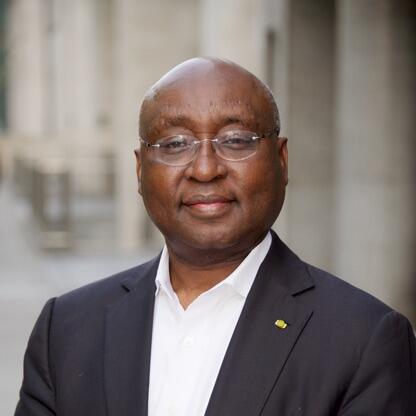
A Rwandan economist, Mr. Kaberuka is Chairman and Managing Partner of SouthBridge, a Pan-African financial advisory and investment firm. Previously, he served as the 7th President of the African Development Bank (AfDB), from 2005 to 2015, in which he is credited with the expansion of the reach and impact of AfDB. During his two terms as President, Mr. Kaberuka led from the front on infrastructure, promoted private sector development and economic integration. The Bank played a major countercyclical role during the 2008 financial crisis to enable African countries in weathering the crisis. Prior to joining AfDB, Mr. Kaberuka served as Rwanda’s Minister of Finance and Economic Planning from 1997 to 2005. Mr. Kaberuka is currently the African Union High Representative for the Peace Fund and Board Chair of The Global Fund to Fight AIDS, Tuberculosis and Malaria and also serves on the Board of the Rockefeller Foundation, the Mo Ibrahim Foundation, the Centre for Global Development and several other advisory boards.
Mr. Donald Kaberuka was educated at universities in Tanzania and Scotland. He holds a PhD in Economics from Glasgow University.
Venezuelan Migrants in Brazil: Children and Family Experiences with Education and Social Services
March 2, 2023 | 11:00 am – 12:30 pm
Speaker: Gabrielle Oliveira, Jorge Paulo Lemann Associate Professor of Education and of Brazil Studies, Harvard Graduate School of Education
Moderator: Sarah Dryden-Peterson, Associate Professor of Education, Harvard Graduate School of Education
An unprecedented number of Venezuelans have left behind the worsening economic and social crisis at home to look for better future prospects. Brazil is hosting about 261,000 Venezuelans as migrants, asylum seekers, or refugees, which, at 18 percent, constitutes the largest share of Brazil’s 1.3 million refugees and migrants population (World Bank, 2020). Many shelters in Brazilian cities are overcrowded, meaning children and families often end up living on the streets and unable to access government services including education. This presentation has two goals: the first is to present background data on both the legal conditions that impact Venezuelan immigrants in Brazil and the education barriers that exist for immigrant and refugee children in Brazilian public schools. The second goal is to present preliminary qualitative data on how public schools (teachers, administrators) are responding to the influx of Venezuelan children in elementary schools.
This event will be hybrid. To register for the in-person session, click here. To register for the virtual session, click here.
This event is co-sponsored by the David Rockefeller Center for Latin American Studies.
Research Seminar: Which Workers Earn More at Productive Firms? Position Specific Skills and Individual Hold-up Power
February 28, 2022 | 11:15 am – 12:30 pm
Speaker: Justin Bloesch, Ph.D. Candidate in Economics, Harvard University
Paper: Which Workers Earn More at Productive Firms? Position Specific Skills and Individual Hold-up Power
Abstract: We argue that productive firms share rents with workers only in occupations where workers have individual hold-up power. We present a model of wage determination where firms produce using a novel generalization of Kremer (1993)’s O-ring production function. Workers have individual hold-up power if (i) labor is organized into distinct, differentiated positions (ii) the output of positions is individually complementary or “critical” in the production process, and (iii) skills are position-specific, i.e., skills are acquired on the job and are not transferable across positions or firms. If output losses from an unfilled position are larger at productive firms, incomplete contracts and on-the-job search incentivize productive firms to pay differentially high wages. We estimate individual worker hold-up power by occupation using the effect of worker deaths on firm profits in Danish administrative data and using a measure of within-firm, across-position task differentiation from US job posting data. High hold-up occupations exhibit both higher wage levels and higher long-run passthrough of permanent firm productivity innovations to wages, supporting the main model predictions. Accounting for heterogeneity in hold-up power across occupations has numerous implications for wage inequality: (1) greater employment of men in high hold-up occupations can account for one fifth of the Danish gender wage gap; (2) rising “superstar firms” increase wage inequality; (3) hold-up power decreases the responsiveness of wages to labor market slack.
Please register in advance and contact Chuck McKenney with any questions.
Research Seminar: How Immigration Grease is Affected by Economic, Institutional, and Policy Contexts: Evidence from EU Labor Markets
February 14, 2022 | 11:15 am – 12:30 pm
Speaker: Martin Kahanec, Professor and Head of the Department of Public Policy at the Central European University (CEU) in Vienna.
Abstract: (Paper)
Theoretical arguments and previous country-level evidence indicate that immigrants are more fluid than natives in responding to changing skill shortages across countries, occupation groups and industries. The diversity across EU member states enables us to test this hypothesis across various institutional, economic and policy contexts. Drawing on the EU LFS and EU SILC datasets, we study the relationship between residual wage premia as a measure of skill shortages in different occupation-industry-country cells and the shares of immigrants and natives working in these cells. We find that immigrants’ responsiveness to skill shortages exceeds that of natives in the EU15, in particular in member states with low GDP, higher levels of immigration from outside EU, and more open immigration and integration policies; but also those with barriers to citizenship acquisition or family reunification. While higher welfare spending seems to exert a lock-in effect, a comparison across different types of welfare states indicates that institutional complementarities alleviate the effect.
Please register in advance and contact Chuck McKenney with any questions.
Research Seminar: Colombia’s Structural Challenges for the Creation of New, Better and More Inclusive Jobs
February 7, 2022 | 11:15 am – 12:30 pm
Please register in advance and contact Chuck McKenney with any questions.
Speakers: Laura Pabón, Eliana Carranza, and Andreas Eberhard-Ruiz
Abstract:
In mid-2020, the Government of Colombia launched a labor reform consultation process (Misión de Empleo) in response to a deterioration in pre-Covid19 employment indicators and changing economic and labor market conditions. Based on a comprehensive review of Colombia’s labor market performance for the 2009-2019 period, this report seeks to provide analytical underpinnings to this process. At the macro level, the report shows that employment in Colombia is insufficiently diversified relying almost exclusively on job creation in the services sectors. This exposes the labor market to cyclical changes in internal demand that are typical for commodity rich economies like Colombia. At the worker level, the report shows that the economy generates too few formal employment opportunities for those with fewer skills and those living in rural areas, implying low earnings, high rates of self-employment, and high levels of informality. At the firm level, the report shows that the labor regulatory regime has contributed to strong increases in labor costs with important effects on entry and exit dynamics of firms contributing to a compositional shift towards larger, more capitalized, and more skill-intensive firms.
World Bank report citation:
Carranza, Eliana; Wiseman, William; Eberhard-Ruiz, Andreas; Cardenas, Ana Lucia. 2021. “Colombia Jobs Diagnostic : Structural Challenges for the Creation of New, Better and More Inclusive Jobs (Spanish).” Jobs Series; Issue No. 30 Washington, D.C. : World Bank Group.
Speaker bios:
Laura Pabón is the Director of Social Development of the National Planning Department of Colombia, and member of the Technical Secretary of Colombia’s Mision de Empleo. In 2020, she was recognized by the Presidency of the Republic and Civil Service as the best public servant in the country. Laura is an economist with a master’s degree in Economics from the Universidad de los Andes and a master’s degree in Public Policy from the University of Chicago.
Eliana Carranza is a Senior Economist at the World Bank Social Protection and Jobs Practice. She is also an Adjunct Lecturer at the Harvard Kennedy School, in the Master in Public Administration in International Development (MPA/ID) Program. Eliana works with national governments in the formulation of diagnoses, strategies and solutions to labor force and employment challenges. She holds an MPA in International Development and a PhD in Political Economy and Government (Economics) from Harvard University.
Andreas Eberhard-Ruiz is an Economist at the World Bank Jobs Group, where he works on jobs, growth, and structural change. Prior to joining the World Bank, he worked for the European Commission and for the Ugandan Finance Ministry as a Fellow of the UK’s Overseas Development Institute. His research focuses on trade and competitiveness, and regional market integration. He holds a PhD from the University of Sussex.
Research Seminar: Innovation Networks and Innovation Policy
January 31, 2022 | 11:15 am – 12:30 pm
Speaker: Ernest Liu, Assistant Professor of Economics at the Bendheim Center for Finance in Princeton’s Department of Economics
Paper: Innovation Networks and Innovation Policy
Abstract: We study the optimal allocation of R&D resources in an endogenous growth model with an innovation network, through which one sector’s past innovations may benefit other sectors’ future innovations. First, we provide closed-form sufficient statistics for the optimal path of R&D resource allocation, and we show that planners valuing long-term growth should allocate more R&D toward key sectors that are upstream in the innovation network. Second, we extend to an open-economy setting and illustrate an incentive for countries to free-ride on fundamental technologies: an economy more reliant on foreign knowledge spillovers has less incentive to direct resources toward innovation-upstream sectors, leading to cross-country differences in unilaterally optimal R&D allocations across sectors. Third, we build the global innovation network based on over 30 million global patents and establish its empirical importance for knowledge spillovers. Fourth, we apply the model to evaluate R&D allocations across countries and time. Adopting optimal R&D allocations can generate substantial welfare improvements across the globe. For the United States, R&D misallocation accounts for about 0.68 percentage points of missing annual growth since the 2000s.
Please register in advance and contact Chuck McKenney with any questions.
Development Talks: Confronting Post-COVID Macroeconomic Challenges in Namibia
January 26, 2022 | 1:00 pm – 2:15 pm
The Growth Lab’s “Development Talks” is a series of conversations with policymakers and academics working in international development. The seminar provides a platform for practitioners and researchers to discuss both the practice of development and analytical work centered on policy.
Speaker: Ipumbu W. Shiimi, Minister of Finance, Namibia
Moderator: Miguel Angel Santos, Director of Applied Research, Growth Lab
Please register in advance to attend this webinar. Contact Chuck McKenney with any event-related questions.
 Speaker’s bio:
Ipumbu Shiimi, an accomplished economist, is the Minister of Finance in the Republic of Namibia. Before his Ministerial appointment, Shiimi was Governor of the Bank of Namibia from 2010 to 2020, where he previously served as Assistant Governor and also occupied several positions from junior to senior level. During his working career, Shiimi participated in various research projects, co-authored multiple publications, and served on various Boards and Committees.
He holds a Master of Science in Financial Economics (1998) and a Postgraduate Diploma in Economic Principles (1995) from the University of London. He also has a Diploma in Foreign Trade and Management (1994) from the Maastricht School of Management, Netherlands, along with Honours in Economics (1993) and Bachelor of Commerce in Economics and Accounting (1992) degrees from the University of Western Cape, South Africa. He underwent specialized training in the Management Development Program at the University of Stellenbosch (2000) and Wits Business School, South Africa (2001).
Book Talk – Reclaiming Populism: How Economic Fairness Can Win Back Disenchanted Voters
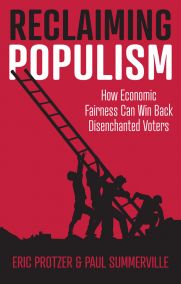
Reclaiming Populism contends that populist upheavals like Trump, Brexit, and the Gilets Jaunes happen when the system really is rigged. Citizens the world over are angry not due to immigration or income inequality, but economic unfairness: the sense of being held back from success because opportunity is not equal and reward is not according to contribution.
This forensic book demonstrates that illiberal populism strikes hardest when family origins decide success rather than talent and effort. The authors, Eric Protzer and Paul Summerville, propose a framework of policy inputs that instead support high social mobility, and apply it to diagnose the differing reasons behind economic unfairness in the US, UK, Italy, and France.
Author: Eric Protzer, Growth Lab Research Fellow
Moderator: Ricardo Hausmann, Director of the Harvard Growth Lab and Rafik Hariri Professor of the Practice of International Political Economy at HKS
Please register in advance. Contact Chuck McKenney with any questions.