Faculty Working Papers
Resolving Malawi’s Binding Foreign Exchange Constraint
Executive Summary
This research note diagnoses the causes behind Malawi’s foreign exchange constraint and identifies options for addressing the problem. Malawi is currently experiencing a severe and prolonged macroeconomic crisis, characterized by declining per capita income, crippling foreign exchange shortages, high inflation, and a rapidly growing (domestic) debt burden. Multi-faceted macroeconomic reforms are needed (see Growth Lab’s previous report, “Malawi’s Path out of Poverty and Toward Prosperity”). However, we find that relaxing extreme foreign exchange shortages by achieving a market-clearing rate could be achieved relatively quickly. The gains of this reform would be large, and the risks would be limited if the exchange rate realignment is matched with consistent monetary and fiscal policy. This note explains this path.
Excess money creation is the cause of both the high and increasing parallel market premium for foreign exchange and high inflation in Malawi today. Since 2020, the monetary base has expanded by a factor of four as the government has relied on the Reserve Bank of Malawi (RBM) to finance its large fiscal deficits. This has resulted in an increasing supply of Kwacha “chasing” a limited supply of dollars, which has caused a rising parallel market premium for foreign exchange. Much of the economy has, in practice, already shifted to the parallel rate, which means that the pass-through of a devaluation of the official rate on inflation would be limited. Previous one-off devaluations failed to address the parallel market premium because they did not align the path of the official exchange rate with that of money growth. Meanwhile, cracking down on the parallel market without addressing underlying causes also will not work because actors in the economy desperate for foreign exchange will always try to find workarounds.
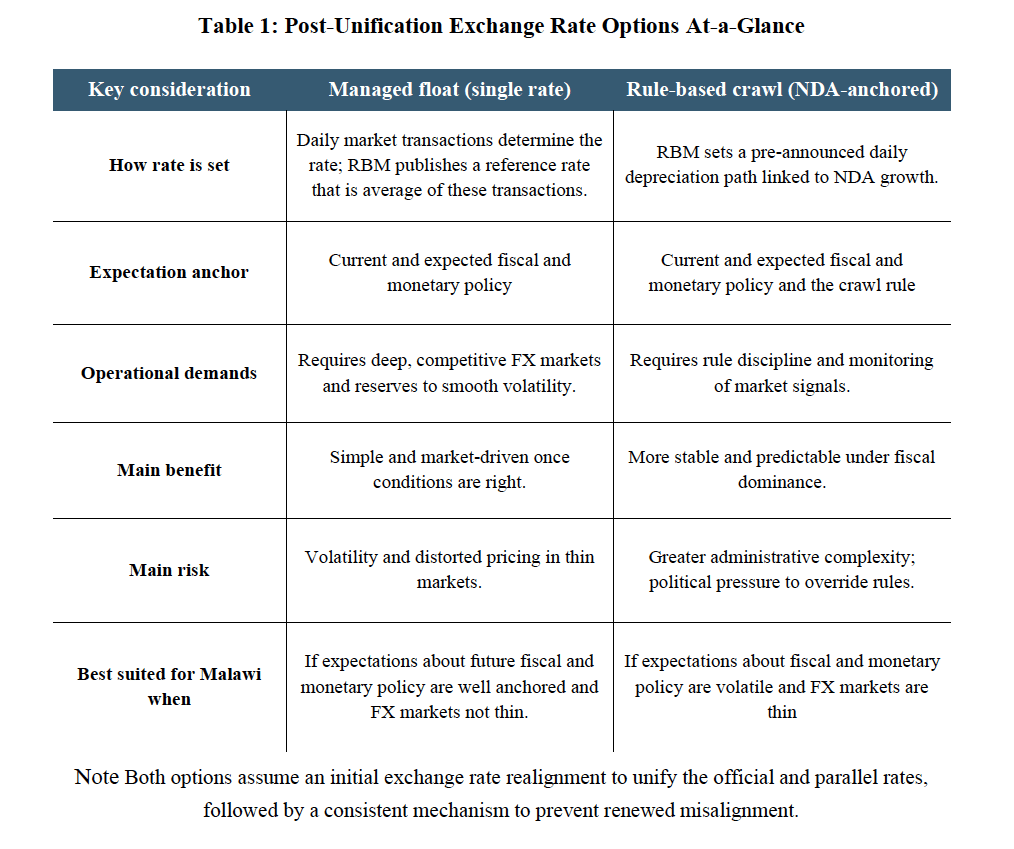
This paper discusses options for achieving a market-clearing exchange rate to end inefficient foreign exchange rationing and bring foreign currency back into official channels. This requires an initial sharp devaluation to unify the official and parallel rates, followed by a consistent policy to prevent renewed misalignment. Two operational paths are discussed as options: a managed float, where the rate is determined daily by bilateral market transactions, or a rule-based managed crawl, which anchors the daily adjustment of the exchange rate to the path of domestic liquidity growth (see Table 1). A full float and an end to capital controls is not advisable in the current context.
Foreign exchange reform is necessary but cannot fully succeed in isolation. Measures aimed at addressing the foreign exchange shortage can work in the short-term to relax this binding constraint on growth. But these measures alone cannot restore other macroeconomic balances. To achieve lower inflation, the Government of Malawi must reduce its primary deficit and limit the need for money printing. Furthermore, policymakers must manage the fiscal impact of devaluation and the transition of administered prices (such as fuel and fertilizer) from the overvalued official exchange rate. Failure to do so could result in a negative fiscal feedback loop, where devaluation necessitates more money printing. Macroprudential policy may also allow for a reduction in the domestic interest burden, and increased donor support would help enable macroeconomic stabilization and growth. In the long term, Malawi must diversify and grow its export sectors to generate more foreign exchange. Analysis discussing these necessary dimensions of overall macroeconomic reform are discussed in the three annexes, while the note focuses on the somewhat independent options that Malawi can use to meaningfully address the binding foreign exchange constraint that the economy currently faces.