Economic Growth and Institutional Strengthening in Albania

Project Dates

2014 –2020

Funded By

Open Society Foundations (2014-2019)

Consulting and Management Albania (2019-2020)

Our work in Albania started in fall 2013 as a way to tackle the slowdown in economic development. At that time, the external sources of growth – remittances and exports – had stalled. Solvency constraints and unfavorable credit market conditions restricted the effectiveness of the fiscal and monetary policies. These factors conspired against an economic recovery and demanded that Albania rethink the processes leading to its growth.

To address this situation, in cooperation with the Government of Albania and the Open Society Foundations, the Growth Lab at the Center for International Development (CID), led by professor Ricardo Hausmann, launched the first project, titled, “Economic Growth in Albania” (2014-2017). The initial project focused on three key areas: (1) ensuring short-term macroeconomic and fiscal stability, (2) building fiscal strength over the medium term, and (3) developing sectors that can be sustainable drivers of growth in exports and jobs.

Over the years, the project has gone through different stages of evolution, from helping Albania gain macroeconomic stability, to targeted interventions in sectors with growth potential, such as agriculture, fasons, tourism, special economic zones, energy, and investments. Recognizing the transformative potential that rests with the Albanian diaspora, the project worked hand in hand with the government and diaspora groups in the United States to find ways of engaging Albanians abroad with social and economic development in Albania.

More About this Project

In 2017, a second project, titled, “Institutional Strengthening and Economic Diversification in Albania” (2017-2019), was launched to advance the work started in the previous four years, and more specifically to: (1) help the government maintain macroeconomic stability, (2) assist with the emergence of new growth actors, and (3) increase government’s capability to implement policies and reforms. The second project was funded by Open Society Foundations. In 2019 and 2020, Consulting and Management Albania sponsored our continued engagement in Albania in the areas related to aviation and energy.

In fulfilling the project objectives, the Growth Lab brought together a team of prominent researchers, experts, and faculty in the fields of macroeconomics, energy policy, public finance, agriculture, labor markets, public administration, infrastructure development, and law, among other areas.

The outcomes of the Albania project include Growth Lab working papers, case studies, analyses, reports, policy briefings and recommendations, trainings, and executive education courses. Since 2014, every year, graduate students from Harvard University have participated in Growth Lab summer internship programs in Albania. 

Diaspora Engagement

At least one-third of Albanians live outside the borders of their home countries in Southeastern Europe. In countries where they live and work, many of them have achieved levels of professional and economic success that would not have been possible at home.

From 2015 through 2016, the Growth Lab undertook an initiative to raise the awareness and make diaspora engagement one of the Albanian government’s priorities. We were driven by the idea of the impact of connecting this wealth of knowledge and economic capital with the home country.

The objectives of our Diaspora Program were:
  • Facilitate relations between the home government and the diaspora community organizations abroad.
     
  • Support the home government with building capacities to engage the diaspora and develop strategies for leveraging its potential to promote economic and social development in Albania, and more largely, in Southeastern Europe.

Our Diaspora Program started with reinforcing the relations with the Albanians in the U.S., but it could serve as a blueprint for other diaspora engagements.

Our action plan evolved in various stages:
  • The first stage involved a series of meetings in the U.S. between the diaspora groups on the one hand and government officials and private sector representatives on the other. A high-level meeting took place in New York City on September 26th, 2015, with the Albanian Prime Minister, Minister of Foreign Affairs, diaspora representatives, and the Growth Lab team headed by Professor Ricardo Hausmann. In that meeting, the Albanian Prime Minister committed to holding a first-ever Diaspora Summit in Tirana in 2016.
     
  • In the second stage, Diaspora leaders visited Albania and other Southeastern European countries to scope the possibility of creating a strategy for engaging the diaspora in the country’s development.
     
  • The third stage involved supporting the Albanian government in organizing the Diaspora Summit and mobilizing diaspora networks to participate in it. To that end, Growth Lab hosted the Albanian Foreign Minister in September 2016 in an event with diaspora members and actively participated in the Diaspora Summit held in Tirana in November 2016.

Since then, the Growth Lab has continued to support the diaspora engagement in different ways, such as hosting the State Minister of Diaspora at Harvard, sending one of our graduate students to Tirana to support the Minister’s team with research on diaspora engagements, participating in the second Diaspora Summit which was held in February 2019, and hosting events at Harvard with visiting Albanian dignitaries and diaspora groups in the Boston area.

The Diaspora Program is jointly organized with the following individuals and their organizations:

Nedelkoska, L. & Khaw, N., 2015. The Albanian Community in the United States: Statistical Profiling of the Albanian-Americans, Growth Lab at Harvard’s Center for International Development

Atlas of Economic Complexity

Explore Albania’s Country Profile

Industry Targeting Dashboard

Match an Industry with Albania’s Capabilities

Visual Story

A Path to Growth after COVID-19

Affiliated Publications

  • Reports

    O’Brien, T., et al., 2020

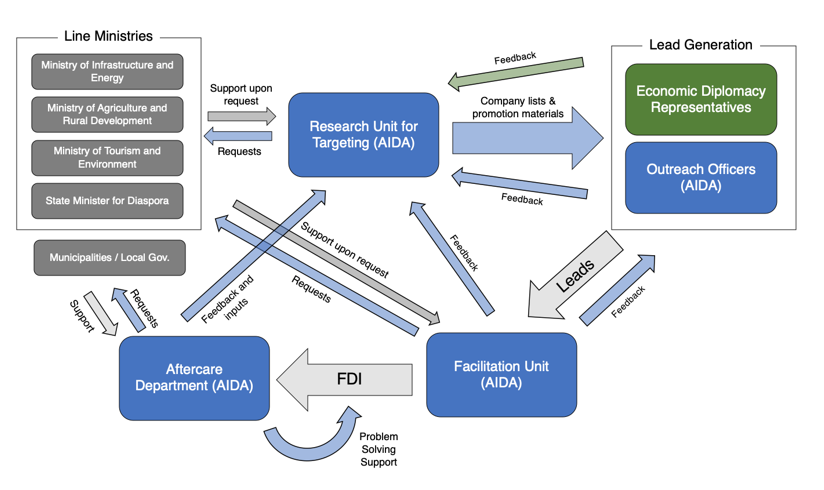
    Accelerating Growth in Albania through Targeted Investment Promotion

    The investment promotion process in Albania is underperforming versus its potential. Between 2014 and 2018, the Albanian economy saw accelerating growth and transformation, which has been tied to the arrival […]
    Growth Lab

    The investment promotion process in Albania is underperforming versus its potential. Between 2014 and 2018, the Albanian economy saw accelerating growth and transformation, which has been tied to the arrival of foreign companies. However, Albania has the potential to realize much more and more diversified foreign direct investment (FDI), which will be critical to accelerating growth in the period of global recovery from the COVID-19 pandemic. As the Albanian economy weathers the storm of COVID-19, it is critical to look to the future by enhancing the investment promotion process to be more targeted and proactive such that Albania can attract transformative global companies aligned with the country’s comparative advantages. This is not only a critical step toward faster and more resilient economic growth in Albania; it also happens to have very high returns in comparison to the limited fiscal spending required to implement the actions required.

    The targeted investment promotion approach discussed in this note would capitalize on Albania’s many existing comparative advantages for attracting efficiency-seeking FDI. It would not displace Albania’s Strategic Investment Law nor the activities of the Albanian Investment Corporation (AIC), which aim to expand the country’s comparative advantages. Efficiency-seeking FDI — global companies that expand into Albania to serve global markets because it makes them more productive — do not need extensive tax incentives, regulatory exemptions, or other subsidies. In fact, an overreliance on these approaches can crowd out firms that do not want or need to rely on government support. Adding targeted investment promotion to Albania’s growth strategy would lead to more jobs, better quality jobs, more inclusive job growth, faster convergence with the income levels of the rest of Europe, and ultimately less outmigration.

    This note summarizes the Growth Lab’s observations of the investment promotion process in Albania, over the last year in particular, and lays out recommendations to capture widespread opportunities for economic transformation that have been missed to date. The recommendations provided at the end of this note provide a roadmap for building an enhanced network for targeted investment promotion that is specific to Albania’s context. These recommendations recognize the current constraints that the COVID-19 pandemic creates but also look past the pandemic to prepare for opportunities that will emerge during the global recovery.

  • Web Articles

    O’Brien, T. & Lu, J., 2020

    Can Albania’s Economic Turnaround Survive COVID-19? A Growth Diagnostic Update

    The Growth Lab’s VizHub

    The Growth Lab, which works with countries to identify obstacles to growth and propose targeted policy solutions, has been conducting applied research in Albania since 2013. This brief analysis takes stock of […]
    Growth Lab
    The Growth Lab, which works with countries to identify obstacles to growth and propose targeted policy solutions, has been conducting applied research in Albania since 2013. This brief analysis takes stock of Albania’s economic growth prior to the COVID-19 crisis and what the strengths and weaknesses of the pre-COVID economy imply for recovery and the possibility of accelerating long-term and inclusive growth in the years to come. Albania is a place where much has been achieved to expand opportunity and well-being as growth has gradually accelerated since 2013-14, but where much remains to be done to continue this acceleration once the immediate crisis of COVID-19 has passed.
  • Publication

    Santos, M., et al., 2020

    Albania’s Industry Targeting Dashboard

    The Growth Lab’s VizHub

    This industry targeting tool is custom-made for Albania. Users can choose any of 272 industries (based on NACE Rev. 2 industry codes) from the above drop-down list and explore the […]
    Growth Lab
    This industry targeting tool is custom-made for Albania. Users can choose any of 272 industries (based on NACE Rev. 2 industry codes) from the above drop-down list and explore the industry’s match with Albania’s current productive capabilities and comparative advantages and disadvantages. The tool is designed for use by government and non-government entities that seek to attract foreign direct investment (FDI) to Albania to accelerate economic development. Harvard Growth Lab research in Albania shows that the long-term pace of economic growth will be determined by the pace at which the country can absorb new economic activities and productive capabilities from abroad. Detailed information on the methodology and data sources used in this tool can be found here. This tool can be used in combination with the Growth Lab’s Atlas of Economic Complexity to explore patterns in global trade in very high detail.
  • Working Papers

    Gadgin Matha, S., Goldstein, P. & Lu, J., 2020

    Air Transportation and Regional Economic Development: A Case Study for the New Airport in South Albania

    Considering the case of the proposed airport in Vlora, South Albania, this report analyzes the channels through which a new greenfield airport can contribute to regional economic development. In December […]
    Growth Lab

    Considering the case of the proposed airport in Vlora, South Albania, this report analyzes the channels through which a new greenfield airport can contribute to regional economic development. In December 2019, the Government of Albania opened a call for offers to build a new airport in the south of the country. While there is evidence indicating that the airport could be commercially viable, this does not provide a grounded perspective on the channels by which the airport could boost the regional economy. To evaluate how the new airport would interact with existing and potential economic activities, this report evaluates three of the most important channels of impact by which the airport could serve as a promoter: (1) economic activities directly related to or promoted by airports, (2) the airport’s potential contribution to the region’s booming tourism sector and (3) the potential for the country’s development of air freight as a tool for export promotion. In each of these three cases, the report identifies complementary public goods or policies that could maximize the airport’s impact in the region.

    The operation of the airport itself could stimulate a series of economic activities directly related to air traffic services. Airports have the ability to mold the economic structure of the places immediately around them, acting both as a consumer and as a supplier of air transport services. Not only activities related to transportation and logistics thrive around airports, but also a variety of manufacturing, trade and construction industries. Nevertheless, the agglomeration benefits of a successful aerotropolis are not guaranteed by the construction of an airport. For South Albania’s new airport to actualize its potential returns, integrated planning of the airport site will be required, with focus on real estate planification and provision of complementary infrastructure.

    Establishing an airport in Vlora has the potential to spur regional development in South Albania through facilitating the growth of the tourism sector and its related activities. Albania’s tourism industry has seen strong growth in the last two decades, but still lags behind its potential. Albania only has a strong penetration in the tourism market of its neighboring markets, and the high seasonality of the tourism season further limits the sector’s growth. The establishment of an airport in South Albania would ease some of the tourism industry constraints tied to transportation into the country and region. Given the high reliance of the tourism industry on its many complementary inputs, more than one area of concern may have to be addressed for the impact of the new airport to be maximized. Facilitating transportation access around the South Albania region and specifically to tourist sites; preparing natural and cultural heritage sites for tourism use and expanding tourism infrastructure to accommodate potential growth are some of the interventions analyzed.

    Airfreight infrastructure could in theory provide opportunities to improve the competitiveness of Albanian exports but developing a successful air cargo cluster is no simple task. An airport can facilitate an alternative mode of transport for specific types of goods and hence promote a country’s exports. In Albania’s case, not only existing textile and agriculture products could be competitively exported through air freight, but also air freight itself could improve Albania’s position to diversify into “nearby” industries, identified by the theory of Economic Complexity. Nevertheless, an effective air freight strategy does not and cannot uniquely depend on the simple availability of a nearby airport. Air cargo operations require both traffic volume that Albania may not be able to provide, as well as complementary cargo-specific infrastructure. Although the potential for air freight in South Albania could be high, it is by no means a safe bet nor does it imply with certainty significant impact in the immediate future.

  • Reports

    Stock, D. & Zuccolo, B., 2019

    Research Note: “One Village One Product” Programs

    The One Village, One Product (OVOP) movement started 40 years ago in a rural Japanese prefecture, with the aim of helping small villages and towns develop by focusing on their […]
    Growth Lab
    The One Village, One Product (OVOP) movement started 40 years ago in a rural Japanese prefecture, with the aim of helping small villages and towns develop by focusing on their local culture and resources. Since then the principles of the OVOP movement have spread to other countries, including Thailand, Malawi, and beyond. The varying levels of success across these different versions of OVOP suggest some lessons on how to best organize rural development programs that could be useful as the Albanian government embarks on its flagship 100+ Villages project.
  • Reports

    Besra, N., 2018

    Agritourism in Albania: Trends, Constraints, and Recommendations

    In Albania, the average specific expenditure by foreign tourists (non-residents) was 13.3% of GDP during 2013-2017, which clocked a 30% growth within the four-year duration. The number of foreign citizen arrivals […]
    Growth Lab
  • Reports

    Guven, D. & Miagkyi, M., 2016

    Albania’s Credit Market

    Credit market activity in Albania has been sluggish in recent years in spite of low and declining interest rates. The economy lost its growth momentum after 2009. Investment and lending activity […]
    Growth Lab

    Credit market activity in Albania has been sluggish in recent years in spite of low and declining interest rates. The economy lost its growth momentum after 2009. Investment and lending activity slowed down substantially despite low interest rates, relative macroeconomic resilience, and available capacity in the private sector to take on more debt. This study analyzes the supply (lenders’) and demand (borrowers’) sides of the market.

    The reason behind the credit market failure is a supply-demand mismatch. Poor financial intermediation is the main problem on the supply side. Despite excess liquidity in the financial sector, banks are excessively risk-averse, bank practices and products are unsophisticated, and non-bank financial market is underdeveloped. Excessive risk aversion translates into tight credit standards, credit rationing and credit crunch for some economic sectors, in particular those dominated by SMEs. On the demand side, firms overall have a low appetite to expand, limited capacity to create bankable and financially viable projects, and are also constrained by infrastructural gaps and economic uncertainty. The mismatch results from the fragmentation of the credit market, with reliable borrowers from traditional sectors having easy access to finance, and other segments being almost fully deprived of credit.

    Government and donor-led policies to mitigate the problem have had little success. Albania enjoys access to a number of domestic and external funding schemes primarily focused on alleviating funding constraints for credit-deprived sectors, but these programs have been ineffective. Further study is needed to understand the reasons behind the limited success of these programs.

    A National Development Bank (NDB) could address some of the observed credit market challenges. While an NDB’s ability to directly resolve demand-side constraints would be limited, an NDB could effectively tackle supply-side constraints in the credit market as well as provide surveillance and collect information from the private sector, leverage technical assistance, and develop tailored financial products. Establishing an NDB should be considered carefully, taking into account functional, governance, funding, staffing and other risk factors.

  • Reports

    Nedelkoska, L. & Khaw, N., 2015

    The Albanian Community in the United States: Statistical Profiling of the Albanian-Americans

    When the Albanian Communist regime fell in 1991-92, many Albanians saw their future outside the borders of Albania. At that time in history, no one anticipated the scale of migration […]
    Growth Lab

    When the Albanian Communist regime fell in 1991-92, many Albanians saw their future outside the borders of Albania. At that time in history, no one anticipated the scale of migration that would take place in the subsequent two decades. Today, one third of Albania’s 1991 population lives abroad. Most of these migrants live and work in neighboring Greece and Italy. The third most popular destination is however the United States. Besides this new wave of migrants, the US has an old Albanian diaspora–the offspring of migrants who came to the US between the First and the Second World War. This is what mainly gives rise to the second generation Albanian-Americans.

    To the best of our knowledge, there is currently no systematic documentation of the socio-demographic and economic characteristics of the Albanian community in the US. To bridge this gap, we use data from the American Community Survey 2012 and analyze these characteristics. The profiling could be of interest for anyone who focuses on the Albanians abroad – the Government’s Programs dealing with diaspora and migration issues, researchers interested in migration questions, the Albanian Community Organizations in the US or the diaspora members themselves.

    We find that the first and the second generation Albanian-Americans have distinctive features. The first generation (those who arrived after the fall of Communism) is more educated than the non-Albanian Americans with comparable demographics. This is particularly true of Albanian women. The education of the second generation resembles more closely the US population with comparable demographic characteristics.

    Despite the qualification advantage, first generation Albanian-Americans earn much less than non-Albanian Americans with comparable socio-demographic characteristics. We find that this is not associated with being Albanian per se but with being an immigrant more generally. The migrant-native gap narrows down with time spent in the US.

    An important channel through which the current gap is maintained is qualification mismatch. We observe that first generation Albanian-Americans are over-represented in occupations requiring little skills and under-represented in occupations requiring medium and high skills, in direct contrast to them being more educated than non-Albanians.

    When it comes to the earnings of second generation Albanian-Americans, the situation is more nuanced. The low skilled Albanian-Americans earn significantly more, and the highly skilled Albanian-Americans earn significantly less than the non-Albanian Americans with comparable socio-demographic characteristics. We currently do not have a straightforward explanation for this pattern.

    The Albanian population in the US is highly concentrated in a few states: New York, Michigan and Massachusetts account for almost 60% of all Albanian Americans. The community in Massachusetts is the best educated; best employed and has the highest earnings among the three, but is also the oldest one in terms of demographics.

    However, due to its sheer size (over 60,000 Albanian-Americans), New York is the host of most Albanians with BA degree (about 10,000). New York also hosts the largest number of high earning Albanians (about 1,800 earn at least $100,000 a year).

  • Reports

    Nedelkoska, L. & Kosmo, M., 2015

    Albanian-American Diaspora Survey Report

    This survey studies the ways in which active Albanian-Americans would like to engage in the development of their home countries. Its results will help us define the focus of the […]
    Growth Lab

    This survey studies the ways in which active Albanian-Americans would like to engage in the development of their home countries. Its results will help us define the focus of the upcoming events organized under the Albanian Diaspora Program.

    Between March 6th and March 22nd 2015, 1,468 Albanian-Americans took part in the online survey, of which 869 completed the survey. The results presented in this report are based on the answers of the latter group. The results of this survey do not represent the opinions of the general Albanian-American community, but rather the opinions of those who are more likely to engage in an Albanian Diaspora Program.

    The survey was jointly prepared with the following Albanian-American organizations: Massachusetts Albanian American Society (MAAS/BESA), Albanian American Success Stories, Albanian Professionals in Washington D.C., Albanian Professionals and Entrepreneurs Network (APEN), Albanian-American Academy, Albanian American National Organization, and VATRA Washington D.C. Chapter. The survey was sponsored by the Open Society Foundations, as a part of the grant OR2013-10995 Economic Growth in Albania granted to the Center for International Development at Harvard University.

  • Reports

    Paul, B., 2015

    Assessing the Medicinal and Aromatic Plants in Albania

    Harvard University’s Center for International Development and the Government of Albania has been engaged in a two year growth strategy exercise starting in 2013 till 2015. Discussions with the Ministry […]
    Growth Lab

    Harvard University’s Center for International Development and the Government of Albania has been engaged in a two year growth strategy exercise starting in 2013 till 2015. Discussions with the Ministry of Agriculture yielded that there is a need for conducting value chain studies on a few important product groups with the following objective:

    • Cultivate ‘value chain’ oriented thinking within the Ministry of Agriculture
    • Identify key issues ‘within’ the particular product groups and ‘across’ different product groups that need to be tackled at the public policy level

    Here is a value chain study of the Medicinal & Aromatic Plants (MAPs), specifically of sage and lavender. The products have been chosen given its huge importance in the economy as the largest export commodity in agriculture and their contributions to a farmer’s income. A special black-belt team comprising ministry officials will take forward the findings of this study and will iteratively make policy, ensuring better policies and implementation at the same time.

  • Reports

    Kumar, R., 2015

    Conditions for Re-Opening Exports of Albanian Mussels to to the EU

    The Centre for International Development (CID) at Harvard University has been leading a two year project with the Government of Albania to help identify and implement growth strategies by studying […]
    Growth Lab

    The Centre for International Development (CID) at Harvard University has been leading a two year project with the Government of Albania to help identify and implement growth strategies by studying the constraints that bind specific sectors. In May this year, the Ministry of Agriculture tasked CID to look at the ban imposed by the European Union (EU) on the export of mussels from Albania. The research was sponsored by the Open Society Foundations, as a part of the grant OR2013-10995 Economic Growth in Albania granted to CID.

    During the research project, we studied the value chain of mussel production and certification in Albania, mapped the requirements laid down by EU legislation and identified shortfalls in compliance. This report presents our findings and recommendations.

    The Butrint lagoon is the main production center for mussels in Albania. By 1989, production from the lagoon had increased to 5,000 tons per year. It dropped dramatically in the 1990s due to an outbreak of cholera and the subsequent ban on the export of mussels by the EU. The ban has not been lifted since. Albania still cannot export mussels to the EU because these do not meet the required sanitary standards.

    Our research finds that lack of reliable and affordable purification facilities is at the root of the problem. Unless this constraint is alleviated, it will continue to frustrate efforts to ensure compliance with standards.

  • Reports

    Ajzenman, N., 2014

    Fresh Tomatoes: Ideas to Build a Productive Ecosystem in Albania

    During the last years production of fresh vegetables in Albania had an important growth due to the increase in the number of Ha using Greenhouses technologies. Many of the new […]
    Growth Lab

    During the last years production of fresh vegetables in Albania had an important growth due to the increase in the number of Ha using Greenhouses technologies. Many of the new investments came from former expats who spent a few years working abroad and came back -in some cases because of the crisis in Greece – with money and some experience in the field. However, although exports showed an important growth (in tomatoes, for example exports doubled from 2013 to 2011!), the sector has not been able to definitely take off and be a relevant player in the international market. The problem is not only that the share of Albania in the European trade is almost negligible but also that diversification didn’t happen, quality has not improved and as a consequence the prices that Albanian producers get is very low – the lowest in Europe for some products like tomatoes. In this context, Albania has been focusing on the regional markets (probably not consciously but as a consequence of not having established a commercial relation with higher-end markets and not having a proper quality produce to offer), has been excluded from the best markets and has not improved the productive methods, practices, etc. Given this situation the building of new capacity was not necessarily a success: local markets started to be oversupplied and production losses are very high as a consequence.

    In this report we analyzed the value chain of the fresh vegetables sector, focusing on the production of tomatoes. We detail the problems of the whole value chain (from the production to the marketing), pointing out the “missing links” that are preventing Albania to become a major tomato exporter in the European market. We find that there is a huge potential for the country – in terms of the natural conditions and also in terms of competitiveness -, but it is very difficult to be reached without making a re-organization of the sector to make it more integrated and give the proper incentives to solve simultaneously all the problems.

    We found that in order to improve the general productivity of the sector it is not necessary to make huge capital disbursements. Although some of the constraints are clearly money-related, most of them are organization-related.

    What the propose in this report is a method to re-organize the sector in a way that makes it easier for the economic agents to vertically and horizontally integrate and transform the sector into a “factory”, where every participant has its defined role and work is divided with specific roles. The role of the Government is twofold: first, to facilitate the organization of this model, find the actors that can lead the change and provide them the incentives to coordinate. Second, to provide all the public goods that are now missing or incomplete (not only in terms of infrastructure but also in terms of marketing, negotiations, etc). In the next sections we explain with detail the constraints and missing links we found throughout the value chain of tomatoes and propose a new model to solve them. We show that with little organizational changes, Albania could increase its tomato exports by four times in a few years.

  • Reports

    Klissurski, G. & Zuccolo, B., 2017

    Diversification in the Industrial Sector of Albania: Identifying Strategic Areas

    In this study, we analyzed Albania’s industrial exports using the frameworks of the Product Space and Economic Complexity in order to determine which products Albania could diversify into in the […]
    Growth Lab

    In this study, we analyzed Albania’s industrial exports using the frameworks of the Product Space and Economic Complexity in order to determine which products Albania could diversify into in the near future. In particular, we identified groups of products that are technologically close to those which Albania already exports and which at the same time are technologically more sophisticated (more complex) than Albania’s average exports. This analysis does not suggest that products that do not fulfill the criteria of technological proximity and product complexity should not be invested in. However, it suggests that some products may have higher chances of succeeding in Albania because of its existing technological capabilities, while also bringing about diversification towards more complex, higher value-added production.

    We find that the top two sectors that satisfy the criteria of being in close proximity to the existing technological capabilities in Albania, while also having relatively highly complex products, are Plastics/Rubbers and Agriculture/Foodstuffs. Within each of these sectors, we list more specific products that make for good candidates for diversification.

  • Reports

    O’Brien, T., Nedelkoska, L. & Frasheri, E., 2017

    What is the Binding Constraint to Growth in Albania?

    About four years ago, at the onset of CID’s engagement in Albania, the country faced two issues that were threatening its macro-fiscal stability: a skyrocketing public debt and an insolvent, […]
    Growth Lab

    About four years ago, at the onset of CID’s engagement in Albania, the country faced two issues that were threatening its macro-fiscal stability: a skyrocketing public debt and an insolvent, publicly-owned electricity distribution system that was plagued by theft and technical inefficiency. These two interlinked issues constrained both short-term economic growth and the ability of the country to develop new drivers of long-term growth. Over the subsequent years, the government was able to successfully respond to these constraints through a now-concluded IMF program and through a series of reforms in the electricity sector. With these constraints now relaxed, CID saw the need for a new analysis of the current and emerging constraints to growth in Albania. This analysis will guide future research and inform the government and non-government actors on emerging economic issues for prioritization.

    While growth has accelerated over the last several years, to over 3% in 2016, this is not a pace that will allow for a rapid convergence of incomes and well-being in Albania with that of developed countries in Europe and elsewhere. This growth diagnostic attempts to identify the binding constraint to sustainably higher economic growth in Albania.

    Recognizing that economic growth requires a number of complementary inputs, from roads to human capital to access to finance and many more, this report compares across eight potentially binding constraints using the growth diagnostic methodology to identify which constraint is most binding. This research was conducted throughout 2016, building on prior research conducted by CID and other organizations in Albania. Each constraint discussed in this report is cited by analysts within or outside the country as the biggest problem for growth in Albania. Through the growth diagnostic framework, we are able to evaluate the evidence and show that some constraints are more binding than others.

    Despite serious issues in many other areas, we find that the binding constraint to stronger growth in Albania is a lack of productive knowhow. By “knowhow,” we mean the knowledge and skills needed to produce complex goods and services. Albania faces a unique knowhow constraint that is deeply rooted in its closed-off past, and the limited diversification that has taken place in the private sector can, in nearly all cases, be linked to distinct inflows of knowhow. The strongest sources of knowhow inflows into Albania have been through foreign direct investment and immigration, especially returning members of the diaspora who start new businesses or upgrade the productivity of existing businesses.

    The evidence also points to particular failings in rule of law in Albania that play an important role in keeping Albania in a low-knowhow equilibrium. Weaknesses in Albania’s rule of law institutions, including frequent policy reversals and corruption in the bureaucracy and judiciary, increase the risk of investments and transaction costs of business. While it is difficult to separate perceptions from reality in this area, both perceptions of weak rule of law and actual rule of law failings appear to play critical roles in constraining more diversified investment in Albania. We find that while existing firms in Albania successfully navigate the rule of law weaknesses, and in some cases benefit from the system, potential new investors are acutely sensitive to rule of law issues.


  • Working Papers

    Hausmann, R. & Nedelkoska, L., 2017

    Welcome Home in a Crisis: Effects of Return Migration on the Non-migrants’ Wages and Employment

    The recent economic depression in Greece hit the population of Albanian migrants in Greece particularly hard, spurring a wave of return migration which increased the Albanian labor force by 5 […]
    Growth Lab

    The recent economic depression in Greece hit the population of Albanian migrants in Greece particularly hard, spurring a wave of return migration which increased the Albanian labor force by 5 percent in less than four years, between 2011 and 2014. We study how this return migration affected the employment chances and earnings of Albanians who never migrated. We find positive effects on the wages of low-skilled non-migrants and overall positive effects on employment. The gains partially offset the sharp drop in remittances in the observed period. An important part of the employment gains are concentrated in the agricultural sector, where most return migrants engage in self-employment and entrepreneurship. Businesses run by return migrants seem to pull Albanians from non-participation, unemployment and subsistence agriculture into commercial agriculture. 

  • Reports

    Jimenez, A., 2016

    Increasing Exports of Albanian Cultivated Fish to the EU

    This document explores Albanian aquaculture in the context of European aquaculture and compares it to neighboring countries, especially Greece. Using information from fieldwork, multiple reports by the United Nations’ Food […]
    Growth Lab

    This document explores Albanian aquaculture in the context of European aquaculture and compares it to neighboring countries, especially Greece. Using information from fieldwork, multiple reports by the United Nations’ Food and Agriculture Organization (FAO), and interviews with experts in government and non-government institutions, we analyze the production of European seabass and Gilthead seabream in Europe in general and in Albania in particular. Albanian cultivation of seabass and seabream has increased sevenfold since production started in the early 2000’s, but it represented only 0.38% of European aquaculture of these two species in 2013. Albania has significantly lower productivity than its neighbors, especially Greece, the dominant actor in the market. The analysis indicates that Albania’s lower productivity is caused by: (i) high costs of cages, fingerlings, and feed; which are all imported; (ii) lack of a formal fish market; and (iii) lack of clarity in the regulation. The document concludes by offering recommendations to get over these impediments for growth including reducing tariffs; encouraging national production of cages, fingerlings, and feed through investment in research; offering more and better financing options for cage acquisition; improving quality controls; establishing a national fish market; and passing the Aquaculture Law to bring clarity to the sector regulation.

  • Reports

    Orozco, M., 2015

    The Demand for and Supply of Nostalgic Products among the Albanian-Americans: A Survey

    The U.S. is home to more than 200,000 ethnic Albanians, about half of whom are emigrants from the Republic of Albania. Despite the significant Albanian population in the U.S., official […]
    Growth Lab

    The U.S. is home to more than 200,000 ethnic Albanians, about half of whom are emigrants from the Republic of Albania. Despite the significant Albanian population in the U.S., official trade of Albanian goods in the U.S. almost does not exist.

    We surveyed about 200 Albanian-Americans and several stores offering goods imported from the Balkan region of Europe in three U.S. metropolitan areas with large Albanian population in order to study their purchasing habits. We found that the willingness to purchase products from the region of origin is certainly not matched by an adequate supply. The stores which offer such products are few, often hard to reach and offer limited supplies of a small variety of commodities. In the study, we recommend steps to strengthen the market for nostalgic good through continued market research, trade-related technical assistance, diaspora-donor partnerships for nostalgic trade development and trade fairs.

  • Reports

    Ali, O., 2015

    Revitalizing the Albanian Electricity Sector

    In an attempt to recuperate its dysfunctional electricity distribution system, Albania privatized its sole electricity distribution company in 2009. Disappointed with the results of the privatization, just five years later, […]
    Growth Lab

    In an attempt to recuperate its dysfunctional electricity distribution system, Albania privatized its sole electricity distribution company in 2009. Disappointed with the results of the privatization, just five years later, the State of Albania renationalized the company.

    The case study “Revitalizing the Albanian Electricity Sector” analyzes the key sources of inefficiencies in the electricity distribution sector in Albania and the structural problems of the current state-owned company. It explains how the tariff setting and the failed infrastructural investments triggered a chain effect of financial instability which spilled beyond the limits of the electricity sector and discusses possible reforms to the sector.

  • Reports

    Lawrence, R., Frasheri, E. & Qazi, M., 2014

    Integration in the Balkans: Albania and Kosovo

    Despite their historic and ethnic ties, trade and investment between Albania and Kosovo remains underdeveloped. To be sure, even if fully developed, Kosovo is unlikely to play a major role […]
    Growth Lab

    Despite their historic and ethnic ties, trade and investment between Albania and Kosovo remains underdeveloped. To be sure, even if fully developed, Kosovo is unlikely to play a major role in Albanian external economic relations. Nonetheless, increased economic integration between the two countries can serve as the basis not only for enhancing the ties between the two countries, but also for spurring the measures that could act as a springboard for Albania’s integration with respect to other countries in the Balkans as well as with the EU.  

See All

Videos

Development Talks / Interviews

News and Blog Posts

Related Media

figure_2_aic_blog_v2.png
Growth Lab
Growth Lab
img_3977_learning_policy_and_practice_blog.jpg
Growth Lab

Podcast

Building Capability to Design and Implement Growth Reforms: The Case Study of Albania

Growth Lab Podcast Series

The Growth Lab has been engaged in an applied research project with the country of Albania since 2013. In this time, we have conducted research on numerous, diverse workstreams related […]

Podcast

Iterations of a Growth Diagnostic: The Case Study of Albania

Growth Lab Podcast Series

The Growth Lab has been engaged in an applied research project with the country of Albania since 2013. In this time, we have conducted research on numerous, diverse workstreams related […]

Podcast

A Snapshot of the Growth Lab’s Research Engagement in Albania

Growth Lab Podcast Series

The Growth Lab has been engaged in an applied research project with the country of Albania since 2013. In this time, we have conducted research on numerous, diverse workstreams related […]

Podcast

Benefiting from Return Migration: Effects of Return Migration on Non-Migrants’ Wages and Employment

On today’s episode of the Growth Lab Podcast, Research Assistant Sehar Noor interviews Ljubica Nedelkoska, Research Fellow at Harvard’s Growth Lab, on her recently published paper about the impact of […]

Podcast

Public Policy in Action: What Did Working in Albania Teach Us about Economic Growth?

Since 2013, the Center for International Development has been collaborating with the Government of Albania to identify binding constraints to economic growth and create policy solutions to solve them. CID’s […]

Podcast

Sources and Consequences of the Public Sector Premium in Albania and Sri Lanka

Across the world, the public sector pays higher average wages than the private sector for similar employees. Using data from Albania and Sri Lanka, the Growth Lab’s Ricardo Hausmann, Ljubica […]

Team Members

Person

Ricardo Hausmann

Director

ermalfrasheri_1.jpeg

Person

Ermal Frasheri

Former Senior Research Fellow

Matt Andrews head shot

Person

Matt Andrews

Edward S. Mason Senior Lecturer in International Development, HKS

Head shot of Pedro Rosas Bravo

Person

Pedro Rosas Bravo

Former Resident Fellow

Shreyas

Person

Shreyas Gadgin Matha

Senior Computational Social Scientist

Head shot of Gustavo Grobocopatel

Person

Gustavo Grobocopatel

General Manager of the Los Grobo Group

Head shot of Peter Harrington

Person

Peter Harrington

Former Research Fellow

person-default-image-big_copy.png

Person

Ellis J. Juan

Economic Development Specialist

David Kennedy head shot

Person

David W. Kennedy

Manley O. Hudson Professor of Law, Harvard Law School

Head shot of Robert Z. Lawrence

Person

Robert Z. Lawrence

Albert L. Williams Professor of International Trade and Investment, HKS

Eduardo Levy Yeyati

Person

Eduardo Levy Yeyati

Dean, Universidad Torcuato di Tella

Head shot of Eduardo Lora

Person

Eduardo Lora

Former Associate

Jessie Lu headshot

Person

Jessie Lu

Former Research Assistant

Paula Marra

Person

Paula Marra

Former Associate

Noel Maurer head shot

Person

Noel Maurer

Former Associate Professor of Business Administration, Harvard Business School

10.11.17cid_headshots529_preview.jpeg

Person

Tim McNaught

Former Research Fellow, BSC

Person

Francisco Monaldi

Former Visiting Professor of Public Policy, Harvard Kennedy School

Frank Muci headshot

Person

Frank Muci

Policy Fellow, London School of Economics and Political Science

timobrien.jpeg

Person

Tim O’Brien

Senior Manager, Applied Research

Head shot of Ugo Panizza

Person

Ugo Panizza

Professor of International Economics, Geneva Graduate Institute

Stuart Russell

Person

Stuart Russell

Former Program Assistant

Head shot of Salimah Samji

Person

Salimah Samji

Director, Building State Capability

Subscribe