Publications
Growth Lab faculty, fellows, and affiliates regularly publish research in a wide range of academic and policy venues. These include working papers in our Working Paper series, books, book chapters, articles in top peer-reviewed journals, policy pieces, op-eds in news outlets, reports, and conference papers.
We’ve highlighted some of our latest releases below.
JOURNAL ARTICLE
Inventing modern invention: The professionalization of technological progress in the US
The rise of industrial research labs fundamentally reshaped the U.S. innovation system in the early 20th century by enabling large-scale, science-based, team-oriented invention, according to new research published in the journal Research Policy. The findings suggest that new technologies, such as AI-powered digital collaboration tools, could play a similar role today by reducing coordination costs and potentially reshaping how collective invention is organized.
Working Papers
Working Papers
Resolving Malawi’s Binding Foreign Exchange Constraint
This research note diagnoses the causes behind Malawi’s foreign exchange constraint and identifies options for addressing the problem. Malawi is currently experiencing a severe and prolonged macroeconomic crisis, characterized by […]
This research note diagnoses the causes behind Malawi’s foreign exchange constraint and identifies options for addressing the problem. Malawi is currently experiencing a severe and prolonged macroeconomic crisis, characterized by declining per capita income, crippling foreign exchange shortages, high inflation, and a rapidly growing (domestic) debt burden. Multi-faceted macroeconomic reforms are needed (see Growth Lab’s previous report, “Malawi’s Path out of Poverty and Toward Prosperity”). However, we find that relaxing extreme foreign exchange shortages by achieving a market-clearing rate could be achieved relatively quickly. The gains of this reform would be large, and the risks would be limited if the exchange rate realignment is matched with consistent monetary and fiscal policy. This note explains this path.
Excess money creation is the cause of both the high and increasing parallel market premium for foreign exchange and high inflation in Malawi today. Since 2020, the monetary base has expanded by a factor of four as the government has relied on the Reserve Bank of Malawi (RBM) to finance its large fiscal deficits. This has resulted in an increasing supply of Kwacha “chasing” a limited supply of dollars, which has caused a rising parallel market premium for foreign exchange. Much of the economy has, in practice, already shifted to the parallel rate, which means that the pass-through of a devaluation of the official rate on inflation would be limited. Previous one-off devaluations failed to address the parallel market premium because they did not align the path of the official exchange rate with that of money growth. Meanwhile, cracking down on the parallel market without addressing underlying causes also will not work because actors in the economy desperate for foreign exchange will always try to find workarounds.
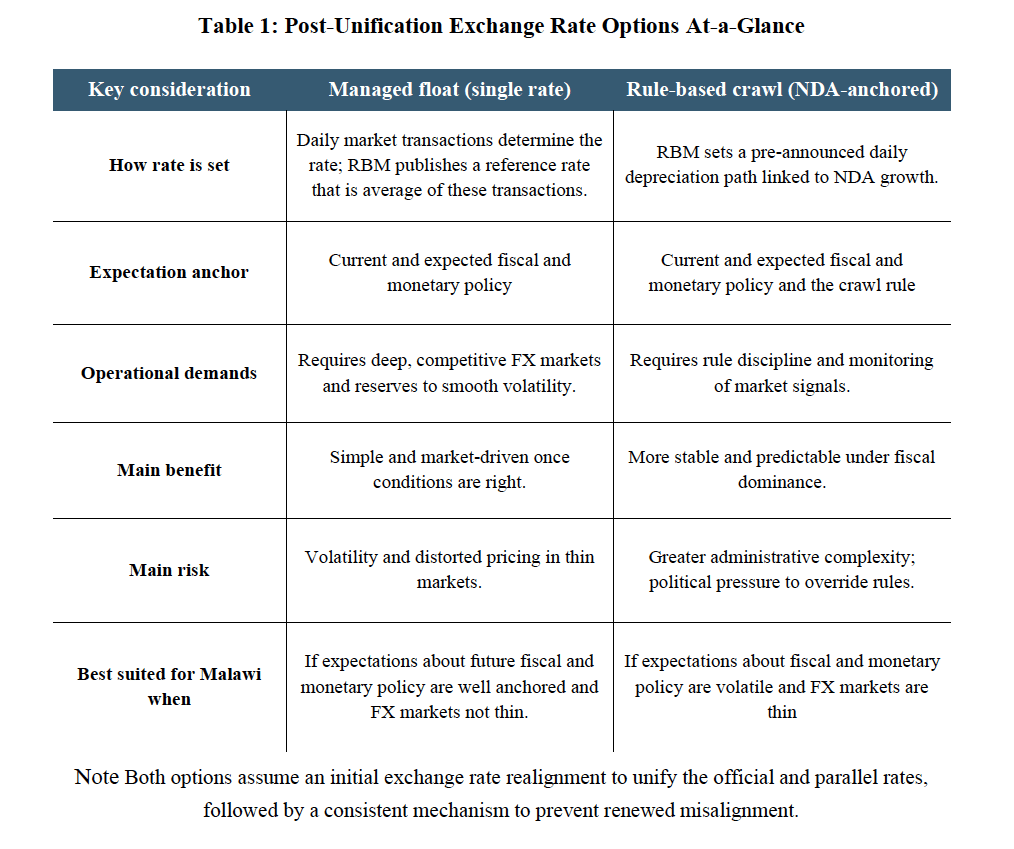
This paper discusses options for achieving a market-clearing exchange rate to end inefficient foreign exchange rationing and bring foreign currency back into official channels. This requires an initial sharp devaluation to unify the official and parallel rates, followed by a consistent policy to prevent renewed misalignment. Two operational paths are discussed as options: a managed float, where the rate is determined daily by bilateral market transactions, or a rule-based managed crawl, which anchors the daily adjustment of the exchange rate to the path of domestic liquidity growth (see Table 1). A full float and an end to capital controls is not advisable in the current context.
Foreign exchange reform is necessary but cannot fully succeed in isolation. Measures aimed at addressing the foreign exchange shortage can work in the short-term to relax this binding constraint on growth. But these measures alone cannot restore other macroeconomic balances. To achieve lower inflation, the Government of Malawi must reduce its primary deficit and limit the need for money printing. Furthermore, policymakers must manage the fiscal impact of devaluation and the transition of administered prices (such as fuel and fertilizer) from the overvalued official exchange rate. Failure to do so could result in a negative fiscal feedback loop, where devaluation necessitates more money printing. Macroprudential policy may also allow for a reduction in the domestic interest burden, and increased donor support would help enable macroeconomic stabilization and growth. In the long term, Malawi must diversify and grow its export sectors to generate more foreign exchange. Analysis discussing these necessary dimensions of overall macroeconomic reform are discussed in the three annexes, while the note focuses on the somewhat independent options that Malawi can use to meaningfully address the binding foreign exchange constraint that the economy currently faces.
Working Papers
Malawi’s Path Out of Poverty and Toward Prosperity
The Malawian economy is currently unable to grow despite the immense potential of its people. Per capita income has been declining since 2020, while poverty remains amongst the highest in […]The Malawian economy is currently unable to grow despite the immense potential of its people. Per capita income has been declining since 2020, while poverty remains amongst the highest in the world. Equally problematic, Malawi’s growth over the preceding decade was wholly insufficient to keep pace with the rest of the global economy. This kept Malawian per capita income at less than 1% of the U.S. level. Unless problems that have been allowed to fester are reversed, most Malawian families will continue to be subjected to poverty and extreme vulnerability, today and potentially for generations to come. Worse, Malawi is in the midst of a slow-moving macroeconomic crisis which could become deeper and more acute if access to foreign exchange collapses further.
Reversing the course of the national economy is ultimately about putting Malawians in a position to pursue opportunities that are currently held back. Even as the nation has faced nearly annual climate-related shocks, Malawians are resilient. It is their access to productive economic networks that holds back opportunity. Other countries such as Rwanda and Ethiopia that are landlocked, face weather shocks, and were recently as poor as Malawi have been able to achieve accelerated growth paths through long-term investment and growth in exports. Malawians are meanwhile brimming with untapped potential, and Malawian businesses are as enterprising as any in the world. There are many potential opportunities for growth in Malawi from agriculture, mining, tourism, and others that are severely held back by macroeconomic circumstances.
Jumpstarting growth is impossible under current macroeconomic constraints. As growth has lagged, and as Malawi has been subjected to shocks, macroeconomic policy has been put in a bind, which has been increasingly tightening. As late 2025, Malawi faces foreign exchange shortages that have played a critical role in undermining the economy for several years. This shortage has come alongside high inflation, which is undermining the hard-earned incomes of Malawians. Recent investment levels have been insufficient for Malawi’s current needs and have been reliant on increasingly fickle donor support. Private investment is extremely low in Malawi. It is very difficult for both domestic and foreign investors to invest in Malawi’s potential when they cannot import the inputs they need or freely move in and out the dollars their export businesses generate, and when returns are at risk of being inflated away. While solving macroeconomic challenges alone will not create the dynamic export sectors that Malawi needs, it is a necessary condition.
The current macroeconomic environment is causing pain and hardship while putting Malawi in an even more vulnerable position. The government has lost access to external credit, leaving it reliant on a vicious cycle of domestic borrowing from banks at high cost and excess money creation to support current spending. Foreign exchange availability teeters on the edge of collapse, with import coverage measured in units of days or weeks. Access to foreign exchange and finance from domestic banks provides a tenuous lifeline, but this system will break at some point if the balance sheets of banks increasingly deteriorate. All the while, as macroeconomic policy targets survival rather than a strategy for addressing the core problems, the damage of these distortions on the economy and lives of everyday Malawians is immense. Macroeconomic anchors are currently ineffective, and Malawians are growing poorer each day. With buffers so thin, Malawi is one shock away from potentially being in an even worse crisis.
As a result, Malawi has two economic problems: a medium-term growth challenge and a short-term macroeconomic stabilization crisis. It is important to understand each of these clearly and how they interact. This note points to several key observations on the growth challenge and the path out of the macroeconomic crisis. The report is organized around five key conclusions, which do not neatly align with the stated understanding of the Government of Malawi nor that of international development community in all cases.
- First, the path to growth will hinge on expanding exports. Malawi has gotten to this critical point because its traditional sources of foreign exchange (e.g., tobacco and aid) have stagnated or declined while its population grows, and it is hit by increasingly more frequent shocks. Since 2012, this has led to three distinct phases of macroeconomic management to live within lesser means. Growth will require a steady increase in export generation, and strategies should thus pay special attention to what holds back the growth of existing and new exporters. The current macroeconomic regime is clearly untenable but a return to previous regimes is also no longer possible. The regime that allowed for a fixed exchange rate and low inflation over 2017-2020 is no longer possible because it relied on positive net foreign reserves that were available at the time. Policymakers will need to develop a new path that is built on generating exports and foreign investment. Such a path will need to both solve the current macro issues and remove restrictions and barriers in areas like land, access to energy, transport that prevent investors from investing in Malawi in high-potential sectors.
- Second, the fundamental cause of the short-term macroeconomic crisis is a fiscal deficit that results in excess money creation and, thus, in exchange rate pressure, inflation, and accumulation of domestic debt. Malawi’s government has taken on spending responsibilities it cannot fund with current tax levels and has financed this gap with a combination of expensive debt and printing by the Reserve Bank of Malawi (RBM). These result in exchange rate pressure, inflation, and an unsustainable domestic debt spiral that threatens to turn into a banking crisis. Thus, solving the macro crisis will require a fiscal adjustment that puts Malawi on a sustainable fiscal path. There are some opportunities on primary expenditure reduction and reducing the high cost of debt services. But there will also need to be a concerted effort on revenue mobilization. With limited available data, it is unclear which tax-related strategies (closing loopholes vs. addressing tax evasion, for example) can have the biggest positive impact, especially in a short-term scenario of an economy under stress. However, international experience and the wider macroeconomic context of Malawi suggest that a bold focus on evasion may be the most important step. If revenue collection can overdeliver, this reduces the need for domestic borrowing and money creation, which makes addressing inflation and the debt path more achievable. Clearer and more transparent fiscal strategies could help to crowd in additional donor budget support. A strong commitment and performance in this realm can also help re-establish credibility for Malawi among the international community.
- Third, addressing the current macroeconomic crisis and high inflation can only happen if money creation slows. Food price shocks may have played an important role in price increases experienced in 2011-15, but this is not the driver of Malawi’s inflation over the last several years. Inflation is coming overwhelmingly from growth of the monetary base, which is a result of money creation. Money creation has been used to fill a fiscal gap that is occurring at unprecedented levels. Bringing down inflation will be impossible without slowing growth of base money by the RBM, which in turn means slowing government borrowing from the RBM. This suggests that the monetary base or the value of net domestic assets may be viable to use as a policy anchor. Meanwhile, issues in food supply and farmer productivity are an ongoing risk. Malawi has available policy options to increase agricultural productivity and food security that have yet to be mobilized to address food supply risks. Food security will be a key concern in the short run. This note, however, focuses on the underlying economic causes of Malawi’s current macroeconomic predicament, long-term lack of growth, and recurring food insecurity.
- Fourth, domestic debt is a ticking time bomb that risks turning into a banking crisis. Sustainability requires dealing with both the high price of the stock of domestic debt and the flow of new domestic debt. Any path to growth and any credible fiscal adjustment will require lowering the growing interest rate burden of Malawi’s debt and getting back to debt sustainability. However, this will not be achieved through external debt reprofiling or debt forgiveness alone. What most undermines Malawi’s current situation is the ballooning path of domestic debt accumulation. High domestic borrowing raises rollover risks, keeps interest costs elevated, and pressures the RBM to finance the deficit, thereby fueling inflation and eroding policy credibility. A large and growing share of the fiscal deficit is now explained by interest payments on this debt, creating a vicious cycle of borrowing to service past borrowing. Unless this cycle is addressed, there will be little other fiscal space, and fiscal adjustment will not be possible. External debt operations can play a supportive role, but only if pursued alongside credible fiscal consolidation and declining money growth. There is also limited room for such borrowing to continue, and if the government cannot use this channel to borrow, then it will be forced to either inflate away the debt with hyperinflation or default, resulting in a larger banking crisis.
- Fifth, the current exchange rate system is not working in terms of stated goals as a macroeconomic anchor. Meanwhile, it is disincentivizing exports and investment making the overall macroeconomic challenges worse. The parallel market has grown as a second-best way for actors in the economy to access foreign exchange. Rather than being a hinderance, it is providing a release valve. At this point, most imports are made at the parallel-market rate, meaning that much of the economy is already off the official rate. Excess money in circulation is leading directly to depreciation of the kwacha in the parallel market and to inflation. Thus, there is more space for policy change than commonly appreciated, especially if there is a clear strategy to deal with the fuel sector which is one of the major sectors to continue to use the official rate. Distortions across the economy from prolonged (and growing) scarcity of officially supplied foreign exchange is a top constraint that holds back the development of new exporters. Rationing of imports at the official exchange rate, and through outright restrictions, not only undermines imported inputs and investment by would-be exporters but also has created an inward-oriented economy that centers on government and donors as markets. Given the consequences on the real economy and the ineffectiveness of the current anchor, the path forward on exchange rate management should be an area of detailed planning and potential experimentation rather than a debate between extremes of a current policy and a free-floating rate.
The goal of this policy note is to provide inputs for Malawian policymakers to develop a truly homegrown reform plan and initial path to growth, which could be leveraged to crowd in short-term support of the IMF and other international institutions. Malawi risks an acute macroeconomic crisis alongside constraints that have undermined growth for decades. History shows that effective approaches in economic circumstances like this cannot be externally driven; they must be homegrown. Malawian leaders need to have a clear understanding of the origins, causes, and consequences of macroeconomic challenges, and the boldness to act on challenges with evidence. Likewise, when governments put forth evidence-based strategies for change and make good faith requests for support, it is the responsibility of international development organizations to help. With these two ingredients, a path out of poverty and toward prosperity is possible.
There may be a window of opportunity to use the current crisis and a potential future IMF program to implement both macroeconomic and investment reforms that could put Malawi on a higher growth path. To replenish buffers and reserves, and regain the confidence of donors and external lenders, Malawi will need external financing from the IMF. This financing will come with its set of conditionalities. Usually, the dynamic is one where these conditions are imposed on a developing country. But there is an opportunity, instead, to proactively approach the IMF with a clear plan. This plan must make difficult choices on issues like the budget and exchange rate. But such a program can also be an opportunity. It can be the moment to make the reforms to both the macroeconomic and investment environment that allows it to grow into the future, credibly showing investors across the world that Malawi is a place where they can thrive. To do so, will require a focused strategy on what reforms are critical and taking advantage of opportunities as they arise.
Working Papers
A Change of Denomination: The Case for CPI-Indexed World Bank Lending
This paper asks whether the World Bank can change the denomination of its lending without weakening its own financial position. Using monthly CPI and exchange rate data, we construct the […]
This paper asks whether the World Bank can change the denomination of its lending without weakening its own financial position. Using monthly CPI and exchange rate data, we construct the dollar returns the Bank would earn on loans indexed to borrowers’ domestic inflation and aggregate those returns using current IBRD and IDA portfolio weights. Portfolio returns are less volatile because cross-country correlations are low. The diversification dividend is large enough to make the financially indifferent coupon on a CPI-indexed instrument close to, and in some cases below, current lending rates. The World Bank can reduce one of the core sources of macroeconomic instability in borrowing countries at little or no financial cost to itself.Working Papers
Japan’s Innovation Challenge: Escaping the Middle-Technology Trap
Japan remains one of the world’s most technologically sophisticated economies, yet its labor productivity has been stagnant for more than two decades. This paper investigates the apparent contradiction between Japan’s high R&D intensity and its weak productivity performance by examining the allocation, composition, and effectiveness of innovation across industries.
Japan remains one of the world’s most technologically sophisticated economies, yet its labor productivity has been stagnant for more than two decades. This paper investigates the apparent contradiction between Japan’s high R&D intensity and its weak productivity performance by examining the allocation, composition, and effectiveness of innovation across industries. Using industry-level data from the OECD, patent-level data linked across technology and industry classifications, and a set of nine technological taxonomies, we document that Japan disproportionately concentrates R&D in mid-technology manufacturing sectors—such as motor vehicles, electrical equipment, and chemicals—that generate relatively low productivity spillovers. High-technology sectors, including ICT, pharmaceuticals, scientific R&D, and advanced digital services, receive a significantly smaller share of investment and exhibit much higher productivity contributions in other countries. We further show that Japan’s indirect, tax-based system of R&D support reinforces this equilibrium by favoring large incumbents and under-supporting SMEs. We conclude by assessing the potential of Japan’s new 17-sector strategy to reorient the innovation system toward frontier technologies.Working Papers
AI Meets Trade: Global Linkages and the Cross-country Distribution of the Gains from AI
This paper provides estimates of expected per capita real income gains from AI over the next decade in OECD and G20 economies. It relies on a multi-country, multi-sector general equilibrium […]This paper provides estimates of expected per capita real income gains from AI over the next decade in OECD and G20 economies. It relies on a multi-country, multi-sector general equilibrium model to incorporate the role of international trade and considers different scenarios regarding AI adoption paths and AI capabilities. In our central scenario, AI-driven productivity gains vary widely across countries and are expected to raise per capita real income growth by 0.1–0.95 percentage points annually. The model’s dynamics reveal a key insight: while countries lagging in AI adoption can gain from cheaper, AI-intensive imports generated by global diffusion, maintaining competitiveness – especially in highly AI-exposed sectors – ultimately requires strong domestic AI adoption. As a further channel, the paper quantifies the welfare effects generated by international knowledge spillovers boosting AI adoption of countries with relatively lower AI adoption.
Working Papers
Un Giro Económico para Bolivia: Principales Hallazgos y Prioridades de Reforma
Esta publicación sintetiza los principales hallazgos y recomendaciones de la serie de investigaciones: Un giro económico para Bolivia. Examinamos los orígenes de la crisis actual y proponemos una estrategia para […]Esta publicación sintetiza los principales hallazgos y recomendaciones de la serie de investigaciones: Un giro económico para Bolivia. Examinamos los orígenes de la crisis actual y proponemos una estrategia para restablecer la estabilidad macroeconómica y, al mismo tiempo, apoyar el crecimiento de largo plazo. El colapso macroeconómico de Bolivia es el síntoma más visible de una crisis más profunda tras un deterioro institucional que debilitó la inversión privada, la capacidad exportadora y el crecimiento de la productividad en toda la economía. En respuesta, presentamos un plan integral de reformas basado en cinco pilares: 1) una consolidación fiscal creíble y que impulse el crecimiento; 2) una red de compensación social eficaz y focalizada; 3) el restablecimiento del equilibrio externo y de la credibilidad monetaria; 4) una renovada capacidad de atracción de inversiones para sectores exportadores; y 5) una base institucional que fomente el desarrollo de nuevas capacidades productivas.
Working Papers
Bolivia’s Economic Pivot: Main Findings and Reform Priorities
This publication synthesizes the main findings and recommendations from a series of reports on Bolivia’s Economic Pivot. We examine the origins of the current crisis and propose a strategy to […]This publication synthesizes the main findings and recommendations from a series of reports on Bolivia’s Economic Pivot. We examine the origins of the current crisis and propose a strategy to restore macroeconomic stability while supporting long-term growth. Bolivia’s macroeconomic collapse is the most visible symptom of a much deeper crisis. While the contraction of natural gas production was a key trigger, the country’s crisis stems from a broader institutional breakdown that weakened private investment, export capacity, and productivity growth across the economy. In response, we outline a comprehensive reform plan based on 5 pillars: 1) a growth-enhancing and credible fiscal consolidation; 2) an effective and targeted social compensation network; 3) a restoration of external balance and monetary credibility; 4) renewed investment attractiveness and restored export potential in strategic sectors; and 5) a new institutional foundation for developing new productive capabilities.
Working Papers
Un Giro Económico para Bolivia: La Gestación de la Crisis Macroeconómica
La crisis macroeconómica de Bolivia se fue gestando durante muchos años. Una bonanza temporal de materias primas en la década de 2000 y un sector gasífero construido en los años […]La crisis macroeconómica de Bolivia se fue gestando durante muchos años. Una bonanza temporal de materias primas en la década de 2000 y un sector gasífero construido en los años noventa dieron lugar a una década de crecimiento, mayores ingresos fiscales y una acumulación sin precedentes de activos externos. Pero, en lugar de aprovechar esa oportunidad para desarrollar nuevas fuentes de ingresos por exportaciones y aumentar la capacidad productiva, el país adoptó políticas que fueron debilitando gradualmente el mismo sector gasífero del que dependía el modelo. Cuando colapsaron la producción de gas y los ingresos por hidrocarburos, el Estado optó por preservar el gasto y el tipo de cambio fijo. El resultado fue una secuencia de medidas cada vez más costosas: primero la pérdida de reservas internacionales, luego el quiebre del régimen cambiario, el aumento del impuesto inflacionario y la represión financiera. En el proceso, el valor real de los ahorros de los bolivianos se fue erosionando a través del sistema de pensiones y de los depósitos bancarios. Este trabajo muestra cómo esa estrategia postergó el ajuste durante casi una década y terminó agravando la crisis. Mediante estimaciones contrafactuales del producto y del tipo de cambio real, cuantifica el costo de la demora y la magnitud de las distorsiones que cualquier programa de estabilización deberá ahora corregir.
Working Papers
Bolivia’s Economic Pivot: The Making of a Macroeconomic Crisis
Bolivia’s macroeconomic crisis was long in the making. A temporary commodity windfall and a gas export engine built in the 1990s delivered a decade of growth, rising fiscal revenues, and […]Bolivia’s macroeconomic crisis was long in the making. A temporary commodity windfall and a gas export engine built in the 1990s delivered a decade of growth, rising fiscal revenues, and an unprecedented buildup of foreign assets. But instead of using that window to build new sources of tradable income and productive capacity, the country adopted policies that gradually weakened the very gas sector on which the model depended. As gas production and hydrocarbon revenues fell, the state chose to preserve spending and the fixed exchange rate. The result was a sequence of increasingly costly stopgaps: first the depletion of international reserves, then the collapse of the peg, the rise of the inflation tax, and financial repression. In the process, households saw the real value of their savings eroded through the pension system and bank deposits. This paper shows how that strategy delayed adjustment for nearly a decade while making the eventual crisis more severe. Using counterfactual benchmarks for output and the real exchange rate, it quantifies the cost of delay and the scale of the distortions that any stabilization program must now unwind.
Working Papers
Bolivia’s Economic Pivot: Early Macroeconomic Achievements and Remaining Challenges
This paper assesses Bolivia’s macroeconomic stabilization prospects through a macro-financial scenario framework, comparing three distinct trajectories: a counterfactual absent any reforms, the path under reforms implemented or announced to date […]This paper assesses Bolivia’s macroeconomic stabilization prospects through a macro-financial scenario framework, comparing three distinct trajectories: a counterfactual absent any reforms, the path under reforms implemented or announced to date (April 2026), and one that assumes a select set of additional reforms. Bolivia’s crisis, rooted in the absence of fiscal adjustment after the collapse of natural gas revenues, ranks among the most challenging in this century. Absent any reform, Bolivia was on the verge of a collapse, including a sharp contraction of imports, deep recession, runaway monetary financing, accelerating inflation, and a high probability of external default. The new government’s initial measures have reduced immediate risks. However, the initial reform package remains insufficient for full stabilization. The paper describes a feasible set of additional reforms to achieve stabilization and growth. An expansionary fiscal consolidation is still possible if reforms are carried out following a specific set of conditions, given Bolivia’s current economic constraints. Stabilization and growth are achievable, but the window of opportunity will narrow if critical reforms are delayed.
Working Papers
Un Giro Económico para Bolivia: Logros Macroeconómicos Iniciales y Desafíos Pendientes
Se evalúan las perspectivas de estabilización macroeconómica de Bolivia a través de un marco de escenarios macro-financieros, comparando tres trayectorias distintas: un contrafactual con ausencia de reformas, una trayectoria bajo […]Se evalúan las perspectivas de estabilización macroeconómica de Bolivia a través de un marco de escenarios macro-financieros, comparando tres trayectorias distintas: un contrafactual con ausencia de reformas, una trayectoria bajo las reformas implementadas o anunciadas hasta la fecha (abril de 2026), y una bajo un conjunto adicional de reformas específicas. La crisis de Bolivia, originada tras la ausencia de ajuste fiscal a pesar del colapso de los ingresos del gas natural, se encuentra entre las más desafiantes de este siglo. En ausencia de reformas, Bolivia se encontraba al borde de un colapso que incluiría una fuerte contracción de las importaciones, una profunda recesión, un financiamiento monetario descontrolado, una inflación acelerada y una alta probabilidad de cesación de pagos externos. Las medidas iniciales del nuevo gobierno han reducido los riesgos inmediatos. Sin embargo, el paquete inicial de reformas sigue siendo insuficiente para lograr una estabilización sostenible en el tiempo. Se describe un conjunto factible de reformas adicionales para lograr la estabilización y el crecimiento, y se evalúan los propspectos de una consolidación fiscal expansiva dadas las restricciones económicas actuales de Bolivia. La estabilización y el crecimiento son alcanzables, pero la ventana de oportunidad se irá cerrando si se demoran las reformas críticas.
Working Papers
Un Giro Económico para Bolivia: Revitalizando el Sector Energético
El sistema energético de Bolivia está en declive estructural. La producción de gas natural ha caído un 54% desde su pico en 2014, derrumbando los volúmenes de exportación y convirtiendo […]El sistema energético de Bolivia está en declive estructural. La producción de gas natural ha caído un 54% desde su pico en 2014, derrumbando los volúmenes de exportación y convirtiendo a los hidrocarburos de motor fiscal en una carga neta sobre las reservas. La causa es institucional, no geológica: el ciclo de nacionalizaciones de 2005–2009 aumentó la captación de ingresos estatales durante el auge de materias primas, pero debilitó los incentivos para la exploración a largo plazo. Los subsidios a los combustibles y al gas doméstico agravaron el problema al distorsionar las señales de precios y desplazar la inversión en energías renovables. La reforma de combustibles de enero de 2026 incrementó el precio del diésel en un 163% y el de la gasolina en un 86%, pero el aumento de los precios mundiales del petróleo ha puesto de manifiesto las debilidades estructurales que aún persisten, y las subvenciones al gas nacional siguen sin modificarse, lo que le costará a Bolivia más de 900 millones de dólares en ingresos de exportación no percibidos solo en 2025. La agenda de reforma requiere tres acciones prioritarias: anclar los precios de combustibles en una fórmula basada en reglas; reestructurar los contratos de hidrocarburos para restablecer los incentivos de exploración; y acelerar el despliegue de energías renovables para liberar gas natural para la exportación.
Working Papers
Bolivia’s Economic Pivot: Reviving the Energy Sector
Bolivia’s energy system is in structural decline. Natural gas production has fallen 54% since its 2014 peak, collapsing export volumes and turning hydrocarbons from a fiscal engine into a net […]Bolivia’s energy system is in structural decline. Natural gas production has fallen 54% since its 2014 peak, collapsing export volumes and turning hydrocarbons from a fiscal engine into a net drain on reserves. The cause is institutional, not geological: the 2005–2009 nationalization cycle increased state revenue capture during the commodity boom but weakened the incentives for long-term exploration. Fuel and domestic gas subsidies compounded the problem, distorting price signals and crowding out renewable investment. The current administration’s January 2026 fuel reform raised diesel prices by 163% and gasoline by 86%, but the heightened global oil prices have displayed the remaining structural weakness and domestic gas subsidy remains untouched, costing Bolivia over $900 million in forgone export earnings in 2025 alone. The reform agenda requires three priority actions: embedding fuel prices in a rules-based formula; restructuring hydrocarbons contracts to restore exploration incentives; and accelerating renewable energy deployment to free up natural gas for export.
Working Papers
Bolivia’s Economic Pivot: Unlocking the Mining and Lithium Potential
Bolivia’s mining sector holds exceptional potential. The country possesses one of the world’s largest lithium resources, ranks fifth in global silver production, and is the fourth-largest zinc exporter. Yet output […]Bolivia’s mining sector holds exceptional potential. The country possesses one of the world’s largest lithium resources, ranks fifth in global silver production, and is the fourth-largest zinc exporter. Yet output has stagnated for over a decade: no large-scale mine has entered production since 2014, and export growth reflects rising prices, not increased output. The regulatory environment is the central constraint: administrative contracts cannot be transferred or used as collateral, large areas are reserved for state enterprises, and Bolivia’s withdrawal from international arbitration has weakened investor protection. Cooperatives and private firms coexist without a framework for formal collaboration, generating conflicts and fiscal distortions. Roughly 60% of Bolivia’s territory remains geologically unexplored, raising exploration risk and limiting the discovery of new deposits. This publication proposes a reform agenda spanning the regulatory, institutional, and fiscal dimensions of the sector, with particular attention to lithium as Bolivia’s most significant untapped opportunity.
Working Papers
Un Giro Económico para Bolivia: Desbloqueando el Potencial Minero y del Litio
El sector minero de Bolivia alberga un potencial excepcional. El país posee una de las mayores reservas de litio del mundo, ocupa el quinto lugar en producción mundial de plata […]El sector minero de Bolivia alberga un potencial excepcional. El país posee una de las mayores reservas de litio del mundo, ocupa el quinto lugar en producción mundial de plata y es el cuarto mayor exportador de zinc. Sin embargo, la producción ha estado estancada por más de una década: ninguna mina de gran escala ha entrado en producción desde 2014, y el crecimiento de las exportaciones refleja el alza de precios, no un aumento de la producción. El entorno regulatorio es la restricción central: los contratos administrativos no pueden transferirse ni usarse como garantía, grandes áreas están reservadas para empresas estatales, y el retiro de Bolivia del arbitraje internacional ha debilitado la protección al inversor. Las cooperativas y las empresas privadas coexisten sin un marco para la colaboración formal, lo que genera conflictos y distorsiones fiscales. Aproximadamente el 60% del territorio boliviano permanece sin explorar geológicamente, lo que eleva el riesgo de exploración y limita el descubrimiento de nuevos yacimientos. Esta publicación propone una agenda de reforma que abarca las dimensiones regulatorias, institucionales y fiscales del sector, con especial atención al litio como la oportunidad sin explotar más significativa de Bolivia.
Working Papers
Un Giro Económico para Bolivia: Oportunidades y Desafíos en Agricultura
El sector agropecuario de Bolivia ha crecido más rápidamente en las últimas dos décadas que en cualquier otro período desde 1960, pero ese crecimiento ha estado impulsado por la expansión […]El sector agropecuario de Bolivia ha crecido más rápidamente en las últimas dos décadas que en cualquier otro período desde 1960, pero ese crecimiento ha estado impulsado por la expansión de la superficie cultivada más que por mejoras en la productividad. El régimen de políticas públicas ha restringido las exportaciones y ha desaprovechado un gran potencial. Los rendimientos de cultivos clave continúan por debajo de los de otros países pares en la región, y la expansión sostenida de la superficie cultivada implica riesgos tanto de costos ambientales como de una menor inserción en mercados internacionales, ya que éstos penalizan más los productos vinculados a la deforestación. A través de análisis comparativo, casos de estudios sobre los principales cultivos de Bolivia, y lecciones sobre la diversificación agrícola del Perú, este análisis identifica un conjunto recurrente de restricciones. Entre ellas, las limitaciones al uso de semillas transgénicas, la debilidad de la investigación y desarrollo y de los servicios de extensión, las brechas fitosanitarias y logísticas, y la falta de riego con orientación comercial. Dado que estas restricciones interactúan de manera distinta según la diversa geografía agrícola de Bolivia, proponemos poner en marcha una Estrategia Nacional para el Potencial Agropecuario que permita a cada una de las distintas regiones agrícolas del país alcanzar su frontera productiva. La diversificación de las exportaciones surgiría como un resultado natural en la medida en que más regiones de Bolivia logren desarrollar su potencial, generando divisas adicionales que son necesarias para aliviar la crisis macroeconómica que actualmente atraviesa el país.
Working Papers
Bolivia’s Economic Pivot: Agricultural Potential and Challenges
Bolivia’s agricultural sector has grown faster over the past two decades than in any period since 1960, but this growth has been driven by the expansion of cultivated area rather […]Bolivia’s agricultural sector has grown faster over the past two decades than in any period since 1960, but this growth has been driven by the expansion of cultivated area rather than by improvements in productivity, while the prevailing policy regime has restricted exports and left significant potential unrealized. Yields for key crops continue to underperform regional peers, and continued expansion of the agricultural frontier risks both environmental costs and reduced access to international markets that increasingly penalize deforestation-linked products. Drawing on cross-country comparisons, case studies of Bolivia’s major crops, and lessons from Peruvian agricultural diversification, this analysis identifies a recurring set of production- and market-side constraints, including restrictions on transgenic seeds, weak R&D and extension services, phytosanitary and logistics gaps, and the lack of commercially-oriented irrigation. Because these constraints interact differently across Bolivia’s diverse agricultural geography, we propose launching a National Strategy for Agricultural Potential to enable each of Bolivia’s distinct agricultural regions to reach its productive frontier. Export diversification would emerge as a natural outcome as more of Bolivia’s regions realize their potential, generating the additional foreign exchange needed to ease the country’s ongoing macroeconomic crisis.
Working Papers
Un Giro Económico para Bolivia: Un Diagnóstico de Crecimiento del Sector Turístico
El turismo representa una oportunidad estratégica para que Bolivia genere divisas y promueva un crecimiento más inclusivo. Este informe busca dimensionar esa oportunidad, identificar sus restricciones más vinculantes y proponer […]El turismo representa una oportunidad estratégica para que Bolivia genere divisas y promueva un crecimiento más inclusivo. Este informe busca dimensionar esa oportunidad, identificar sus restricciones más vinculantes y proponer soluciones a ellas. Utilizando un modelo de gravedad del turismo internacional, encontramos que Bolivia tiene una brecha de más de 370 millones de dólares frente a su potencial. Nuestro diagnóstico identifica dos restricciones principales. A nivel nacional, la escasa conectividad aérea internacional limita el acceso de Bolivia a mercados clave. Recomendamos un paquete de reformas para mejorar la competitividad del sector aeronáutico y ampliar el acceso aéreo. A nivel local, las fallas de coordinación y los problemas de gobernanza dificultan la consolidación de ecosistemas turísticos, particularmente evidenciado en el circuito del Salar de Uyuni. Proponemos una nueva arquitectura de gobernanza a nivel de destino para facilitar la coordinación, alinear incentivos y generar mayores beneficios para las comunidades locales.
Working Papers
Bolivia’s Economic Pivot: A Growth Diagnostics of the Tourism Sector
Tourism represents a strategic opportunity for Bolivia to generate foreign exchange and support more inclusive growth. This report aims to quantify the opportunity, identify binding constraints and propose solutions. Using […]Tourism represents a strategic opportunity for Bolivia to generate foreign exchange and support more inclusive growth. This report aims to quantify the opportunity, identify binding constraints and propose solutions. Using a gravity model of international tourism, we find that Bolivia performs significantly below its potential with an unrealized gap of more than USD 370 million. Applying Growth Diagnostics heuristics, we identify two constraints and suggest policy responses. At the national level, weak international air connectivity limits Bolivia’s access from key source markets. Accordingly, the report recommends a package of reforms to improve aviation competitiveness and air access. At the local level, coordination failures and governance issues hinder the emergence of strong tourism ecosystems, particularly in the Salar de Uyuni circuit. We propose a new destination-level governance architecture to facilitate coordination, align incentives, and deliver stronger benefits for local communities.
Working Papers
The Cube: A Lawful, Incremental Framework for Using Public Procurement to Pull Innovation
Governments already spend large sums to promote innovation through grants, tax credits, loans, equity instruments, incubators, prizes, and advisory programs. Yet public procurement is vastly larger than conventional innovation-policy budgets. […]Governments already spend large sums to promote innovation through grants, tax credits, loans, equity instruments, incubators, prizes, and advisory programs. Yet public procurement is vastly larger than conventional innovation-policy budgets. In OECD economies, procurement is roughly 13 percent of GDP, while direct support and tax relief for business R&D together are only a fraction of one percent of GDP. This asymmetry matters. Even a very small innovation-oriented tilt in procurement can represent a material increase in the effective scale of innovation policy.
Yet procurement systems are rarely used this way. Most public procurement organizations are designed to secure timely delivery, preserve integrity, ensure equal treatment of suppliers, and obtain value for money. They are not designed to explore technological uncertainty, nurture early markets, or orchestrate experimentation with new solutions. Procurement officers are typically judged on compliance, continuity of service, and avoidance of visible failure. Under those incentives, the safe equilibrium is predictable: detailed specifications, strong threshold requirements, large established suppliers, price-dominant competitions, and risk transfer to vendors wherever possible.
This report argues that governments do not need to choose between lawful procurement and innovation policy. They can make procurement more innovation-friendly without abandoning core procurement principles. The relevant question is not whether procurement law should be suspended in the name of innovation. The relevant question is how familiar and lawful procurement tools can be reframed so that public buyers learn about technological possibilities, reduce uncertainty, validate solutions, and scale what works.
This is the purpose of The Cube.
Working Papers
Mapping Economic Opportunities in Global Clean Energy Supply Chains
The energy transition offers countries that can manufacture clean energy technologies substantial opportunities for sustainable economic growth. This paper provides a framework for context-aware industrial policy by applying economic complexity […]
The energy transition offers countries that can manufacture clean energy technologies substantial opportunities for sustainable economic growth. This paper provides a framework for context-aware industrial policy by applying economic complexity theory to a newly constructed dataset of twelve key clean energy supply chains (CESCs). We find that CESCs are diverse but highly interdependent; they are also growing faster and are more concentrated than other industries. CESCs exhibit substantial entry, exit and competitive churn, and countries are more likely to enter CESC industries that are related to their existing productive capabilities. We also explore changing global competitiveness and country positioning in these industries, and draw out implications of these patterns for industrial policymakers.Working Papers
New Mexico’s Economy Over Time and Space
This report examines New Mexico’s economy over more than a century to inform statewide and regional economic development efforts. By mapping both long-term trajectories and recent changes, the analysis is […]This report examines New Mexico’s economy over more than a century to inform statewide and regional economic development efforts. By mapping both long-term trajectories and recent changes, the analysis is designed to support effective strategies for state and local leaders as they seek to address persistent challenges, respond to new risks, and leverage unique opportunities across the state’s diverse economies.
Long-Term Perspective (1900–2020)
The first section of this report provides an overview of New Mexico’s longer-term growth path to understand how the past influences the present and future of the state economy. New Mexico’s population never accelerated like some of its neighbors and peers. Slowdowns and uneven growth meant that New Mexico never attracted people in the way that Arizona, Colorado, or Utah did. Recent population growth has been the slowest in the last 120 years for New Mexico, indicating important economic problems that have made people “vote with their feet” to leave the state. Population growth and migration patterns are always co-evolving with what is happening in the state economy. Early in the 20th century, New Mexico’s economy was centered on agriculture, and over the next century, New Mexico saw a uniquely precipitous drop in employment in this sector. New Mexico missed early waves of manufacturing-led industrialization that benefited other states. This likely indicates a limit on how much manufacturing growth is possible moving forward, as the state has fewer latent capabilities and assets than other states that historically had larger manufacturing sectors. Mining, including the extraction of oil and gas, grew to be a critical part of the New Mexican economy and government revenues, but never accounted for more than 10% of jobs. Government activity also grew to be a uniquely large part of the state economy in New Mexico because of both state and federal funding.
Beneath the long-term statewide trends, New Mexico’s economy is striking for the variation of economic performance and drivers across the state. From a long-term perspective, many rural areas are still responding to major economic shocks to their sources of tradable income that often happened many decades ago. In an ideal world, major urban hubs would absorb the outmigration from regions that are losing population. However, as rural communities navigate these challenges, urban areas have not been in a strong enough position to absorb displaced populations from other parts of the state or in-migration from other states. As the state economy has evolved from industries that are rooted in place (such as agriculture and mining) to industries that thrive in more urban settings (such as professional services), the weaknesses of urban economies in New Mexico in comparison to other states stand out.
Medium and Short-Term Perspective (1997-2024)
Several of the challenges of New Mexico over the long-term have continued to play out over the last 25 years. New Mexico’s per capita growth has been relatively low, and its income level has fallen further behind other states, especially within the region. The period of 2005-17 was exceptionally weak, marked by several years of per capita contraction that cannot be explained by national patterns. Arguably, the most important problem over 2005-17 was that state and local government activity followed a procyclical pattern that made the downturn worse when fiscal policy could have been designed to partially offset the pain of the downturn. The decline in the state government activity appears to be driven by a significant drop in tax collection that was only partially cushioned by increased federal spending at the time. While New Mexico is now enjoying a period of more robust growth, an economic upswing since 2018 has yet to offset the effects of a prolonged stagnation. Past dynamics suggest that today’s “boom” in growth will likely be followed by a period of “bust”. Whether the current higher growth trajectory should be expected to continue hinges on the sustainability of current growth drivers and the potential for others to emerge.
Again, beneath these state patterns, there is significant variation in economic performance across New Mexico’s regions. A few urban counties, most of all Bernalillo County, drive the state’s overall economic activity, and their growth has lagged national trends. Counties across the state have growth patterns that are largely uncorrelated with each other. One can see the effects of state-level downturns across many counties, but state growth does not translate equally in all counties. In fact, some counties have grown in a negatively correlated way with statewide growth over the last 25 years. Depending on their local economic drivers, some counties are currently growing rapidly — for example, Lea and Eddy counties, which benefit directly from current oil and gas expansion in the Permian Basin. Several rural counties have seen growth, driven by different sectors in recent years, even as they face long-term pressures. Meanwhile, several urban economies are struggling to absorb population and labor. A deep dive into Albuquerque’s growth finds that an undersupply of housing is the most binding constraint today.
Implications for Economic Strategy and Policy
New Mexico is building on several strengths in its economic development strategy. Recent successes, including major business investments in Albuquerque and Las Cruces and the expansion of universal childcare and tuition-free college, mark important steps forward. The state has channeled a great part of its oil and gas windfalls into permanent funds, ensuring increased reserves for use in education, early childhood, and future flexibility. Annual distributions from these reserves now account for major shares of education spending, and they are projected to become an even larger part of the state budget. New Mexico has also had some success in targeting sectors for investment attraction and in a public push in site development and site readiness for investment. The state also faces new and recurring stressors, and this report has several implications for strategy moving forward. As federal funds recede, the state’s reserves are increasingly needed to offset cuts in healthcare, higher education, and other urgent areas, narrowing available fiscal space for new priorities. New Mexico has improved its ability to save revenues generated during the current resource boom, but it will also have to navigate spending tradeoffs. We suggest more deployment of the state’s fiscal resources to expand regional capacity to attract investment and actions to better address housing supply constraints in urban areas — both of which are small budget items in relation to existing priorities but with large potential gains. While New Mexico is moving in the right direction by targeting sectors and identifying key sites for development, the diversity of regional challenges and opportunities calls for greater regional tailoring. County-by-county analyses of diversification opportunities, using economic complexity methods, are available in this online repository. As for addressing labor supply constraints, investments in childcare and higher education effectively target long-term pressures on talent retention and attraction. However, the principal obstacle remains housing. There are state and local actions that can be taken to allow housing supply to better meet growing demand.
Working Papers
Women at Work: A Systematic Diagnostic of Female Saudi Employment Gains in Saudi Arabia
Saudi Arabia has witnessed a paradox where high demand for labor did not translate into high labor force participation for Saudi women. Despite possessing higher educational attainment than men, Saudi […]Saudi Arabia has witnessed a paradox where high demand for labor did not translate into high labor force participation for Saudi women. Despite possessing higher educational attainment than men, Saudi women historically faced lower participation rates, higher unemployment, and concentration in lower-paying sectors. This paper examines the paradoxical surge in Saudi women’s employment during a period of economic weakness following the 2014 oil price shock and 2020 pandemic. The study documents unprecedented employment gains driven primarily by new labor market entrants, particularly women with high school education or less, who diversified beyond traditional education and health sectors into retail, construction, manufacturing, and food services. Through empirical analysis of policy reforms implemented between 2016-2022, the paper identifies three key drivers of Saudi women’s employment gains: the removal of legal and social barriers (including workspace requirements and driving restrictions), wage subsidies during COVID-19, and increases in the Nitaqat de facto minimum wage for Saudi workers. While these gains represent historic progress, the analysis reveals concerning trends, including a widening gender wage gap and questions regarding the sustainability of subsidy-dependent employment growth. The paper highlights the need to balance short-term policy interventions to increase women’s entry into the workforce with long-term diversification efforts that align women’s skills and wage expectations with market demands to ensure sustainable and equitable employment outcomes.
Working Papers
Global Networks, Monetary Policy and Trade
We develop a novel framework to study the interaction between monetary policy and trade. Our New Keynesian open economy model incorporates international production networks, sectoral heterogeneity in price rigidities, and […]We develop a novel framework to study the interaction between monetary policy and trade. Our New Keynesian open economy model incorporates international production networks, sectoral heterogeneity in price rigidities, and trade distortions. We decompose the general equilibrium response to trade shocks into distinct channels that account for demand shifts, policy effects, exchange rate adjustments, expectations, price stickiness, and input–output linkages. Tariffs act simultaneously as demand and supply shocks, leading to endogenous fragmentation through changes in trade and production network linkages. We show that the net impact of tariffs on domestic inflation, output, employment, and the dollar depends on the endogenous monetary policy response in both the tariff-imposing and tariff-exposed countries, within a global general equilibrium framework. Our quantitative exercise replicates the observed effects of the 2018 tariffs on the U.S. economy and predicts a 1.6 pp decline in U.S. output, a 0.8 pp rise in inflation, and a 4.8% appreciation of the dollar in response to a retaliatory trade war linked to tariffs announced on “Liberation Day.” Tariff threats, even in the absence of actual implementation, are self-defeating— leading to a 4.1% appreciation of the dollar, 0.6% deflation, and a 0.7 pp decline in output, as agents re-optimize in anticipation of future distortions. Dollar appreciates less or even can depreciate under retaliation, tariff threats, and increased global uncertainty.
Working Papers
Global Imbalances in International Trade, Dynamics of Debt and Finance: Causes and Mitigation Measures
Global imbalances have been building up in the world economy for decades and have reached critical levels, giving rise to tariff confrontations, trade wars, and geopolitical tensions. This paper presents […]Global imbalances have been building up in the world economy for decades and have reached critical levels, giving rise to tariff confrontations, trade wars, and geopolitical tensions. This paper presents our systemic analysis of three global imbalances: international trade, debt dynamics, and finance. Based on our new systemic concept of global imbalances and analysis of a large body of historical and latest financial and economic data in various countries and the world economy, we have concluded that these three global imbalances are closely interconnected and mutually influence each other through different channels and nonlinear feedback mechanisms that we describe. These three global imbalances are interrelated symptoms of deep structural problems in the global economy that require corrective measures both at the level of individual countries, especially the US and China, and at the global coordinated efforts by key countries within the G7 and G20. We highlight the key structural problems in the global economy, suggest a modern interpretation of the Triffin dilemma through the prism of equilibrium levels of exchange rates, and suggest possible measures to mitigate the global imbalances.
Working Papers
Tackling Discrepancies in Trade Data: The Harvard Growth Lab International Trade Datasets
Bilateral trade data informs foreign and domestic policy decisions, serves as a growth indicator, determines tariffs, and is the basis for financial and investment decisions for corporations. Accurate trade data […]Bilateral trade data informs foreign and domestic policy decisions, serves as a growth indicator, determines tariffs, and is the basis for financial and investment decisions for corporations. Accurate trade data translates into better decision-making. However, the raw bilateral trade data reported by UN Comtrade suffer from two structural problems: reporting differences between country partners and countries reporting in different product classification systems, which require product-level harmonization to compare data across countries. In this paper, we address these challenges by combining a mirroring technique and a data-driven concordance method. Mirroring reconciles importer and exporter differences by imputing country reliability scores and applying a weighted country-pair average to calculate the estimated trade value. We harmonize product classifications across vintages by calculating conversion weights that reflect a product’s market share. The resulting publicly available datasets mitigate issues in raw trade statistics, reducing reporting inconsistencies while maintaining product-level granularity across six decades.
Working Papers
Raising the Bar: A Poverty Line for Global Inclusion
The first of the United Nations 2015 Sustainable Development Goals is: “End poverty in all its forms everywhere.” An implication of this broad goal is the existence of an array […]
The first of the United Nations 2015 Sustainable Development Goals is: “End poverty in all its forms everywhere.” An implication of this broad goal is the existence of an array of poverty lines, which raises the question of an appropriate lower-bound and an upper-bound to global poverty lines. The ‘dollar-a-day’ poverty line (updated for inflation to P$2.15 in 2017 PPP) is widely accepted as a global lower-bound poverty line (GLBPL). However, while different countries, organizations, and authors use higher poverty lines, there is no consensus on a global upper bound poverty line (GUBPL). We estimate a GUBPL using two conceptually distinct approaches, both grounded in the tension between the focus axiom for poverty measures and standard economic social welfare measures. We set a candidate GUBPL either at: (i) the consumption consistent with the achievement of adequate material well-being or (ii) the consumption level where marginal utility is “near enough” zero. Using either approach, empirical results across an array of measures of well-being demonstrate that ad hoc poverty lines, including the World Bank’s highest reported poverty line of P$6.85, are far too low to be plausible candidates for a GUBPL. Using the two approaches across four distinct indicators of well-being, all of the empirical results suggest a GUBPL of at least P$21.5, ten times higher than the standard GLPBL of P$2.15. The use of both a lower bound and upper bound global poverty line balances the radically exclusive nature of the ‘dollar-a-day’ standard, which classifies people with very low levels of material well-being and hence very high marginal utility of income as “not poor” with an equally radically inclusive GUBPL which counts only those with globally high material achievement and low(ish) marginal utility of income as “not poor.”Working Papers
De Facto Openness to Immigration
Various factors influence why some countries are more open to immigration than others. Policy is only one of them. We design country-specifc measures of openness to immigration that aim to […]Various factors influence why some countries are more open to immigration than others. Policy is only one of them. We design country-specifc measures of openness to immigration that aim to capture de facto levels of openness to immigration, complementing existing de jure measures of immigration, based on enacted immigration laws and policy measures. We estimate these for 148 countries and three years (2000, 2010, and 2020). For a subset of countries, we also distinguish between openness towards tertiary-educated migrants and less than tertiary-educated migrants. Using the measures, we show that most places in the World today are closed to immigration, and a few regions are very open. The World became more open in the first decade of the millennium, an opening mainly driven by the Western World and the Gulf countries. Moreover, we show that other factors equal, countries that increased their openness to immigration, reduced their old-age dependency ratios, and experienced slower real wage growth, arguably a sign of relaxing labor and skill shortages.
Explore the country rankings in our interactive visualization website and learn more about the project, Leveraging the Global Talent Pool to Jumpstart Prosperity in Emerging Economies.
Working Papers
Serving From Hermosillo: Opportunities in Cross-Border Trade of Services
Technological advances have increased the general tradability of services, leading international trade in services to outpace trade in goods, especially after the global financial crisis and the COVID-19 pandemic. Services […]Technological advances have increased the general tradability of services, leading international trade in services to outpace trade in goods, especially after the global financial crisis and the COVID-19 pandemic. Services once considered less tradable due to the necessity of physical proximity between consumer and provider are now increasingly digitized and delivered remotely. Cross-border services now represent 79% of all internationally traded services, and digitally deliverable activities like engineering, accounting, database and other information services are experiencing yearly U.S. imports growth rates over 15%. This report analyzes how Mexico has been capitalizing on some of these trends over the past five years using the most granular data available. Then, we analyze opportunities from the perspective of Hermosillo.
Hermosillo is poised to benefit from this global expansion due to its comparative advantages and existing productive capabilities in potentially tradeable services. We estimate the revealed comparative advantage of Hermosillo in each tradeable service category and find that the city is better positioned than similarly rich and complex cities in Mexico to take advantage of several of these opportunities. This is because Hermosillo is currently intensive in these opportunities, and also because Hermosillo has other industries that are similar to the opportunities in terms of their occupational structure (which could potentially supply additional labor in case tradeable service industries were to expand rapidly). Moreover, Hermosillo’s wage differentials compared to the U.S. are significant for most industries and occupations, including all tradable service industries and teleworkable occupations. This provides a cost advantage for foreign firms seeking to outsource part of their operations. Hermosillo also boasts a well-educated workforce with high levels of schooling and a strong emphasis on STEM fields, positioning it well to meet a potential expansion in educated labor demand.
Some tradable services represent bigger opportunities for Hermosillo, but the city will need to develop new capabilities in cross-border service provision in order to take advantage of them. In particular, engineering services, database and other information services, business and management consulting, research and development, education, and accounting services require attention and further research to inform effective strategies. To realize these opportunities, local firms may need to overcome sector-specific challenges related to internationalization. Policymakers can play a pivotal role by fostering strategic partnerships, attracting multinational service providers to bring in knowhow, and creating supportive enabling environments for teleworking and digital service provision.
Working Papers
Una Estrategia de Crecimiento Económico para Hermosillo
Hermosillo se está quedando atrás en materia de crecimiento económico y diversificación productiva. Históricamente la ciudad se ha beneficiado de una fuerte presencia manufacturera, liderada por Ford, y un capital […]Hermosillo se está quedando atrás en materia de crecimiento económico y diversificación productiva. Históricamente la ciudad se ha beneficiado de una fuerte presencia manufacturera, liderada por Ford, y un capital humano de alta calidad; sin embargo, se quedó rezagada con respecto a ciudades comparativas en términos de creación de empleo y diversificación económica entre 2010-2020. Este bajo desempeño se deriva principalmente de un menor crecimiento y diversificación de la industria manufacturera en comparación con ciudades mexicanas más dinámicas. Es importante destacar que Hermosillo mantiene importantes ventajas competitivas, sobre todo en infraestructura logística, costos de y acceso a electricidad, y calidad del capital humano. Pero también enfrenta retos en materia de sustentabilidad del agua, de asequibilidad y de oferta de vivienda, así como de movilidad urbana. Hermosillo debe encontrar una combinación de políticas públicas que le permitan capitalizar en sus ventajas, así como solucionar las potenciales restricciones al crecimiento que va a enfrentar.
Hermosillo tiene claras oportunidades para acelerar su crecimiento económico. Hay tres cambios importantes en el contexto global que Hermosillo puede aprovechar: la transición energética, la relocalización de las cadenas de suministro y el boom del comercio internacional de servicios digitales. Estas tres tendencias se alinean particularmente con algunas de las ventajas competitivas existentes de Hermosillo. La ubicación estratégica de la ciudad cerca del mercado estadounidense, la mano de obra calificada, sus instituciones educativas y los abundantes recursos solares la ponen en buena posición para capitalizar estos cambios a través de acciones de política pública.
Las oportunidades económicas de Hermosillo podrían desbloquearse si la ciudad resuelve estratégicamente sus principales limitaciones. La gestión sostenible del agua y la mejora de su planificación urbana, particularmente en vivienda y transporte público, son las restricciones más urgentes que, una vez atendidas, permitirían a la ciudad crecer a un ritmo más cercano a su potencial. El incremento de la oferta vivienda y el desarrollo de un sistema de transporte público eficiente reduciría los costos de vida y los costos laborales para las empresas, haciendo a Hermosillo más atractiva para trabajadores e inversionistas. A su vez, es necesario establecer un modelo sostenible de gestión del agua que permita garantizar el crecimiento futuro de la ciudad. La resolución de estas limitaciones es esencial para posicionar a Hermosillo como un centro importante para las cadenas de suministro de manufactura avanzada, de la industria verde y de servicios digitales en el norte de México. La ciudad tiene muchos elementos a su favor para prosperar, pero requiere abordar estas limitaciones de manera coordinada para desbloquear su próxima fase de crecimiento económico.
Working Papers
Nearshoring in Hermosillo: Analysis of Economic Growth Opportunities
This is one of four Growth Lab reports that aim to identify promising growth opportunities for Hermosillo. The focus of this report is nearshoring. Nearshoring is not a new phenomenon in […]This is one of four Growth Lab reports that aim to identify promising growth opportunities for Hermosillo. The focus of this report is nearshoring. Nearshoring is not a new phenomenon in Mexico, but recent changes in U.S. policy aimed to incentivize nearshoring of critical industries. This report first explores current realities of nearshoring and friendshoring in recent years, based on global trade and the distance which U.S. imports are traveling, and Mexico’s dynamics in global trade and investment in comparison to other countries. The report then evaluates the economic growth opportunities that nearshoring could incentivize in Hermosillo. We analyze the nearshoring opportunity set for Hermosillo across products and industries and if they are based on the city’s productive capabilities.
This report confirms that nearshoring and friendshoring have been taking place in global trade and investment in response to U.S. policy between 2017 and 2023. Mexico has made gains in its exports to the U.S. market in recent years as exports from China have lost ground, but it is not the only country doing so. A few countries like Vietnam benefited even more, despite being geographically far from the U.S. market. Mexico is seeing growth in products it has traditionally exported, but it is not seeing much diversification into products that the U.S. has deemed critical. Nor is Mexico seeing promising investment trends that would signal an acceleration of growth in these opportunities. Given Hermosillo’s position as a large city that is near the U.S. market, and to a growing market in Arizona in particular, the process of nearshoring represents a potentially transformational chance to jumpstart growth in attractive industries to better position the local economy for the future.
This report provides analysis to begin to identify the most promising nearshoring opportunities for Hermosillo, but local action is needed to build on these initial observations. We identify products and industries that are attractive opportunities for nearshoring in Hermosillo and we evaluate which industries are most consistent with Hermosillo’s existing industry structure and underlying productive capabilities. Promising opportunities stand out in industries related to medical equipment, electronics, machinery, and plastics and the latter sections of this report explore these opportunities in some detail, both quantitatively and more qualitatively. Local strategies to capitalize on these opportunities will vary in design and local actors should weigh the criteria provided and other considerations when deciding which industries are the highest priority for targeted investment promotion and other action steps. One exception, however, is in the value chain for semiconductors, where the emerging opportunity to supply and complement the value chain that is forming in Arizona is too large to pass up. Semiconductors represent an essential area that policymakers and the business community in Hermosillo should embrace, along with a set of additional promising nearshoring opportunities.
Working Papers
A New Algorithm to Efficiently Match U.S. Census Records and Balance Representativity with Match Quality
We introduce a record linkage algorithm that allows one to (1) efficiently match hundreds of millions of records based not just on demographic characteristics but also name similarity, (2) make […]We introduce a record linkage algorithm that allows one to (1) efficiently match hundreds of millions of records based not just on demographic characteristics but also name similarity, (2) make statistical choices regarding the trade-off between match quality and representativity and (3) automatically generate a ground truth of true and false matches, suitable for training purposes, based on networked family relationships. Given the recent availability of hundreds of millions of digitized census records, this algorithm significantly reduces computational costs to researchers while allowing them to tailor their matching design towards their research question at hand (e.g. prioritizing external validity over match quality). Applied to U.S Census Records from 1850 to 1940, the algorithm produces two sets of matches, one designed for representativity and one designed to maximize the number of matched individuals. At the same level of accuracy as commonly used methods, the algorithm tends to have a higher level of representativity and a larger pool of matches. The algorithm also allows one to match harder-to-match groups with less bias (e.g. women whose names tend to change over time due to marriage).
Working Papers
Growth Through Diversification in Hermosillo
In this report, we study Hermosillo’s economic performance and assess critical issues affecting the city’s ability to achieve stronger economic growth. Although Hermosillo is far from experiencing economic stagnation, it […]In this report, we study Hermosillo’s economic performance and assess critical issues affecting the city’s ability to achieve stronger economic growth. Although Hermosillo is far from experiencing economic stagnation, it fell behind other cities that managed to become successful economic hubs between 2010 and 2020. The main reason behind this trailing growth is Hermosillo’s relatively low diversification and investment dynamics, especially in the manufacturing sector. We apply growth diagnostic testing on various potential constraints to economic growth: logistics, electricity, water, human capital, housing, and transportation. Although none of them have directly constrained economic growth in the past, some are explicit threats to increasing growth in the future, thus catching up with high-performing peers. Electricity, human capital, and logistics are comparative advantages, while water, housing, and transportation are threats.
In 2025, Mexico is expected to start a new period in its economic history marked by the promise of nearshoring and a new presidential administration. In the past, Mexico has gone through milestones that heavily impacted its economic development path, like the establishment of NAFTA and the China Shock (Hanson, 2010). The rise of Northern Mexico and other regions like El Bajío as global manufacturing hubs has resulted from greater integration with the North American market. This has brought foreign direct investments (FDI) targeted at establishing manufacturing sites primarily to cater to US demand and exports to the rest of the world. Mexico holds high expectations that nearshoring will bring opportunities of the same or greater magnitude. In that context, Hermosillo stands out as a city with the potential to exploit those opportunities and enhance its economic transformation. It is crucial to analyze its binding constraints for economic growth, comparative advantages, and potential concerns to understand how well-positioned Hermosillo is to take advantage of this momentum.
Following the introduction and a methodological overview, the report is divided into four main sections. Section 3 provides a growth perspective on Hermosillo; Section 4 presents an analysis of growth constraints; Section 5 explains the local diversification challenge in detail; and Section 6 describes strategic policy areas to accelerate growth that result from this growth diagnostic analysis.
Working Papers
How Wyoming’s Exodus of Young Adults Holds Back Economic Diversification
A missing ingredient to Wyoming’s diversification efforts is keeping young people and families in the state. By the time people born in Wyoming reach their thirties, nearly two thirds have left – one of the highest rates in the country. Without access to this workforce, it is exceedingly difficult for the Wyoming economy to diversify. Wyoming is a rural Mountain West state with a high Gross State Product (GSP) per capita, foremostly driven by its fossil fuel sector. The state’s longstanding strengths in resource extraction provide much of its livelihood, including both its private earnings and public finances. Its other industries are comparatively much smaller, but Wyoming would benefit from their expansion in order to smooth out resource-related shocks going forward. Importantly, Wyoming should think on a big scale when considering such opportunities. Middling, business-as-usual growth in its non-resource sectors will not fundamentally do much to insulate Wyoming’s economy against resource busts. One category of diversification opportunities to consider are those in industries tied to the natural endowments of the land. Wyoming generally does well in these sectors, but prospects of further expansion are either highly uncertain or limited in scale. Some of the most promising opportunities are in new energy and critical minerals, but these carry significant technological uncertainty and/or modest income potential. Transformative growth in agriculture is likely to be difficult because Wyoming faces hard constraints on its water consumption, and its tourism income per capita is already among the very highest of any US states. Adding value to raw materials is a commonly-discussed strategy that, in practice, does not work well in the modern economy because raw materials are often easily traded over long distances. While it is therefore vital for Wyoming to pursue economic activities related to its natural endowments, it must also look to its advanced services and manufacturing sectors. Wyoming is a severe laggard in these industries versus other states, and serious action is needed to generate the large pools of skilled labor that they need to succeed. There is widespread recognition that Wyoming is behind on this matter, and the state has made critical investments in education to bridge this gap. The missing ingredient, however, is keeping young people and families in the state. By the time people born in Wyoming reach their thirties, nearly two thirds have left – one of the highest rates in the country. Without access to this workforce, it is exceedingly difficult for the Wyoming economy to diversify. Empirically, young Wyomingites and families overwhelmingly leave the state in favor of larger cities. University of Wyoming graduates especially are attracted to large cities a few hours’ drive away from Laramie, Wyoming (where the University of Wyoming is located). These destinations include Fort Collins and Denver. Even if it wanted to, Wyoming could not wave a magic wand to create a large urban metropolis overnight, and it is therefore necessary to understand what specifically attracts young adults and families to these big cities instead of Wyoming towns so that the latter can compete better. The evidence shows that housing is a surprisingly important factor related to migration decisions on which Wyoming underperforms. Young adults fresh out of university often prefer to live in centrally-located apartments, so that they are close to jobs, restaurants, and friends. Wyoming towns, however, lack dense multi-family housing in their downtown cores as compared to other US towns with very similar overall population. This lack of dense downtown housing suitable for young people contributes to an overall housing supply deficiency, thereby driving up housing prices across the board. It also entails depressed foot traffic in downtowns, leading to fewer customers for local businesses and ultimately fewer urban amenities like restaurants versus Colorado communities – a key result given that surveyed University of Wyoming students report that restaurants are their top desired urban amenity. The main reason there is not denser housing in Wyoming downtowns is because strict regulations have illegalized them. A plethora of restrictions exist around issues like minimum lot sizes, maximum building heights, minimum parking space requirements, maximum dwellings per unit of area, and more. Studies show that Wyoming is more overregulated than other communities when it comes to restrictions on housing density. Other places successfully leave these decisions to the free market rather than government, and Wyoming could remove these restrictions to increase its supply of housing for young people at no cost. There is additionally a lack of funding for arterial infrastructure in Wyoming, such as water and sewage lines, which drives up development costs. A general lack of funding for community assets arguably also affects young peoples’ and families’ migration decisions. There is evidence that community demand for investment outstrips supply in water and transport infrastructure, and that many counties use allotted sales tax expansions (“Penny Taxes”) very frequently. One way Wyoming could direct more funding to its local communities is via an expanded grants management system; Wyoming gets less federal grant funding per person than other rural US states, and based on interviews this is tied to a lack of dedicated staff who can navigate the significant overhead associated with following and applying for grants. Overall, while Wyoming is currently a laggard on advanced service and manufacturing industries there are concrete steps it could take to compete better by retaining more of its young people. Wyoming’s Pathways to Prosperity economic development project has already enacted a number of changes to support that outcome, but more can be done. With denser downtowns and more funding for community assets, Wyoming would bolster both its economic and cultural vitality by keeping its young people and leveraging them to obtain growth in new industries. Related project: Pathways to Prosperity in Wyoming
Working Papers
Escaping from Hardship, Searching for Comfort: Climate Matching in Refugees’ Destination Choices
Do refugees settle in destinations that are ecologically similar to their origins? We assess the relevance of “climate matching” theories of migration for Venezuelan refugees in South America. Leveraging social […]Do refugees settle in destinations that are ecologically similar to their origins? We assess the relevance of “climate matching” theories of migration for Venezuelan refugees in South America. Leveraging social media data, we build and validate the first local bilateral matrix of Venezuelan flows across the region. We measure bilateral ecological similarities in terms of temperature, precipitation, elevation, and distance to the coastline. Performing Poisson Pseudo-Maximum Likelihood gravity models of migration, we show that Venezuelan flows are more likely between ecologically similar areas. Model predictions explain independent measurements of Venezuelans’ settlement choices at both bilateral and destination levels.
Working Papers
Green Growth Opportunities for Hermosillo: Supplying the Global Energy Transition
As the world decarbonizes, demand for products that enable the green transition will increase rapidly. Solar panels and wind turbines will be needed to generate renewable energy, and critical minerals […]As the world decarbonizes, demand for products that enable the green transition will increase rapidly. Solar panels and wind turbines will be needed to generate renewable energy, and critical minerals like copper and lithium will be required for wiring and batteries. Many other products and services within supply chains for such “green products” have a similar dynamic but are less widely known. While reducing carbon emissions often comes in conflict with economic development goals, producing the products that enable the world to decarbonize presents a significant opportunity for places to diversify their economies and generate income for their citizens.
This section analyzes Hermosillo’s opportunities to produce green products. We analyze the industries which produce these green products and Hermosillo’s capabilities in those industries in the most granular detail that data currently allows. We find not only that Hermosillo can produce products needed for the green transition and thus capture new sources of income for its people and businesses, but also that many of these products are good stepping stones for future economic activities. In the process of learning how to produce these products, Hermosillo can better enable further diversification opportunities. We classify these opportunities accordingly, along both the intensive margin –– industries in which Hermosillo already has a revealed comparative advantage –– and the extensive margin, in which it does not.
The most immediate green opportunity for Hermosillo lies in the mining of metals. Critical minerals required for the green transition, such as lithium and copper, are present in Sonora, but recent federal policy changes threaten expansion and productivity. The Government of Sonora needs to leverage its experience dealing with mining interests, environmental issues, and the demands of local communities to help co-produce mining policies which are both sustainable and productive. These can have positive spillovers in Hermosillo in the form of mining services growth and the location of mining company headquarters in the city, as in the past.
Overall, Hermosillo has opportunities to leverage the green transition to help diversify its economy, but it is not as well-positioned as its peers. Hermosillo will need to coordinate investment efforts in order to compete with peer cities, who are better positioned to take advantage of these opportunities today. Industries such as manufacturing of electronic components and semiconductors and manufacturing of plastics products are among the more feasible and attractive industries for Hermosillo to target for promotion. Coordinating the manufacturing of green inputs with efforts to take advantage of solar energy resources is a strong strategy for the city. Large solar parks will need to be constructed to harness the cities’ solar energy resources. By using the planned build-out of these industries as a source of final demand, Hermosillo may be able to out-compete peer cities in attracting a solar panel OEM, which would help diversify the city into electronic components and semiconductors, as well as into the manufacturing of electric generation equipment.
BOOK
Canada After America: A Strategy for Prosperity in a Changed World
Drawing on research from the Growth Lab and insights from economic complexity, Ricardo Hausmann and Eric Protzer offer a practical strategy for Canadian prosperity while retaining independence from the U.S. They argue the answer is not to retreat from globalization, but to compete better in the rest of the world. Canada must get more of its natural resources to global markets while building industries—aerospace, life sciences, technology—that can overcome the tyranny of distance.