Mexico Projects & Research

Mexico Projects & Research

The Growth Lab has conducted research across Mexico, on the national and subnational level. 

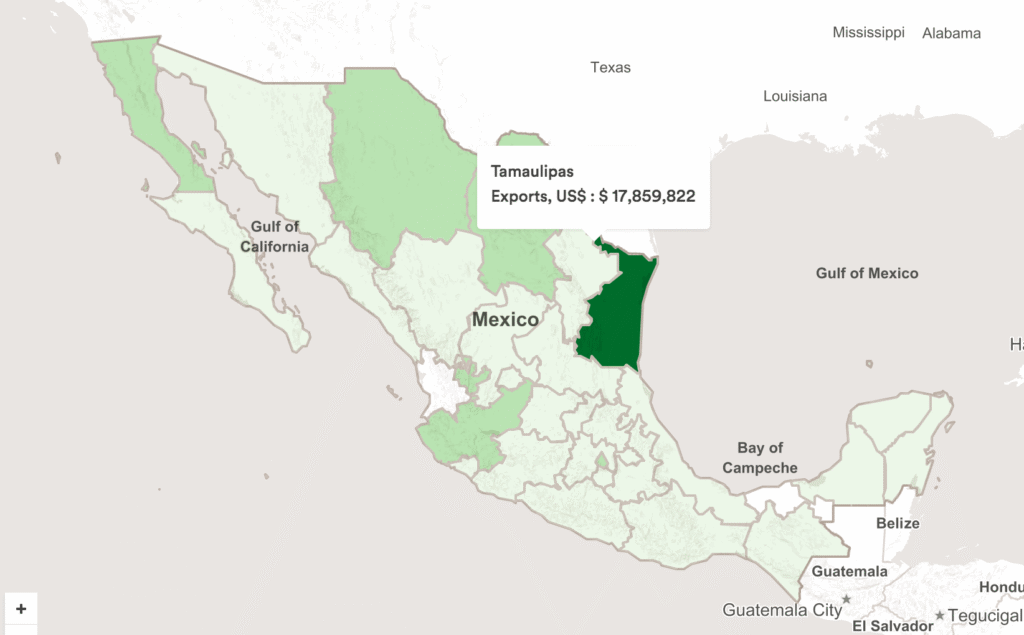
Map of Mexico with state borders and names

Research Projects

  • A colorful sign of Hermosillo adjacent to a city street with businesses

    Project

    Latin America

    Charting Economic Growth Strategies in Hermosillo

    As part of our research agenda on cities as engines of economic growth, researchers are studying emerging growth opportunities across Sonora with a focus on Hermosillo that stem from a context of relocation of global supply chains, green energy transition, and the rise of knowledge-intensive services.
  • Project

    Baja California

    Economic Growth in Baja California, Campeche & Tabasco

    The goal of this project was to diagnose the challenges and obstacles confronting Baja California, Campeche and Tabasco in terms of growth and productivity, and identify the development strategy that would allow for expansion or strengthening of their industries through transitioning to activities with greater complexity or added value.
  • Mexico Atlas - Washing Machines Exports

    Project

    Mexico

    Mexico Atlas of Economic Complexity

    Large income gaps prevail across regions in Mexico. Nuevo Leon exhibits levels of productivity similar to those of South Korea, while Guerrero and Chiapas experience productivity levels below Honduras. These large disparities reproduce even as we break into smaller geographical units: Tuxtla Gutierrez, Chiapas’ capital, has eight times the income of Aldama and Mitontic, its poorest municipalities.
  • Analysis of Economic Potential of Mexico's Southern States (Chiapas)

    Project

    Chiapas

    Analysis of Economic Potential of Mexico’s Southern States (Chiapas)

    Collaboration (2014-2015) with the Mexican Ministry of Finance to examine the underlying causes of poverty in Mexico’s poorest state.
  • Project

    Latin America

    Mexico Competitiveness

    The key strengths and weaknesses of Mexico’s economic landscape are explored in a comprehensive new report co-produced by the World Economic Forum (WEF) and Harvard’s Center for International Development (CID).

Latest Research

  • Working Papers

    Arcay, G. & O’Brien, T., 2025

    Serving From Hermosillo: Opportunities in Cross-Border Trade of Services

    Technological advances have increased the general tradability of services, leading international trade in services to outpace trade in goods, especially after the global financial crisis and the COVID-19 pandemic. Services […]
    Growth Lab

    Technological advances have increased the general tradability of services, leading international trade in services to outpace trade in goods, especially after the global financial crisis and the COVID-19 pandemic. Services once considered less tradable due to the necessity of physical proximity between consumer and provider are now increasingly digitized and delivered remotely. Cross-border services now represent 79% of all internationally traded services, and digitally deliverable activities like engineering, accounting, database and other information services are experiencing yearly U.S. imports growth rates over 15%. This report analyzes how Mexico has been capitalizing on some of these trends over the past five years using the most granular data available. Then, we analyze opportunities from the perspective of Hermosillo. 

    Hermosillo is poised to benefit from this global expansion due to its comparative advantages and existing productive capabilities in potentially tradeable services. We estimate the revealed comparative advantage of Hermosillo in each tradeable service category and find that the city is better positioned than similarly rich and complex cities in Mexico to take advantage of several of these opportunities. This is because Hermosillo is currently intensive in these opportunities, and also because Hermosillo has other industries that are similar to the opportunities in terms of their occupational structure (which could potentially supply additional labor in case tradeable service industries were to expand rapidly). Moreover, Hermosillo’s wage differentials compared to the U.S. are significant for most industries and occupations, including all tradable service industries and teleworkable occupations. This provides a cost advantage for foreign firms seeking to outsource part of their operations. Hermosillo also boasts a well-educated workforce with high levels of schooling and a strong emphasis on STEM fields, positioning it well to meet a potential expansion in educated labor demand. 

    Some tradable services represent bigger opportunities for Hermosillo, but the city will need to develop new capabilities in cross-border service provision in order to take advantage of them. In particular, engineering services, database and other information services, business and management consulting, research and development, education, and accounting services require attention and further research to inform effective strategies. To realize these opportunities, local firms may need to overcome sector-specific challenges related to internationalization. Policymakers can play a pivotal role by fostering strategic partnerships, attracting multinational service providers to bring in knowhow, and creating supportive enabling environments for teleworking and digital service provision.

  • Working Papers

    Daboin, J., et al., 2025

    Una Estrategia de Crecimiento Económico para Hermosillo

    Hermosillo se está quedando atrás en materia de crecimiento económico y diversificación productiva. Históricamente la ciudad se ha beneficiado de una fuerte presencia manufacturera, liderada por Ford, y un capital […]
    Growth Lab

    Hermosillo se está quedando atrás en materia de crecimiento económico y diversificación productiva. Históricamente la ciudad se ha beneficiado de una fuerte presencia manufacturera, liderada por Ford, y un capital humano de alta calidad; sin embargo, se quedó rezagada con respecto a ciudades comparativas en términos de creación de empleo y diversificación económica entre 2010-2020. Este bajo desempeño se deriva principalmente de un menor crecimiento y diversificación de la industria manufacturera en comparación con ciudades mexicanas más dinámicas. Es importante destacar que Hermosillo mantiene importantes ventajas competitivas, sobre todo en infraestructura logística, costos de y acceso a electricidad, y calidad del capital humano. Pero también enfrenta retos en materia de sustentabilidad del agua, de asequibilidad y de oferta de vivienda, así como de movilidad urbana. Hermosillo debe encontrar una combinación de políticas públicas que le permitan capitalizar en sus ventajas, así como solucionar las potenciales restricciones al crecimiento que va a enfrentar. 

    Hermosillo tiene claras oportunidades para acelerar su crecimiento económico. Hay tres cambios importantes en el contexto global que Hermosillo puede aprovechar: la transición energética, la relocalización de las cadenas de suministro y el boom del comercio internacional de servicios digitales. Estas tres tendencias se alinean particularmente con algunas de las ventajas competitivas existentes de Hermosillo. La ubicación estratégica de la ciudad cerca del mercado estadounidense, la mano de obra calificada, sus instituciones educativas y los abundantes recursos solares la ponen en buena posición para capitalizar estos cambios a través de acciones de política pública.

    Las oportunidades económicas de Hermosillo podrían desbloquearse si la ciudad resuelve estratégicamente sus principales limitaciones. La gestión sostenible del agua y la mejora de su planificación urbana, particularmente en vivienda y transporte público, son las restricciones más urgentes que, una vez atendidas, permitirían a la ciudad crecer a un ritmo más cercano a su potencial. El incremento de la oferta vivienda y el desarrollo de un sistema de transporte público eficiente reduciría los costos de vida y los costos laborales para las empresas, haciendo a Hermosillo más atractiva para trabajadores e inversionistas. A su vez, es necesario establecer un modelo sostenible de gestión del agua que permita garantizar el crecimiento futuro de la ciudad. La resolución de estas limitaciones es esencial para posicionar a Hermosillo como un centro importante para las cadenas de suministro de manufactura avanzada, de la industria verde y de servicios digitales en el norte de México. La ciudad tiene muchos elementos a su favor para prosperar, pero requiere abordar estas limitaciones de manera coordinada para desbloquear su próxima fase de crecimiento económico.

  • Working Papers

    Fortunato, A., 2025

    Nearshoring in Hermosillo: Analysis of Economic Growth Opportunities

    This is one of four Growth Lab reports that aim to identify promising growth opportunities for Hermosillo. The focus of this report is nearshoring. Nearshoring is not a new phenomenon in […]
    Growth Lab

    This is one of four Growth Lab reports that aim to identify promising growth opportunities for Hermosillo. The focus of this report is nearshoring. Nearshoring is not a new phenomenon in Mexico, but recent changes in U.S. policy aimed to incentivize nearshoring of critical industries. This report first explores current realities of nearshoring and friendshoring in recent years, based on global trade and the distance which U.S. imports are traveling, and Mexico’s dynamics in global trade and investment in comparison to other countries. The report then evaluates the economic growth opportunities that nearshoring could incentivize in Hermosillo. We analyze the nearshoring opportunity set for Hermosillo across products and industries and if they are based on the city’s productive capabilities.

    This report confirms that nearshoring and friendshoring have been taking place in global trade and investment in response to U.S. policy between 2017 and 2023. Mexico has made gains in its exports to the U.S. market in recent years as exports from China have lost ground, but it is not the only country doing so. A few countries like Vietnam benefited even more, despite being geographically far from the U.S. market. Mexico is seeing growth in products it has traditionally exported, but it is not seeing much diversification into products that the U.S. has deemed critical. Nor is Mexico seeing promising investment trends that would signal an acceleration of growth in these opportunities. Given Hermosillo’s position as a large city that is near the U.S. market, and to a growing market in Arizona in particular, the process of nearshoring represents a potentially transformational chance to jumpstart growth in attractive industries to better position the local economy for the future.

    This report provides analysis to begin to identify the most promising nearshoring opportunities for Hermosillo, but local action is needed to build on these initial observations. We identify products and industries that are attractive opportunities for nearshoring in Hermosillo and we evaluate which industries are most consistent with Hermosillo’s existing industry structure and underlying productive capabilities. Promising opportunities stand out in industries related to medical equipment, electronics, machinery, and plastics and the latter sections of this report explore these opportunities in some detail, both quantitatively and more qualitatively. Local strategies to capitalize on these opportunities will vary in design and local actors should weigh the criteria provided and other considerations when deciding which industries are the highest priority for targeted investment promotion and other action steps. One exception, however, is in the value chain for semiconductors, where the emerging opportunity to supply and complement the value chain that is forming in Arizona is too large to pass up. Semiconductors represent an essential area that policymakers and the business community in Hermosillo should embrace, along with a set of additional promising nearshoring opportunities.

  • Working Papers

    Fortunato, A., et al., 2024

    Growth Through Diversification in Hermosillo

    In this report, we study Hermosillo’s economic performance and assess critical issues affecting the city’s ability to achieve stronger economic growth. Although Hermosillo is far from experiencing economic stagnation, it […]
    Growth Lab

    In this report, we study Hermosillo’s economic performance and assess critical issues affecting the city’s ability to achieve stronger economic growth. Although Hermosillo is far from experiencing economic stagnation, it fell behind other cities that managed to become successful economic hubs between 2010 and 2020. The main reason behind this trailing growth is Hermosillo’s relatively low diversification and investment dynamics, especially in the manufacturing sector. We apply growth diagnostic testing on various potential constraints to economic growth: logistics, electricity, water, human capital, housing, and transportation. Although none of them have directly constrained economic growth in the past, some are explicit threats to increasing growth in the future, thus catching up with high-performing peers. Electricity, human capital, and logistics are comparative advantages, while water, housing, and transportation are threats. 

    In 2025, Mexico is expected to start a new period in its economic history marked by the promise of nearshoring and a new presidential administration. In the past, Mexico has gone through milestones that heavily impacted its economic development path, like the establishment of NAFTA and the China Shock (Hanson, 2010). The rise of Northern Mexico and other regions like El Bajío as global manufacturing hubs has resulted from greater integration with the North American market. This has brought foreign direct investments (FDI) targeted at establishing manufacturing sites primarily to cater to US demand and exports to the rest of the world. Mexico holds high expectations that nearshoring will bring opportunities of the same or greater magnitude. In that context, Hermosillo stands out as a city with the potential to exploit those opportunities and enhance its economic transformation. It is crucial to analyze its binding constraints for economic growth, comparative advantages, and potential concerns to understand how well-positioned Hermosillo is to take advantage of this momentum. 

    Following the introduction and a methodological overview, the report is divided into four main sections. Section 3 provides a growth perspective on Hermosillo; Section 4 presents an analysis of growth constraints; Section 5 explains the local diversification challenge in detail; and Section 6 describes strategic policy areas to accelerate growth that result from this growth diagnostic analysis. 

  • Working Papers

    Shah, T., 2024

    Green Growth Opportunities for Hermosillo: Supplying the Global Energy Transition

    As the world decarbonizes, demand for products which enable the green transition will increase rapidly. Solar panels and wind turbines will be needed to generate renewable energy, and critical minerals […]
    Growth Lab

    As the world decarbonizes, demand for products which enable the green transition will increase rapidly. Solar panels and wind turbines will be needed to generate renewable energy, and critical minerals like copper and lithium will be required for wiring and batteries. Many other products and services within supply chains for such “green products” have a similar dynamic but are less widely known. While reducing carbon emissions often comes in conflict with economic development goals, producing the products that enable the world to decarbonize presents a significant opportunity for places to diversify their economies and generate income for their citizens.

    This section analyzes Hermosillo’s opportunities to produce green products. We analyze the industries which produce these green products and Hermosillo’s capabilities in those industries in the most granular detail that data currently allows. We find not only that Hermosillo can produce products needed for the green transition and thus capture new sources of income for its people and businesses, but also that many of these products are good stepping stones for future economic activities. In the process of learning how to produce these products, Hermosillo can better enable further diversification opportunities. We classify these opportunities accordingly, along both the intensive margin –– industries in which Hermosillo already has a revealed comparative advantage –– and the extensive margin, in which it does not.

    The most immediate green opportunity for Hermosillo lies in the mining of metals. Critical minerals required for the green transition, such as lithium and copper, are present in Sonora, but recent federal policy changes threaten expansion and productivity. The Government of Sonora needs to leverage its experience dealing with mining interests, environmental issues, and the demands of local communities to help co-produce mining policies which are both sustainable and productive. These can have positive spillovers in Hermosillo in the form of mining services growth and the location of mining company headquarters in the city, as in the past.

    Overall, Hermosillo has opportunities to leverage the green transition to help diversify its economy, but is not as well positioned as peers. Hermosillo will need to coordinate investment efforts in order to compete with peer cities, who are better positioned to take advantage of these opportunities today. Industries such as manufacturing of electronic components and semiconductors and manufacturing of plastics products are among the more feasible and attractive industries for Hermosillo to target for promotion. Coordinating the manufacturing of green inputs with efforts to take advantage of solar energy resources is a strong strategy for the city. Large solar parks will need to be constructed to harness the cities’ solar energy resources. By using the planned build-out of these industries as a source of final demand, Hermosillo may be able to out-compete peer cities in attracting a solar panel OEM, which would help diversify the city into electronic components and semiconductors, as well as into the manufacturing of electric generation equipment.

  • Working Papers

    Lamby, L., 2024

    Green Growth Opportunities for Hermosillo: “Powershoring”

    The process of global decarbonization offers significant growth opportunities for Hermosillo, given its outstanding solar power potential. As fossil fuels are relatively cheap to transport, they created an “energy flat […]
    Growth Lab

    The process of global decarbonization offers significant growth opportunities for Hermosillo, given its outstanding solar power potential. As fossil fuels are relatively cheap to transport, they created an “energy flat world,” allowing industries to thrive in locations that are far away from energy sources. Renewable energy, however, is much more costly to transport. Because of this, energy-intensive industries are naturally incentivized to relocate to areas with competitive green energy in a decarbonizing world ––something known as “powershoring.” Powershoring is a green growth opportunity for Hermosillo; that is, a pathway for Hermosillo to accelerate its own economic growththrough helping the global economy to decarbonize. Powershoring is becoming an increasingly important opportunity as businesses face carbon taxes and other costs inconsuming fossil fuel energy, which come from both regulators and consumers.

    Hermosillo’s powershoring strategy should involve both attracting new industries and exploring new growth opportunities for existing industries. On the intensive margin of existing industries, companies may expand by integrating renewable energy into their own consumption of renewable sources. Hermosillo can build on its strengths in the food and agricultural sectors. On the extensive margin of new industries, attractive opportunities arise in the chemicals manufacturing cluster, the glass and ceramics cluster, and the semiconductors and electronics cluster. The industries identified in these clusters can be targeted for potential investment promotion efforts, given their large energy demands. In this report, we provide initial observations on several of these industries from an investment promotion perspective. 

    To establish Hermosillo as a prime destination for industries seeking lower emissions, government and industry must work together on long- and short-term strategies. A significant obstacle is the intermittency of solar energy, which is subject to weather variability and the unavoidable reality that the sun does not shine at night. A current approach by companies is to use energy from the grid in combination with green energy certificates to offset resulting carbon emissions, but this practice is untenable for some end consumers. Over the longer-term, intermittency could be resolved through advances in battery storage and connections to neighboring regions, where wind power and other complementary renewable energy can be sourced. Since decarbonizing the grid is a long-term scenario, early movers can capitalize on opportunities through green industrial parks that provide a dedicated supply of renewable energy. The region’s energy infrastructure will need to evolve to ensure stability, but the short-term focus should be on industries that align with Hermosillo’s existing capabilities and renewable potential. Prioritizing sectors where processes are more easily electrified, and water needs are manageable appears to be the most logical place to begin a dynamic process of attracting and growing powershoring opportunities in Hermosillo.

  • Journal Articles

    Hausmann, R., Pietrobelli, C. & Santos, M.A., 2021

    Place-specific determinants of income gaps: New sub-national evidence from Mexico

    Journal of Business Research

    The literature on wage gaps between Chiapas and the rest of Mexico revolves around individual factors, such as education and ethnicity. Yet, twenty years after the Zapatista rebellion, the schooling […]
    1-s2.0-s0148296320x00154-cov150h.gif
    The literature on wage gaps between Chiapas and the rest of Mexico revolves around individual factors, such as education and ethnicity. Yet, twenty years after the Zapatista rebellion, the schooling gap has shrunk while the wage gap has widened, and we find no evidence indicating that Chiapas indigenes are worse-off than their likes elsewhere in Mexico. We explore a different hypothesis and argue that place-specific characteristics condition the choices and behaviors of individuals living in Chiapas and explain persisting income gaps. Most importantly, they limit the necessary investments at the firm level in dynamic capabilities. Based on census data, we calculate the economic complexity index, a measure of the knowledge agglomeration embedded in the economic activities at the municipal level. Economic complexity explains a larger fraction of the wage gap than any individual factor. Our results suggest that the problem is Chiapas, and not Chiapanecos.
  • Working Papers

    Barrios, D., et al., 2018

    Tabasco: Diagnóstico de Crecimiento

    Since 2003, the GDP per capita of Tabasco has consistently figured among the 4 largest in the country. However, this level of economic activity has not translated into an equally […]
    Growth Lab

    Since 2003, the GDP per capita of Tabasco has consistently figured among the 4 largest in the country. However, this level of economic activity has not translated into an equally favorable performance in other social welfare metrics. According to CONEVAL, the Tabasco poverty rate in 2016 was 50.9%, seven percentage points higher than the national rate (43.6%). On the other hand, the average monthly income of the workers of the state is in the 40th percentile of all the states.

    This discrepancy can be explained because the mining activity, despite accumulating only 3% of jobs, represents more than 50% of the state’s GDP. If we only consider non-oil GDP, we have that the GDP per capita of the state has tended to be located around the country’s median, and for 2016 it was in the 30th percentile nationwide.

  • Working Papers

    Barrios, D., et al., 2018

    Tabasco: Reporte de Complejidad Ecónomica

    Este estudio busca identificar las capacidades productivas de Tabasco a partir de un análisis de la composición de sus exportaciones y su empleo basándose en la perspectiva de la complejidad […]
    Growth Lab

    Este estudio busca identificar las capacidades productivas de Tabasco a partir de un análisis de la composición de sus exportaciones y su empleo basándose en la perspectiva de la complejidad económica. Asimismo, busca identificar productos potenciales que requieran una base de conocimientos productivos similar a la que ya tiene Tabasco y que le permita mejorar su complejidad económica actual y prospectiva.

    Para tales efectos, primero se explora la evolución en el tiempo del valor de las exportaciones de Tabasco y la composición de las mismas, así como de los principales productos de exportación. En sentido, se tiene que las exportaciones de Tabasco están determinadas por el sector petrolero. Los envíos de petróleo representan alrededor del 97% de las exportaciones estatales y explican más del 90% del aumento de las exportaciones de la última década.

  • Working Papers

    Barrios, D., et al., 2018

    Tabasco: Diagnóstico Industrial

    En este estudio se consideraron los productos priorizados en el Reporte de Complejidad Económica de Tabasco y se procedió a evaluar su potencial a partir de un conjunto de consideraciones […]
    Growth Lab

    En este estudio se consideraron los productos priorizados en el Reporte de Complejidad Económica de Tabasco y se procedió a evaluar su potencial a partir de un conjunto de consideraciones de mercado. Luego, se agregó el potencial de cada producto en distintas colecciones de producto, y se seleccionó una industria cuya estimulación y desarrollo constituya una apuesta de desarrollo prometedora el estado. Respecto de éste se detallaron algunas estadísticas generales como una forma de evaluar su potencial de crecimiento e impacto para la economía local, estatal y nacional.

    Para el objeto de este estudio, el sector industrial escogido para el análisis de cuellos de botella fue el de “Químicos” y, más puntualmente, los productos: “Agentes de limpieza orgánicos (ex. Jabón)”, “Aprestos y aceleradores de tintura”, “Mezclas de sustancias odoríferas”, “Placas fotográficas” y “Tinta”. El desarrollo de esta colección de productos representa una importante oportunidad, la que, a la fecha, los productores mexicanos no han podido aprovechar del todo. Sin embargo, estos productos han presentado un gran dinamismo dentro de México en los años recientes. Entre 2004 y 2014, las exportaciones de México en estos productos se han duplicado, el empleo en los sectores asociados a estos productos ha aumentado un 20%, y el salario promedio en estos sectores ha aumentado entre 40% y 50%.

  • Working Papers

    Barrios, D., et al., 2018

    Tabasco: Insumos para el desarrollo de recomendaciónes

    En este documento se presentaron una serie de insumos para el desarrollo de políticas para Tabasco, que apuntan a la estructuración de una estrategia de transformación productiva que le permita […]
    Growth Lab
    En este documento se presentaron una serie de insumos para el desarrollo de políticas para Tabasco, que apuntan a la estructuración de una estrategia de transformación productiva que le permita al estado revertir la tendencia adversa de los últimos años y promover una senda de crecimiento sostenido. Asimismo, este documento buscó consolidar los principales hallazgos de las investigaciones que hicieron parte del proyecto “Diseño de estrategias de transformación productiva para Tabasco.
  • Working Papers

    Barrios, D., et al., 2018

    Campeche: Diagnóstico de Crecimiento

    Campeche cuenta con el PIB per cápita más alto de todo México. Si bien buena parte de este desempeño se debe a la actividad petrolera (la cual representa 80% de […]
    Growth Lab

    Campeche cuenta con el PIB per cápita más alto de todo México. Si bien buena parte de este desempeño se debe a la actividad petrolera (la cual representa 80% de la actividad económica del estado), incluso si se considera únicamente el PIB no petrolero per cápita el estado se ubicaba por encima del 80% de las entidades federativas del país. En 2016 el PIB per cápita de la entidad –a pesar de ser el más alto de todo México – era 45% de su valor en 2003, lo que equivale a una caída anual promedio de aproximadamente 6%. Si bien esta caída ha sido sostenida, las razones que la subyacen parecen haber variado en el tiempo.

    En el período 2003-2009 se evidenció una divergencia entre el comportamiento de la actividad petrolera y la no petrolera. Por un lado, todos los sectores de la economía no petrolera, con la excepción de servicios de apoyo a los negocios, reflejaron tasas de crecimiento positivas. Por el contrario, la actividad petrolera cayó abruptamente, debido a que a pesar de que hubo aumentos en la cantidad de pozos de desarrollo perforados y en la cantidad de equipos de perforación activos, la producción petrolera cayó 26%, alcanzado con ello niveles que no se habían observado desde 1997.

See All

Study Groups

Study Groups

The Growth Lab occassionally offers study groups to Harvard Kennedy School and Harvard students who are interested in exploring topics beyond their coursework while engaging with practitioners and researchers affiliated with the Lab.

Participating students are encouraged to share ideas, research and new approaches to the discussion topics. 

Harvard Kennedy School students seated around a table in a conference room.

Spring 2025

An Exploration of Rural American Economies

This study group will meet weekly over six weeks to introduce and discuss issues facing rural economies across the United States and relevant national, state, and local strategies. The study group will bring in learnings and guests from the Growth Lab’s multi-year research project in Wyoming and new research in New Mexico, as well as material from the Brookings Institution’s Reimagining Rural Policy program.

After several initial weeks of cases and discussion, the group will welcome several (virtual) guests to share their reflections on recent developments. This study group runs alongside an expanded focus on rural communities by our project on Wyoming and new research and support across New Mexico.

Students interested in participating must submit an application. The application deadline is Friday, March 14.

First-year students who complete this study group may have the opportunity to work directly with rural communities in these two states in the fall semester.

Info Session

Date: March 10, 2025
Time: 12:00 pm – 1:00 pm
Location: Wexner 434A

All students are welcome to join us for an informational lunch about the opportunity to participate in a 6-week study group on rural economies. The info session will include a 30-minute presentation by the Growth Lab and virtual participation by members of the Wyoming Business Council and/or New Mexico Economic Development Department.

RSVP is required.

Optional preparation for info session: “What everyone should know about rural America ahead of the 2024 election” and “Rural America’s economies are often left out by a design flaw in federal funding.”

Session 1

Date: March 24, 2025
Time: 4:15 pm – 5:30 pm
Location: 414B (Democracy Lab)

Topic: Reimagine Rural Case Studies. Discussion questions prepared by the Growth Lab based on two informative stories of rural communities from Pennsylvania and West Virginia.

Preparation: Listen to Episodes 1 & Episode 6 of Season 1 of Reimagine Rural.

Session 2

Date: March 31, 2025
Time: 4:15 pm – 5:30 pm
Location: 414B (Democracy Lab)

Topic: Reimagine Rural Case Study & Summary. Discussion questions prepared by the Growth Lab based on two informative stories of rural communities from a Mississippi Delta community and a reservation community in South Dakota.

Preparation: Listen to Episodes 4 & Episode 7 of Season 1 of Reimagine Rural.

Session 3

Date: April 7, 2025
Time: 4:15 pm – 5:30 pm
Location: 414B (Democracy Lab)

Topic: A framing of the challenges in supporting rural communities with guest speakers from existing state and federal systems after 2+ years working with the Growth Lab. Introductory comments followed by Q&A / discussion.

Speakers
Heather Tupper

Heather Tupper

Regional Offices Director
Wyoming Business Council

Brandi Harlow

Brandi Harlow

Northeast Regional Director
Wyoming Business Council

Vinicius Bueno

Vinicius Bueno

Economic Policy & Research Advisor, Wyoming Business Council

Connor Christensen

Connor Christensen

Economic Policy & Research Advisor, Wyoming Business Council


Preparation: Skim the statewide Comprehensive Economic Development Strategy (CEDS) as well as an analysis of how communities can leverage federal grants.

Session 4

Date: April 14, 2025
Time: 4:15 pm – 5:30 pm
Location: 414B (Democracy Lab)

Topic:  Identifying local opportunities in New Mexico. Presentation of work in progress analysis about how to identify opportunities in small counties and discussion about how local stakeholders can act upon the insights.

Optional preparation: Skim the latest state plan and read an article about it, and read a Dallas Fed article with an overview about NM.

Session 5

Date: April 21, 2025
Time: 4:15 pm – 5:30 pm
Location: 414B (Democracy Lab)

Topic: Hannah Conover, Executive Director of Grant Ready Kentucky, will join virtually to discuss rural economies in Kentucky, efforts and innovations in expanding local capability in the state and beyond, and working in the current moment of federal policy.

Preparation: Listen to Episode 9 of Season 2 of Reimagine Rural.

Session 6

Date: April 28, 2025
Time: 4:15 pm – 5:30 pm
Location: 414B (Democracy Lab)

Topic: An active discussion with guest speaker Tony Pippa from the Brookings Institution and host of Reimagine Rural. Questions from students that span topics of the previous five sessions to be sent to Tony in advance.

Preparation: Episode 8 of Season 1 of Reimagine Rural.

Interns (2024)

Interns (2024)

Each year, the Growth Lab offers students exciting opportunities to work as part of its team through internships and collaborations in policy research projects. Our teams work on a unique blend of research and real-world policy engagements, providing an opportunity to test theories and witness the impact of research on complex economic development problems. 

Economic Prosperity in the Amazon Rainforest

Economic Prosperity in the Amazon Rainforest

Deforestation is often treated as inevitable to serve the economic needs of human populations, local and global. However, our research in the Peruvian and Colombian Amazon finds that forest loss is not inevitable. The research identifies opportunities to achieve shared prosperity without sacrificing the forest by increasing the complexity of the neglected cities of the Amazon.

At the Growth Lab, we have two decades of research into how to generate growth and prosperity. Through engagement with the Gordon and Betty Moore Foundation, we have developed research and policy options in two Amazonian contexts: Loreto in Peru, and Caquetá, Guaviare and Putumayo, in Colombia.

Lessons in Generating Shared Prosperity while Protecting the Forest in the Peruvian and Colombian Amazon

The central lesson of our research is that the perceived conflict between economic growth and forest protection fails to hold in the evidence from the Peruvian and Colombian Amazon. Many parts of the Amazon find themselves in the “lose-lose” scenario of low prosperity and high deforestation. Rates of deforestation differ across locales more than the rates of economic growth. Alarming increases in deforestation are not found to be accompanied by greater economic growth. This is due to the fact that the drivers of prosperity and deforestation are distinct – as they happen in different places. Deforestation occurs where the agricultural frontier meets the forest edge, often through extensive cattle-ranching. By contrast, the economic drivers in the Amazon are its urban areas often located far from the forest edge, including in non-forested piedmont regions. These cities offer greater economic complexity by accessing a wider range of productive capabilities in higher-income activities without those activities driving deforestation.

Read More About Generating Shared Prosperity

Achieving shared prosperity in the Amazon depends on the connectivity and opportunity in its urban areas. What a city is able to export or sell outside the city determines the success of the city. The economic challenge in the Amazon is that its cities do not export, in that they sell few things outside the city. This further limits the capacity to import those items that the city does not produce. The need to expand exports to be able to afford the imported inputs for more complex activities describes a fundamental coordination challenge behind connectivity in the Amazon.

The strategy should be territorial across three geographies of opportunity: (i) in cities, through tourism services, transport services, professional services, and agro-processing industry; (ii) in rural non-forested areas, in more intensive crops and sustainable agroforestry; and (iii) in forest areas, based on ecotourism, carbon markets for reforestation, and forest protection services.

Additionally, the greatest promise for prosperity in the Amazon is to make forest protection the most profitable activity, particularly through carbon markets. Deforestation is driven by basic market economics: the private returns to owning deforested land are higher than the social returns of keeping that land as a forest. The goal of policy should therefore be to make forest protection and reforestation more profitable than cattle ranching. Reforesting with carbon credits is not a profitable activity in any Amazonian country at today’s prices and with carbon titles that are unclear and costly to enforce.

Our researchers present a summary of the growth trajectory, economic complexity analysis, growth diagnostic, and policy report for each project.  It concludes with the central lessons and key insights for an economic path forward in these regions.

The city of Tingo Maria with La Bella Durmiente mountain in the background
Photo: Tingo Maria, Peru

The most underutilized tool for economic prosperity in the Amazon is its cities. Perhaps the most surprising facet of life in each of the four Amazonian regions studied is that the majority of people live in urban areas. This is a telling fact of economic geography: that even in the most remote parts of the Amazon, people want to come together to live in densely populated areas. How can one explain Iquitos, a city in Loreto deep in the forest that cannot be reached by road, but is home to more than 470,000 people? Yet Iquitos matches the findings of our global research that the secret to shared prosperity is productive knowhow – that as a society expands the range of knowhow available, it increases the diversity and complexity of its production.

A place grows by adding new knowhow to produce more, and more complex, things. To bring different knowhow together, people must live near each other. Hence, cities form, affording greater complexity and prosperity, and, crucially, city activities are not those linked to deforestation, like low complexity cattle-ranching.

Resources in the Amazon are being spent in the wrong direction, by targeting the forest not the cities. Because deforestation is happening in the forest, resources targeting forest conservation are being spent to support a small minority of families to improve their livelihoods. But just because a flat tire is flat at the bottom does not mean the hole is there. The source cause of deforestation in the Amazon is its stagnant, disconnected cities, where underinvestment in urban roads, water, sewage, and housing result in weak generation of higher income opportunities, despite being where the majority live. The solution to deforestation, as with that of creating shared prosperity, relies on generating better opportunities in cities to pull more people in from rural areas to reduce the pressure on expanding the agricultural frontier into the forest. This is consistent with our research: there are few global cases of generating prosperity in the forest, but vast examples of building thriving urban spaces. Shared prosperity is easier to achieve in urban areas than in the forest.  

amazon_forest_in_putumayo_colombia_shutterstock_2266701051_copy.jpg
Photo: Putumayo, Colombia

The defining feature of the Amazonian economies is its remoteness. The long distances and travel times to large markets outside the region present a significant constraint to competitiveness in each of the four regions studied. Yet these regions also face an additional “connectivity trap” that further limit the viability of economic diversification. The lack of quality, timely transport connections with external markets restricts the economy complexity of the Amazon and, in turn, the low complexity of the cities limits the returns to new investments.

In Colombia, transport costs from Amazonian cities to the rest of Colombia are exceedingly high, even when controlling for distance. Transport routes often depend on a single route, for which any disruption (e.g., blockades) adds costs and uncertainty. The lack of transport connectivity presents a binding constraint to the profitability of agro-processing and time-sensitive agroforestry products in many parts of the Colombian Amazon. The extreme isolation of Iquitos in Loreto results in a higher level of economic complexity than expected. Given the extensive time required for imports and exports to Iquitos, the research finds that a set of activities, such as beverage bottling, are viable to produce locally rather than import. This affords a more complex set of industries than those that would be competitive if exposed to import competition. However, this extreme remoteness also puts a ceiling on production at the level of local demand, as exports face these time requirements as a disadvantage in reaching external markets.

Related Publications

  • Book Chapter

    Cheston, T., 2025

    Economic Prosperity With Environmental Preservation

    Cities in Amazonia: People and Nature in Harmony, 165-167.

    The publication sheds light on the ongoing urbanization in Amazonia and emphasizes the need for urgent action to guide it towards sustainability, improving both forest protection and the well-being of its residents.

    This book explores the complex and rapidly evolving urbanization of Amazonia, a vast, diverse, and ecologically critical region undergoing a profound transformation. Amazonia is now home to nearly 41 million urban residents across 895 settlements — and yet its urbanization remains poorly understood, underestimated in scale, fragmented in form, and frequently overlooked in policy.

    Through multidisciplinary perspectives and contributions from more than 50 experts, this book examines how urban growth intersects with environmental degradation, social inequality, and gaps in governance. Despite these challenges, cities in Amazonia are also places of promising innovations, from tailored healthcare services and environmental monitoring to community-led planning and cross-border cooperation.

    Rooted in both local insight and regional coordination frameworks, including the Amazonia Forever program, this work offers a holistic and evidence-based understanding of urbanization in Amazonia. It argues for urgent, coordinated action to guide sustainable, inclusive development — before current urbanization trajectories lead to irreversible ecological and social consequences. The book invites researchers, policymakers and practitioners to recognize Amazonia’s cities not only as sites of vulnerability but as key agents in shaping the region’s — and the planet’s — future.

    Chapter four highlights successful practices and innovative approaches that address this region’s urban challenges. Some focus on people, improving healthcare, and mapping needs for riverine communities. Others emphasize environmental care, with cities leading sustainability efforts, nature-based solutions, partnerships and ecosystem restoration to boost resilience. It also stresses the importance of increasing prosperity by finding opportunities even under difficult, cross-border conditions

    Keywords: urbanization, cities, urban areas, sustainability, climate, productivity, well-being, infrastructure, Amazonia, urban development

    JEL Codes: R11; R12; O18; R58; J24; R42; Q54; Z13

  • Working Papers

    Bustos, S., Cheston, T. & Rao, N., 2023

    The Missing Economic Diversity of the Colombian Amazon

    Alarming rates of forest loss in the Colombian Amazon have created a perceived trade-off that the only means of achieving economic prosperity is by sacrificing the forest. This study finds […]
    Growth Lab

    Alarming rates of forest loss in the Colombian Amazon have created a perceived trade-off that the only means of achieving economic prosperity is by sacrificing the forest. This study finds little evidence of this trade-off; rather, we find that economic development and forest protection are not an either-or choice. Forest clearing is driven by extensive cattle-ranching as a means to secure land titles. In essence, the loss of some of the world’s richest biodiversity is the result of some of the least economically complex activities that fail to achieve economic prosperity in the region. If anything, the acceleration in deforestation has accompanied a period of economic stagnation.

    The existing economic model in the Amazon – centered on agrarian colonization and mineral extraction – has not generated prosperity for the people, all while failing the forest. The exceptional diversity of the Amazon’s biome is not reflected in the region’s economy. The Amazonian economy is best characterized by its low diversity and low complexity. A significant proportion of employment is linked to public administration – more than in other departments of the country. Very little of the production in the departments is destined to be consumed outside the departments (“exported”).

    This study seeks to define an alternative economic model for the Colombian Amazon from the perspective of economic complexity with environmental sustainability. Economic complexity research finds that the productive potential of places depends not only on the soil or natural resources, but on the productive capabilities—or knowhow—held by its people. This research finds that the Colombian Amazon will not become rich by adding value to its raw materials or by specializing in one economic activity. Rather, economic development is best described as a process of expanding the set of capabilities present to be able to produce a more diverse set of goods, of increasingly greater complexity. This model starts from the base of understanding the existing productive capabilities in Caquetá, Guaviare, and Putumayo, to identify high-potential economic sectors that build off those capabilities to achieve new, sustainable pathways to shared prosperity.

    Achieving shared prosperity in the Amazon depends on the connectivity and opportunity in its urban areas. The primary drivers of greater economic complexity – and prosperity – are the cities in the Amazon. Even in the remote areas of the Amazon, the majority of people in Caquetá, Guaviare, and Putumayo live in urban areas. The low prosperity in the Colombian Amazon is driven by the lack of prosperous cities. The report finds that Amazonian cities are affected by the lack of connectivity to major Colombian cities that limit their ability to ‘export’ things outside the department to then expand the capacity to ‘import’ the things that are not produced locally as a means to improve well-being.

  • Working Papers

    Cheston, T. & Rueda-Sanz, A., 2023

    Una historia de la economía de dos Amazonias: Lecciones sobre generar prosperidad compartida mientras se protege la selva en Perú y Colombia

    A menudo se piensa que alcanzar la prosperidad económica en la selva amazónica es incompatible con la protección del ambiente. Los investigadores ambientales suelen advertir, con razón, que la velocidad […]
    Growth Lab
    A menudo se piensa que alcanzar la prosperidad económica en la selva amazónica es incompatible con la protección del ambiente. Los investigadores ambientales suelen advertir, con razón, que la velocidad de la deforestación actual está llevando a la Amazonía a un potencial punto de quiebre a partir del cual la selva no podrá dejar de deteriorarse hasta convertirse en una sábana herbácea. Pero se habla menos de lo que hay que hacer para generar prosperidad compartida en las comunidades amazónicas. La deforestación suele tratarse como algo inevitable a la hora de atender las necesidades humanas, locales y globales. Este reporte sintetiza los hallazgos de dos proyectos del Laboratorio de Crecimiento de Harvard University, que estudian la naturaleza del crecimiento económico en dos contextos amazónicos: el departamento de Loreto, en Perú, y los departamentos de Caquetá, Guaviare y Putumayo, en Colombia. La meta de estas colaboraciones es valerse de la investigación de alcance global que ha hecho el Growth Lab sobre la naturaleza del crecimiento económico para aplicar esos métodos al reto único de desarrollar rutas hacia la prosperidad en la Amazonía, de manera que no se perjudique a la selva. Este reporte compara y contrasta los hallazgos en la Amazonía peruana y colombiana para evaluar hasta qué punto hay lecciones que se puedan generalizar sobre la relación entre crecimiento económico y protección del bosque en la Amazonía. 
  • Working Papers

    Goldstein, P., et al., 2023

    The Connectivity Trap: Stuck between the Forest and Shared Prosperity in the Colombian Amazon

    The Colombian Amazon faces the dual challenge of low economic growth and high deforestation. High rates of deforestation in Colombia have led to a perceived trade-off between economic development and […]
    Growth Lab

    The Colombian Amazon faces the dual challenge of low economic growth and high deforestation. High rates of deforestation in Colombia have led to a perceived trade-off between economic development and protecting the forest. However, we find little evidence of this trade-off: rising deforestation is not associated with higher economic growth. In fact, the forces of deforestation of some of the world’s most complex biodiversity are driven by some of the least complex economic activities, like cattle-ranching, whose subsistence-level incomes are unable to meet the economic ambitions for the region. All the while, the majority of the Amazonian departments’ population works in non-forested cities and towns, at a distance from the agriculture frontier that forms the “arc of deforestation.” The relative urbanization of the Amazonian departments, despite the vast land mass available, recognizes that prosperity is achieved through close social-economic interactions to expand the knowledge set available to be able to produce more, and more complex activities. Achieving economic goals therefore relies on creating new productive opportunities in non-forested, urban areas.

    The risk of deforestation reduces incentives to improve the connectivity of Amazonian departments with major cities and export markets. The remoteness of these departments increases the cost of ‘exporting’ goods to markets outside the departments. Poor connectivity contributes to the low economic complexity of the departments. In turn, the low complexity reduces incentives to coordinate new investments that would generate returns to greater connectivity. Coordination failures, which occur when a group of economic actors (e.g., firms, workers) could achieve a better outcome but fail to do so because they do not coordinate their actions, are widespread in all three of the Amazonian departments studied. This limits the creation of new capabilities and productive diversification to generate new jobs and higher incomes.

    We posit that economic growth in the Colombian Amazonian is limited by a “connectivity trap” whereby the lack of external market connectivity restricts economic complexity, and, in turn, the low complexity fosters the coordination failures that limit returns to new diversification. Ultimately, low returns to diversification further reduce incentives to improve connectivity. Underpinning the connectivity trap is the belief that limiting the connectivity of Amazonian departments with large Colombian cities and the broader global economy will limit incentives for deforestation. Yet, deforestation has accelerated in recent years, despite the continued poor connectivity. We argue that Colombia must create a new national law to curb deforestation by eliminating the financial incentives for land speculation. Reclassifying forested lands under the control of national protection systems with severe restrictions on economic activities and strengthened enforcement, as detailed in an accompanying report, provides the needed legal clarity regarding land formalization. Within the law to eliminate incentives for deforestation, the national government should create a new development approach for the Colombian Amazon. This approach must move beyond a natural resource-based approach to the region, to center on the productive potential of its urban areas, and the carbon markets and tourism potential of its forested areas. One pillar of this approach is to build new public sector capabilities to coordinate investments into new, targeted productive sectors to create new national-local mechanisms of investment promotion. A second pillar is to improve connectivity to external markets through road and air investments between Caquetá, Guaviare, and Putumayo and major cities and ports.

  • Working Papers

    Cheston, T., et al., 2023

    Seeing the Forest for More than the Trees: A Policy Strategy to Curb Deforestation and Advance Shared Prosperity in the Colombian Amazon

    Does economic prosperity in the Colombian Amazon require sacrificing the forest? This research compendium of a series of studies on the Colombian Amazon finds the answer to this question is […]
    Growth Lab
    Does economic prosperity in the Colombian Amazon require sacrificing the forest? This research compendium of a series of studies on the Colombian Amazon finds the answer to this question is no: the perceived trade-off between economic growth and forest protection is a false dichotomy. The drivers of deforestation and prosperity are distinct – as they happen in different places. Deforestation occurs at the agricultural frontier, in destroying some of the world’s most complex biodiversity by some of the least economically complex activities, particularly cattle-ranching. By contrast, the economic drivers in the Amazon are its urban areas often located far from the forest edge, including in non-forested piedmont regions. These cities offer greater economic complexity by accessing a wider range of productive capabilities in higher-income activities with little presence of those activities driving deforestation. Perhaps the most underappreciated facet of life in each of the three Amazonian regions studied, Caquetá, Guaviare, and Putumayo, is that the majority of people live in urban areas. This is a telling fact of economic geography: that even in the remote parts of the Amazon, people want to come together to live in densely populated areas. This corroborates the findings of our global research over the past two decades that prosperity results from expanding the productive capabilities available locally to diversify production to do more, and more complex, activities.
  • Working Papers

    Cheston, T. & Rueda-Sanz, A., 2023

    The Economic Tale of Two Amazons: Lessons in Generating Shared Prosperity while Protecting the Forest in the Peruvian and Colombian Amazon

    Achieving economic prosperity in the Amazon rainforest is often seen as incompatible with protecting the forest. Environmental researchers rightly warn that rapid deforestation is pushing the Amazon close to a […]
    Growth Lab
    Achieving economic prosperity in the Amazon rainforest is often seen as incompatible with protecting the forest. Environmental researchers rightly warn that rapid deforestation is pushing the Amazon close to a potential tipping point of forest dieback into grassy savanna. Less has been said about what is required to generate shared prosperity in Amazonian communities. Deforestation is often treated as inevitable to serve human needs, local and global. This report synthesizes the findings of two engagements by the Growth Lab at Harvard University that study the nature of economic growth in two Amazonian contexts: Loreto in Peru, and Caquetá, Guaviare, and Putumayo, in Colombia. The aim of these engagements is to leverage the Growth Lab’s global research into the nature of economic growth to apply those methods to the unique challenge of developing paths to prosperity in the Amazon in ways that do not harm the forest. This report compares and contrasts the findings from the Peruvian and Colombian Amazon to assess the extent to which there are generalizable lessons on the relationship between economic growth and forest protection in the Amazon.
  • Working Papers

    Hausmann, R., et al., 2023

    Looking for Virtue in Remoteness: Policy Recommendations for Sustainable and Inclusive Growth in the Peruvian Amazonia

    Loreto is a place full of contrasts. Although it is the largest department in Peru, it is one of the least populated in the country. Its capital, Iquitos, is closer […]
    Growth Lab

    Loreto is a place full of contrasts. Although it is the largest department in Peru, it is one of the least populated in the country. Its capital, Iquitos, is closer to Brazil and Colombia’s border states than it is to the capitals of its neighboring regions in Peru – San Martin and Ucayali. Iquitos can only be reached by air or river, making it one of the largest cities in the world without road access. Since its foundation, Loreto’s economy has depended on the exploitation of natural resources: from the Amazon rubber boom at the end of the 19th and the beginning of the 20th centuries, to the oil extraction and exploitation of forest resources that predominate today. This model has brought with it significant environmental damage and has produced a pattern of slow and volatile growth, which has opened an ever-widening gap between the economy of the region and that of the rest of the country. Between 1980 and 2018, Loreto grew at an average compound annual growth rate four times lower than the rest of Peru. Otherwise stated, while the rest of Peru has tripled the size of its economy, Loreto increased it by just under one-third.

    Within the last decade (2008-2018), the region has distanced itself from its Amazonian peers in the country (Ucayali, San Martín, and Madre de Dios), which have grown at an average annual growth rate five times higher. Loreto’s average per capita income fell from three-quarters of the national average in 2008 to less than half of it by 2018. In addition to – or perhaps as a consequence of – its economic challenges, Loreto is also among the departments with the worst indicators of social development, including the highest levels of anemia and child malnutrition in Peru.

    In this context, the Growth Lab at Harvard University partnered with the Gordon and Betty Moore Foundation to develop a research study that would provide inputs and policy recommendations to boost the development of the region and foster sustainable prosperity.

  • Working Papers

    Hausmann, R., et al., 2022

    Overcoming Remoteness in the Peruvian Amazonia: A Growth Diagnostic of Loreto

    Is there a tradeoff between environmental sustainability and economic development? If there is a place where that question can be approximated, that is Loreto. Located on the western flank of […]
    Growth Lab

    Is there a tradeoff between environmental sustainability and economic development? If there is a place where that question can be approximated, that is Loreto. Located on the western flank of the Amazon jungle, Loreto is Peru’s largest state and the one with the lowest population density. Its capital, Iquitos, is the largest city without road access in the world. For three decades, the region’s income and development has diverged from that of Peru and its other Amazonian peers by orders of magnitude. And yet, despite plummeting contributions from natural resources – that predominate in the policy discussion in and on the state – Loreto has developed a more complex productive ecosystem than one would expect, given its geographical isolation. As a result, it has a stock of productive capabilities that can be redeployed in economic activities with higher value-added, able to sustain higher wages and better living standards.

    We deployed a thorough Growth Diagnostic of Loreto to identify the most binding constraints preventing private investment and development in sustainable economic activities. In the process, we relied on domestic databases available to the public in Peru and international datasets, combining and validating our analytical insights with extensive field visits to the Peruvian Amazonia and lengthy interviews with policymakers, private businesses, and academia. Improving fluvial connectivity, developing the capacity to sort out coordination failures associated with the process of self-discovery, and substituting oil for solar energy, are the three policy goals that would deliver the largest bang for the reform buck. The latter presents an opportunity for environmental organizations – subsidizing solar – to move away from their status quo of preventing bad things from happening, to a more constructive one that entails enabling good things and sustainable industries to happen.

    Project page: Economic Growth and Structural Transformation in Loreto, Peru

  • Working Papers

    Hausmann, R., et al., 2021

    Loreto’s Hidden Wealth: Economic Complexity Analysis and Productive Diversification Opportunities

      This report has three main objectives. Firstly, to identify and assess the agglomeration of know-how that is currently present in Loreto’s existing economic activities. Secondly, to define technological proximity metrics […]
    Growth Lab


    This report has three main objectives. Firstly, to identify and assess the agglomeration of know-how that is currently present in Loreto’s existing economic activities. Secondly, to define technological proximity metrics based on available data in order to identify the economic activities that generate the most value-added and which require similar productive capacities to those that are already present in the region. Finally, this paper seeks to identify those economic activities that are relatively “adjacent” to Loreto’s stock of productive know-how and which, therefore, have high potential to lead the productive transformation of its economy.

    The Growth Lab at Harvard University, with funding provided by the Gordon and Betty Moore Foundation, has undertaken this investigation with the aim of identifying the existing productive capacities in Loreto, as well as the economic activities with potential to drive the structural transformation of its economy. This paper is part of a broader investigation – Promoting Sustainable Economic Growth and Structural Transformation in the Amazon Region of Loreto, Peru – which seeks to contribute with context-specific inputs for the development of national and sub-national public policies that promote productive development and prosperity in this Peruvian state.

  • Working Papers

    Hausmann, R., et al., 2020

    Buscando virtudes en la lejanía: Recomendaciones de política para promover el crecimiento inclusivo y sostenible en Loreto, Peru

    Loreto es un lugar de contrastes. Es el departamento más grande del Perú, pero se encuentra entre los de menor densidad poblacional. Su capital, Iquitos, está más cerca de los […]
    Growth Lab

    Loreto es un lugar de contrastes. Es el departamento más grande del Perú, pero se encuentra entre los de menor densidad poblacional. Su capital, Iquitos, está más cerca de los estados fronterizos de Brasil y Colombia que de las capitales de sus regiones vecinas en el Perú – San Martín y Ucayali. Sólo se puede llegar a Iquitos por vía aérea o fluvial, lo que la convierte en una de las mayores ciudades del mundo sin acceso por carretera. Desde la fundación del departamento, la economía de Loreto ha dependido de la explotación de recursos naturales, desde el boom del caucho a finales del siglo XIX y principios del XX hasta la extracción petrolera y explotación de recursos forestales que predomina en nuestros días. Este modelo ha traído consigo daños ambientales significativos y ha producido un patrón de crecimiento lento y volátil, que ha abierto una brecha cada vez más amplia entre la economía de la región y la del resto del país. Entre 1980 y 2018, Loreto creció a una tasa promedio compuesta anual cuatro veces menor a la del resto del Perú. Es decir, mientras el resto del Perú triplicó el tamaño de su economía, la de Loreto creció algo menos que un tercio.

    En la última década (2008-2018), la región también se ha venido distanciando de sus pares amazónicos en el país (Ucayali, San Martín y Madre de Dios), que han crecido a una tasa promedio anual cinco veces mayor. En este período, el ingreso promedio por habitante en Loreto ha pasado de ser tres cuartas partes del promedio nacional en 2008 a menos de la mitad para 2018. Además del rezago económico – o quizás como consecuencia de él -, Loreto también se ubica entre los departamentos con peores indicadores de desarrollo social, anemia y desnutrición infantil del Perú.

    En este contexto, el Laboratorio de Crecimiento de la Universidad de Harvard se asoció con la Fundación Gordon and Betty Moore para desarrollar una investigación que proporcionara insumos y recomendaciones de política para acelerar el desarrollo de la región y generar prosperidad de forma sostenible.

  • Working Papers

    Hausmann, R., et al., 2020

    Diagnóstico de Crecimiento de Loreto: Principales Restricciones al Desarrollo Sostenible

    Sembrado en el flanco oeste de la selva amazónica, Loreto se encuentra entre los departamentos más pobres y con peores indicadores sociales del Perú. El desarrollo enfrenta allí un sinfín […]
    Growth Lab

    Sembrado en el flanco oeste de la selva amazónica, Loreto se encuentra entre los departamentos más pobres y con peores indicadores sociales del Perú. El desarrollo enfrenta allí un sinfín de barreras, pero no todas son igualmente limitantes y tampoco hay recursos para atender todos los problemas a la vez. El Laboratorio de Crecimiento de la Universidad de Harvard, bajo el auspicio de la Fundación Gordon and Betty Moore, ha desarrollado un Diagnóstico de Crecimiento que buscar identificar las restricciones más limitantes, y priorizar las intervenciones de políticas públicas alrededor de un número reducido de factores con el mayor impacto. La investigación, que se fundamenta en análisis de bases de datos nacionales e internacionales, e incluye factores cuantitativos y cualitativos derivados de las visitas de campo, identifica a la conectividad de transporte, los problemas de coordinación asociados al autodescubrimiento, y la energía eléctrica, como las restricciones más vinculantes para el desarrollo de Loreto. De acuerdo con nuestras conclusiones, mejoras en la provisión de estos tres factores tendrían un mayor impacto sobre el desarrollo sostenible de la región que mejores en la educación y los niveles de capital humano, el acceso a financiamiento, y otros sospechosos habituales. Este reporte es el segundo de una investigación más amplia – Transformación estructural y restricciones limitantes a la prosperidad en Loreto, Perú – que busca aportar insumos para el desarrollo de políticas públicas a escala nacional y regional que contribuyan a promover el desarrollo productivo y la prosperidad de la región.

  • Working Papers

    Hausmann, R., et al., 2020

    La Riqueza Escondida de Loreto: Análisis de Complejidad Económica y Oportunidades de Diversificación Productiva

    El Laboratorio de Crecimiento de la Universidad de Harvard, bajo el auspicio de la Fundación Gordon and Betty Moore, ha desarrollado esta investigación para identificar las capacidades productivas existentes en […]
    Growth Lab

    El Laboratorio de Crecimiento de la Universidad de Harvard, bajo el auspicio de la Fundación Gordon and Betty Moore, ha desarrollado esta investigación para identificar las capacidades productivas existentes en Loreto y las actividades económicas con potencial para liderar la transformación estructural de su economía. Este reporte forma parte de una investigación más amplia – Transformación estructural y restricciones limitantes a la prosperidad en Loreto, Perú – que busca aportar insumos para el desarrollo de políticas públicas a escala nacional y regional que contribuyan a promover el desarrollo productivo y la prosperidad de la región, tomando en cuenta sus características particulares.

See All

HKS Executive Education

Leading Green Growth

Leading Green Growth: Economic Strategies for a Low-Carbon World is a new, one-week on-campus Executive Education program. Under the direction of faculty chairs Ricardo Hausmann and Daniel Schrag, you will gain a foundational understanding of decarbonization and its economic impact. You will also acquire the essential tools and knowledge to anticipate new trends, remain competitive, and achieve prosperity in a low-carbon future. Session dates: May 17 – 22, 2026

nuno-marques-az0ed9t8hpk-unsplash_cropped_01.jpg

Projects

Loreto, Peru

Explore the research and meet the team behind our Promoting Sustainable Economic Growth and Structural Transformation project in Loreto, Peru. 

Amazonian Regions in Colombia

Explore research papers, videos, photos and news coverage related to our Advancing Economic Development and Environmental Sustainability project in Colombia. 

Research Assistantships

Research Assistantships

The Growth Lab designed its student RA program to engage HKS students to work on research questions relevant to the Lab’s ongoing projects and research themes. To date, the Lab has incorporated 45 students into our work around the world. 

Our teams work on a unique blend of academic research and real-world policy engagements that leverage many skills and concepts that are taught at HKS. These RA opportunities aim to expand participating students’ learning experiences while also contributing to the Growth Lab’s research and impact.

Jump To

Ricardo Hausmann speaks to a room full of students

General Guidelines

Interested Harvard students are invited to apply for up to three RA positions on the topics listed below. Applicants should possess a developed skillset for economic analysis and a strong interest in public administration in developing countries and/or lower-income communities. RAs’ work will be supervised by Growth Lab researchers, staff, Professor Ricardo Hausmann, and/or other Growth Lab associates.

  • Duration: Positions will vary in length and time commitment depending on project needs, with a goal of being flexible to the demands of courses and other student activities. A typical workload is 2-4 hours per week. Please see details below.
  • Start/end dates: Many positions begin during the fall semester and continue into January, while some extend through the spring semester.
Harvard Kennedy School Building Exterior

How to Apply

Applications for these paid opportunities will be accepted on a rolling basis through September 24th. Prospective candidates are requested to submit the following materials through an online form. Open to currently enrolled Harvard students only.

On the form, you will be asked to indicate positions of interest (up to three) and answer a few short questions for each opportunity

  • CV or resumé
  • Latest transcripts available (if second-year student or completed another graduate program)

Research Assistantship Opportunities

Deep Dive into Firm Level Trade

Description: The Growth Lab has been analysing value chains in clean energy technologies and other industries with a view to helping places integrate into these value chains. This research has so far relied on various aggregated trade data sets. We are acquiring a new, large-scale trade data set on firm-to-firm transactions, built from customs data. We will use the increased richness in this dataset to refine our understanding of green value chains and of places’ ability to integrate into these value chains using green industrial policy. While we will start with green industries, this work will have broader implications for industrial policy in other industries as well. Work will involve conducting deep dives into this dataset alongside Growth Lab researchers.

Required experience/qualifications: Completed or enrolled in one of Ricardo Hausmann’s courses. Background on trade flow analysis and trade policy, familiarity with gravity models is preferred.

Expected deliverables: TBD

Evaluating Integration of Migrants to Different Economies


Description: Support research on the success of migrant integration into different countries using labor force surveys.

Required experience/qualifications: Experience with large datasets and labor data.

Expected deliverable: TBD

Industrial Composition of Conglomerates in Developing Countries

Description: In many emerging economies, conglomerates solve many market failures. In this research, we will examine the properties of conglomerates in developing countries. In particular, we will analyse which industries the conglomerates pick to co-agglomerate under themselves.

Required experience/qualifications: Completed or enrolled in one of Ricardo Hausmann’s courses; dealing with large datasets; coding; and network analysis.

Expected deliverables: TBD

Jobs and Skills

Description: The Growth Lab has access to a large-scale dataset on jobs and skills. We would like to understand the skill accumulation process using this dataset.

Required experience/qualifications: Completed or enrolled in one of Ricardo Hausmann’s courses; and dealing with large-scale data.

Expected deliverables: TBD

Powershoring

Description: One green growth strategy is for places to use ample renewable energy resources to build an energy-intensive industrial base. We are building a model that lets us assess suitable locations for clean energy-intensive industrial sites that make use of local clean energy resources. This work will largely involve identifying, cleaning, and combining large geospatial and other datasets on various parameters related to industry energy intensiveness. It will also involve applying techno-economic models that assess cost effectiveness of industrial production, at scale using these datasets. We aim to use this analysis to support policymakers who seek to develop an industrial base using clean energy resources.

Required experience/qualification: Completed or enrolled in one of Ricardo Hausmann’s courses; industrial analysis; and interest in green growth.

Expected deliverables: TBD

Visualizing Different Spaces

Description: The Growth Lab deals with many different datasets that require intuitive visual representations. The RA will help Growth Lab fellows in streamlining this process.

Required experience/qualifications: Dealing with large datasets; background in visualizations; coding; and network analysis.

Expected deliverables: TBD

Assessing the Potential for Free Trade Agreements

Description: Conduct research and analysis to assess Azerbaijan’s potential for new FTAs, identifying priority partners and evaluating sectoral opportunities and risks.

Required experience/qualification: Completed or enrolled in one of Ricardo Hausmann’s courses. Background on trade flow analysis and trade policy, familiarity with gravity models is preferred.

Expected deliverables: Presentation and/or policy brief.

FDI Promotion for Strategic Opportunities

Tourism as a Pathway to Exports Diversification

Andean and Sub-Andean Valleys Agricultural Opportunities

Description: Agriculture in Bolivia’s Andean and sub-Andean valleys has long been central to rural livelihoods, yet its productivity, diversification, and market integration lag behind comparable regions in neighboring countries. While regional peers have seen growth in highland crops such as coffee, quinoa, grapes, and horticulture, Bolivia’s valleys remain underdeveloped and face persistent logistical, institutional, and policy constraints. This RAship will focus on understanding how these peers achieved agricultural success in their highland valleys, and what lessons emerge for Bolivia. The research will look at the institutional arrangements (cooperatives, irrigation systems, extension services), infrastructure and logistics improvements, and policy frameworks that enabled productivity growth and market access. By studying these comparative experiences, the RAship will highlight what Bolivia could adapt or replicate to unlock opportunities in its own valleys and promote rural development.

Experience/qualification: Experience conducting literature reviews, case studies, synthesizing academic and policy sources, and writing analytical memos. Experience in agriculture topics is preferred. Ability to work with basic economic or agricultural data. Familiarity with Latin America, particularly Andean economies, is strongly preferred. Reading proficiency in Spanish (many sources will be in Spanish).

Expected deliverables: A written output/presentation summarizing key findings, including policy recommendations.

Business and Labor Regulations

Description: For the past 20 years, Bolivia’s state-centric economic growth model has stifled private sector development. Today, the country has one of the highest informality rates in Latin America (close to 80%), low private investment (around 6% of GDP, 3x times lower than neighboring countries such as Paraguay and Peru), and little diversification in business activities. Firms cite burdensome business regulations, including restrictive labor policies, a very bureaucratic tax system, and trade barriers, as some of the obstacles constraining private sector development. The purpose of this workstream is to (i) analyze and evaluate Bolivia’s business regulations and identify most binding regulations to private sector development, with a focus on labor regulations, (ii) study the relationship between these regulations and informality, and (iii) provide policy recommendations for reform including changes to labor laws, the tax regime, and other restrictive policies. The RA would have the opportunity to apply the growth diagnostics methodology on labor market dynamics using quantitative and qualitative methods, engage with private sector actors in Bolivia, and advance the Lab’s understanding of the causes behind informality.

Required experience/qualifications: Experience conducting literature reviews, regulatory analysis, and writing policy memos. Ability to work with different data sources, such as enterprise surveys. Background in labor markets and informality preferred. Spanish proficiency preferred.

Expected deliverables: A business and labor regulations diagnostic with policy recommendations (both written output and slide deck). If interviews are conducted, a summary of the key findings during the interviews.

Fiscal Decentralization and Local Governance

Description: Bolivia faces mounting macro-fiscal pressures driven by high and persistent fiscal deficits, monetization, and rising financial vulnerabilities. The Growth Lab has built a consolidated public-sector fiscal picture; the next step is to disaggregate it by level of government and assess how Bolivia’s decentralization architecture shapes revenues, expenditures, and fiscal balances. The student will (i) assemble and harmonize fiscal data for central, departmental, and municipal governments; (ii) map the budget cycle and execution bottlenecks across levels; and (iii) analyze how current and potential reforms in fiscal decentralization (i.e., intergovernmental competencies, transfers, and borrowing rules would affect fiscal balances at each level of government and to the overall fiscal position. The work blends public-finance analytics, institutional mapping, and policy translation.

Required experience/qualifications: Experience with public finance/fiscal federalism (revenue & expenditure assignments, intergovernmental transfers, PFM/budget execution). Spanish reading proficiency for budget/legal documents is a plus (English writing for outputs).

Expected deliverables: A harmonized subnational fiscal dataset with a codebook; a short diagnostic (written output) and slide deck on revenue/expenditure composition by level of government, execution, and decentralization implications; and a scenario tool to gauge impacts of plausible decentralization/transfer reforms.

Formalization of Mining Activities

Description: Bolivia’s mining cooperatives are at the center of the country’s mining sector and play a unique role compared to international norms – they dominate the $3bn heavy gold mining sector of the country. Originally created as small groups of workers who took over operations abandoned by the state during the 1980s collapse of COMIBOL, they have since grown into politically powerful organizations. Today, tens of thousands of miners are formally affiliated with cooperatives, though many operate under highly informal conditions. Unlike private firms, cooperatives are legally considered associations of workers rather than commercial enterprises, which exempts them from paying corporate income tax and provides them with other fiscal advantages. This legal status has encouraged their rapid expansion but also left regulatory oversight weak, leading to widespread informality within a “semi-formal” framework. We would like to understand efforts that other countries, such as Peru, have undertaken to formalize the informal mining sector. The RA will (i) analyze formalization approaches in other countries, such as Peru, and (ii) analyze the application of these learnings to Bolivia.

Experience/qualifications: Experience conducting literature reviews, case studies, synthesizing academic and policy sources, and writing analytical memos. Familiarity with Latin America and Spanish proficiency is preferred (many sources will be in Spanish).

Expected deliverable: A written output/presentation summarizing key findings, including policy recommendations.

Infrastructure Landscape with Focus on Logistics and Transportation

Description: Bolivia’s transport constraints are costly within the country and to export markets. Mountainous/Amazonian geography hinder regional development and raise general logistic costs. Poor air connectivity and other means of reaching international markets act as a barrier to internatinonal exports and foreign-exchange (FOREX) generation. Transport costs are especially problematic for growth in agriculture exports and tourism exports. Quantifying how these costs shape market access and connectivity is key to boosting growth, diversifying into higher-value products and experiences, and increasing FOREX generation.

Required experience/qualification: Strong data skills and experience with geospatial analysis. Experience in analyzing multi-modal transport costs and logistics, including trade research is preferred. Spanish proficiency preferred.

Expected deliverable: A quantitative overview of Bolivia’s multimodal transport costs (e.g. road, rail, air, and river) with a focus on how these costs affect agriculture and tourism. This should include subnational and international comparisons, highlighting major bottlenecks and their implications for competitiveness. The work should also provide clear visualizations (maps, charts).

Overview of State-Owned Enterprises

Description: Bolivia has one of the world’s largest fiscal deficits, which has triggered an ongoing macroeconomic crisis. Its economy is also highly constrained by a complex web of distortions. There are over 60 state-owned enterprises (SOEs), many of which hold several subsidiaries and contribute to both the fiscal crisis and the economy’s distortions. Taken together, they employ a substantial share of formally employed workers, and hold many real estate or other types of assets in their large balance sheets. A few key SOEs related to hydrocarbons, mining, electricity, telecommunications and transport explain most of the contribution to the fiscal deficit. However, other SOEs may introduce distortions or compete unfairly in specific markets. For example, there are SOEs for milk products, sugar, agro-processing, seeds and fertilizers, glass containers, paper and cardboard. The purpose of the research workstream is to study the landscape of SOEs in detail to understand each SOE’s externalities, fiscal contribution, balance sheet composition, employment, and capacity to be a positive agent of change over the short term or long term in Bolivia. RAs may be able to coordinate with counterparts in the Bolivian government during their research process.

Experience/qualification: Experience conducting literature reviews, case studies, synthesizing academic and policy sources, and writing analytical memos. Familiarity with Latin America and Spanish proficiency is strongly preferred (many sources will be in Spanish). Background in macroeconomics and microeconomics preferred.

Expected deliverables: A written output/presentation summarizing key findings, including policy recommendations.

Macro Data Dashboard and/or Other Macro Suppport

Description: Malawi is facing a macroeconomic crisis where the path forward is not clear. Addressing high inflation, spiraling debt, foreign exchange scarcity, and growing risks within the financial system will require not only well-informed and bold policy choices but also active monitoring and adjustments as policy changes are implemented. Therefore, one focus of the next phase of the Growth Lab’s project in Malawi will include developing dashboards and other monitoring tools for tracking GDP, inflation, exchange rates (official & parallel), fiscal/monetary variables, and sectoral trends to improve decision-making. One or more student RAs could assist the team in building such tools using cleaned data from reliable sources (RBM, NSO, IMF, World Bank) as well as leveraging macro-level information to better inform priority decisions by the government.

Required experience/qualifications: Background in macroeconomics and data analysis. Skills with creating dashboards in Excel, Tableau, Markdown, Shiny, etc., are preferred.

Expected deliverables: Updated macroeconomic dashboard (could change based on the needs of counterparts).

Migration Policy Analysis

Description: Economic opportunity in Malawi is severely constrained. Alongside project research to address constraints and accelerate growth opportunities in Malawi, the project will seek to inform better labor migration to countries with stronger economies. This topic will combine global research on new models of labor migration, including rotational migration, and specific policy strategies that will be explored with the Government of Malawi. Work is expected to include quantitative analysis, building on work in recent years by the Growth Lab and partner institutions, as well as qualitative research with Malawian counterparts.

Required experience/qualifications: Experience or special interest exhibited on the topic of labor migration.

Expected deliverables: Well-developed policy proposal(s).

Responsiveness to Citizen Priorities and the Political Economy of Reform

Description: The Growth Lab’s project in Malawi is seeking to involve student RAs from Malawi and the wider region of Southern and Eastern Africa, in order to better prioritize economic research that responds to the needs of Malawian citizens and issues facing the region. Student RAs will not only share their own local knowledge and perspectives but also work alongside the Growth Lab team to develop approaches for better elevating voices across Malawian society and for diagnosing political economy roadblocks that undermine better responsiveness to society’s needs.

Required experience/qualifications: Malawian or from the nearby region, or special experience in the region.

Expected deliberables: TBD

Survey Data Processing and Policy Research Support

Description: A Growth Lab team has conducted initial research over the summer to understand Malawi’s current macroeconomic crisis and its longer-term constraints to growth. The multi-year research project will empower the newly elected government with research and capacity building. To aid this effort, we are seeking student RA support with data cleaning, descriptive analysis, and policy research. This may include policy areas such as tax policy, social safety net design, labor market policies, and agriculture policy.

Required experience/qualifications: Experience with granular work with survey data and economics. Completed or enrolled in Ricardo Hausmann’s courses (DEV-130 or DEV-309) is preferred.

Expected deliverables: TBD

Cost of Living in Moroccan Cities

Description: After conducting extensive economic resarch at the national level in Morocco, the Growth Lab is expanding its research focus on individual cities to empower better local growth strategies. Student RA support is needed to help collect and analyze data on the cost of living in various Moroccan cities, especially data on housing costs for the last several years in Morocco, likely using archived rental data. This information will be used in city-level diagnostic efforts in the short term and will also contribute to a new effort at the Africa Business School in Morocco to construct datasets using emerging technologies. These datasets are intended for widespread use for economic research and policymaking in areas that are poorly covered by national data

Required experience/qualifications: Coding experience. City-level work experience or interest in Growth Diagnostics is preferred.

Expected deliverable: TBD

Innovation Collaborations

Description: Over the last year, the Growth Lab has conducted substantial research on innovation patterns in Morocco utilizing patent and research publication data. This research focus will expand in collabortion with a new research center that is now being launched at the Africa Business School. Student RA support will help to expand this joint research. One initial focus will be to analyze quantitatively and qualitatively potential university partnerships inside and outside Morocco to develop its innovation ecosystem.

Required experience/qualifications: Experience in innovation policy and coding is preferred.

Expected deliverables: Presentation and/or policy brief.

City-level Growth Diagnostic Report

Description: The Growth Lab has developed a new approach to guide growth diagnostics in cities and other local labor markets and has worked intensively with 12 cities in the US, Canada, and Finland to utilize the framework. A small team (2-4) RAs is needed to help in continuing to apply and refine the framework in new cities. We expect the focus to be on working with cities in developing countries where the Growth Lab currently has research projects, including Morocco, Bolivia, and Malawi. Student RAs would work on one or two cities under the guidance of Growth Lab fellows.

Required experience/qualifications: Completed or enrolled in Ricardo Hausmann’s courses (DEV-130 or DEV-309). City-level work experience and/or a desire to work at the city level in the future is preferred.

Expected deliverables: Diagnostic case study or similar.

Community Action Support Related to Rural Economy Pilot Effort

Description: The Growth Lab has conducted an intensive research project on the State of Wyoming, together with state and local partners, over the last three years. Following an effort over the last several months to support six targeted struggling rural economies across the state, the team is seeking one or more student RAs to expand the capacities of these communities in ways that are consistent with the local diagnoses of constraints to growth. Examples of targeted support could include: better marketing/repurposing of a rural gas station for new ownership in Clearmont, WY; support toward community projects to prepare for rare earth mining near Newcastle, WY; and local project design and delivery support with Lusk, WY.

Experience/qualifications: Participation in the Growth Lab’s Study Group on Rural American Economies in Spring 2025, and experience or special interest in rural economies is preferred.

Expected deliverables: TBD

New Approaches for Targeting State-Level Grant Program

Description: The Growth Lab has conducted an intensive research project on the State of Wyoming, together with state and local partners, over the last three years. The Wyoming Business Council, the state’s economic development agency, has developed a range of new approaches to respond to constraints to growth as a result of this collaboration. One objective that WBC is currently pursuing is better targeting of one of its largest grant programs to better target grant spending to projects that address binding constraints (see here for more information). The Growth Lab team is seeking student support to help in this policy design challenge.

Required experience/qualifications: Relevant experience in design or execution of grant programs. Participation in the Growth Lab’s Study Group on Rural American Economies in Spring 2025, and experience or special interest in rural economies is preferred.

Expected deliverables: TBD

New Tools for Surveying Wyoming Businesses and Communities

Description: The Growth Lab has conducted an intensive research project on the State of Wyoming, together with state and local partners, over the last three years. The Wyoming Business Council, the state’s economic development agency, has developed a range of new approaches to respond to constraints to growth as a result of this collaboration. One new function that the Business Council is interested in expanding is regular and structured surveying – both of the business community and of local towns and other communities. The team is seeking a student RA with experience in surveying to help in the design of possible approaches.

Experience/qualifications: Experience in survey design and/or execution. Participation in the Growth Lab’s Study Group on Rural American Economies in Spring 2025, and experience or special interest in rural economies is preferred.

Expected deliverable: TBD

Questions

Please feel free to email Alicia Galinsky, Senior Program Coordinator.

Past Student Research Assistants

2023–2024

The Growth Lab hired 12 students to work across 8 research themes in 2023–2024.

  • Four students, Vinicius Bueno (MPA/ID), Ella Hanson (MPP), David Ogabu (MPA/ID), and Ryan Silber (MC-MPA), conducted reviews of grant applications by small communities across Wyoming.
  • Sami Almutari (MPP) contributed to our green growth strategy for the UAE.
  • Zheng Ma (PhD) and Fran Komolkiti (MPA/ID) collaborated with research on the development of an anomaly detection model.
  • Bran Shim (MC-MPA) worked with the Wyoming team to study the childcare market and help state officials to develop policy ideas for increasing the supply of childcare. This culminated in a white paper, and a launch of several initiatives by state officials in the subsequent year.
  • Tianyue Hu (MPP) contributed to our project mapping clean energy supply chains.
  • Cindy Fan (MPP) assisted with the writing of teaching cases for HKS courses and our executive education program, Leading Green Growth.
  • Amina Benzakour Knidel (MPP) worked with the Morocco team on early growth diagnostic analysis, particularly by assisting the team in political economy analysis around thorny development issues.
  • Alice Zhang (MPA/ID) supported our work creating an empirical measure of a country’s openness to migration.
2022–2023

The Growth Lab hired 15 students to work across 10 research themes in 2022–2023.

  • Five students — Ahmad Aldabbagh (MPA/ID), Julieta Cabezon (MPA/ID), Benjamin Maluenda (MPA), Miguel Molina (MPA/ID), and Eva Richter (MPP) – supported Growth Lab research on green growth, including through helping to build supply chain mapping tools and location competitiveness assessment approaches.
  • Ahmed Raza (MPA) and Laura Romero (MPA/ID) helped to expand research frameworks understanding place-specific constraints and opportunities in agricultural value chains.
  • Ostap Stefak (Undergraduate) and Eduardo Vargas (MPA/ID) provided academic research support on economic complexity topics, including a “genotypic approach” to the Product Space and the relationship between economic complexity and the occurrence growth miracles.
  • Rachel Chang (MPA/ID) helped construct visual stories that translate data and visualizations into timely insights for decision-makers.
  • Shikha Dahiya (MPA) supported a Growth Lab flagship research effort on the role of remoteness in development.
  • Gabriel Kelvin (MPP) helped to build and expand the Growth Lab’s geographical comparable and locally specific (“Glocal”) dataset and interactive tools.
  • Juan Mejía (MPP) worked on developing interactive tools for understanding and applying crime-related data.
  • Alvaro Morales (MPA) worked on developing datasets to better understand and predict refugee movements between countries.
  • Shunta Takino (MPP) provided support in drafting book chapters on economic complexity.

Student Engagement

Student Engagement

The Growth Lab provides students with hands-on research experience, networking opportunities, and resources to help them develop their skills and achieve their academic and professional goals.


We aim to foster a culture of learning and innovation that contributes to the Growth Lab’s mission of promoting economic growth and development around the world. In doing so, we hope to push the research frontiers of the Growth Lab by involving the knowhow, ideas, and energy of students.

Jump To

Opportunities

Summer Internships

The Growth Lab regularly recruits Master’s level students for its Summer Internship Program. The students are embedded in our policy projects, working at various government ministries and closely with senior officials to conduct research as well as policy analysis.

Become a Research Assistant

This in-semester program allows students to apply for “research assistant-ships” with the Growth Lab where they’ll have the opportunity to work closely with faculty and researchers on various projects, gaining hands-on research experience and skills.  

Rural Economies Study Group

Study Groups

The Growth Lab occasionally offers study groups to Harvard Kennedy School and Harvard students who are interested in exploring topics beyond their coursework while engaging with practitioners and researchers affiliated with the Lab.

Blogs

Student Stories and Research Blogs

Get to know our past interns! In this blog series, they share project research, challenges, experiences and advice for future interns.

Seminars and Events

The Growth Lab’s Research Seminar Series (interdisciplinary exchanges between the social and natural sciences, and speakers are welcome to present early-stage or mature work) and Development Talks (series of conversations with policymakers and academics working in economic development) are open to all students. We hosted more than 35 events and 1,750 attendees in 2023.

Students crowd around UAE's Minister of Economy

Subscribe

Sign up for the Growth Lab’s Research Newsletter, a quarterly publication featuring our team’s latest findings, papers, projects, podcasts, and more.  Learn more about our upcoming events and job opportunities by signing up for our weekly Events email.

Research Seminar: Robot Adoption, Organizational Capital and the Productivity Paradox

Study Group: Lessons Learned from Venezuela’s Democratization Efforts

Study Group: Lessons Learned from Venezuela’s Democratization Efforts

The study group will host three sessions in April 2023 to contribute to answering why the democratization strategies tried in Venezuela in the last five years have failed to achieve sustainable political change and how the regime has adapted and responded to pro-democratic challenges.

The study group discussions will be led by Freddy Guevara, visiting fellow at the Ash Center, and hosted by the Growth Lab, the Venezuelan HKS Caucus, and the Ash Center’s Initiative on Democracy in Hard Places. It is open to Harvard University students, fellows, alums, and other relevant actors that can contribute to the discussions.

The initiative aims to enable an in-depth examination of Venezuela’s democratization struggle in the last five years that includes:

  1. Assessing the main strategies implemented by the Venezuelan Opposition to induce political change.
  2. Examining how the regime prepared to meet pro-democratic challenges and how it has reacted to deactivate its transformational potential.
  3. Balancing lessons learned (successes and failures) from the strategies examined.
  4. Discussing the prospects of rebuilding democracy in Venezuela.

Each session will start with initial interventions from the study group facilitator, who will then open the floor for the guest speakers, and questions and comments from the participants.

Seating is limited. Registration is required for each session.

Venezuelan Flag

Sessions

Session I

Date: April 7, 2023
Time: 9:00 am – 10:30 am
Location: R-229 (Carr Conference Room), Rubenstein building, HKS

Topic: Historical overview of the theories of change considered by the democratic forces from 2016 to 2022. Discussion about elections, mass mobilization, and negotiations under a dictatorship.

Initial remarks by:
Dr. Tarek Masoud, Ford Foundation Professor of Democracy and Governance, co-Editor of the Journal of Democracy of the National Endowment for Democracy, and serves as the Faculty Director of the Kennedy School’s Middle East Initiative and the Initiative on Democracy in Hard Places.

Speakers:
Freddy Guevara, Fellow Researcher at the Ash Center, Vice President of the Venezuelan Parliament (2016), and a former political prisoner of Nicolas Maduro

Genesis Dávila, Humans Rights Defender, President of Defiende Venezuela, LL.M. International Legal Studies at New York University, and a Fulbright scholar

Session II

Date: April 14, 2023
Time: 9:00 am – 10:30 am
Location: B-L-4 Conference Room, Belfer building, HKS

Topic: The Interim Government, the Economy, and International Sanctions: pressure from within and from outside.

Guest Speakers:
José Ramón Morales-Arilla, Postdoctoral Research Associate at the Department of Politics at Princeton University and Research Fellow at Harvard’s Growth Lab.

Ricardo Villasmil, Research Fellow at the Center for International Development’s Growth Lab, and former President of the Ad-hoc Central Bank of Venezuela in exile. 

Session III

Date: April 21, 2023
Time: 9:00 am – 10:30 am
Location: B-L-4 Conference Room, Belfer building, HKS 

opic: An alternative model to analyze the nature of the regime and its military support; a roundtable about Venezuela’s future, and conclusions.

Guest Speakers:
Jose Gustavo Arocha, MC-MPA 2018, Retired Lt Colonel, Venezuela Army; Senior Fellow at Center for a Secure Free Society; Research Affiliate, Center for Complex Interventions; former political prisoner.

José Ignacio Hernández, Visiting Fellow at Harvard Growth Lab, Senior Associate at CSIS, and former Special General Attorney of the interim Government of Venezuela.

Development Talks

Development Talks

The Growth Lab’s “Development Talks” is a series of conversations with policymakers and academics working on economic growth and development in countries, regions, states, and cities in the US and around the world. The seminar provides a platform for practitioners and researchers to discuss both economic growth and development and analytical work centered on policy.

We value engagement with the academic and policy community focused on economic growth and development, and do so through classroom teaching, seminars, and events. The Growth Lab hosted more than 30 events and 1,700 attendees in 2024. If you’d like to support our engagement, please email Andrea Carranza.

Featured Dev Talks

More Dev Talks

Our Speakers

We provide a forum for senior policymakers to discuss their experiences in policy reform and for academics to share their research insights related to the practice of economic development.

Past speakers include: Dr. Omar Razzaz, Former Prime Minister of Jordan; HE Abdullah bin Touq Al Marri, UAE Minister of Economy; Ipumbu W. Shiimi, Namibia Minister of Finance; Antoinette M. Sayeh, Deputy Managing Director of the IMF; Jody K. Olsen, Executive Director of U.S. Peace Corps; Etjen Xhafaj, MP in Albanian Parliament; Ann Bernstein, Executive Director, Centre for Development and Enterprise; Joseph Henrich, Professor, Harvard University; Chris Blattman, Professor, University of Chicago; Leah Boustan, Professor of Economics, Princeton University; Donald Kaberuka, President, African Development Bank;  and Nangula Uaandja, CEO, Namibia Investment Promotion and Development Board.

A collage of Development Talk speakers
Students crowd around UAE's Minister of Economy
HKS students converse with UAE Minister of Economy Abdulla Bin Touq Al Marri following his Development Talk.

Summer Internship Program

Summer Internship Program

Each year, the Growth Lab offers Harvard graduate students exciting opportunities to work as part of our team through internships in our applied research projects. Our teams work on a unique blend of research and real-world policy engagements that provide an opportunity to test theories and witness the impact when research is applied to complex economic development problems. Experiences of interns in past years are shared in our blog. Summer interns have an opportunity to contribute and learn from our engagements, make an impact, and work directly with policymakers around the world.

Note that the Growth Lab Summer Internship is separate from CID’s Global Internship Program. Growth Lab Summer Internships offer an opportunity to collaborate directly with ongoing research taking place at the Growth Lab.

Jump To

Growth Lab researchers standing before a woman and a table full of goods.

2025

General Guidelines

Applicants should have a developed skillset for economic analysis and a strong interest in public policy in developing countries and struggling economies. Growth Lab internships tend to require the ability to manage multiple tasks, significant interpersonal skills to work within government teams, and creativity to work through the challenges that arise in complex bureaucracies. Additionally, interns must be enterprising individuals who can identify problems and propose avenues to address them. All interns will be partially supervised by Growth Lab researchers and Professor Ricardo Hausmann. The degree of oversight and collaboration with the Growth Lab team will vary based on the needs of the assignment.

  • Duration: Internships will have a minimum duration of eight weeks. Priority will be given to applicants who can work for 10 weeks or more.
  • Start/end dates: Dates will be determined based on the timelines of applicants and internship providers/Growth Lab teams.
  • Eligibility: Please note that our summer internship opportunities are only available to current Harvard graduate students.
  • Application deadline: Friday, February 7th

Internship Funding

Applicants are strongly advised to apply for HKS funding, through HIDIF and other sources. In some cases, the host project may offer modest stipends, but this is not guaranteed.

Harvard Kennedy School Building Exterior

How to Apply

Application deadline is Friday, February 7, 2025, at 11:59 PM Eastern Time; however, we will be reviewing candidates on a rolling basis, so we encourage you to apply as soon as possible. Prospective candidates are requested to submit the following materials:

  • CV
  • Cover letter: In your cover letter, please indicate your top choice of projects from among those listed in this packet, detailing in which you have the greatest interest and why. Note that you will still be considered for all positions that Growth Lab application reviewers deem appropriate.
  • Writing sample – no longer than two pages.
  • First semester transcripts.

Please send your application to growthlab@hks.harvard.edu with the subject line: Growth Lab Summer 2025 Internship: [First and Last Name]. Please clearly list the internship(s) in which you are interested within the body of the email.

Internship Opportunities

Given the nature of the Growth Lab’s projects, specific activities for each internship offered may vary from the descriptions herein. In case internships need to be modified, we would make any necessary adjustments before the application deadline.

Azerbaijan

The Growth Lab’s engagement in Azerbaijan is advancing research and evidence-based policy development to achieve outcomes on economic diversification and job creation. After a fifteen-year period of remarkable economic growth driven by the discovery of oil, Azerbaijan is in the midst of a low growth period marked by high volatility in household consumption. The historical driver of economic dynamism — oil revenues that fuel net government spending — has proven unable to sustain growth over the recent period and is a finite resource unable to drive growth in the long-run. The economy currently lacks alternate sources of growth to pick up the slack.

If past growth has been driven by oil, and oil cannot continue to do so in the long run, how can the government manage the transition out of oil to create new growth drivers? The project is a three-year engagement. The Growth Lab team has recently concluded the diagnostics phase of the project and is currently in the policy formulation stage.

Internship Opportunities:
The project is seeking roughly three interns this summer to expand upon several areas of research. This follows six summer internships in 2024 and five ongoing student assignments. Summer interns in 2025 are expected to conduct research and policy analysis on central workstreams for the project around: macroeconomic policy, green growth and industrial policy, and subnational diagnostics. The selected candidates can expect to collaborate closely with the Ministry of Economy and organizations in Azerbaijan, as well as the Growth Lab team throughout the summer. Depending on the most pressing needs as well as the intern’s profile, possible areas of focus for the internship(s) include:

  • Green Industrial Parks: collaborate with the team on policies and a strategy for Azerbaijan to utilize its renewable energy sources in creating green industrial parks to attract FDI and produce products in a more green way.
  • Macroeconomic modelling: Managing oil transfers in the context of declining reserves allows for several potential studies on fiscal management; optimal levels of non-oil revenues and revenue sources; monetary policy and exchange rate regime, etc.
  • Subnational analysis: Opportunities within Azerbaijan are not uniform, where this analysis will aim to study the different potential of the regions within Azerbaijan for diversification and growth.
    • Prepare diagnostic studies of Azerbaijan’s primary economic regions to evaluate regional constraints and growth potential.

These internships will take place in Azerbaijan.

City of Baltimore

The Growth Lab is planning to launch a new multi-year project focused on growth with the City of Baltimore. For the past several decades, the City of Baltimore has been losing population while the larger region, including surrounding Baltimore County, has experienced growth. Baltimore has faced loss of manufacturing activity over the last half century and especially intensive problems of crime and deep-seated inequities between races and places within the city. Baltimore as a city and as a metropolitan region has substantial assets and opportunities that are underdeveloped, while many areas of the city face widespread vacancies as individuals and families leave the city in search of better quality of life. Very recently — since 2022 — efforts by the city have resulted in a significant decline in gun violence and the city is working on various other priorities including vacancies, education, and downtown redevelopment. This project aims to work with city leaders and regional stakeholders to build on progress and mobilize a shared strategy for inclusive growth.

Internship Opportunities:
The Growth Lab anticipates hosting 2-3 interns to contribute to early stages of this project, including through local data and systems analyses to develop a shared diagnostic, business and other stakeholder interviews, and hands-on policy-related work with local teams.

All internships will take place in Baltimore.

Bolivia

The Growth Lab recently started a new engagement on Bolivia’s economy. Bolivia is currently facing major challenges which, if unaddressed, could undermine the economic potential of the country. Beyond steering clear of a short-term economic collapse, it is also crucial to design and implement a mid-term economic strategy that will put the country on a path towards inclusive economic prosperity. In its first phase, the project aims to provide an original and evidence-based understanding of Bolivia’s economic situation, and to outline a short- and mid-term economic strategy for the country. This effort will build on the Growth Lab’s growth diagnostics methods and global experience but will also involve deep collaboration with a wide range of Bolivian and international experts.

Internship Opportunities:

The exact focus of summer internships will be based on the analytical progress achieved in the first half of 2025. However, the following topics are likely to constitute interesting areas of investigation for the summer interns that will be selected:

  • Bolivia’s fiscal situation and public debt management.
  • External accounts, monetary policy and exchange rate framework.
  • Natural gas, lithium and other extractive industries.
  • Agriculture and the development of high-value agricultural activities.
  • Logistics, local economic development and inclusiveness of economic development.
  • Other key areas as uncovered by growth diagnostics work.

Internships will likely be based in La Paz, Bolivia.

Meghalaya

The Growth Lab’s engagement in the Indian state of Meghalaya seeks to identify growth and job creation opportunities for the youth through evidence-based research and policy development. Nested in India’s North-Eastern region, Meghalaya is one of the most isolated places in the world, a result driven by its geographical features (landlocked, rugged topography and extreme rainfall) and compounded by the uneasy political relationships it has with its neighbors, its unique tribal institutions, and its poor connectivity infrastructure. Not surprisingly, it is one of the poorest states in India and one of the slowest growing over the past two decades.

Internship Opportunities:
The project is seeking 3-4 interns this summer to expand upon several areas of research.

The selected candidates will work with the Government Innovation Lab (GIL), an elite policy-oriented unit staffed by a growing cadre of young professionals and led by the state’s Principal Secretary & Development Commissioner, a 2014 MC/MPA graduate. The GIL hosted 8 and 3 summer interns in 2022 and 2023, respectively, and had two MPIAD graduates as full-time consultants between 2022 and 2024.

The internships will take place in the capital city of Shillong and are likely to involve some amount of travel within the state. Depending on the most pressing needs of the unit as well as the intern’s profile, possible areas of focus for these internships include participating in the design and/or implementation of economic, health, education, and other human development initiatives, as well as in pilot programs carried out by the GIL.

Morocco

The Growth Lab is entering a new phase of a wide-ranging applied economic research project, in partnership with Morocco’s OCP Group and Mohammed VI Polytechnic University (UM6P). The initial 18-month project focused on two main tracks: (1) diagnosing Morocco’s constraints to stronger economic growth and job creation, and (2) understanding complexities of OCP’s proposed green ammonia investment. Four HKS summer interns who were based at UM6P in Rabat contributed to the diagnostic research while current student RAs are working on topics ranging from understanding Morocco’s challenges and opportunities in the electric vehicle value chain, diagnosing Morocco’s underperforming healthcare industry, to better understanding Morocco’s various vulnerabilities to climate change.

This internship period will mark the start of a multi-year expansion upon this work. The intended focus is in applying newly developed research tools on innovation in a variety of other strategic areas for Morocco and its exporters (for example, agriculture, energy, biotech, healthcare, water, logistics & shipping, data storage and processing) as well as research and policy support in issues of urban development and developing innovation ecosystems in cities. Possible internship topics could include:

  • Quantitative analyses on innovation, based on patenting, scientific publications and other big data sources.
  • Innovation policies in Morocco, Africa and globally.
  • Sectoral studies (e.g. agriculture, electricity).
  • Urban economics and local development policies.

The internship opportunities would take place largely or completely in Morocco.

New Mexico

The Growth Lab is collaborating with New Mexico’s Economic Development Department through a one-year fellowship position. This collaboration is working to deepen and strengthen New Mexico’s statewide Economic Diversification and Resilience Strategy, with a focus on both shared statewide challenges and distinct local issues across the state’s cities, towns, and tribal nations. The State of New Mexico faces fiscal vulnerabilities stemming from the global energy transition while many local economies may face significant shocks and pressures to their economic drivers and job markets as well as to their fiscal resources. The energy transition is layered on top of longstanding realities of high poverty and inequality in the state. The work in New Mexico involves problem solving with public, private, and civil society leaders in both cities and rural areas.

Internship Opportunities:
Over the summer, the Growth Lab is seeking 3-4 interns to deepen the work of this fellowship through focused research and engagement on key issue areas or dedicated to specific regions with heavily extractive economies. For example, some internships may be focused on statewide topics like site readiness planning for investment across many areas of the state. Others may be focused on overall local economic development strategy improvements with individual counties, towns, tribes, or pueblos, and be based in those places.

All internships will take place in New Mexico.

Nigera

The Growth Lab is planning to launch a new multi-year research project on the Nigerian economy in collaboration with the Nigerian Economic Summit Group (NESG). The Growth Lab team will work alongside Nigerian researchers, government officials, and other stakeholders to strengthen research and policymaking capacity to overcome Nigeria’s short-term and long-term economic challenges. Nigeria faces significant macroeconomic challenges at present, including high inflation, and longstanding struggles to diversify economic growth drivers beyond oil and gas. Its immense human potential remains underutilized. Rather than seeing global businesses enter Nigeria, the last several years have been marked to be an exit of Nigerian businesses that have been successful in foreign markets. Nigeria is a large and diverse country with varying local challenges and opportunities. The Growth Lab project will aim to work on shared national challenges and local strategies in various parts of the country.

The following are initial guiding research questions for the new engagement:

  1. What constraints are binding better economic performance across Nigeria and what underlying political economy and governance issues may prevent these constraints from being addressed?
  2. What combination of macroeconomic policy changes and under what sequencing would address pressing macro-fiscal impediments while improving the long-term resilience and growth pillars of the economy of Nigeria?
  3. How can Nigeria implement a regional approach to identify and sustain local engines of economic growth, and what are the key factors and strategies that would contribute to the success of such an approach? What are the differential binding constraints affecting different regions of the country?

Internship Opportunities:

The project team is seeking a team of interns (4 or more positions) to work in embedded positions within Nigerian government ministries and/or with other local counterparts. Specific topics will take shape over the period of January through May 2025 and are likely to include a focus on macroeconomic analysis and modeling; economic complexity analysis; and targeted research into sectors, issues, and regions.

These internships would be conducted in Nigeria.

Questions

Please feel free to email Alicia Galinsky, Senior Program Coordinator.

Subscribe